Washington, D.C.: Traffic signals — Part 2 Practice Test
Questions in this part include: “What color are the lights of an RRFB when it is activated?” · “Who must obey traffic signals?”
Independent educational site · not affiliated with any government agency or DMV
Ready? Test yourself
Answer to start, or tap Start below:
What color are the lights of an RRFB when it is activated?
- Instant feedback with an explanation
- Every answer cites its source in the manual
- Your best score is saved on this device
- Keyboard: press 1 to 4 to answer and Enter for the next question
Questions are original and based on the official manual "District of Columbia Driver Manual" (Updated January 2024), District of Columbia Department of Motor Vehicles (DC DMV).
All 18 questions in this practice test
Take the test above first, then use this list to study. Tap “Show answer” to see the correct answer and explanation.
Show the questions and answersHide the questions
-
What color are the lights of an RRFB when it is activated?
- Red
- White
- Green
- Yellow
Show answer
Correct answer: Yellow
An activated RRFB has yellow lights that flash with high frequency.
Source: District of Columbia Driver Manual (Updated January 2024), page 10
-
What are an RRFB’s flashing lights intended to help drivers do?
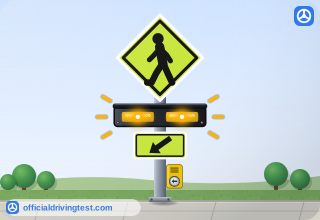
- More easily see pedestrians who are crossing
- Judge the speed of traffic on the cross street
- Find the nearest marked crosswalk at night
- Know when the signal ahead will turn red
Show answer
Correct answer: More easily see pedestrians who are crossing
The flashing lights are intended to help drivers more easily see pedestrians who are crossing.
Source: District of Columbia Driver Manual (Updated January 2024), page 10
-
How long do an RRFB’s flashing yellow lights flash?
- A fixed ten seconds every time
- Only until the first driver stops
- Long enough for pedestrians to cross safely
- Until the pedestrian leaves the sidewalk
Show answer
Correct answer: Long enough for pedestrians to cross safely
The lights flash long enough to allow pedestrians to cross the street safely.
Source: District of Columbia Driver Manual (Updated January 2024), page 10
-
A traffic signal is green, but a police officer signals you to stop. What should you do?
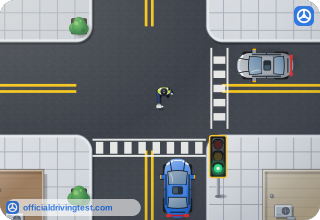
- Obey the traffic signal
- Do what the vehicle in front of you does
- Slow down and proceed through if the way is clear
- Obey the traffic officer
Show answer
Correct answer: Obey the traffic officer
The manual’s sample question states that when the signal is green and an officer signals you to stop, you obey the officer.
Source: District of Columbia Driver Manual (Updated January 2024), page 11
-
At a busy intersection with pedestrian signals together with normal traffic signals, which must drivers obey?
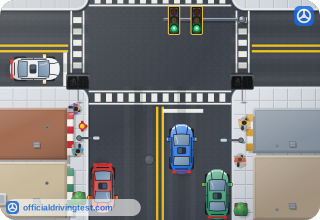
- The WALK and DON’T WALK signals
- Whichever signal changes first
- Neither, if no pedestrian is present
- The normal traffic signals
Show answer
Correct answer: The normal traffic signals
Drivers obey the normal traffic signals, while pedestrians obey the WALK and DON’T WALK signals.
Source: District of Columbia Driver Manual (Updated January 2024), page 35
-
What does a “Bus Only” signal allow buses to do?
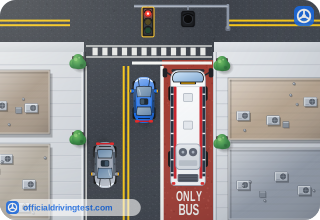
- Proceed through an intersection before the light turns green
- Pass through a red light after stopping for three seconds
- Stop in the intersection to pick up passengers
- Turn left from any lane
Show answer
Correct answer: Proceed through an intersection before the light turns green
Bus Only signals give buses a head start before the light turns green for other traffic.
Source: District of Columbia Driver Manual (Updated January 2024), page 39
-
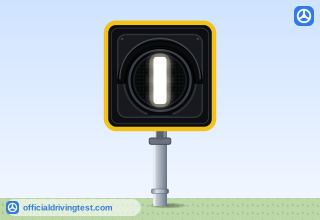
On a bus-only traffic signal, what does a vertical bar mean?
- It tells all of the other vehicles in the intersection to stop
- It shows that the priority signal is about to end
- When the bus should proceed; it serves as the green light for the bus
- It tells the bus to yield to cars
Show answer
Correct answer: When the bus should proceed; it serves as the green light for the bus
A vertical bar is the green light for a bus that is stopped at the intersection.
Source: District of Columbia Driver Manual (Updated January 2024), page 39
-
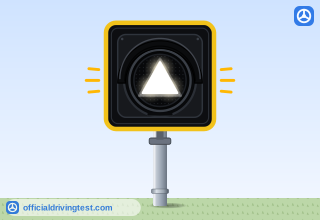
On a bus-only traffic signal, what does a flashing triangle show?
- The bus must stop where it is right now
- The priority signal is about to end
- The bus lane is closed
- Other traffic may go first
Show answer
Correct answer: The priority signal is about to end
After three seconds of the vertical bar, a flashing triangle warns that the priority signal is about to end.
Source: District of Columbia Driver Manual (Updated January 2024), page 39
-
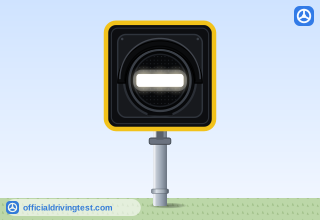
On a bus-only traffic signal, what does a horizontal bar mean?
- Buses may continue through the red light while still having priority
- Buses must stop in the lane for three seconds
- Buses are allowed to proceed first
- Buses no longer have priority and must obey normal traffic signals
Show answer
Correct answer: Buses no longer have priority and must obey normal traffic signals
The horizontal bar ends the bus priority, so buses follow the normal traffic signals.
Source: District of Columbia Driver Manual (Updated January 2024), page 39
-
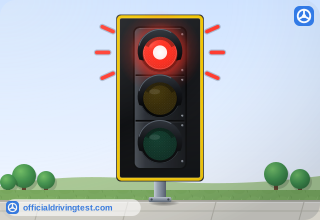
What must you do where there is a flashing red traffic signal?
- Slow down and proceed with caution
- Yield to cross traffic only
- Make a full stop
- Stop only if other vehicles are approaching
Show answer
Correct answer: Make a full stop
A flashing red signal requires a full stop.
Source: District of Columbia Driver Manual (Updated January 2024), page 44
-
At a steady red signal, what must you do before turning right, unless a sign prohibits the turn?
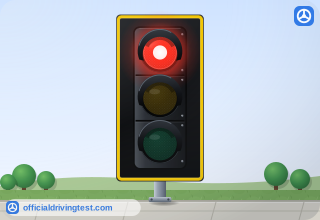
- Slow down and yield only to pedestrians
- Make a full stop and yield the right-of-way
- Wait for a police officer to wave you through
- Stop only if traffic is approaching
Show answer
Correct answer: Make a full stop and yield the right-of-way
You may turn right on red only after a full stop and yielding to pedestrians, bicyclists, and other traffic.
Source: District of Columbia Driver Manual (Updated January 2024), page 44
-
Who must obey traffic signals?
- Only people who are driving motor vehicles on public streets
- Everyone walking, driving, or riding a bicycle on a street or highway
- Drivers and pedestrians, but not people riding bicycles
- Only drivers, whenever a traffic officer is present
Show answer
Correct answer: Everyone walking, driving, or riding a bicycle on a street or highway
Traffic signals apply to pedestrians, drivers, and bicyclists alike.
Source: District of Columbia Driver Manual (Updated January 2024), page 50
-
Approaching an intersection controlled by a traffic control device, what may a driver NOT do?
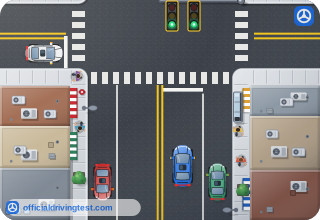
- Stop at the stop line and wait there while the signal is red
- Turn right after a complete stop at a red signal where allowed
- Wait for pedestrians who are in the crosswalk to clear it completely
- Drive across private property, such as a gas station lot, to avoid the signal
Show answer
Correct answer: Drive across private property, such as a gas station lot, to avoid the signal
A driver may not cut across private property, such as gas stations or store parking lots, or leave the roadway to avoid a traffic control device.
Source: District of Columbia Driver Manual (Updated January 2024), page 50
-
In what order are traffic signals usually arranged?
- Red, yellow, and green from top to bottom, or left to right
- Green, yellow, and red from top to bottom or left to right
- Yellow, red, and green from left to right only
- Red, green, and yellow from top to bottom only
Show answer
Correct answer: Red, yellow, and green from top to bottom, or left to right
Signals are usually red, yellow, and green from top to bottom or from left to right.
Source: District of Columbia Driver Manual (Updated January 2024), page 50
-
What must you do when you approach an intersection where the traffic lights are out of service or malfunctioning?
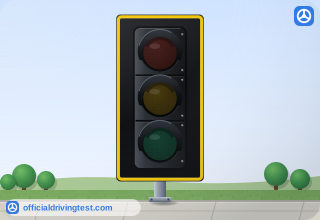
- Slow down and go through if no cars are visible
- Treat it as a yield sign and go when clear
- Come to a stop as you would for a stop sign
- Stop only if other vehicles are waiting
Show answer
Correct answer: Come to a stop as you would for a stop sign
The law treats a dark or malfunctioning signal like a stop sign: you stop first.
Source: District of Columbia Driver Manual (Updated January 2024), page 50
-
After you stop at an intersection where the signals are out of service, how must you proceed?
- Right away, since the signals no longer apply to you at all
- Only when the signals come back into service again later
- By the rules of right of way, unless a traffic officer directs you
- By following the vehicle that is in front of you at the time
Show answer
Correct answer: By the rules of right of way, unless a traffic officer directs you
After stopping, you follow the rules of right of way unless a traffic officer directs you to proceed.
Source: District of Columbia Driver Manual (Updated January 2024), page 50
-
At a steady red signal with no stop line, where must you stop?
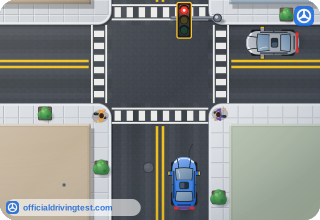
- Before entering the crosswalk
- Halfway across the crosswalk
- Just past the crosswalk
- In the middle of the intersection
Show answer
Correct answer: Before entering the crosswalk
If there is no stop line, you must stop before entering the crosswalk and stay stopped while the signal is red.
Source: District of Columbia Driver Manual (Updated January 2024), page 50
-
When may you turn right at a red signal?
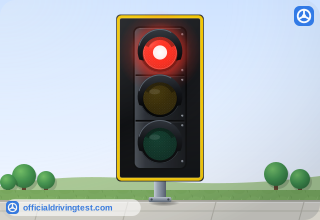
- Whenever no other vehicle is in sight at the intersection
- Only after the signal has turned yellow for a moment
- Only when a police officer waves you on to turn
- After a complete stop, unless a No Turn on Red sign is posted
Show answer
Correct answer: After a complete stop, unless a No Turn on Red sign is posted
A right turn on red is allowed after a complete stop unless signs at the intersection prohibit it.
Source: District of Columbia Driver Manual (Updated January 2024), page 50