Pavement markings in Washington, D.C.
The District of Columbia Driver Manual shows or names everything on this page: 22 in all, on pages 10, 34, 39, 51, 57–58.
Independent educational site · not affiliated with any government agency or DMV
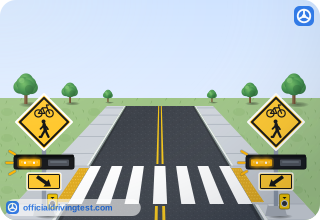
Crosswalk with RRFB Beacons
The manual does not state it
Manual page 10
Rumble Strips
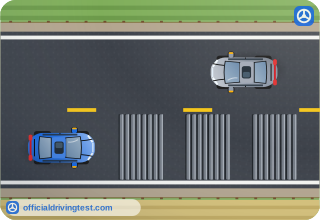
Rumble strips are short sections of corrugated roadway which alert you with the noise your tires make when you drive over them. Rumble strips warn of possible hazards such as dangerous intersections or when one is driving too close to the roadway edge.
Manual page 34
Red Bus Lanes
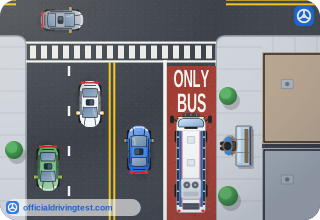
Bus lanes are indicated by solid red pavement and Bus Only markings on the road. Some bus lanes are in operations 24/7 while others may have different hours of operation.
Manual page 39
Railroad Crossing Pavement Marking (X and RR)
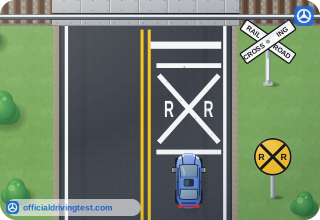
Markings on the road, consisting of a white "X" and the letters "RR", alert you that you are about to cross railroad tracks and need to watch for trains, which can't stop quickly.
Manual page 51
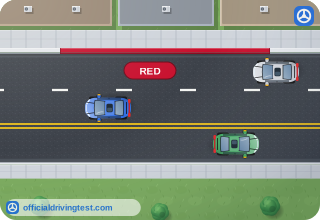
Red Curb
Red markings are generally not used; but some communities do use red curbs to indicate no parking zones.
Manual page 57
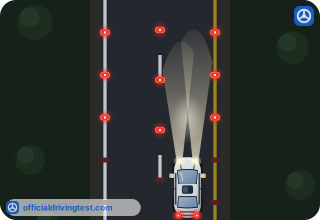
Red Raised Pavement Reflectors
Red reflectors on the pavement show areas not to be entered or used. They are positioned on the road surface so that only traffic flowing in the wrong direction would observe them.
Manual page 57
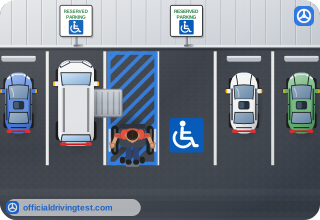
Blue Parking-Space Markings
Blue markings show parking spaces for persons with disabilities.
Manual page 57
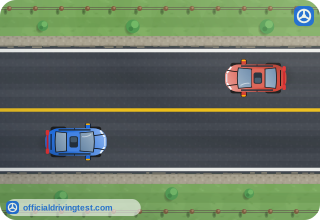
Yellow Center Line
Yellow center lines mean two-way traffic, flowing in opposite directions.
Manual page 57
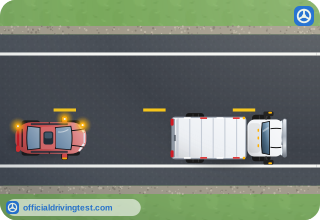
BROKEN YELLOW LINE
Broken yellow center lines mean that passing on the left is allowed in either direction when the way ahead is clear.
Manual page 57
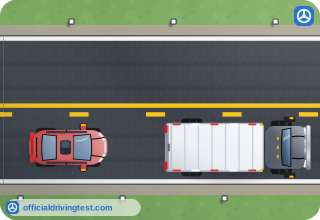
ONE SOLID, ONE BROKEN YELLOW LINES
A broken yellow line alongside a solid yellow line means that passing is allowed from the side of the broken line, but not from the side of the solid line. Vehicles on the solid yellow line side may only cross the line to pass pedestrians, bicyclists, and riders of scooters or skateboards, when the opposite lane is clear, and you can pass safely.
Manual page 57
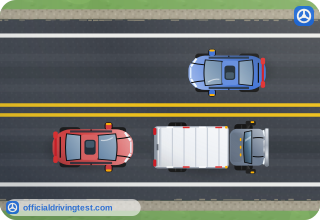
DOUBLE SOLID YELLOW LINES
Double solid yellow lines mark the center of the road and separate traffic traveling in two different directions. Passing is not allowed in either direction. You may not cross the lines unless you are making a left turn or passing pedestrians, bicyclists, and riders of scooters or skateboards, when the opposite lane is clear, and you can pass safely.
Manual page 57
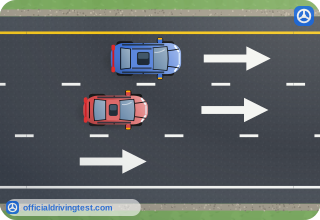
BROKEN WHITE LINE
Broken white lines separate lanes of traffic going in the same direction. You may change lanes with caution.
Manual page 57
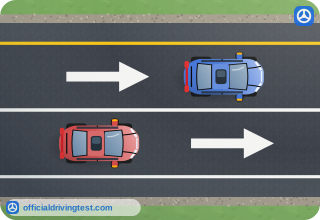
SOLID WHITE LINE
Solid white lines show turn lanes and discourage lane changes near intersections, interchange/on- and off-ramps, and at other locations where lane changes might be dangerous. Solid white lines also mark the right edge of pavement.
Manual page 57
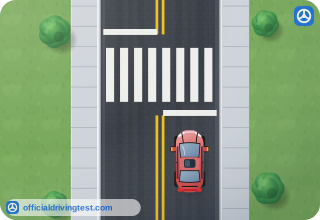
SOLID WHITE LINE (Stop Line)
Stop lines, crosswalks and parking spaces also are marked by white lines.
Manual page 57
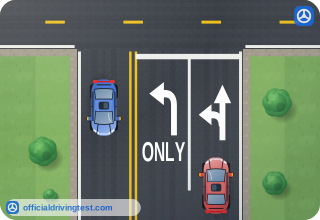
WHITE LANE ARROWS
White lane arrows are curved or straight. If you are in a lane marked with a curved arrow or a curved arrow and the word ONLY, you must turn in the direction of the arrow. If your lane is marked with both a curved and straight arrow, you may turn or go straight.
Manual page 57
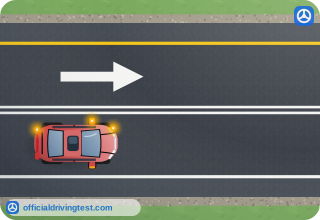
DOUBLE SOLID WHITE LINE
Double solid white lines separate lanes of traffic going in the same direction. Most often they are used to designate special use lane from conventional lanes, as when used to separate a High Occupancy Vehicle lane from the other lanes of an expressway. You may not cross these lines. You may enter the designated special use lane only where signs and markings allow.
Manual page 57
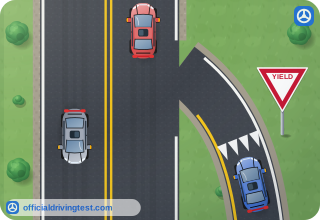
YIELD LINE
A Yield Line is a line of triangles extending across the roadway that may be used with a yield sign to show the point at which you must yield or stop, if necessary. A yield line is often seen at the entrance of a roundabout.
Manual page 58
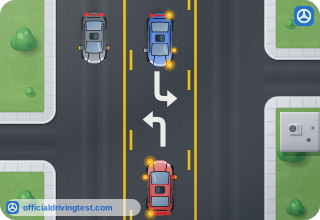
THREE-LANE ROADS (Center Turn Lane)
If both sides of the center lane are marked by a solid yellow line and a broken yellow line, drivers traveling in either direction may use the lane for making left turns. However, they may not travel further than 150 feet in this lane.
Manual page 58
THREE-LANE ROADS (Broken Lines Both Sides)
If the center lane is marked by a single broken yellow line on both sides, drivers traveling in either direction may use the center lane for passing.
Manual page 58
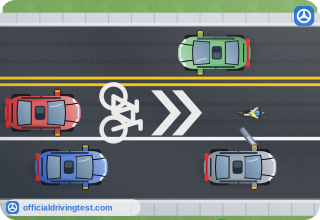
SHARED LANE ROADS
A shared lane marking, or sharrow, consists of a bicycle symbol with a double chevron arrow above it and is used on travel lanes too narrow for motor vehicles and bicycles to share side-by-side. Sharrows clarify where bicyclists are encouraged to ride in the lane and remind drivers to expect bicyclists on the road.
Manual page 58
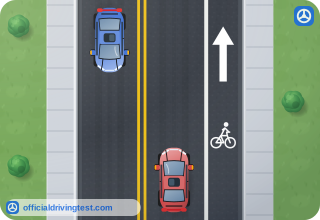
BICYCLE LANE
Bicycle lanes are indicated by a solid or dashed white line or green pavement markings, and a bicyclist symbol. A bicycle lane is for the preferential use of bicyclists. Drivers should not drive in the bicycle lane except when necessary to turn left or right.
Manual page 58
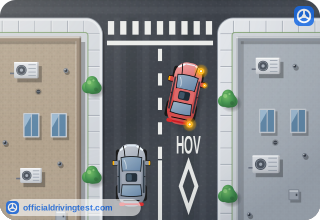
HIGH OCCUPANCY VEHICLE (HOV) LANE
High Occupancy Vehicles (HOV) lanes are marked on highways by a diamond shape in the center of the lane. HOV lanes may also be special lanes separated by a barrier or solid double white lines.
Manual page 58