Washington, D.C.: Pavement markings
Yellow and white lines, broken and solid lines, yield lines, shared lane markings, bike lanes and HOV diamonds. Split into 2 shorter tests so you're not stuck in one long quiz.
Independent educational site · not affiliated with any government agency or DMV
Choose a part
Pavement markings — Part 1
Questions in this part include: “According to the manual’s sample question, what is the best way to tell if you are permitted to pass other vehicles?”
Pavement markings — Part 2
Questions in this part include: “What do solid white lines also mark?”
Questions are original and based on the official manual "District of Columbia Driver Manual" (Updated January 2024), District of Columbia Department of Motor Vehicles (DC DMV).
All 33 Pavement markings questions with answers
Choose a part above to take a practice test, or study every question and answer here.
Show the questions and answersHide the questions
1Part 117 questions
-
According to the manual’s sample question, what is the best way to tell if you are permitted to pass other vehicles?
- See if there are solid or broken lane markings
- See if there is a flashing green light
- See if the road ahead is straight
- See if the vehicle ahead signals that it is OK to pass
Show answer
Correct answer: See if there are solid or broken lane markings
The manual gives the lane markings, solid or broken, as the best way to tell whether passing is permitted.
Source: District of Columbia Driver Manual (Updated January 2024), page 11
-
According to the fog safety tips, white pavement markings denote:
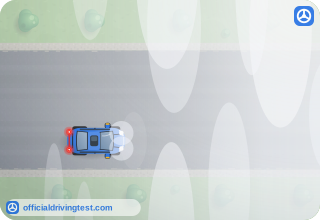
- The left travel edge of the roadway
- The division of opposing traffic
- The right travel edge of the roadway
- The center of a two-way road
Show answer
Correct answer: The right travel edge of the roadway
The manual says white pavement markings denote the right travel edge of the roadway.
Source: District of Columbia Driver Manual (Updated January 2024), page 29
-
According to the fog safety tips, yellow pavement markings are used to divide:
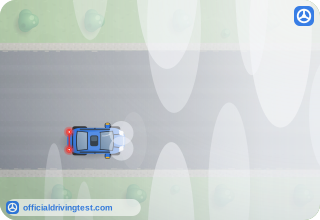
- Traffic moving in the same direction
- Opposing roadway traffic
- Bicycle lanes from travel lanes
- Parking spaces from lanes
Show answer
Correct answer: Opposing roadway traffic
The manual says yellow is used to divide opposing roadway traffic and to indicate the left travel edge of the roadway.
Source: District of Columbia Driver Manual (Updated January 2024), page 29
-
What are rumble strips?
- Painted stripes on the pavement that show where a lane ends
- Raised signs that mark the edge of a bridge
- Short corrugated sections of roadway that alert you with tire noise
- Wide sections of smooth pavement for passing
Show answer
Correct answer: Short corrugated sections of roadway that alert you with tire noise
Driving over rumble strips makes noise and warns you of a hazard.
Source: District of Columbia Driver Manual (Updated January 2024), page 34
-
On a two-lane highway, which of these is a place where you must not pass?
- On a straight stretch with a clear view of the road ahead and no oncoming vehicles
- Where a vehicle ahead is traveling slower than the other traffic on the road
- On a road where the center of the roadway is not marked by any line at all
- Where the solid yellow line is on your side of the center of the roadway
Show answer
Correct answer: Where the solid yellow line is on your side of the center of the roadway
A solid yellow line on your side of the center means passing is not allowed.
Source: District of Columbia Driver Manual (Updated January 2024), page 41
-
Which of these describes a place where passing is not allowed on a two-lane highway?
- Where there are two solid yellow lines
- On a straight road with a clear view ahead
- Where the shoulder is wide enough
- On a road with light traffic
Show answer
Correct answer: Where there are two solid yellow lines
Two solid yellow lines mean you must not pass.
Source: District of Columbia Driver Manual (Updated January 2024), page 41
-
What do red reflectors on the pavement show?
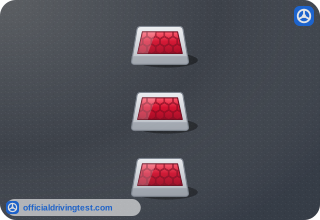
- Areas not to be entered or used
- Parking spaces for persons with disabilities
- The center of a two-way road
- The edge of a bicycle lane
Show answer
Correct answer: Areas not to be entered or used
Red reflectors on the pavement show areas not to be entered or used.
Source: District of Columbia Driver Manual (Updated January 2024), page 57
-
Who can see the red reflectors on the pavement?
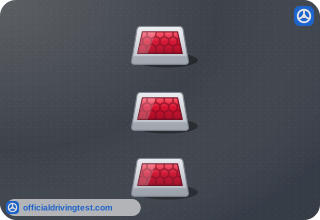
- Only drivers who are traveling at night
- Only traffic going the wrong direction
- Only bicyclists who are in a bike lane
- All drivers, from every direction
Show answer
Correct answer: Only traffic going the wrong direction
Red reflectors are positioned so only traffic flowing in the wrong direction would observe them.
Source: District of Columbia Driver Manual (Updated January 2024), page 57
-
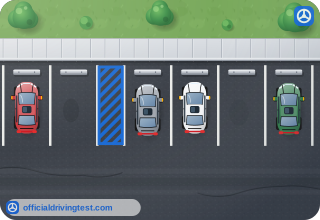
What do blue pavement markings show?
- Areas that are not to be entered or used
- Bicycle lanes along the roadway
- Zones where no parking is allowed
- Parking spaces for people with disabilities
Show answer
Correct answer: Parking spaces for people with disabilities
Blue markings show parking spaces for persons with disabilities.
Source: District of Columbia Driver Manual (Updated January 2024), page 57
-
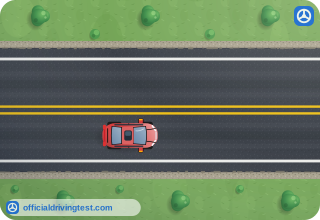
What do yellow center lines mean?
- Two-way traffic in opposite directions
- One-way traffic going in the same direction
- A lane that is reserved for buses only
- The right edge of the pavement on the road
Show answer
Correct answer: Two-way traffic in opposite directions
Yellow center lines separate two-way traffic that flows in opposite directions.
Source: District of Columbia Driver Manual (Updated January 2024), page 57
-
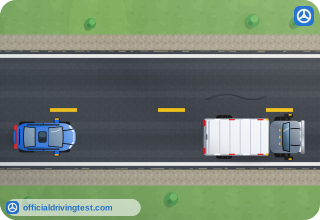
What do broken yellow center lines mean?
- Passing is never allowed in either direction at all
- Passing is allowed only for drivers in the right lane
- Passing on the left is allowed in either direction if clear
- Passing is allowed only if you use the shoulder
Show answer
Correct answer: Passing on the left is allowed in either direction if clear
Broken yellow center lines allow passing on the left in either direction when the way ahead is clear.
Source: District of Columbia Driver Manual (Updated January 2024), page 57
-
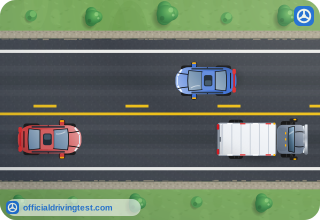
A broken yellow line lies alongside a solid yellow line. From which side is passing allowed?
- From the side of the solid line
- From both sides
- From the side of the broken line
- From neither side
Show answer
Correct answer: From the side of the broken line
Passing is allowed from the side of the broken line, but not from the side of the solid line.
Source: District of Columbia Driver Manual (Updated January 2024), page 57
-
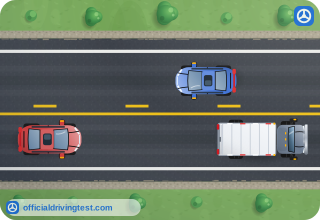
Vehicles on the solid yellow line side of one solid and one broken yellow line may cross it only to pass whom?
- Pedestrians, bicyclists, and riders of scooters or skateboards
- Vehicles that are parked along the side of the road ahead
- Any slower motor vehicle that is traveling ahead of you
- Buses that are stopped at a bus stop along the road
Show answer
Correct answer: Pedestrians, bicyclists, and riders of scooters or skateboards
On the solid-line side you may cross only to pass pedestrians, bicyclists, and riders of scooters or skateboards, when the opposite lane is clear and you can pass safely.
Source: District of Columbia Driver Manual (Updated January 2024), page 57
-
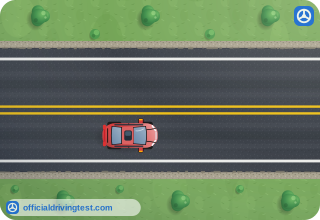
What do double solid yellow lines separate?
- Lanes of traffic going in the same direction
- A bicycle lane from a travel lane
- A special use lane from conventional lanes
- Traffic traveling in two different directions
Show answer
Correct answer: Traffic traveling in two different directions
Double solid yellow lines mark the center of the road and separate traffic traveling in opposite directions.
Source: District of Columbia Driver Manual (Updated January 2024), page 57
-
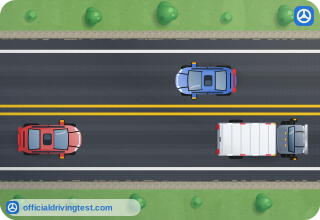
Is passing allowed in either direction where there are double solid yellow lines?
- Yes, if the way ahead is clear of traffic
- No, passing is not allowed either way
- Yes, but only from the right-hand lane
- Yes, but only during daylight hours
Show answer
Correct answer: No, passing is not allowed either way
Passing is not allowed in either direction at double solid yellow lines.
Source: District of Columbia Driver Manual (Updated January 2024), page 57
-
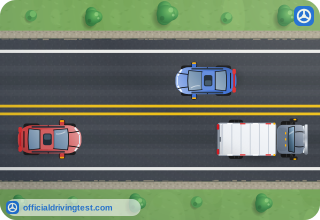
When the opposite lane is clear and you can pass safely, when may you cross double solid yellow lines?
- When making a left turn or passing pedestrians, bicyclists, and riders of scooters or skateboards
- When making a right turn or passing any slower vehicle that is traveling on the road ahead
- When no traffic can be seen in either direction anywhere on the road ahead of you
- When changing over to a lane that has less traffic in it than your current lane has
Show answer
Correct answer: When making a left turn or passing pedestrians, bicyclists, and riders of scooters or skateboards
You may not cross them unless making a left turn or passing pedestrians, bicyclists, and riders of scooters or skateboards, when the opposite lane is clear and you can pass safely.
Source: District of Columbia Driver Manual (Updated January 2024), page 57
-
What do broken white lines separate?
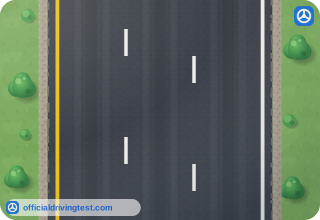
- Traffic traveling in opposite directions
- A turn lane from a travel lane
- Lanes of traffic going in the same direction
- The roadway from the shoulder
Show answer
Correct answer: Lanes of traffic going in the same direction
Broken white lines separate lanes going in the same direction, and you may change lanes with caution.
Source: District of Columbia Driver Manual (Updated January 2024), page 57
2Part 216 questions
-
What may you do across a broken white line?
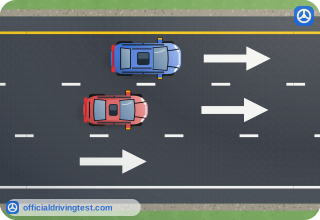
- Pass only if no traffic is coming
- Change lanes with caution
- Change lanes only after a complete stop
- Nothing, because you may not cross it
Show answer
Correct answer: Change lanes with caution
You may change lanes with caution across a broken white line.
Source: District of Columbia Driver Manual (Updated January 2024), page 57
-
What do solid white lines show and discourage?
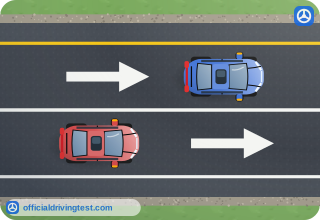
- They show passing zones and encourage lane changes at intersections
- They show bicycle lanes and prohibit all turns near an intersection
- They show the center of the road and prohibit all stopping on it
- They show turn lanes and discourage lane changes in dangerous places
Show answer
Correct answer: They show turn lanes and discourage lane changes in dangerous places
Solid white lines show turn lanes and discourage lane changes near intersections, ramps, and other dangerous places.
Source: District of Columbia Driver Manual (Updated January 2024), page 57
-
What do solid white lines also mark?
- The center of a two-way road
- The left edge of a divided highway
- A no-passing zone
- The right edge of the pavement
Show answer
Correct answer: The right edge of the pavement
Solid white lines also mark the right edge of the pavement.
Source: District of Columbia Driver Manual (Updated January 2024), page 57
-
What color are the lines that mark stop lines, crosswalks, and parking spaces?
- Yellow
- White
- Orange
- Green
Show answer
Correct answer: White
Stop lines, crosswalks and parking spaces also are marked by white lines.
Source: District of Columbia Driver Manual (Updated January 2024), page 57
-
What do arrows used with white lines show?
- Which lane is closed ahead
- How fast traffic may move in the lane
- Which turn may be made from the lane
- Which lanes may be used for passing
Show answer
Correct answer: Which turn may be made from the lane
Arrows used with white lines indicate which turn may be made from that lane.
Source: District of Columbia Driver Manual (Updated January 2024), page 57
-
If your lane is marked with a curved arrow, or a curved arrow and the word ONLY, what must you do?
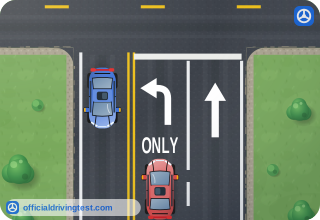
- Turn in the direction of the arrow
- Go straight ahead or turn
- Change to another lane
- Turn only if traffic is clear
Show answer
Correct answer: Turn in the direction of the arrow
A lane marked with a curved arrow, with or without ONLY, requires you to turn in the arrow's direction.
Source: District of Columbia Driver Manual (Updated January 2024), page 57
-
If your lane is marked with both a curved arrow and a straight arrow, what may you do?
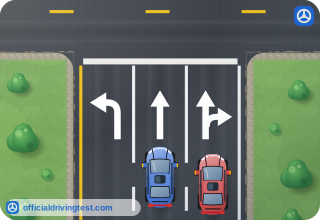
- Only turn in the direction of the curved arrow
- Turn or go straight
- Only go straight
- Change lanes before the intersection
Show answer
Correct answer: Turn or go straight
A lane with both a curved and a straight arrow lets you turn or go straight.
Source: District of Columbia Driver Manual (Updated January 2024), page 57
-
What do double solid white lines separate?
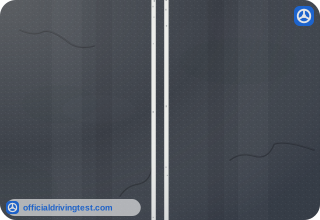
- Traffic traveling in opposite directions
- The roadway from the shoulder
- A bicycle lane from a parking lane
- Lanes of traffic going in the same direction
Show answer
Correct answer: Lanes of traffic going in the same direction
Double solid white lines separate lanes of traffic going in the same direction.
Source: District of Columbia Driver Manual (Updated January 2024), page 57
-
Where may you enter a designated special use lane that is separated by double solid white lines?
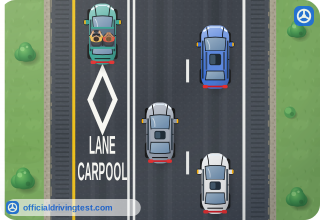
- Only where signs and markings allow
- Anywhere when traffic is light
- Anywhere if you signal first
- Only at the beginning of the lane
Show answer
Correct answer: Only where signs and markings allow
You may not cross double solid white lines and may enter the special use lane only where signs and markings allow.
Source: District of Columbia Driver Manual (Updated January 2024), page 58
-
What is a line of triangles extending across the roadway?
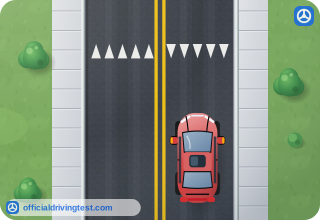
- A stop line
- A crosswalk
- A yield line
- A merge line
Show answer
Correct answer: A yield line
A yield line is a line of triangles across the roadway showing where you must yield or stop, if necessary.
Source: District of Columbia Driver Manual (Updated January 2024), page 58
-
Where is a yield line often seen?
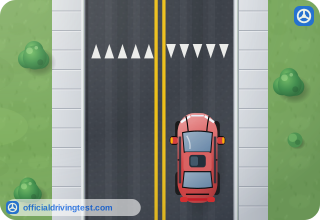
- At a railroad crossing
- At a school crossing
- At a roundabout entrance
- At the end of a freeway
Show answer
Correct answer: At a roundabout entrance
A yield line is often seen at the entrance of a roundabout.
Source: District of Columbia Driver Manual (Updated January 2024), page 58
-
On a three-lane road, what may drivers use the center lane for when both of its sides are marked by a solid yellow line and a broken yellow line?
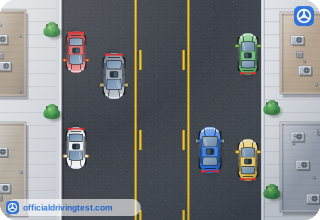
- Passing
- Parking
- Driving straight at any distance
- Making left turns
Show answer
Correct answer: Making left turns
When both sides of the center lane have a solid yellow and a broken yellow line, drivers in either direction may use it for left turns.
Source: District of Columbia Driver Manual (Updated January 2024), page 58
-
In a center lane marked for left turns on a three-lane road, how far may you travel in the lane?
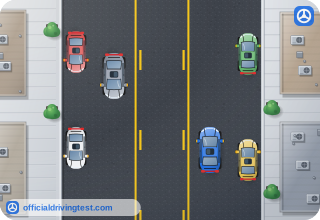
- No further than 50 feet
- No further than 150 feet
- No further than 250 feet
- No further than 500 feet
Show answer
Correct answer: No further than 150 feet
Drivers using the lane for left turns may not travel further than 150 feet in it.
Source: District of Columbia Driver Manual (Updated January 2024), page 58
-
What does a shared lane marking, or sharrow, consist of?
- A bicycle symbol with a double chevron arrow above it
- A bicycle symbol inside a white diamond
- A solid white line with a bicycle symbol beside it
- A diamond with a bicycle symbol
Show answer
Correct answer: A bicycle symbol with a double chevron arrow above it
A sharrow is a bicycle symbol with a double chevron arrow above it.
Source: District of Columbia Driver Manual (Updated January 2024), page 58
-
Where are shared lane markings used?
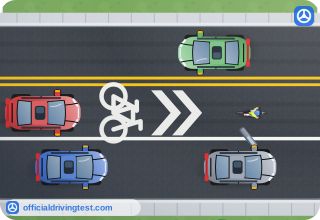
- On lanes that are reserved for bicycles only, at all times
- On lanes that are reserved for buses and carpools only
- On lanes too narrow for cars and bicycles to share side-by-side
- On the shoulder beside a freeway in the District
Show answer
Correct answer: On lanes too narrow for cars and bicycles to share side-by-side
Sharrows are used on travel lanes too narrow for motor vehicles and bicycles to share side-by-side.
Source: District of Columbia Driver Manual (Updated January 2024), page 58
-
What else may a diamond-shaped marking in a lane indicate?
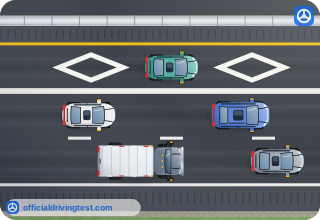
- The lane is reserved for bicyclists
- The lane is a left-turn lane
- The lane is reserved for use as a bus lane
- The lane ends ahead
Show answer
Correct answer: The lane is reserved for use as a bus lane
A diamond-shaped marking may also indicate that the lane is reserved as a bus lane.
Source: District of Columbia Driver Manual (Updated January 2024), page 58