Washington, D.C.: Emergencies and crashes — Part 2 Practice Test
Questions in this part include: “Which item should a winter emergency kit include for traction on snow or ice?” · “To avoid skids, the manual says to drive as though you have what between your foot and the gas or brake pedal?”
Independent educational site · not affiliated with any government agency or DMV
Ready? Test yourself
Answer to start, or tap Start below:
Which item should a winter emergency kit include for traction on snow or ice?
- Instant feedback with an explanation
- Every answer cites its source in the manual
- Your best score is saved on this device
- Keyboard: press 1 to 4 to answer and Enter for the next question
Questions are original and based on the official manual "District of Columbia Driver Manual" (Updated January 2024), District of Columbia Department of Motor Vehicles (DC DMV).
All 16 questions in this practice test
Take the test above first, then use this list to study. Tap “Show answer” to see the correct answer and explanation.
Show the questions and answersHide the questions
-
Which item should a winter emergency kit include for traction on snow or ice?
- A tow rope
- A road atlas
- Kitty litter or sand
- A spare battery
Show answer
Correct answer: Kitty litter or sand
The manual lists kitty litter or sand for traction on snow or ice among the items for the emergency kit.
Source: District of Columbia Driver Manual (Updated January 2024), page 28
-
Which item should a winter emergency kit include?
- A spare tire cover
- A small shovel
- A pair of jumper cables
- A paper map
Show answer
Correct answer: A small shovel
The manual lists a small shovel in the emergency kit, along with flares, a first aid kit, a blanket and kitty litter or sand.
Source: District of Columbia Driver Manual (Updated January 2024), page 28
-
To avoid skids, the manual says to drive as though you have what between your foot and the gas or brake pedal?
- A glass of water
- A sheet of ice
- A tennis ball
- An egg
Show answer
Correct answer: An egg
The comparison means avoiding abrupt changes in speed or direction.
Source: District of Columbia Driver Manual (Updated January 2024), page 28
-
Where should you practice stopping and skid recovery before driving on packed snow or ice?
- In a safe area on private property at slow speed
- On a quiet residential street at moderate speed
- On an empty highway ramp at moderate speed
- On the shoulder of a limited access highway
Show answer
Correct answer: In a safe area on private property at slow speed
The manual advises practicing in a safe area on private property at slow speed.
Source: District of Columbia Driver Manual (Updated January 2024), page 28
-
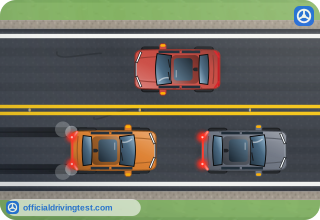
If your wheels are locked and not turning, you:
- Will stop in a much shorter distance
- Can still steer the vehicle normally
- Do not have control over the vehicle
- Have better traction on ice and snow
Show answer
Correct answer: Do not have control over the vehicle
The manual says that if the wheels do not turn, you have no control over the vehicle.
Source: District of Columbia Driver Manual (Updated January 2024), page 28
-
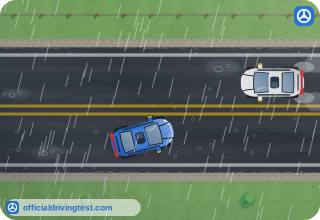
In a skid, if your rear wheels start going to the right, what should you do with your front wheels?
- Turn them to the left
- Hold them straight
- Turn them sharply back
- Turn them to the right
Show answer
Correct answer: Turn them to the right
The manual says to steer in the direction of the skid.
Source: District of Columbia Driver Manual (Updated January 2024), page 29
-
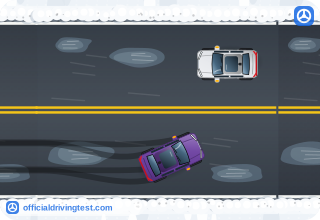
When recovering from a skid, what should you do with the gas pedal (accelerator)?
- Take your foot off it
- Press it harder
- Press it to the floor
- Tap it quickly
Show answer
Correct answer: Take your foot off it
Steer in the direction of the skid and take your foot off the gas pedal.
Source: District of Columbia Driver Manual (Updated January 2024), page 29
-
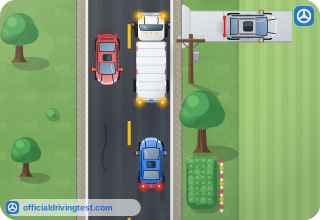
If a collision seems inevitable, how should you try to hit another vehicle or object?
- Straight on with your brakes locked
- Head-on at the lowest possible speed
- Squarely from the rear only
- At an angle rather than head-on
Show answer
Correct answer: At an angle rather than head-on
The manual says to do anything to keep from hitting a vehicle or object head-on and to try to hit at an angle.
Source: District of Columbia Driver Manual (Updated January 2024), page 29
-
If your car won’t run on the shoulder of a highway, what does the manual say to do to signal for help?
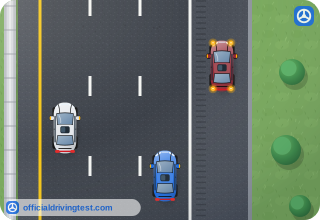
- Stand on the shoulder beside your car and wave at the passing drivers
- Raise the hood, or tie a white cloth on the left door handle or radio antenna
- Leave the doors open and the engine running with the flashers on
- Walk along the highway to the nearest phone to call for help
Show answer
Correct answer: Raise the hood, or tie a white cloth on the left door handle or radio antenna
A raised hood or a white cloth on the left door handle or antenna shows that you need help.
Source: District of Columbia Driver Manual (Updated January 2024), page 31
-
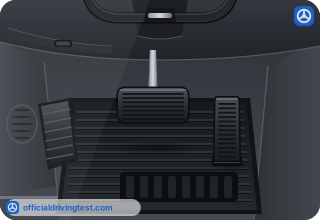
What will you notice when anti-lock brakes (ABS) engage?
- The brake pedal drops all the way to the floor and stays there
- The steering wheel locks and you cannot turn it at all
- A loud hiss from the engine and a burning smell in the cabin
- A rumble from the brakes, and the brake pedal vibrates under your foot
Show answer
Correct answer: A rumble from the brakes, and the brake pedal vibrates under your foot
When the ABS engages, you hear a rumble from the brakes and feel the pedal vibrate.
Source: District of Columbia Driver Manual (Updated January 2024), page 32
-
When ABS engages, what does the driver have to do?
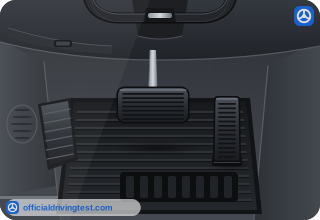
- Press down hard on the brake pedal, hold it, and steer where you want to go
- Pump the brake pedal quickly while you steer to where you want to go
- Take your foot off the brake and steer where you want to go
- Press the pedal lightly and shift to neutral while you steer
Show answer
Correct answer: Press down hard on the brake pedal, hold it, and steer where you want to go
The ABS computer controls the individual wheels, so you keep steady pressure and steer.
Source: District of Columbia Driver Manual (Updated January 2024), page 32
-
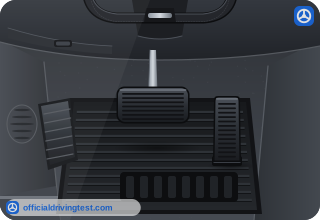
What happens if you pump the brakes or remove steady pressure from the pedal while ABS is engaged?
- It makes the ABS work harder
- It locks the steering wheel
- It disengages or turns off the ABS
- Nothing, because the ABS keeps working
Show answer
Correct answer: It disengages or turns off the ABS
Steady pressure keeps the ABS working; pumping or letting up switches it off.
Source: District of Columbia Driver Manual (Updated January 2024), page 32
-
Where does the manual say is the best place to practice using ABS?
- A busy road during rush hour
- An empty parking lot
- A narrow country road
- An interstate on-ramp
Show answer
Correct answer: An empty parking lot
You can learn how your vehicle reacts to sudden braking by practicing in an empty parking lot.
Source: District of Columbia Driver Manual (Updated January 2024), page 32
-
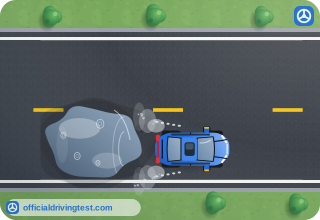
After driving through deep water, what should you do?
- Turn the heater on high
- Shift to neutral and coast
- Turn the headlights off
- Test your brakes
Show answer
Correct answer: Test your brakes
Wet brakes may pull to one side or not hold at all, so test them after deep water.
Source: District of Columbia Driver Manual (Updated January 2024), page 32
-
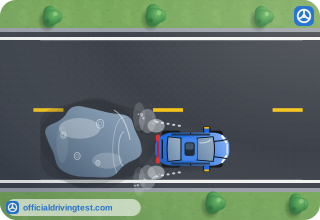
How do you dry wet brakes?
- Put the car in low gear, drive slowly and apply the brakes lightly
- Drive fast in high gear and press the brakes hard several times
- Park and wait for an hour with the brakes released
- Shift to neutral and coast with the brake off
Show answer
Correct answer: Put the car in low gear, drive slowly and apply the brakes lightly
Light braking while driving slowly in low gear dries the brakes.
Source: District of Columbia Driver Manual (Updated January 2024), page 32
-
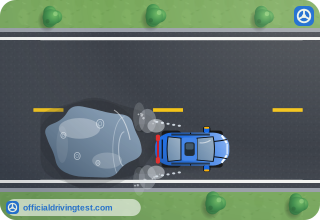
While drying wet brakes, how often should you test them?
- Every 20 feet, until the brakes stop pulling to one side
- Every mile, until the brakes are cool
- Every 200 feet, until braking action returns to normal
- Only once, at the end of the trip
Show answer
Correct answer: Every 200 feet, until braking action returns to normal
You test every 200 feet and continue until the braking action is normal again.
Source: District of Columbia Driver Manual (Updated January 2024), page 32