Washington, D.C.: Emergencies and crashes — Part 1 Practice Test
Questions in this part include: “After a crash, how long must you remain at or as close as possible to the scene?” · “If you damage an unattended vehicle or other property and cannot find the owner, what must you leave in or on it?”
Independent educational site · not affiliated with any government agency or DMV
Ready? Test yourself
Answer to start, or tap Start below:
After a crash, how long must you remain at or as close as possible to the scene?
- Instant feedback with an explanation
- Every answer cites its source in the manual
- Your best score is saved on this device
- Keyboard: press 1 to 4 to answer and Enter for the next question
Questions are original and based on the official manual "District of Columbia Driver Manual" (Updated January 2024), District of Columbia Department of Motor Vehicles (DC DMV).
All 17 questions in this practice test
Take the test above first, then use this list to study. Tap “Show answer” to see the correct answer and explanation.
Show the questions and answersHide the questions
-
After a crash, how long must you remain at or as close as possible to the scene?
- Until a tow truck arrives to move your damaged vehicle
- Until the other driver has left the scene of the crash
- Until you have called your insurance company to report the crash
- Until you have aided any injured person and identified yourself
Show answer
Correct answer: Until you have aided any injured person and identified yourself
You must stay as close to the scene as possible until you have aided any injured person and identified yourself.
Source: District of Columbia Driver Manual (Updated January 2024), page 22
-
If possible, what should you do with your car after a crash?
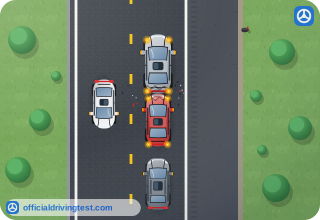
- Move it away from the line of traffic
- Leave it where it stopped, in the lane
- Move it onto the sidewalk
- Back it up toward the other vehicle
Show answer
Correct answer: Move it away from the line of traffic
The manual says to move your car away from the line of traffic if possible.
Source: District of Columbia Driver Manual (Updated January 2024), page 22
-
In most instances, how is assistance to a person injured in a crash accomplished?
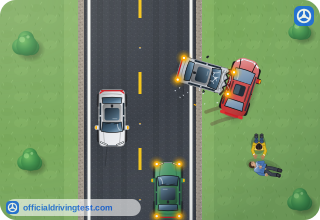
- By driving the person to a hospital yourself
- By moving the person to the side of the road
- By calling for an ambulance
- By waiting for another driver to stop
Show answer
Correct answer: By calling for an ambulance
Depending on the extent of the injury, assistance is in most instances accomplished by calling for an ambulance.
Source: District of Columbia Driver Manual (Updated January 2024), page 22
-
Normally, what should you not attempt to do with a person who is unconscious or seriously hurt?
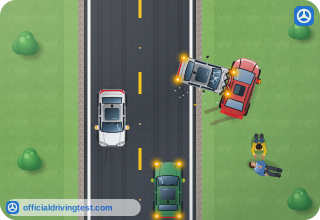
- Move the person
- Call for an ambulance for the person
- Give your name to other people involved
- Report the crash to the nearest police department
Show answer
Correct answer: Move the person
The manual says you should normally not attempt to move an unconscious or seriously hurt person.
Source: District of Columbia Driver Manual (Updated January 2024), page 22
-
Besides their name and address, what must drivers involved in a crash give about the vehicle they are driving?
- The date on which it was purchased new
- Its mileage reading at the time of the crash
- Its registration information
- Its most recent inspection date
Show answer
Correct answer: Its registration information
Drivers must give their name, address and the registration information of the vehicle they are driving.
Source: District of Columbia Driver Manual (Updated January 2024), page 22
-
Upon request, what must you show to the other person or persons involved in a crash?
- Your vehicle title
- Your driver license
- Your insurance card only
- Your work badge
Show answer
Correct answer: Your driver license
The manual says that, upon request, you must show your driver license to the others involved.
Source: District of Columbia Driver Manual (Updated January 2024), page 22
-
If no one in a crash is in condition to receive your information and no police officer is present, what must you do?
- Wait one day, then report it to your insurance company
- Keep the information and give it out only if someone asks later
- Leave a note on the other vehicle and then drive away
- Report it to the nearest police department as soon as possible
Show answer
Correct answer: Report it to the nearest police department as soon as possible
You must, as soon as possible, report the information to the nearest police department.
Source: District of Columbia Driver Manual (Updated January 2024), page 22
-
If you damage an unattended vehicle or other property and cannot find the owner, what must you leave in or on it?
- Your car keys
- A written notice
- A parking ticket
- A repair estimate
Show answer
Correct answer: A written notice
If the owner cannot be located, a written notice with your identifying information must be left in a conspicuous and secure place.
Source: District of Columbia Driver Manual (Updated January 2024), page 22
-
What should you do if you strike and injure a domestic animal with your vehicle?
- Notify the police department having jurisdiction in the area
- Drive away if the animal is still able to walk away
- Take the animal to a shelter or clinic on your own
- Wait beside the road for the animal to recover on its own
Show answer
Correct answer: Notify the police department having jurisdiction in the area
You should immediately notify the police department with jurisdiction; the police contact the proper agency to get medical care for the animal.
Source: District of Columbia Driver Manual (Updated January 2024), page 22
-
Up to what speed will most tires with tread "wipe" the road surface the way a windshield wiper cleans the windshield?
- 25 miles per hour
- 35 miles per hour
- 45 miles per hour
- 55 miles per hour
Show answer
Correct answer: 35 miles per hour
At speeds up to 35 miles per hour most tires with tread wipe the road; the wiping action gets less effective as speed increases.
Source: District of Columbia Driver Manual (Updated January 2024), page 24
-
What is it called when tires ride on a layer of water as speed increases?
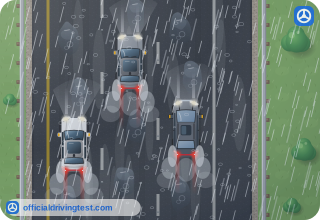
- Wiping
- Flooding
- Black ice
- Hydroplaning
Show answer
Correct answer: Hydroplaning
The manual calls tires riding on a layer of water, like a water ski, hydroplaning.
Source: District of Columbia Driver Manual (Updated January 2024), page 24
-
As soon as you feel a loss of control while hydroplaning, what should you do?
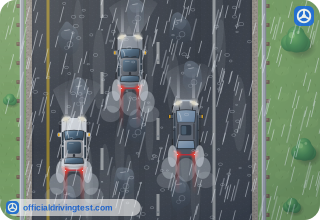
- Brake as hard as you can right away
- Turn the wheel sharply
- Accelerate to regain traction
- Take your foot off the gas pedal
Show answer
Correct answer: Take your foot off the gas pedal
The manual says to take your foot off the gas pedal, hold the wheel firmly in the direction you intend to go, and let your speed drop.
Source: District of Columbia Driver Manual (Updated January 2024), page 24
-
If you see a flooded roadway ahead, what should you do?
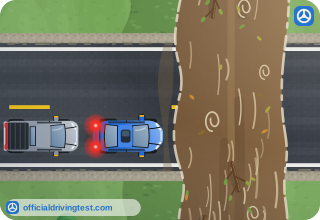
- Drive through slowly in a low gear
- Turn around and find another route
- Follow the car ahead through the water
- Cross if the water looks shallow
Show answer
Correct answer: Turn around and find another route
The manual says not to drive through flooded areas; turn around and find another route.
Source: District of Columbia Driver Manual (Updated January 2024), page 24
-
How much water reaching the bottom of a vehicle may cause loss of control or possible stalling?
- One inch
- Three inches
- Six inches
- One foot
Show answer
Correct answer: Six inches
The manual says six inches of water at the bottom of a vehicle may cause loss of control or stalling.
Source: District of Columbia Driver Manual (Updated January 2024), page 24
-
How much moving water can carry away most vehicles, including sports utility vehicles and pickup trucks?
- Two feet
- Four inches
- Ten inches
- One foot
Show answer
Correct answer: Two feet
The manual says two feet of moving water can carry away most vehicles, including SUVs and pickup trucks.
Source: District of Columbia Driver Manual (Updated January 2024), page 24
-
Floodwaters can damage a roadway by:
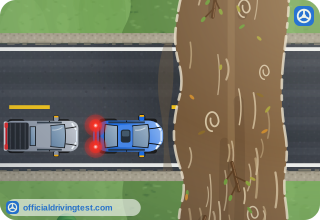
- Freezing the pavement surface overnight
- Washing away the underlying road surface
- Melting the paint of the lane markings
- Lifting the road surface off its base
Show answer
Correct answer: Washing away the underlying road surface
Floodwaters can wash away the underlying road surface, so you should not cross a flooded road even if the water looks shallow.
Source: District of Columbia Driver Manual (Updated January 2024), page 24
-
If there is no other route around a flooded road, what should you do?
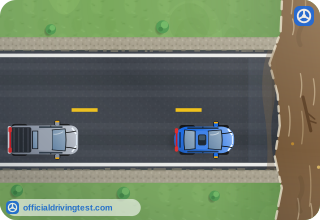
- Drive through at a slow and steady walking pace only
- Wait in your vehicle right at the edge of the water
- Follow a larger truck or bus slowly through the water
- Proceed to higher ground and wait for the water to subside
Show answer
Correct answer: Proceed to higher ground and wait for the water to subside
The manual says that if there is no other route, you should go to higher ground and wait for the water to subside.
Source: District of Columbia Driver Manual (Updated January 2024), page 24