Hazardous Materials: Loading and unloading hazardous materials — Part 3
Questions in this part include: “Corrosive liquids must never be loaded next to or above which of these?” · “Where do the shipper's transport index numbers for Class 7 packages appear?”
Independent educational site · not affiliated with any government agency or DMV
Ready? Test yourself
Answer to start, or tap Start below:
Corrosive liquids must never be loaded next to or above which of these?
- Instant feedback with an explanation
- Every answer cites its source in the manual
- Your best score is saved on this device
- Keyboard: press 1 to 3 to answer and Enter for the next question
Questions are written in our own words from the CDL manual; they are not the real test's questions. With your state chosen, every answer gives its page in your state's CDL manual. Without a state, answers cite the CDL manual, national model as printed by New Jersey (July 2017).
All 19 questions in this practice test
Take the test above first, then use this list to study. Tap “Show answer” to see the correct answer and explanation.
Show the questions and answersHide the questions
-
Corrosive liquids must never be loaded next to or above which of these?
- Division 4.3 Dangerous When Wet materials
- Class 9 miscellaneous hazardous goods
- Class 7 radioactive material packages
Show answer
Correct answer: Division 4.3 Dangerous When Wet materials
Corrosive liquids must never go beside or above Divisions 1.4, 4.1 or 4.3, Class 5, or Division 2.3 Zone B poisonous gases.
Source: CDL manual, national model as printed by New Jersey, Section 9 (July 2017)
-
Which of these may never be loaded in the same vehicle with corrosive liquids?
- Division 1.5 blasting agents
- Division 1.4 explosives
- Division 4.1 flammable solids
Show answer
Correct answer: Division 1.5 blasting agents
Blasting agents are on the list of materials that cannot ride with corrosive liquids at all. Divisions 1.4 and 4.1 are only barred from being next to or below them.
Source: CDL manual, national model as printed by New Jersey, Section 9 (July 2017)
-
Which of these may never be loaded in the same vehicle with corrosive liquids?
- Division 4.2 combustible materials
- Class 9 miscellaneous hazardous goods
- Class 7 radioactive material packages
Show answer
Correct answer: Division 4.2 combustible materials
Spontaneously combustible materials of Division 4.2 are on the list of loads that cannot ride with corrosive liquids.
Source: CDL manual, national model as printed by New Jersey, Section 9 (July 2017)
-
A vehicle has no racks for gas cylinders. What must be true of the cargo space?
- The floor must slope toward the doors
- The floor must be flat
- The walls must be padded
Show answer
Correct answer: The floor must be flat
Without racks, the cargo space floor must be flat.
Source: CDL manual, national model as printed by New Jersey, Section 9 (July 2017)
-
How may compressed gas cylinders be held upright in a vehicle?
- Tied loosely with rope or cord
- Leaned against the cargo space wall
- In vehicle racks or tip-proof boxes
Show answer
Correct answer: In vehicle racks or tip-proof boxes
Cylinders must stay upright, either in racks fixed to the vehicle or in boxes that stop them tipping over.
Source: CDL manual, national model as printed by New Jersey, Section 9 (July 2017)
-
When may a gas cylinder be loaded lying down?
- When it makes up less than half the load
- When it is chained down at both ends
- If its relief valve sits in the vapor space
Show answer
Correct answer: If its relief valve sits in the vapor space
A cylinder may lie on its side only if its design keeps the relief valve in the vapor space.
Source: CDL manual, national model as printed by New Jersey, Section 9 (July 2017)
-
Which kind of container must never be used to carry poisonous gas or poisonous materials?
- A container with a pressure gauge
- A container with a double wall
- A container with interconnections
Show answer
Correct answer: A container with interconnections
Containers that are connected to each other are not allowed for Division 2.3 or 6.1 materials.
Source: CDL manual, national model as printed by New Jersey, Section 9 (July 2017)
-
Where must a package with a POISON label never be placed?
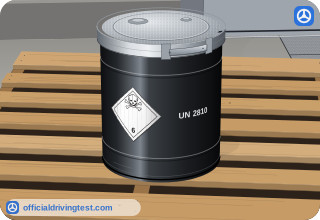
- In the cargo space near the doors
- In the driver's cab or sleeper
- In a tank trailer
Show answer
Correct answer: In the driver's cab or sleeper
Poison packages stay out of the cab and the sleeper, and also away from food meant for people or animals.
Source: CDL manual, national model as printed by New Jersey, Section 9 (July 2017)
-
Which cargo is not allowed in the same vehicle as a POISON or POISON INHALATION HAZARD package?
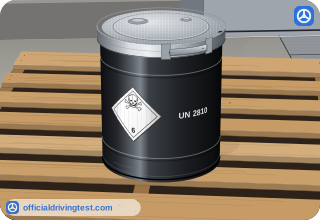
- Mouthwash and skin creams
- Food for people or animals
- Spare tires and hand tools
Show answer
Correct answer: Food for people or animals
Poison packages must not be loaded with anything meant to be eaten by people or animals, unless the poison is overpacked in an approved way.
Source: CDL manual, national model as printed by New Jersey, Section 9 (July 2017)
-
What is needed to load or unload Class 2 materials in cargo tanks?
- A second driver on site
- Special training
- A written note from the shipper
Show answer
Correct answer: Special training
Class 2 materials in cargo tanks follow special loading and unloading rules, and the driver needs special training for them.
Source: CDL manual, national model as printed by New Jersey, Section 9 (July 2017)
-
Where do the shipper's transport index numbers for Class 7 packages appear?
- On the shipping paper and nowhere else
- On the Radioactive II or III label
- On the vehicle's outside placard
Show answer
Correct answer: On the Radioactive II or III label
The shipper prints the transport index on the package label, which reads Radioactive II or Radioactive III.
Source: CDL manual, national model as printed by New Jersey, Section 9 (July 2017)
-
Radiation passes through nearby packages. What is controlled for Class 7 packages loaded together?
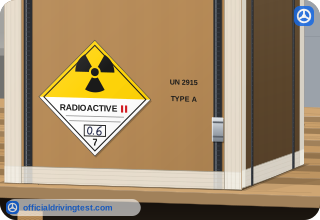
- How many packages may be loaded together
- How fast the vehicle may travel
- Which side of the cargo space they use
Show answer
Correct answer: How many packages may be loaded together
The number of radioactive packages loaded together is limited, and so is how close they are to people, animals and unexposed film.
Source: CDL manual, national model as printed by New Jersey, Section 9 (July 2017)
-
What does the transport index of a radioactive package tell the driver?
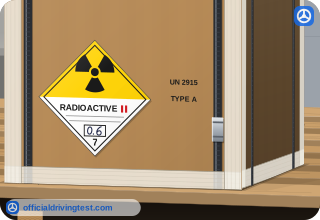
- How heavy the package is when it is full
- How much control is needed while it travels
- How many hours it may stay on the vehicle
Show answer
Correct answer: How much control is needed while it travels
The index shows how strictly the number of packages and their distance from people, animals and film must be controlled.
Source: CDL manual, national model as printed by New Jersey, Section 9 (July 2017)
-
What is the highest total transport index allowed for all radioactive packages in one vehicle?
- 10
- 100
- 50
Show answer
Correct answer: 50
The transport indexes of all the packages on one vehicle are added up, and the sum may not go above 50.
Source: CDL manual, national model as printed by New Jersey, Section 9 (July 2017)
-
A radioactive package has a transport index of 1.1. How close may it be left to people or the cargo space walls?
- No closer than two feet
- No closer than six inches
- Right against the wall if it is braced
Show answer
Correct answer: No closer than two feet
A package rated 1.1 on the transport index must stay at least two feet away from people and from the walls of the cargo space.
Source: CDL manual, national model as printed by New Jersey, Section 9 (July 2017)
-
Charged storage batteries may not be loaded in the same vehicle with which explosives?
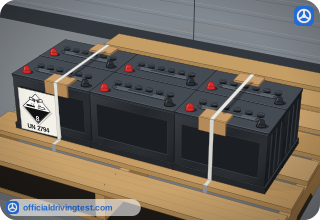
- Division 1.4 explosives
- Division 1.5 blasting agents
- Division 1.1 explosives
Show answer
Correct answer: Division 1.1 explosives
The Do Not Load table bars charged storage batteries from sharing a vehicle with Division 1.1.
Source: CDL manual, national model as printed by New Jersey, Section 9 (July 2017)
-
When may Class 1 detonating primers share a vehicle with other explosives?
- Only in authorized packages
- Only if the primers sit on top
- Only if the trip is by daytime
Show answer
Correct answer: Only in authorized packages
Detonating primers may not be loaded with any other explosives unless they are in authorized containers or packages.
Source: CDL manual, national model as printed by New Jersey, Section 9 (July 2017)
-
Cyanides and cyanide mixtures may not be loaded in the same vehicle with which cargo?
- Class 2.2 non-flammable gases
- Acids and acidic materials
- Class 9 miscellaneous goods
Show answer
Correct answer: Acids and acidic materials
Division 6.1 cyanides must be kept away from acids and acidic or corrosive materials that could release hydrocyanic acid.
Source: CDL manual, national model as printed by New Jersey, Section 9 (July 2017)
-
Besides the examples in the manual's table, where are other materials that must be kept apart named?
- The Hazardous Materials Table
- The vehicle's annual inspection record
- The Segregation Table
Show answer
Correct answer: The Segregation Table
The Segregation Table for Hazardous Materials names the other products that must be kept apart in a load.
Source: CDL manual, national model as printed by New Jersey, Section 9 (July 2017)
-
Only in Arizona's manual
A combination carries Division 1.1 or 1.2 explosives. Which load must the other vehicle in the combination not contain?
- Division 2.2 non-flammable gas
- Division 2.3 or Division 6.1 poisons
- Class 9 miscellaneous materials
Show answer
Correct answer: Division 2.3 or Division 6.1 poisons
Division 1.1 or 1.2 explosives may not travel in a combination whose other vehicle holds a Division 2.3 poison gas or a Division 6.1 poison.
Source: CDL manual, national model as printed by New Jersey, Section 9 (July 2017)