Hazardous Materials: 30 Hardest Questions
Questions that need a second thought, picked for close numbers, exceptions and easy-to-confuse rules. Take your time.
Independent educational site · not affiliated with any government agency or DMV
Ready? Test yourself
Answer to start, or tap Start below:
A product is missing from the Hazardous Materials Table. What does that tell you?
- Instant feedback with an explanation
- Every answer cites its source in the manual
- Your best score is saved on this device
- Keyboard: press 1 to 3 to answer and Enter for the next question
Questions are written in our own words from the CDL manual; they are not the real test's questions. With your state chosen, every answer gives its page in your state's CDL manual. Without a state, answers cite the CDL manual, national model as printed by New Jersey (July 2017).
All 30 questions in this practice test
Take the test above first, then use this list to study. Tap “Show answer” to see the correct answer and explanation.
Show the questions and answersHide the questions
-
A product is missing from the Hazardous Materials Table. What does that tell you?
- It is safe to treat it as an ordinary load
- It is hazmat only if the driver decides so
- It can still be hazmat if a definition fits it
Show answer
Correct answer: It can still be hazmat if a definition fits it
The table does not list everything. A material counts as hazardous when its characteristics fit a definition in the regulations.
Source: CDL manual, national model as printed by New Jersey, Section 9 (July 2017)
-
A truck hauling Division 1.1, 1.2, or 1.3 explosives is never to be parked close to the traveled part of the road. What distance does the rule name?
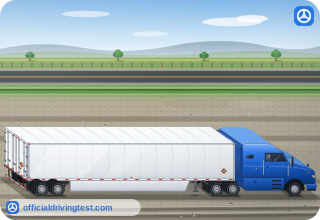
- Twenty feet
- Fifty feet
- Five feet
Show answer
Correct answer: Five feet
Explosives of these divisions must not be parked within five feet of the traveled road surface.
Source: CDL manual, national model as printed by New Jersey, Section 9 (July 2017)
-
Can a single identification number stand for more than one chemical?
- No, each chemical has its own number
- Only when the chemicals are gases
- Yes, one number can cover several chemicals
Show answer
Correct answer: Yes, one number can cover several chemicals
Some identification numbers are shared, so one number may point to several different chemicals.
Source: CDL manual, national model as printed by New Jersey, Section 9 (July 2017)
-
Under what condition may a cargo tank be moved with its valves or covers open?
- When the trip is only a short one
- When it is empty under the federal rule
- When the load is not flammable
Show answer
Correct answer: When it is empty under the federal rule
Moving a tank with open valves or covers is illegal unless the tank counts as empty under 49 CFR 173.29.
Source: CDL manual, national model as printed by New Jersey, Section 9 (July 2017)
-
The general public is moved away because of a hazardous materials incident. How long must the evacuation last before a call to the National Response Center is required?
- More than one hour
- More than six hours
- Any amount of time at all
Show answer
Correct answer: More than one hour
Reporting is required when the public is evacuated for longer than one hour.
Source: CDL manual, national model as printed by New Jersey, Section 9 (July 2017)
-
How is the packing group written in a shipping description?
- In ordinary digits, with PG required
- As a single letter, such as A or B
- In Roman numerals, with PG optional
Show answer
Correct answer: In Roman numerals, with PG optional
The packing group is shown in Roman numerals. The letters PG may come before it, but they are not required.
Source: CDL manual, national model as printed by New Jersey, Section 9 (July 2017)
-
Which class 6.1 materials are in Placard Table 1, needing a placard in any amount?
- Inhalation hazard zone A and B materials only
- Every class 6.1 poison, in any amount
- Class 6.1 materials in packages over 119 gallons
Show answer
Correct answer: Inhalation hazard zone A and B materials only
Only the inhalation hazard zone A and B poisons are in Table 1. Other class 6.1 materials fall under Table 2.
Source: CDL manual, national model as printed by New Jersey, Section 9 (July 2017)
-
When may a gas cylinder be loaded lying down?
- When it makes up less than half the load
- When it is chained down at both ends
- If its relief valve sits in the vapor space
Show answer
Correct answer: If its relief valve sits in the vapor space
A cylinder may lie on its side only if its design keeps the relief valve in the vapor space.
Source: CDL manual, national model as printed by New Jersey, Section 9 (July 2017)
-
When is the shipper's certification on the shipping paper not required?
- You pull cargo tanks you or your employer supplied
- The load is small enough for one trip
- The carrier has hauled for that shipper before
Show answer
Correct answer: You pull cargo tanks you or your employer supplied
The certification step is skipped if the cargo tanks you pull come from you or your employer.
Source: CDL manual, national model as printed by New Jersey, Section 9 (July 2017)
-
Your cargo tank for hazardous materials is empty. Do you still stop before a railroad crossing?
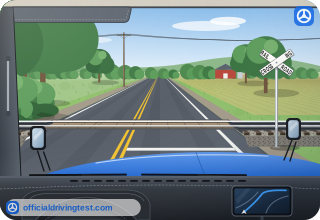
- Yes, loaded or empty, the stop is required
- No, an empty tank needs no stop
- Only if the tank was last loaded with gas
Show answer
Correct answer: Yes, loaded or empty, the stop is required
Cargo tanks used for hazardous materials must stop at railroad crossings whether they are loaded or empty.
Source: CDL manual, national model as printed by New Jersey, Section 9 (July 2017)
-
Where may the letters RQ appear in relation to the basic description of a material?
- Before or after it
- Only before it
- Only after it
Show answer
Correct answer: Before or after it
The letters RQ can stand either ahead of or behind the basic description.
Source: CDL manual, national model as printed by New Jersey, Section 9 (July 2017)
-
In Placard Table 2, which placard is listed for class 6.2 Infectious Substances?
- Poison
- No placard is listed
- Corrosive
Show answer
Correct answer: No placard is listed
Table 2 shows no placard for class 6.2 infectious substances.
Source: CDL manual, national model as printed by New Jersey, Section 9 (July 2017)
-
How tall must shipping-name letters be on a portable tank holding more than 1,000 gallons?
- At least two inches
- At least one inch
- At least four inches
Show answer
Correct answer: At least two inches
On large portable tanks of more than 1,000 gallons the lettering must be at least two inches high. Smaller tanks may use one-inch letters.
Source: CDL manual, national model as printed by New Jersey, Section 9 (July 2017)
-
Compressed gas is involved in an accident. Whom must you notify?
- The state transportation office
- The shipper
- The manufacturer of the tank
Show answer
Correct answer: The shipper
The shipper must be told whenever compressed gas is involved in any accident.
Source: CDL manual, national model as printed by New Jersey, Section 9 (July 2017)
-
A carrier only hauls a shipment and did not create it. How long must it keep a copy of the shipping paper?
- 1 year
- 2 years
- 3 years
Show answer
Correct answer: 1 year
A carrier that only provides transport, and is not the originator, must keep the paper or an image of it for 1 year.
Source: CDL manual, national model as printed by New Jersey, Section 9 (July 2017)
-
Special cargo heater rules apply when loading which of these?
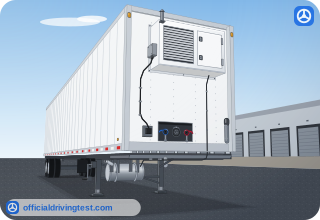
- Class 3 flammable liquids
- Class 5 oxidizers
- Class 4 flammable solids
Show answer
Correct answer: Class 3 flammable liquids
Heater rules apply to explosives, flammable gas and flammable liquids, so oxidizers and flammable solids are not in that group.
Source: CDL manual, national model as printed by New Jersey, Section 9 (July 2017)
-
In the hazard class table, fuel oil is listed as which kind of material?
- Flammable Liquids
- Corrosives
- Combustible Liquids
Show answer
Correct answer: Combustible Liquids
The table lists fuel oil as the example of combustible liquids, which have no class number.
Source: CDL manual, national model as printed by New Jersey, Section 9 (July 2017)
-
Your unplacarded truck carries a small amount of chlorine. Must you stop before a railroad crossing?
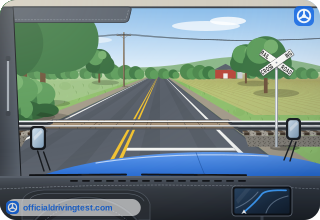
- Yes, any amount of chlorine requires a stop
- No, only a full load requires a stop
- No, if the crossing has flashing lights
Show answer
Correct answer: Yes, any amount of chlorine requires a stop
Carrying any amount of chlorine means you must stop before a railroad crossing.
Source: CDL manual, national model as printed by New Jersey, Section 9 (July 2017)
-
What does the Table 2 footnote say about the Class 9 placard?
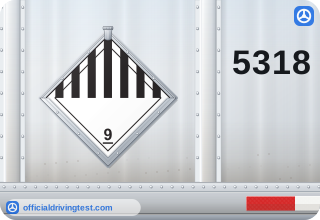
- It is not required for domestic transportation
- It is required only on cargo tank vehicles
- It replaces the DANGEROUS placard on mixed loads
Show answer
Correct answer: It is not required for domestic transportation
Within domestic transportation, the Class 9 placard is not required.
Source: CDL manual, national model as printed by New Jersey, Section 9 (July 2017)
-
In which case does the original shipping paper not need a signed shipper's certification?
- The load is a small amount
- Carrier supplies the package
- The shipper used this carrier before
Show answer
Correct answer: Carrier supplies the package
A signed certification is not required when the carrier provides the package, or when a private carrier is hauling its own product.
Source: CDL manual, national model as printed by New Jersey, Section 9 (July 2017)
-
A radioactive package has a transport index of 1.1. How close may it be left to people or the cargo space walls?
- No closer than two feet
- No closer than six inches
- Right against the wall if it is braced
Show answer
Correct answer: No closer than two feet
A package rated 1.1 on the transport index must stay at least two feet away from people and from the walls of the cargo space.
Source: CDL manual, national model as printed by New Jersey, Section 9 (July 2017)
-
On a public road, when may you move flammable compressed gas from one tank into another?
- Only to fuel road construction or maintenance machinery
- Only when the first tank is already half empty
- Only if the second tank carries matching placards
Show answer
Correct answer: Only to fuel road construction or maintenance machinery
Transferring flammable compressed gas on a public road is not allowed, except when fueling machinery for road construction or maintenance.
Source: CDL manual, national model as printed by New Jersey, Section 9 (July 2017)
-
Which class 7 radioactive shipments fall in Placard Table 1, needing a placard in any amount?
- Those with a White I label
- Those with a Yellow III label
- Those with a Yellow II label
Show answer
Correct answer: Those with a Yellow III label
Table 1 lists class 7 only for the Yellow III label, and the placard is Radioactive.
Source: CDL manual, national model as printed by New Jersey, Section 9 (July 2017)
-
In Column 4, what do the letters "NA" before an identification number tell you?
- Material is barred from all highway trips
- Used only within the U.S. and to or from Canada
- Name used on international air shipments only
Show answer
Correct answer: Used only within the U.S. and to or from Canada
An NA number goes with a name used only within the United States and to or from Canada.
Source: CDL manual, national model as printed by New Jersey, Section 9 (July 2017)
-
A compressed gas delivery uses a pump driven by your engine. At what point do you shut the engine off?
- After the transfer, before unhooking
- Before the transfer starts
- After you have unhooked the hose
Show answer
Correct answer: After the transfer, before unhooking
The engine may run the pump, but it is shut off once the transfer ends and before the hose is disconnected.
Source: CDL manual, national model as printed by New Jersey, Section 9 (July 2017)
-
Division 1.1 or 1.2 explosives may not share a combination with which other load?
- Empty returnable pallets
- Class 9 miscellaneous goods
- Class 7 Yellow III packages
Show answer
Correct answer: Class 7 Yellow III packages
If the other vehicle in the combination holds Class 7 packages with the Yellow III label, explosives of Division 1.1 or 1.2 cannot be carried.
Source: CDL manual, national model as printed by New Jersey, Section 9 (July 2017)
-
You are parked with Division 1.1 explosives and want another person to watch the vehicle for you. Where must the vehicle be?
- On a public road shoulder
- On the consignee's property
- In a rest stop lot
Show answer
Correct answer: On the consignee's property
Someone else may watch the vehicle only on the shipper's, carrier's, or consignee's property. Elsewhere, the driver must watch it.
Source: CDL manual, national model as printed by New Jersey, Section 9 (July 2017)
-
How much of one Table 2 class loaded at one place means you must use that class's own placard instead of DANGEROUS?
- 1,001 pounds
- 5,000 pounds
- 2,205 pounds
Show answer
Correct answer: 2,205 pounds
Once 2,205 pounds or more of a single Table 2 class is loaded at one place, the specific placard for it is required.
Source: CDL manual, national model as printed by New Jersey, Section 9 (July 2017)
-
A shipment has a total transport index of 5.1 to 10.0. What is the minimum distance in feet to undeveloped film when the packages stay 8 to 12 hours?
- 9 feet
- 15 feet
- 11 feet
Show answer
Correct answer: 11 feet
For a transport index of 5.1 to 10.0, packages kept 8 to 12 hours must be 11 feet from undeveloped film.
Source: CDL manual, national model as printed by New Jersey, Section 9 (July 2017)
-
Which of these may never be loaded in the same vehicle with corrosive liquids?
- Division 1.5 blasting agents
- Division 1.4 explosives
- Division 4.1 flammable solids
Show answer
Correct answer: Division 1.5 blasting agents
Blasting agents are on the list of materials that cannot ride with corrosive liquids at all. Divisions 1.4 and 4.1 are only barred from being next to or below them.
Source: CDL manual, national model as printed by New Jersey, Section 9 (July 2017)