Hazardous Materials: Loading and unloading hazardous materials — Part 2
Questions in this part include: “What makes a metal non-ferrous?” · “Division 1.1 or 1.2 explosives may not share a combination with which other load?”
Independent educational site · not affiliated with any government agency or DMV
Ready? Test yourself
Answer to start, or tap Start below:
What makes a metal non-ferrous?
- Instant feedback with an explanation
- Every answer cites its source in the manual
- Your best score is saved on this device
- Keyboard: press 1 to 3 to answer and Enter for the next question
Questions are written in our own words from the CDL manual; they are not the real test's questions. With your state chosen, every answer gives its page in your state's CDL manual. Without a state, answers cite the CDL manual, national model as printed by New Jersey (July 2017).
All 19 questions in this practice test
Take the test above first, then use this list to study. Tap “Show answer” to see the correct answer and explanation.
Show the questions and answersHide the questions
-
What makes a metal non-ferrous?
- It weighs less than plain steel
- It has been painted or coated over
- It has no iron or iron alloys in it
Show answer
Correct answer: It has no iron or iron alloys in it
A non-ferrous metal is one that contains no iron and no iron alloys.
Source: CDL manual, national model as printed by New Jersey, Section 9 (July 2017)
-
Besides hooks, which hand tools are never used on explosive packages?
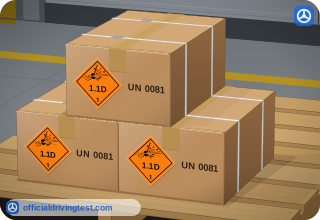
- Rubber-headed hand tools
- Metal tools of any kind
- Plastic hand tools
Show answer
Correct answer: Metal tools of any kind
Hooks are not the only thing banned: no metal tools at all may be used on explosives.
Source: CDL manual, national model as printed by New Jersey, Section 9 (July 2017)
-
How may packages of explosives be moved during loading?
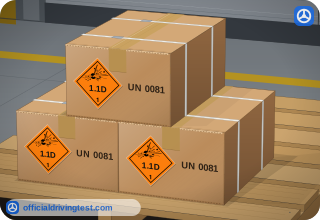
- Rolled gently across the floor
- Tossed short distances to a helper
- Never dropped, thrown or rolled
Show answer
Correct answer: Never dropped, thrown or rolled
Explosives need extra care, so packages are never dropped, thrown or rolled, and metal tools and hooks are not used on them.
Source: CDL manual, national model as printed by New Jersey, Section 9 (July 2017)
-
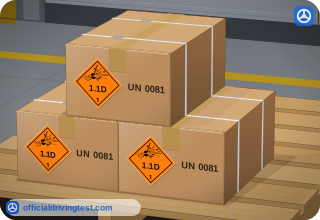
Besides sharp points in the cargo space, what else must explosive packages be protected from?
- Cargo that gives off a strong smell
- Cargo packed in plastic wrap
- Other cargo that might damage them
Show answer
Correct answer: Other cargo that might damage them
Explosive packages are shielded from any other cargo that might harm them.
Source: CDL manual, national model as printed by New Jersey, Section 9 (July 2017)
-
When may Division 1.1, 1.2 or 1.3 explosives be moved between vehicles on a public road?
- Only in an emergency
- Only at night
- Any time the shoulder is wide
Show answer
Correct answer: Only in an emergency
On a public road such explosives are transferred between vehicles only when an emergency makes it necessary for safety.
Source: CDL manual, national model as printed by New Jersey, Section 9 (July 2017)
-
A Division 1.1 load must be moved to another vehicle on a public road because of an emergency. What must the driver do?
- Put out red reflectors or lanterns
- Put out burning flares to warn traffic
- Switch on the four-way flashers only
Show answer
Correct answer: Put out red reflectors or lanterns
Such a transfer is allowed on a public road only in an emergency, and the driver must warn other road users with red reflectors, flags or electric lanterns.
Source: CDL manual, national model as printed by New Jersey, Section 9 (July 2017)
-
A package of explosives has an oily stain on it. What should the driver do?
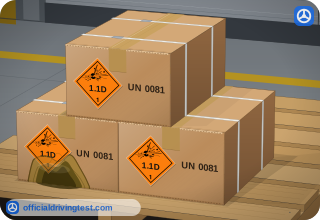
- Refuse to take it
- Wipe it and load it at the back
- Load it next to the door
Show answer
Correct answer: Refuse to take it
Damaged explosive packages are never carried, and dampness or an oily stain counts as a warning sign.
Source: CDL manual, national model as printed by New Jersey, Section 9 (July 2017)
-
When may Division 1.1 or 1.2 explosives NOT be hauled in a vehicle combination?
- When one trailer is a dry van
- When a placarded cargo tank is in it
- When the combination has three axles
Show answer
Correct answer: When a placarded cargo tank is in it
A marked or placarded cargo tank anywhere in the combination rules out carrying Division 1.1 or 1.2 explosives.
Source: CDL manual, national model as printed by New Jersey, Section 9 (July 2017)
-
Which load in the other vehicle of a combination rules out carrying Division 1.1 or 1.2 explosives?
- Division 1.4 small explosives
- Class 9 miscellaneous goods
- Division 1.1 A explosives
Show answer
Correct answer: Division 1.1 A explosives
Division 1.1 and 1.2 may not ride in a combination if the other vehicle holds Division 1.1 A initiating explosives.
Source: CDL manual, national model as printed by New Jersey, Section 9 (July 2017)
-
Division 1.1 or 1.2 explosives may not share a combination with which other load?
- Empty returnable pallets
- Class 9 miscellaneous goods
- Class 7 Yellow III packages
Show answer
Correct answer: Class 7 Yellow III packages
If the other vehicle in the combination holds Class 7 packages with the Yellow III label, explosives of Division 1.1 or 1.2 cannot be carried.
Source: CDL manual, national model as printed by New Jersey, Section 9 (July 2017)
-
Division 1.1 or 1.2 explosives may not be hauled in a combination whose other vehicle carries which load?
- Division 2.3 gas, Hazard zone A or B
- Division 2.2 non-flammable gas
- Class 3 flammable liquids in drums
Show answer
Correct answer: Division 2.3 gas, Hazard zone A or B
Poison gas of Hazard zone A or B in the other vehicle rules out Division 1.1 or 1.2 explosives. So does Division 6.1 poison of Hazard zone A.
Source: CDL manual, national model as printed by New Jersey, Section 9 (July 2017)
-
What describes Class 4 flammable solids?
- Gases stored under high pressure
- Liquids that give off heavy fumes
- Solids that react to water or heat
Show answer
Correct answer: Solids that react to water or heat
Class 4 materials are solids that can react, even to the point of fire or explosion, when exposed to water, heat or air, or on their own.
Source: CDL manual, national model as printed by New Jersey, Section 9 (July 2017)
-
If a Class 4 or 5 product turns dangerous when wet, what must be done during loading, unloading and the trip?
- Keep it cold
- Keep it dry
- Keep it ventilated by opening the doors
Show answer
Correct answer: Keep it dry
A product that becomes unstable when wet must stay dry at all times, from loading until it is unloaded.
Source: CDL manual, national model as printed by New Jersey, Section 9 (July 2017)
-
What kind of vehicle must carry materials that can heat up or catch fire on their own?
- A vehicle with sealed airtight walls
- A vehicle with enough ventilation
- A vehicle with a refrigeration unit
Show answer
Correct answer: A vehicle with enough ventilation
Materials prone to spontaneous heating or combustion need a vehicle that has sufficient ventilation.
Source: CDL manual, national model as printed by New Jersey, Section 9 (July 2017)
-
How should breakable containers of corrosive liquid be loaded by hand?
- Two at a time, on their sides
- One by one, right side up
- In a pile, then braced
Show answer
Correct answer: One by one, right side up
Each breakable corrosive container is handled alone and kept upright, never dropped or rolled.
Source: CDL manual, national model as printed by New Jersey, Section 9 (July 2017)
-
On what kind of surface should breakable containers of corrosive liquid be loaded?
- An even floor
- A stack of pallets
- A sloped floor
Show answer
Correct answer: An even floor
Breakable corrosive containers go onto an even floor, and they are never dropped or rolled.
Source: CDL manual, national model as printed by New Jersey, Section 9 (July 2017)
-
Under what condition may carboys be stacked in tiers?
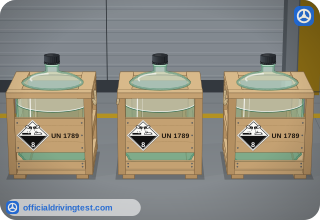
- When the upper tiers are all empty
- When the carboys are strapped together
- When the lower tiers can bear the load
Show answer
Correct answer: When the lower tiers can bear the load
Carboys may be stacked only when the lower layers are strong enough to carry the layers above them without damage.
Source: CDL manual, national model as printed by New Jersey, Section 9 (July 2017)
-
Where may nitric acid NOT be placed in a load?
- Above any other product
- Beside other cargo
- Under any other product
Show answer
Correct answer: Above any other product
Nitric acid must never be loaded above any other product.
Source: CDL manual, national model as printed by New Jersey, Section 9 (July 2017)
-
What must a driver make sure of when loading charged storage batteries?
- That they lie flat so they stay low in the truck
- That they stay upright and are not hit by cargo
- That they are covered with a thin metal sheet
Show answer
Correct answer: That they stay upright and are not hit by cargo
Batteries are kept upright so the liquid cannot spill, and other cargo must not fall on them and cause a short circuit.
Source: CDL manual, national model as printed by New Jersey, Section 9 (July 2017)