Hazardous Materials: Loading and unloading hazardous materials — Part 1
Questions in this part include: “While loading containers of hazardous materials, which tool should a driver keep out of use?” · “What should a driver do about the packages once hazardous materials are loaded?”
Independent educational site · not affiliated with any government agency or DMV
Ready? Test yourself
Answer to start, or tap Start below:
What should a driver do with the parking brake before hazardous materials are loaded or unloaded?
- Instant feedback with an explanation
- Every answer cites its source in the manual
- Your best score is saved on this device
- Keyboard: press 1 to 3 to answer and Enter for the next question
Questions are written in our own words from the CDL manual; they are not the real test's questions. With your state chosen, every answer gives its page in your state's CDL manual. Without a state, answers cite the CDL manual, national model as printed by New Jersey (July 2017).
All 19 questions in this practice test
Take the test above first, then use this list to study. Tap “Show answer” to see the correct answer and explanation.
Show the questions and answersHide the questions
-
While loading containers of hazardous materials, which tool should a driver keep out of use?
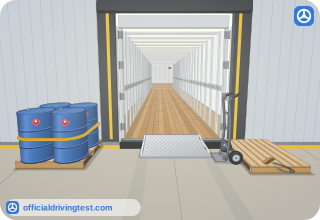
- A hand truck
- A cargo hook
- A loading ramp
Show answer
Correct answer: A cargo hook
Tools that can puncture or tear a container must not be used when loading hazardous materials, and hooks are named as one of them.
Source: CDL manual, national model as printed by New Jersey, Section 9 (July 2017)
-
What should a driver do with the parking brake before hazardous materials are loaded or unloaded?
- Release it so the load can settle
- Set it so the vehicle cannot move
- Leave it as is if the engine is running
Show answer
Correct answer: Set it so the vehicle cannot move
The parking brake is set first so the vehicle cannot roll while the cargo is being handled.
Source: CDL manual, national model as printed by New Jersey, Section 9 (July 2017)
-
Why should hazardous materials be loaded away from heat sources?
- Heat can fade the labels on the packages
- Heat makes the placards hard to read
- Heat can make many products more dangerous
Show answer
Correct answer: Heat can make many products more dangerous
Many hazardous products become more dangerous when they get hot, so they are kept away from anything that gives off heat.
Source: CDL manual, national model as printed by New Jersey, Section 9 (July 2017)
-
A driver notices that one package of hazardous material is leaking before departure. What is the rule?
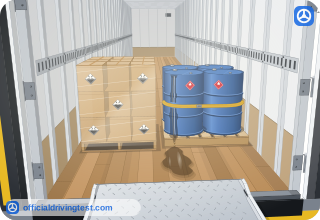
- Do not move the vehicle with it aboard
- Carry it only on short trips
- Carry it if the leak looks small
Show answer
Correct answer: Do not move the vehicle with it aboard
Moving a vehicle that carries a leaking hazardous materials package is illegal, because the driver, the truck and other people could be in danger.
Source: CDL manual, national model as printed by New Jersey, Section 9 (July 2017)
-
What must be done to containers of hazardous materials so the packages do not shift in transit?
- They must be stacked as high as possible
- They must be braced
- They must be loaded last
Show answer
Correct answer: They must be braced
Bracing keeps the packages from moving around while the vehicle is on the road.
Source: CDL manual, national model as printed by New Jersey, Section 9 (July 2017)
-
Smoking is never allowed near which of these loads while it is being loaded or unloaded?
- Class 3 flammable liquids
- Class 8 corrosives
- Class 7 radioactive materials
Show answer
Correct answer: Class 3 flammable liquids
Fire and smoking are kept away from explosives, flammable gas, flammable liquids, flammable solids and oxidizers.
Source: CDL manual, national model as printed by New Jersey, Section 9 (July 2017)
-
Special cargo heater rules apply when loading which of these?
- Class 3 flammable liquids
- Class 5 oxidizers
- Class 4 flammable solids
Show answer
Correct answer: Class 3 flammable liquids
Heater rules apply to explosives, flammable gas and flammable liquids, so oxidizers and flammable solids are not in that group.
Source: CDL manual, national model as printed by New Jersey, Section 9 (July 2017)
-
A helper wants to smoke while oxidizers are being unloaded. What is the correct response?
- Allow it if he stands at the tailgate
- Do not allow smoking anywhere nearby
- Allow it after the first half is unloaded
Show answer
Correct answer: Do not allow smoking anywhere nearby
Oxidizers are on the list of loads around which nobody may smoke during loading or unloading.
Source: CDL manual, national model as printed by New Jersey, Section 9 (July 2017)
-
Which kind of container needs special care during loading because of parts that stick out?
- Containers with flat screw lids
- Containers wrapped in thick plastic
- Containers with valves or fittings
Show answer
Correct answer: Containers with valves or fittings
Valves and other fittings can be damaged or knocked open, so such containers must be loaded very carefully.
Source: CDL manual, national model as printed by New Jersey, Section 9 (July 2017)
-
What should a driver do about the packages once hazardous materials are loaded?
- Open them at stops to check for damage
- Open them to let fumes escape
- Leave every package closed for the whole trip
Show answer
Correct answer: Leave every package closed for the whole trip
After loading, no package is opened during the trip.
Source: CDL manual, national model as printed by New Jersey, Section 9 (July 2017)
-
On the road, a driver wants to pour a hazardous product from a damaged package into a good one. What is the rule?
- Do it only with gloves and a mask on
- Never pour it from one package to another
- Do it only on a flat, level shoulder
Show answer
Correct answer: Never pour it from one package to another
Hazardous materials must never be moved from one package to another during the trip, and loaded packages are not opened.
Source: CDL manual, national model as printed by New Jersey, Section 9 (July 2017)
-
Which container may be emptied while it is still on the vehicle?
- A drum
- A cylinder
- A cargo tank
Show answer
Correct answer: A cargo tank
A cargo tank is the only container that may be emptied on the vehicle. Other packages stay closed and full while aboard.
Source: CDL manual, national model as printed by New Jersey, Section 9 (July 2017)
-
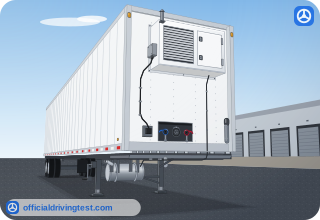
What do the rules usually say about cargo heaters when certain explosives, flammable gas or flammable liquids are carried?
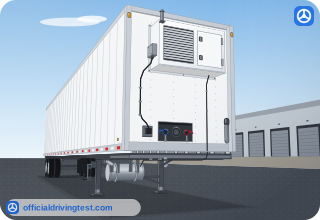
- Heaters may run on low only
- Heaters are required in cold weather
- Heaters are usually forbidden
Show answer
Correct answer: Heaters are usually forbidden
Heaters, even automatic heater and air conditioner units, are usually not allowed in a cargo space holding these products unless the driver has read all the related rules.
Source: CDL manual, national model as printed by New Jersey, Section 9 (July 2017)
-
Which of these loads may not stick out past the end of the vehicle?
- Class 3 flammable liquids
- Class 2.1 flammable gas
- Class 1 explosives
Show answer
Correct answer: Class 1 explosives
Explosives, flammable solids and oxidizers cannot be carried as overhang or tailgate loads.
Source: CDL manual, national model as printed by New Jersey, Section 9 (July 2017)
-
When may Class 4 and Class 5 loads be carried outside a closed cargo space?
- When the whole trip is under 50 miles
- When the placards are clearly displayed
- If packages or a tarp resist fire and water
Show answer
Correct answer: If packages or a tarp resist fire and water
The closed-space rule is waived only if every package resists fire and water, or the load is covered with a tarp that resists both.
Source: CDL manual, national model as printed by New Jersey, Section 9 (July 2017)
-
What should the engine be doing while explosives are loaded or unloaded?
- Idling to keep the heater warm
- Running to power the air brakes
- Turned off
Show answer
Correct answer: Turned off
The engine is switched off before explosives are handled, and then the cargo space is checked.
Source: CDL manual, national model as printed by New Jersey, Section 9 (July 2017)
-
How is a cargo heater made safe before explosives are loaded?
- Turned to its lowest heat setting available
- Disconnected from power and its fuel tank drained
- Wrapped in a thick fire-resistant blanket
Show answer
Correct answer: Disconnected from power and its fuel tank drained
The heater is fully disabled by cutting its power source and emptying its fuel tank.
Source: CDL manual, national model as printed by New Jersey, Section 9 (July 2017)
-
What should a driver look for inside the cargo space before loading explosives?
- Wet floors and loose canvas tarps
- Dust, dirt and old faded placards
- Sharp points such as nails and bolts
Show answer
Correct answer: Sharp points such as nails and bolts
Anything sharp, including bolts, screws, nails and broken panels or floorboards, can damage the packages.
Source: CDL manual, national model as printed by New Jersey, Section 9 (July 2017)
-
What kind of floor liner is needed for Division 1.1, 1.2 or 1.3 explosives?
- Steel plate
- Non-metallic or non-ferrous material
- Any material that contains iron
Show answer
Correct answer: Non-metallic or non-ferrous material
The floor must be tight and lined with non-metallic material or a metal that has no iron in it.
Source: CDL manual, national model as printed by New Jersey, Section 9 (July 2017)