Hazardous Materials: Bulk packaging and tanks
Markings on bulk packaging, loading and unloading cargo tanks, flammable liquids and compressed gas.
Independent educational site · not affiliated with any government agency or DMV
Ready? Test yourself
Answer to start, or tap Start below:
What separates a cargo tank from a portable tank?
- Instant feedback with an explanation
- Every answer cites its source in the manual
- Your best score is saved on this device
- Keyboard: press 1 to 3 to answer and Enter for the next question
Questions are written in our own words from the CDL manual; they are not the real test's questions. With your state chosen, every answer gives its page in your state's CDL manual. Without a state, answers cite the CDL manual, national model as printed by New Jersey (July 2017).
All 23 questions in this practice test
Take the test above first, then use this list to study. Tap “Show answer” to see the correct answer and explanation.
Show the questions and answersHide the questions
-
What separates a cargo tank from a portable tank?
- A cargo tank holds only liquids; a portable tank holds only gases.
- A cargo tank is permanently attached to the vehicle; a portable tank is not.
- A cargo tank is filled off the vehicle; a portable tank is filled on it.
Show answer
Correct answer: A cargo tank is permanently attached to the vehicle; a portable tank is not.
A cargo tank is fixed to the vehicle and stays on it during loading. A portable tank is filled or emptied off the vehicle and then placed on one for the trip.
Source: CDL manual, national model as printed by New Jersey, Section 9 (July 2017)
-
Which pair of cargo tank types is the most common?
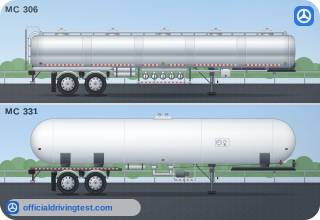
- MC331 carries liquids; MC306 carries gases
- MC306 carries liquids; MC331 carries gases
- MC306 carries gases; MC312 carries liquids
Show answer
Correct answer: MC306 carries liquids; MC331 carries gases
The MC306 is the usual cargo tank for liquids, and the MC331 is the usual one for gases.
Source: CDL manual, national model as printed by New Jersey, Section 9 (July 2017)
-
Where can you find the identification number of a hazardous material?
- Column 4 of the shipping paper
- Column 4 of the hazmat table
- Column 3 of the hazmat table
Show answer
Correct answer: Column 4 of the hazmat table
The Hazardous Materials Table lists each material's identification number in its column 4.
Source: CDL manual, national model as printed by New Jersey, Section 9 (July 2017)
-
How must the identification number of a hazardous material look on a cargo tank?
- White numbers, 100 mm (3.9 in) tall, on black
- Black numbers, 100 mm (3.9 in) tall, on orange
- Black numbers, 50 mm (2 in) tall, on yellow
Show answer
Correct answer: Black numbers, 100 mm (3.9 in) tall, on orange
Identification numbers are shown in black, 100 mm (3.9 inches) high, on an orange panel, a placard, or a white diamond when no placard is needed.
Source: CDL manual, national model as printed by New Jersey, Section 9 (July 2017)
-
What marking must a specification cargo tank show besides its identification number?
- The date it was built
- The date it was last re-tested
- The date it was last filled
Show answer
Correct answer: The date it was last re-tested
Specification cargo tanks carry markings that show when they were last re-tested.
Source: CDL manual, national model as printed by New Jersey, Section 9 (July 2017)
-
Besides the shipping name, what name must a portable tank display?
- The lessee or owner
- The shipper of the contents
- The tank's manufacturer
Show answer
Correct answer: The lessee or owner
A portable tank must show the name of its lessee or owner.
Source: CDL manual, national model as printed by New Jersey, Section 9 (July 2017)
-
Where must a portable tank display the shipping name of its contents?
- On the top and the bottom
- On the front end only
- On two opposing sides
Show answer
Correct answer: On two opposing sides
The shipping name goes on two opposite sides of the portable tank, together with the name of the lessee or owner.
Source: CDL manual, national model as printed by New Jersey, Section 9 (July 2017)
-
How tall must shipping-name letters be on a portable tank holding more than 1,000 gallons?
- At least two inches
- At least one inch
- At least four inches
Show answer
Correct answer: At least two inches
On large portable tanks of more than 1,000 gallons the lettering must be at least two inches high. Smaller tanks may use one-inch letters.
Source: CDL manual, national model as printed by New Jersey, Section 9 (July 2017)
-
On which parts of a bulk package holding 1,000 gallons or more must the identification number appear?
- Each side and each end
- Two opposing sides only
- The top and one side
Show answer
Correct answer: Each side and each end
Larger bulk packages show the number on all four faces. Portable tanks under 1,000 gallons need it only on two opposite sides.
Source: CDL manual, national model as printed by New Jersey, Section 9 (July 2017)
-
A portable tank is loaded on your truck and its identification numbers cannot be seen. What must you do?
- Show the number on the rear of the truck only
- Nothing, because the tank already carries the number
- Put the number on all four sides of the truck
Show answer
Correct answer: Put the number on all four sides of the truck
The number must be visible from outside. If the tank hides it, the vehicle itself carries it on all four faces.
Source: CDL manual, national model as printed by New Jersey, Section 9 (July 2017)
-
Which markings are intermediate bulk containers (IBCs) not required to carry?
- The identification number
- Placards on all sides
- Owner's name and shipping name
Show answer
Correct answer: Owner's name and shipping name
Unlike portable tanks, IBCs do not need the owner's name or the shipping name displayed.
Source: CDL manual, national model as printed by New Jersey, Section 9 (July 2017)
-
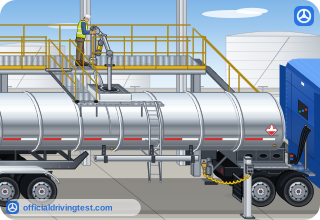
How close must the person watching a cargo tank being loaded or unloaded stay to the tank?
- Within 50 feet
- Within 100 feet
- Within 25 feet
Show answer
Correct answer: Within 25 feet
The attendant must remain within 25 feet of the tank and have a clear view of it throughout the transfer.
Source: CDL manual, national model as printed by New Jersey, Section 9 (July 2017)
-
Besides being alert, what must the person who watches a cargo tank during loading be able to do?
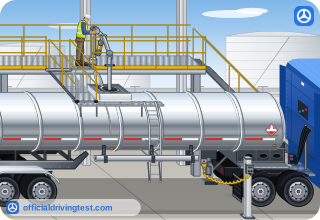
- Move the cargo tank if needed
- Repair the tank's valves
- Sign the shipping paper for the shipper
Show answer
Correct answer: Move the cargo tank if needed
The attendant must have the authority and the ability to move the cargo tank if the situation calls for it.
Source: CDL manual, national model as printed by New Jersey, Section 9 (July 2017)
-
Which cargo tanks have their own special attendance rules?
- Tanks carrying only flammable liquids
- Tanks carrying propane and anhydrous ammonia
- Tanks carrying only corrosive liquids
Show answer
Correct answer: Tanks carrying propane and anhydrous ammonia
Cargo tanks hauling propane or anhydrous ammonia are covered by special rules about attending the tank.
Source: CDL manual, national model as printed by New Jersey, Section 9 (July 2017)
-
When must manholes and valves of a hazmat cargo tank be closed before you drive?
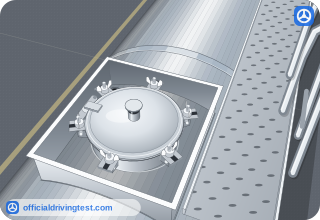
- Always, however little or short
- Only if more than half full
- Only on trips over a mile
Show answer
Correct answer: Always, however little or short
Closed manholes and valves prevent leaks, so they must be shut before every move of a tank with hazardous materials.
Source: CDL manual, national model as printed by New Jersey, Section 9 (July 2017)
-
Under what condition may a cargo tank be moved with its valves or covers open?
- When the trip is only a short one
- When it is empty under the federal rule
- When the load is not flammable
Show answer
Correct answer: When it is empty under the federal rule
Moving a tank with open valves or covers is illegal unless the tank counts as empty under 49 CFR 173.29.
Source: CDL manual, national model as printed by New Jersey, Section 9 (July 2017)
-
When may the engine run while flammable liquids are loaded or unloaded?
- When the weather is cold
- When the tank is nearly full
- When it is needed to run a pump
Show answer
Correct answer: When it is needed to run a pump
The engine is shut off for flammable liquid transfers, except when it powers a pump.
Source: CDL manual, national model as printed by New Jersey, Section 9 (July 2017)
-
When filling a cargo tank through an open filling hole, how long must the tank stay grounded?
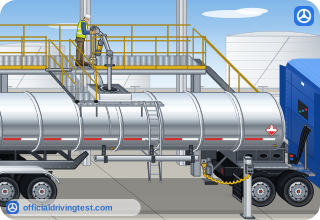
- Until the first gallons have flowed in
- Until the filling hole has been closed
- Until the hose is connected
Show answer
Correct answer: Until the filling hole has been closed
The tank is grounded before the filling hole is opened and stays grounded until the hole is closed again.
Source: CDL manual, national model as printed by New Jersey, Section 9 (July 2017)
-
When may the discharge valves for liquid on a tank of compressed gas be open?
- Only while loading or unloading
- Whenever the engine is running
- While the tank is parked
Show answer
Correct answer: Only while loading or unloading
On a compressed gas tank, the valves that discharge liquid stay closed except during loading and unloading.
Source: CDL manual, national model as printed by New Jersey, Section 9 (July 2017)
-
When loading or unloading compressed gas, what do you do with the engine if it does not power a pump?
- Run it at idle during the transfer
- Turn it off while loading or unloading
- Keep it running until the hose is unhooked
Show answer
Correct answer: Turn it off while loading or unloading
If the engine is not needed to run the transfer pump, it is shut off during loading and unloading.
Source: CDL manual, national model as printed by New Jersey, Section 9 (July 2017)
-
A compressed gas delivery uses a pump driven by your engine. At what point do you shut the engine off?
- After the transfer, before unhooking
- Before the transfer starts
- After you have unhooked the hose
Show answer
Correct answer: After the transfer, before unhooking
The engine may run the pump, but it is shut off once the transfer ends and before the hose is disconnected.
Source: CDL manual, national model as printed by New Jersey, Section 9 (July 2017)
-
What must be done with loading and unloading connections before a cargo tank is coupled, uncoupled or moved?
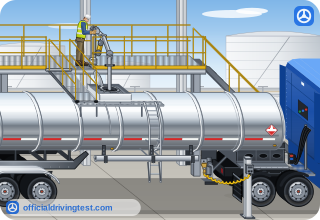
- Disconnect only the vapor line
- Disconnect every connection
- Disconnect after the tank is coupled
Show answer
Correct answer: Disconnect every connection
Every loading and unloading connection is unhooked before the tank is coupled, uncoupled or moved.
Source: CDL manual, national model as printed by New Jersey, Section 9 (July 2017)
-
What must you do to a trailer that is uncoupled from the power unit?
- Leave the landing gear down only
- Park it facing downhill
- Chock it to prevent movement
Show answer
Correct answer: Chock it to prevent movement
An uncoupled trailer or semi-trailer is always chocked so it cannot roll.
Source: CDL manual, national model as printed by New Jersey, Section 9 (July 2017)