Hazardous Materials: Loading and unloading hazardous materials
General loading rules, no smoking, securing packages, and the rules for explosives, corrosives, compressed gases, poisons, radioactive materials and mixed loads. Split into 3 shorter tests so you're not stuck in one long quiz.
Independent educational site · not affiliated with any government agency or DMV
Choose a part
Loading and unloading hazardous materials — Part 1
Questions in this part include: “While loading containers of hazardous materials, which tool should a driver keep out of use?”
Loading and unloading hazardous materials — Part 2
Questions in this part include: “What makes a metal non-ferrous?”
Loading and unloading hazardous materials — Part 3
Questions in this part include: “Corrosive liquids must never be loaded next to or above which of these?”
Questions are written in our own words from the CDL manual; they are not the real test's questions. With your state chosen, every answer gives its page in your state's CDL manual. Without a state, answers cite the CDL manual, national model as printed by New Jersey (July 2017).
All 57 Loading and unloading hazardous materials questions with answers
Choose a part above to take a practice test, or study every question and answer here.
Show the questions and answersHide the questions
1Part 119 questions
-
While loading containers of hazardous materials, which tool should a driver keep out of use?
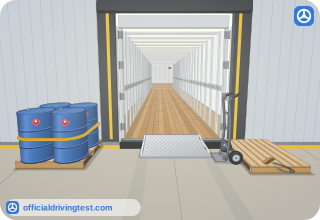
- A hand truck
- A cargo hook
- A loading ramp
Show answer
Correct answer: A cargo hook
Tools that can puncture or tear a container must not be used when loading hazardous materials, and hooks are named as one of them.
Source: CDL manual, national model as printed by New Jersey, Section 9 (July 2017)
-
What should a driver do with the parking brake before hazardous materials are loaded or unloaded?
- Release it so the load can settle
- Set it so the vehicle cannot move
- Leave it as is if the engine is running
Show answer
Correct answer: Set it so the vehicle cannot move
The parking brake is set first so the vehicle cannot roll while the cargo is being handled.
Source: CDL manual, national model as printed by New Jersey, Section 9 (July 2017)
-
Why should hazardous materials be loaded away from heat sources?
- Heat can fade the labels on the packages
- Heat makes the placards hard to read
- Heat can make many products more dangerous
Show answer
Correct answer: Heat can make many products more dangerous
Many hazardous products become more dangerous when they get hot, so they are kept away from anything that gives off heat.
Source: CDL manual, national model as printed by New Jersey, Section 9 (July 2017)
-
A driver notices that one package of hazardous material is leaking before departure. What is the rule?
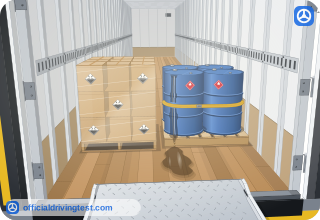
- Do not move the vehicle with it aboard
- Carry it only on short trips
- Carry it if the leak looks small
Show answer
Correct answer: Do not move the vehicle with it aboard
Moving a vehicle that carries a leaking hazardous materials package is illegal, because the driver, the truck and other people could be in danger.
Source: CDL manual, national model as printed by New Jersey, Section 9 (July 2017)
-
What must be done to containers of hazardous materials so the packages do not shift in transit?
- They must be stacked as high as possible
- They must be braced
- They must be loaded last
Show answer
Correct answer: They must be braced
Bracing keeps the packages from moving around while the vehicle is on the road.
Source: CDL manual, national model as printed by New Jersey, Section 9 (July 2017)
-
Smoking is never allowed near which of these loads while it is being loaded or unloaded?
- Class 3 flammable liquids
- Class 8 corrosives
- Class 7 radioactive materials
Show answer
Correct answer: Class 3 flammable liquids
Fire and smoking are kept away from explosives, flammable gas, flammable liquids, flammable solids and oxidizers.
Source: CDL manual, national model as printed by New Jersey, Section 9 (July 2017)
-
Special cargo heater rules apply when loading which of these?
- Class 3 flammable liquids
- Class 5 oxidizers
- Class 4 flammable solids
Show answer
Correct answer: Class 3 flammable liquids
Heater rules apply to explosives, flammable gas and flammable liquids, so oxidizers and flammable solids are not in that group.
Source: CDL manual, national model as printed by New Jersey, Section 9 (July 2017)
-
A helper wants to smoke while oxidizers are being unloaded. What is the correct response?
- Allow it if he stands at the tailgate
- Do not allow smoking anywhere nearby
- Allow it after the first half is unloaded
Show answer
Correct answer: Do not allow smoking anywhere nearby
Oxidizers are on the list of loads around which nobody may smoke during loading or unloading.
Source: CDL manual, national model as printed by New Jersey, Section 9 (July 2017)
-
Which kind of container needs special care during loading because of parts that stick out?
- Containers with flat screw lids
- Containers wrapped in thick plastic
- Containers with valves or fittings
Show answer
Correct answer: Containers with valves or fittings
Valves and other fittings can be damaged or knocked open, so such containers must be loaded very carefully.
Source: CDL manual, national model as printed by New Jersey, Section 9 (July 2017)
-
What should a driver do about the packages once hazardous materials are loaded?
- Open them at stops to check for damage
- Open them to let fumes escape
- Leave every package closed for the whole trip
Show answer
Correct answer: Leave every package closed for the whole trip
After loading, no package is opened during the trip.
Source: CDL manual, national model as printed by New Jersey, Section 9 (July 2017)
-
On the road, a driver wants to pour a hazardous product from a damaged package into a good one. What is the rule?
- Do it only with gloves and a mask on
- Never pour it from one package to another
- Do it only on a flat, level shoulder
Show answer
Correct answer: Never pour it from one package to another
Hazardous materials must never be moved from one package to another during the trip, and loaded packages are not opened.
Source: CDL manual, national model as printed by New Jersey, Section 9 (July 2017)
-
Which container may be emptied while it is still on the vehicle?
- A drum
- A cylinder
- A cargo tank
Show answer
Correct answer: A cargo tank
A cargo tank is the only container that may be emptied on the vehicle. Other packages stay closed and full while aboard.
Source: CDL manual, national model as printed by New Jersey, Section 9 (July 2017)
-
What do the rules usually say about cargo heaters when certain explosives, flammable gas or flammable liquids are carried?
- Heaters may run on low only
- Heaters are required in cold weather
- Heaters are usually forbidden
Show answer
Correct answer: Heaters are usually forbidden
Heaters, even automatic heater and air conditioner units, are usually not allowed in a cargo space holding these products unless the driver has read all the related rules.
Source: CDL manual, national model as printed by New Jersey, Section 9 (July 2017)
-
Which of these loads may not stick out past the end of the vehicle?
- Class 3 flammable liquids
- Class 2.1 flammable gas
- Class 1 explosives
Show answer
Correct answer: Class 1 explosives
Explosives, flammable solids and oxidizers cannot be carried as overhang or tailgate loads.
Source: CDL manual, national model as printed by New Jersey, Section 9 (July 2017)
-
When may Class 4 and Class 5 loads be carried outside a closed cargo space?
- When the whole trip is under 50 miles
- When the placards are clearly displayed
- If packages or a tarp resist fire and water
Show answer
Correct answer: If packages or a tarp resist fire and water
The closed-space rule is waived only if every package resists fire and water, or the load is covered with a tarp that resists both.
Source: CDL manual, national model as printed by New Jersey, Section 9 (July 2017)
-
What should the engine be doing while explosives are loaded or unloaded?
- Idling to keep the heater warm
- Running to power the air brakes
- Turned off
Show answer
Correct answer: Turned off
The engine is switched off before explosives are handled, and then the cargo space is checked.
Source: CDL manual, national model as printed by New Jersey, Section 9 (July 2017)
-
How is a cargo heater made safe before explosives are loaded?
- Turned to its lowest heat setting available
- Disconnected from power and its fuel tank drained
- Wrapped in a thick fire-resistant blanket
Show answer
Correct answer: Disconnected from power and its fuel tank drained
The heater is fully disabled by cutting its power source and emptying its fuel tank.
Source: CDL manual, national model as printed by New Jersey, Section 9 (July 2017)
-
What should a driver look for inside the cargo space before loading explosives?
- Wet floors and loose canvas tarps
- Dust, dirt and old faded placards
- Sharp points such as nails and bolts
Show answer
Correct answer: Sharp points such as nails and bolts
Anything sharp, including bolts, screws, nails and broken panels or floorboards, can damage the packages.
Source: CDL manual, national model as printed by New Jersey, Section 9 (July 2017)
-
What kind of floor liner is needed for Division 1.1, 1.2 or 1.3 explosives?
- Steel plate
- Non-metallic or non-ferrous material
- Any material that contains iron
Show answer
Correct answer: Non-metallic or non-ferrous material
The floor must be tight and lined with non-metallic material or a metal that has no iron in it.
Source: CDL manual, national model as printed by New Jersey, Section 9 (July 2017)
2Part 219 questions
-
What makes a metal non-ferrous?
- It weighs less than plain steel
- It has been painted or coated over
- It has no iron or iron alloys in it
Show answer
Correct answer: It has no iron or iron alloys in it
A non-ferrous metal is one that contains no iron and no iron alloys.
Source: CDL manual, national model as printed by New Jersey, Section 9 (July 2017)
-
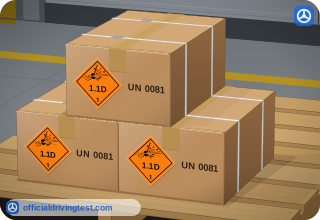
Besides hooks, which hand tools are never used on explosive packages?
- Rubber-headed hand tools
- Metal tools of any kind
- Plastic hand tools
Show answer
Correct answer: Metal tools of any kind
Hooks are not the only thing banned: no metal tools at all may be used on explosives.
Source: CDL manual, national model as printed by New Jersey, Section 9 (July 2017)
-
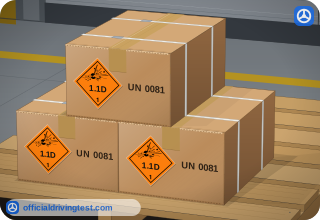
How may packages of explosives be moved during loading?
- Rolled gently across the floor
- Tossed short distances to a helper
- Never dropped, thrown or rolled
Show answer
Correct answer: Never dropped, thrown or rolled
Explosives need extra care, so packages are never dropped, thrown or rolled, and metal tools and hooks are not used on them.
Source: CDL manual, national model as printed by New Jersey, Section 9 (July 2017)
-
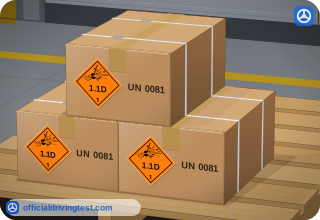
Besides sharp points in the cargo space, what else must explosive packages be protected from?
- Cargo that gives off a strong smell
- Cargo packed in plastic wrap
- Other cargo that might damage them
Show answer
Correct answer: Other cargo that might damage them
Explosive packages are shielded from any other cargo that might harm them.
Source: CDL manual, national model as printed by New Jersey, Section 9 (July 2017)
-
When may Division 1.1, 1.2 or 1.3 explosives be moved between vehicles on a public road?
- Only in an emergency
- Only at night
- Any time the shoulder is wide
Show answer
Correct answer: Only in an emergency
On a public road such explosives are transferred between vehicles only when an emergency makes it necessary for safety.
Source: CDL manual, national model as printed by New Jersey, Section 9 (July 2017)
-
A Division 1.1 load must be moved to another vehicle on a public road because of an emergency. What must the driver do?
- Put out red reflectors or lanterns
- Put out burning flares to warn traffic
- Switch on the four-way flashers only
Show answer
Correct answer: Put out red reflectors or lanterns
Such a transfer is allowed on a public road only in an emergency, and the driver must warn other road users with red reflectors, flags or electric lanterns.
Source: CDL manual, national model as printed by New Jersey, Section 9 (July 2017)
-
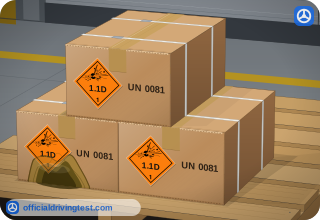
A package of explosives has an oily stain on it. What should the driver do?
- Refuse to take it
- Wipe it and load it at the back
- Load it next to the door
Show answer
Correct answer: Refuse to take it
Damaged explosive packages are never carried, and dampness or an oily stain counts as a warning sign.
Source: CDL manual, national model as printed by New Jersey, Section 9 (July 2017)
-
When may Division 1.1 or 1.2 explosives NOT be hauled in a vehicle combination?
- When one trailer is a dry van
- When a placarded cargo tank is in it
- When the combination has three axles
Show answer
Correct answer: When a placarded cargo tank is in it
A marked or placarded cargo tank anywhere in the combination rules out carrying Division 1.1 or 1.2 explosives.
Source: CDL manual, national model as printed by New Jersey, Section 9 (July 2017)
-
Which load in the other vehicle of a combination rules out carrying Division 1.1 or 1.2 explosives?
- Division 1.4 small explosives
- Class 9 miscellaneous goods
- Division 1.1 A explosives
Show answer
Correct answer: Division 1.1 A explosives
Division 1.1 and 1.2 may not ride in a combination if the other vehicle holds Division 1.1 A initiating explosives.
Source: CDL manual, national model as printed by New Jersey, Section 9 (July 2017)
-
Division 1.1 or 1.2 explosives may not share a combination with which other load?
- Empty returnable pallets
- Class 9 miscellaneous goods
- Class 7 Yellow III packages
Show answer
Correct answer: Class 7 Yellow III packages
If the other vehicle in the combination holds Class 7 packages with the Yellow III label, explosives of Division 1.1 or 1.2 cannot be carried.
Source: CDL manual, national model as printed by New Jersey, Section 9 (July 2017)
-
Division 1.1 or 1.2 explosives may not be hauled in a combination whose other vehicle carries which load?
- Division 2.3 gas, Hazard zone A or B
- Division 2.2 non-flammable gas
- Class 3 flammable liquids in drums
Show answer
Correct answer: Division 2.3 gas, Hazard zone A or B
Poison gas of Hazard zone A or B in the other vehicle rules out Division 1.1 or 1.2 explosives. So does Division 6.1 poison of Hazard zone A.
Source: CDL manual, national model as printed by New Jersey, Section 9 (July 2017)
-
What describes Class 4 flammable solids?
- Gases stored under high pressure
- Liquids that give off heavy fumes
- Solids that react to water or heat
Show answer
Correct answer: Solids that react to water or heat
Class 4 materials are solids that can react, even to the point of fire or explosion, when exposed to water, heat or air, or on their own.
Source: CDL manual, national model as printed by New Jersey, Section 9 (July 2017)
-
If a Class 4 or 5 product turns dangerous when wet, what must be done during loading, unloading and the trip?
- Keep it cold
- Keep it dry
- Keep it ventilated by opening the doors
Show answer
Correct answer: Keep it dry
A product that becomes unstable when wet must stay dry at all times, from loading until it is unloaded.
Source: CDL manual, national model as printed by New Jersey, Section 9 (July 2017)
-
What kind of vehicle must carry materials that can heat up or catch fire on their own?
- A vehicle with sealed airtight walls
- A vehicle with enough ventilation
- A vehicle with a refrigeration unit
Show answer
Correct answer: A vehicle with enough ventilation
Materials prone to spontaneous heating or combustion need a vehicle that has sufficient ventilation.
Source: CDL manual, national model as printed by New Jersey, Section 9 (July 2017)
-
How should breakable containers of corrosive liquid be loaded by hand?
- Two at a time, on their sides
- One by one, right side up
- In a pile, then braced
Show answer
Correct answer: One by one, right side up
Each breakable corrosive container is handled alone and kept upright, never dropped or rolled.
Source: CDL manual, national model as printed by New Jersey, Section 9 (July 2017)
-
On what kind of surface should breakable containers of corrosive liquid be loaded?
- An even floor
- A stack of pallets
- A sloped floor
Show answer
Correct answer: An even floor
Breakable corrosive containers go onto an even floor, and they are never dropped or rolled.
Source: CDL manual, national model as printed by New Jersey, Section 9 (July 2017)
-
Under what condition may carboys be stacked in tiers?
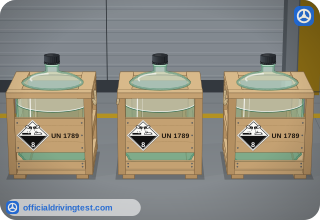
- When the upper tiers are all empty
- When the carboys are strapped together
- When the lower tiers can bear the load
Show answer
Correct answer: When the lower tiers can bear the load
Carboys may be stacked only when the lower layers are strong enough to carry the layers above them without damage.
Source: CDL manual, national model as printed by New Jersey, Section 9 (July 2017)
-
Where may nitric acid NOT be placed in a load?
- Above any other product
- Beside other cargo
- Under any other product
Show answer
Correct answer: Above any other product
Nitric acid must never be loaded above any other product.
Source: CDL manual, national model as printed by New Jersey, Section 9 (July 2017)
-
What must a driver make sure of when loading charged storage batteries?
- That they lie flat so they stay low in the truck
- That they stay upright and are not hit by cargo
- That they are covered with a thin metal sheet
Show answer
Correct answer: That they stay upright and are not hit by cargo
Batteries are kept upright so the liquid cannot spill, and other cargo must not fall on them and cause a short circuit.
Source: CDL manual, national model as printed by New Jersey, Section 9 (July 2017)
3Part 319 questions
-
Corrosive liquids must never be loaded next to or above which of these?
- Division 4.3 Dangerous When Wet materials
- Class 9 miscellaneous hazardous goods
- Class 7 radioactive material packages
Show answer
Correct answer: Division 4.3 Dangerous When Wet materials
Corrosive liquids must never go beside or above Divisions 1.4, 4.1 or 4.3, Class 5, or Division 2.3 Zone B poisonous gases.
Source: CDL manual, national model as printed by New Jersey, Section 9 (July 2017)
-
Which of these may never be loaded in the same vehicle with corrosive liquids?
- Division 1.5 blasting agents
- Division 1.4 explosives
- Division 4.1 flammable solids
Show answer
Correct answer: Division 1.5 blasting agents
Blasting agents are on the list of materials that cannot ride with corrosive liquids at all. Divisions 1.4 and 4.1 are only barred from being next to or below them.
Source: CDL manual, national model as printed by New Jersey, Section 9 (July 2017)
-
Which of these may never be loaded in the same vehicle with corrosive liquids?
- Division 4.2 combustible materials
- Class 9 miscellaneous hazardous goods
- Class 7 radioactive material packages
Show answer
Correct answer: Division 4.2 combustible materials
Spontaneously combustible materials of Division 4.2 are on the list of loads that cannot ride with corrosive liquids.
Source: CDL manual, national model as printed by New Jersey, Section 9 (July 2017)
-
A vehicle has no racks for gas cylinders. What must be true of the cargo space?
- The floor must slope toward the doors
- The floor must be flat
- The walls must be padded
Show answer
Correct answer: The floor must be flat
Without racks, the cargo space floor must be flat.
Source: CDL manual, national model as printed by New Jersey, Section 9 (July 2017)
-
How may compressed gas cylinders be held upright in a vehicle?
- Tied loosely with rope or cord
- Leaned against the cargo space wall
- In vehicle racks or tip-proof boxes
Show answer
Correct answer: In vehicle racks or tip-proof boxes
Cylinders must stay upright, either in racks fixed to the vehicle or in boxes that stop them tipping over.
Source: CDL manual, national model as printed by New Jersey, Section 9 (July 2017)
-
When may a gas cylinder be loaded lying down?
- When it makes up less than half the load
- When it is chained down at both ends
- If its relief valve sits in the vapor space
Show answer
Correct answer: If its relief valve sits in the vapor space
A cylinder may lie on its side only if its design keeps the relief valve in the vapor space.
Source: CDL manual, national model as printed by New Jersey, Section 9 (July 2017)
-
Which kind of container must never be used to carry poisonous gas or poisonous materials?
- A container with a pressure gauge
- A container with a double wall
- A container with interconnections
Show answer
Correct answer: A container with interconnections
Containers that are connected to each other are not allowed for Division 2.3 or 6.1 materials.
Source: CDL manual, national model as printed by New Jersey, Section 9 (July 2017)
-
Where must a package with a POISON label never be placed?
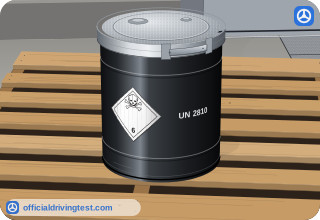
- In the cargo space near the doors
- In the driver's cab or sleeper
- In a tank trailer
Show answer
Correct answer: In the driver's cab or sleeper
Poison packages stay out of the cab and the sleeper, and also away from food meant for people or animals.
Source: CDL manual, national model as printed by New Jersey, Section 9 (July 2017)
-
Which cargo is not allowed in the same vehicle as a POISON or POISON INHALATION HAZARD package?
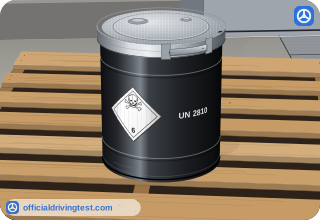
- Mouthwash and skin creams
- Food for people or animals
- Spare tires and hand tools
Show answer
Correct answer: Food for people or animals
Poison packages must not be loaded with anything meant to be eaten by people or animals, unless the poison is overpacked in an approved way.
Source: CDL manual, national model as printed by New Jersey, Section 9 (July 2017)
-
What is needed to load or unload Class 2 materials in cargo tanks?
- A second driver on site
- Special training
- A written note from the shipper
Show answer
Correct answer: Special training
Class 2 materials in cargo tanks follow special loading and unloading rules, and the driver needs special training for them.
Source: CDL manual, national model as printed by New Jersey, Section 9 (July 2017)
-
Where do the shipper's transport index numbers for Class 7 packages appear?
- On the shipping paper and nowhere else
- On the Radioactive II or III label
- On the vehicle's outside placard
Show answer
Correct answer: On the Radioactive II or III label
The shipper prints the transport index on the package label, which reads Radioactive II or Radioactive III.
Source: CDL manual, national model as printed by New Jersey, Section 9 (July 2017)
-
Radiation passes through nearby packages. What is controlled for Class 7 packages loaded together?
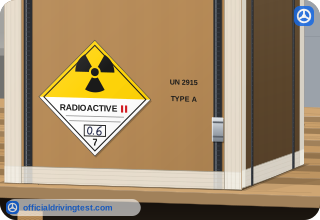
- How many packages may be loaded together
- How fast the vehicle may travel
- Which side of the cargo space they use
Show answer
Correct answer: How many packages may be loaded together
The number of radioactive packages loaded together is limited, and so is how close they are to people, animals and unexposed film.
Source: CDL manual, national model as printed by New Jersey, Section 9 (July 2017)
-
What does the transport index of a radioactive package tell the driver?
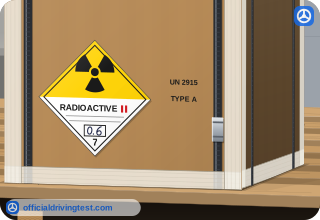
- How heavy the package is when it is full
- How much control is needed while it travels
- How many hours it may stay on the vehicle
Show answer
Correct answer: How much control is needed while it travels
The index shows how strictly the number of packages and their distance from people, animals and film must be controlled.
Source: CDL manual, national model as printed by New Jersey, Section 9 (July 2017)
-
What is the highest total transport index allowed for all radioactive packages in one vehicle?
- 10
- 100
- 50
Show answer
Correct answer: 50
The transport indexes of all the packages on one vehicle are added up, and the sum may not go above 50.
Source: CDL manual, national model as printed by New Jersey, Section 9 (July 2017)
-
A radioactive package has a transport index of 1.1. How close may it be left to people or the cargo space walls?
- No closer than two feet
- No closer than six inches
- Right against the wall if it is braced
Show answer
Correct answer: No closer than two feet
A package rated 1.1 on the transport index must stay at least two feet away from people and from the walls of the cargo space.
Source: CDL manual, national model as printed by New Jersey, Section 9 (July 2017)
-
Charged storage batteries may not be loaded in the same vehicle with which explosives?
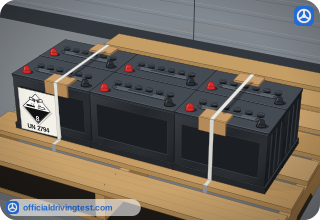
- Division 1.4 explosives
- Division 1.5 blasting agents
- Division 1.1 explosives
Show answer
Correct answer: Division 1.1 explosives
The Do Not Load table bars charged storage batteries from sharing a vehicle with Division 1.1.
Source: CDL manual, national model as printed by New Jersey, Section 9 (July 2017)
-
When may Class 1 detonating primers share a vehicle with other explosives?
- Only in authorized packages
- Only if the primers sit on top
- Only if the trip is by daytime
Show answer
Correct answer: Only in authorized packages
Detonating primers may not be loaded with any other explosives unless they are in authorized containers or packages.
Source: CDL manual, national model as printed by New Jersey, Section 9 (July 2017)
-
Cyanides and cyanide mixtures may not be loaded in the same vehicle with which cargo?
- Class 2.2 non-flammable gases
- Acids and acidic materials
- Class 9 miscellaneous goods
Show answer
Correct answer: Acids and acidic materials
Division 6.1 cyanides must be kept away from acids and acidic or corrosive materials that could release hydrocyanic acid.
Source: CDL manual, national model as printed by New Jersey, Section 9 (July 2017)
-
Besides the examples in the manual's table, where are other materials that must be kept apart named?
- The Hazardous Materials Table
- The vehicle's annual inspection record
- The Segregation Table
Show answer
Correct answer: The Segregation Table
The Segregation Table for Hazardous Materials names the other products that must be kept apart in a load.
Source: CDL manual, national model as printed by New Jersey, Section 9 (July 2017)
-
Only in Arizona's manual
A combination carries Division 1.1 or 1.2 explosives. Which load must the other vehicle in the combination not contain?
- Division 2.2 non-flammable gas
- Division 2.3 or Division 6.1 poisons
- Class 9 miscellaneous materials
Show answer
Correct answer: Division 2.3 or Division 6.1 poisons
Division 1.1 or 1.2 explosives may not travel in a combination whose other vehicle holds a Division 2.3 poison gas or a Division 6.1 poison.
Source: CDL manual, national model as printed by New Jersey, Section 9 (July 2017)