Hazardous Materials: Exam simulator
40 random questions from every topic of this test, like a mini exam.
Independent educational site · not affiliated with any government agency or DMV
Ready? Test yourself
40 questions in this practice test; pass mark 80%, as on the real test.
- Instant feedback with an explanation
- Every answer cites its source in the manual
- Your best score is saved on this device
- Keyboard: press 1 to 3 to answer and Enter for the next question
Questions are written in our own words from the CDL manual; they are not the real test's questions. With your state chosen, every answer gives its page in your state's CDL manual. Without a state, answers cite the CDL manual, national model as printed by New Jersey (July 2017).
Sample questions
The exam simulator picks 40 random questions from every topic each time you start. Here are a few examples.
Show the questions and answersHide the questions
-
What makes a product a hazardous material?
- It is carried in a tank of any size or kind
- It poses a risk to health, safety and property
- It is shipped by more than one carrier
Show answer
Correct answer: It poses a risk to health, safety and property
Hazardous materials are products that can endanger health, safety and property while being transported.
Source: CDL manual, national model as printed by New Jersey, Section 9 (July 2017)
-
What does a material's hazard class tell you about it?
- The name its shipper uses on the papers
- The order it is listed in the table
- The risks that go with the material
Show answer
Correct answer: The risks that go with the material
A material's hazard class shows the risks that come with it.
Source: CDL manual, national model as printed by New Jersey, Section 9 (July 2017)
-
A hazardous materials shipping paper runs longer than one page. What must its first page show?
- How many pages the whole paper has
- The weight of the whole load in pounds
- The names of every carrier on the route
Show answer
Correct answer: How many pages the whole paper has
Pages are numbered, and page one gives the page count, such as 1 of 4, so a reader can tell whether any page is missing.
Source: CDL manual, national model as printed by New Jersey, Section 9 (July 2017)
-
When must the correct placards be attached to the vehicle?
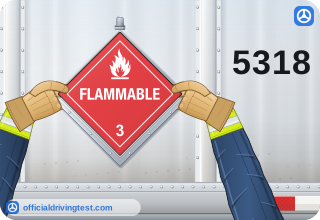
- Before you drive the vehicle
- Before you unload at the first stop
- After the load passes inspection
Show answer
Correct answer: Before you drive the vehicle
The right placards go on before the vehicle moves, not later on the trip.
Source: CDL manual, national model as printed by New Jersey, Section 9 (July 2017)
-
While loading containers of hazardous materials, which tool should a driver keep out of use?
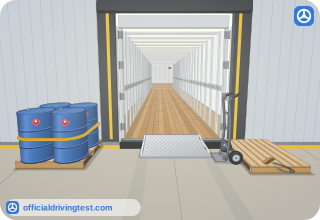
- A hand truck
- A cargo hook
- A loading ramp
Show answer
Correct answer: A cargo hook
Tools that can puncture or tear a container must not be used when loading hazardous materials, and hooks are named as one of them.
Source: CDL manual, national model as printed by New Jersey, Section 9 (July 2017)
-
What separates a cargo tank from a portable tank?
- A cargo tank holds only liquids; a portable tank holds only gases.
- A cargo tank is permanently attached to the vehicle; a portable tank is not.
- A cargo tank is filled off the vehicle; a portable tank is filled on it.
Show answer
Correct answer: A cargo tank is permanently attached to the vehicle; a portable tank is not.
A cargo tank is fixed to the vehicle and stays on it during loading. A portable tank is filled or emptied off the vehicle and then placed on one for the trip.
Source: CDL manual, national model as printed by New Jersey, Section 9 (July 2017)
-
A truck hauling Division 1.1, 1.2, or 1.3 explosives is never to be parked close to the traveled part of the road. What distance does the rule name?
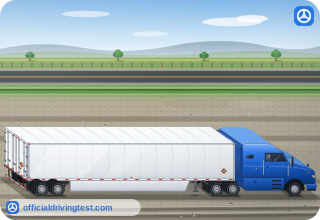
- Twenty feet
- Fifty feet
- Five feet
Show answer
Correct answer: Five feet
Explosives of these divisions must not be parked within five feet of the traveled road surface.
Source: CDL manual, national model as printed by New Jersey, Section 9 (July 2017)
-
How can a firefighter look up a product in the Emergency Response Guidebook?
- By the carrier's name and the truck's license plate
- By the proper shipping name or the identification number
- By the color of the placard and the size of the package
Show answer
Correct answer: By the proper shipping name or the identification number
Responders look up the product by its proper shipping name or its identification number, taken from the shipping paper, so those must be right.
Source: CDL manual, national model as printed by New Jersey, Section 9 (July 2017)