Hazardous Materials: Driving and parking with hazardous materials — Part 3
Questions in this part include: “You stop on the shoulder to change a tire on a placarded truck. Do the rules for parking and attending it still apply?” · “What must an explosives driver do when the carrier hands over the required documents?”
Independent educational site · not affiliated with any government agency or DMV
Ready? Test yourself
Answer to start, or tap Start below:
A shipper hands you a hazardous materials load but no shipping paper. What should you do?
- Instant feedback with an explanation
- Every answer cites its source in the manual
- Your best score is saved on this device
- Keyboard: press 1 to 3 to answer and Enter for the next question
Questions are written in our own words from the CDL manual; they are not the real test's questions. With your state chosen, every answer gives its page in your state's CDL manual. Without a state, answers cite the CDL manual, national model as printed by New Jersey (July 2017).
All 19 questions in this practice test
Take the test above first, then use this list to study. Tap “Show answer” to see the correct answer and explanation.
Show the questions and answersHide the questions
-
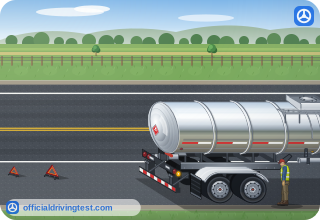
You stop on the shoulder to change a tire on a placarded truck. Do the rules for parking and attending it still apply?
- No, they apply to long-term parking only
- Only if the tire is on a trailer
- Yes, they still apply during tire work
Show answer
Correct answer: Yes, they still apply during tire work
The parking and attendance rules for placarded vehicles remain in force during any tire check, repair or change.
Source: CDL manual, national model as printed by New Jersey, Section 9 (July 2017)
-
A shipper hands you a hazardous materials load but no shipping paper. What should you do?
- Refuse it until a paper is prepared
- Take it and get the paper at delivery
- Take it if the packages are labeled
Show answer
Correct answer: Refuse it until a paper is prepared
A hazardous materials shipment must not be accepted without a properly prepared shipping paper.
Source: CDL manual, national model as printed by New Jersey, Section 9 (July 2017)
-
How can you make hazmat shipping papers stand out from your other papers?
- Put them in the bottom of the pile with a clip
- Store them in a separate envelope in the sleeper
- Tab them or keep them on top of the pile
Show answer
Correct answer: Tab them or keep them on top of the pile
Marking the hazmat papers with tabs, or placing them at the top of the pile, lets others find them quickly, for example after a crash.
Source: CDL manual, national model as printed by New Jersey, Section 9 (July 2017)
-
While you are at the wheel, where must hazmat shipping papers be kept?
- Within reach while belted in, or in the door pouch
- In the sleeper berth, where they are protected
- In a locked box at the rear of the trailer
Show answer
Correct answer: Within reach while belted in, or in the door pouch
The papers must be reachable while you are belted in, or sit in the driver's door pouch, and anyone entering the cab must be able to see them easily.
Source: CDL manual, national model as printed by New Jersey, Section 9 (July 2017)
-
Which rule applies to where hazmat shipping papers are placed in the cab?
- They must be kept in a sealed envelope
- They must be easy to see on entering
- They must be filed behind the other papers
Show answer
Correct answer: They must be easy to see on entering
Shipping papers must be placed where a person entering the cab can see them easily.
Source: CDL manual, national model as printed by New Jersey, Section 9 (July 2017)
-
When you leave the driver's seat, where should the hazmat shipping papers be left?
- On the dashboard, facing the windshield
- In the glove box, out of sight
- In the door pouch or on the seat
Show answer
Correct answer: In the door pouch or on the seat
Away from the wheel, the papers go in the pouch on the driver's door or on the seat, so other people can find them quickly after a crash.
Source: CDL manual, national model as printed by New Jersey, Section 9 (July 2017)
-
Where must the emergency response information for a hazmat load be kept?
- In the trailer's cargo area
- With the carrier's office records
- With the shipping paper
Show answer
Correct answer: With the shipping paper
Emergency response information goes in the same place as the shipping paper, so both are found together.
Source: CDL manual, national model as printed by New Jersey, Section 9 (July 2017)
-
Which copy must a carrier hand to a driver hauling Division 1.1, 1.2 or 1.3 explosives?
- The Federal Motor Carrier Safety Regulations, Part 391
- The Federal Motor Carrier Safety Regulations, Part 397
- The Federal Motor Carrier Safety Regulations, Part 383
Show answer
Correct answer: The Federal Motor Carrier Safety Regulations, Part 397
Drivers of these explosives receive a copy of Part 397 of the Federal Motor Carrier Safety Regulations, together with written instructions for delays or accidents.
Source: CDL manual, national model as printed by New Jersey, Section 9 (July 2017)
-
Written instructions for an explosives driver in case of delay or accident must say what about emergencies?
- What to do in a fire, accident or leak
- Which repair shops to use
- How to bill the shipper for losses
Show answer
Correct answer: What to do in a fire, accident or leak
The instructions list who to contact, what the explosives are, and the precautions for fires, accidents and leaks.
Source: CDL manual, national model as printed by New Jersey, Section 9 (July 2017)
-
What must an explosives driver do when the carrier hands over the required documents?
- Mail a copy to the shipper
- Sign a receipt for them
- Leave them at the terminal
Show answer
Correct answer: Sign a receipt for them
The driver signs a receipt for the documents and must then know them and carry them while driving.
Source: CDL manual, national model as printed by New Jersey, Section 9 (July 2017)
-
Which item must an explosives driver carry while driving, besides the shipping papers and written emergency instructions?
- A copy of the driver's medical records
- A list of every nearby safe haven
- A written route plan
Show answer
Correct answer: A written route plan
While driving with these explosives you carry the shipping papers, the written emergency instructions, the written route plan and a copy of Part 397.
Source: CDL manual, national model as printed by New Jersey, Section 9 (July 2017)
-
What must a driver hauling chlorine in cargo tanks keep in the vehicle?
- An approved gas mask
- A portable eyewash station
- A second fire extinguisher
Show answer
Correct answer: An approved gas mask
Chlorine tank drivers need an approved gas mask in the vehicle, plus a kit for controlling leaks in the dome cover plate fittings.
Source: CDL manual, national model as printed by New Jersey, Section 9 (July 2017)
-
A chlorine tank driver must carry an emergency kit to control leaks at which place?
- The vehicle's fuel line fittings and hoses
- The dome cover plate fittings
- The bottom drain valve of the tank
Show answer
Correct answer: The dome cover plate fittings
The kit is meant for leaks in the fittings of the dome cover plate on the cargo tank.
Source: CDL manual, national model as printed by New Jersey, Section 9 (July 2017)
-
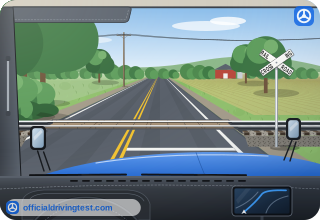
Does a placarded vehicle have to stop before a railroad crossing?
- Yes, it must stop
- Only if a train is in sight
- Only if the crossing has no gates
Show answer
Correct answer: Yes, it must stop
A placarded vehicle must always stop before a railroad crossing, whatever the signals show.
Source: CDL manual, national model as printed by New Jersey, Section 9 (July 2017)
-
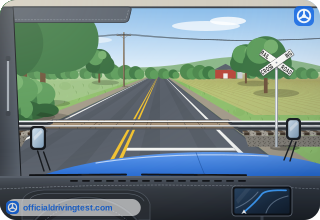
Your unplacarded truck carries a small amount of chlorine. Must you stop before a railroad crossing?
- Yes, any amount of chlorine requires a stop
- No, only a full load requires a stop
- No, if the crossing has flashing lights
Show answer
Correct answer: Yes, any amount of chlorine requires a stop
Carrying any amount of chlorine means you must stop before a railroad crossing.
Source: CDL manual, national model as printed by New Jersey, Section 9 (July 2017)
-
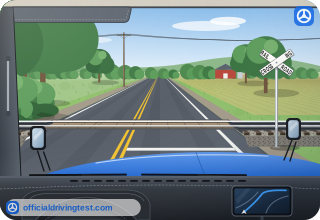
Your cargo tank for hazardous materials is empty. Do you still stop before a railroad crossing?
- Yes, loaded or empty, the stop is required
- No, an empty tank needs no stop
- Only if the tank was last loaded with gas
Show answer
Correct answer: Yes, loaded or empty, the stop is required
Cargo tanks used for hazardous materials must stop at railroad crossings whether they are loaded or empty.
Source: CDL manual, national model as printed by New Jersey, Section 9 (July 2017)
-
Where must a hazmat vehicle stop for a railroad crossing?
- 5 to 15 feet from the nearest rail
- 50 to 100 feet short of the nearest rail
- 15 to 50 feet short of the nearest rail
Show answer
Correct answer: 15 to 50 feet short of the nearest rail
The stop is made between 15 and 50 feet short of the first rail.
Source: CDL manual, national model as printed by New Jersey, Section 9 (July 2017)
-
After stopping at a railroad crossing in a placarded truck, when may you go across?
- When the crossing signals have turned off
- As soon as the vehicle ahead has fully crossed
- When no train is near and you can clear the tracks
Show answer
Correct answer: When no train is near and you can clear the tracks
Cross only when no train is coming and you can get completely over the tracks without having to stop on them.
Source: CDL manual, national model as printed by New Jersey, Section 9 (July 2017)
-
What should you avoid doing while your hazmat vehicle is on railroad tracks?
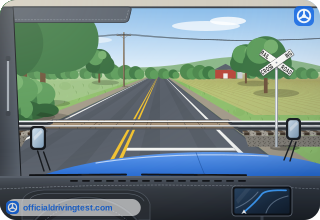
- Using the horn
- Turning on the hazard lights
- Changing gears
Show answer
Correct answer: Changing gears
Gears must not be shifted while the vehicle is crossing the tracks.
Source: CDL manual, national model as printed by New Jersey, Section 9 (July 2017)