Hazardous Materials: Driving and parking with hazardous materials — Part 2
Questions in this part include: “Some local areas ban hazardous materials in tunnels or on bridges. When should you check this?” · “What is the closest you may smoke to a placarded cargo tank that carries flammable liquids?”
Independent educational site · not affiliated with any government agency or DMV
Ready? Test yourself
Answer to start, or tap Start below:
Your vehicle is placarded and another road exists that is longer but avoids crowds and tunnels. What should you do?
- Instant feedback with an explanation
- Every answer cites its source in the manual
- Your best score is saved on this device
- Keyboard: press 1 to 3 to answer and Enter for the next question
Questions are written in our own words from the CDL manual; they are not the real test's questions. With your state chosen, every answer gives its page in your state's CDL manual. Without a state, answers cite the CDL manual, national model as printed by New Jersey (July 2017).
All 19 questions in this practice test
Take the test above first, then use this list to study. Tap “Show answer” to see the correct answer and explanation.
Show the questions and answersHide the questions
-
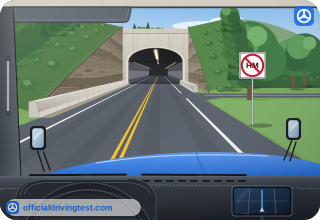
Some local areas ban hazardous materials in tunnels or on bridges. When should you check this?
- Only when crossing a state line
- Always, before you start
- Only when the load is explosives
Show answer
Correct answer: Always, before you start
Local bans can apply to tunnels, bridges and other roads, so check for them before every trip.
Source: CDL manual, national model as printed by New Jersey, Section 9 (July 2017)
-
Your vehicle is placarded and another road exists that is longer but avoids crowds and tunnels. What should you do?
- Take the shorter route through town
- Use the tunnel but drive slowly now
- Take the longer road, though inconvenient
Show answer
Correct answer: Take the longer road, though inconvenient
A placarded vehicle should stay away from crowded areas, tunnels, and tight streets, even on a less convenient route, unless there is no other way.
Source: CDL manual, national model as printed by New Jersey, Section 9 (July 2017)
-
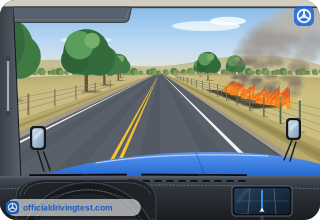
When may a placarded vehicle be driven near an open fire?
- When the fire is small and attended
- When you have slowed to a crawl
- When you can pass safely without stopping
Show answer
Correct answer: When you can pass safely without stopping
Drive near an open fire only if you can get past safely without having to stop.
Source: CDL manual, national model as printed by New Jersey, Section 9 (July 2017)
-
What must a driver have in hand when hauling Division 1.1, 1.2, or 1.3 explosives?
- A written route plan, which the driver follows
- A verbal route agreement with the shipper
- A map marked by the dispatcher
Show answer
Correct answer: A written route plan, which the driver follows
The explosives driver must carry a written route plan and keep to it.
Source: CDL manual, national model as printed by New Jersey, Section 9 (July 2017)
-
On an explosives trip, who normally prepares the route plan and what does the driver receive?
- The driver writes it at the delivery site
- The shipper mails it after the trip starts
- The carrier prepares it ahead and gives a copy
Show answer
Correct answer: The carrier prepares it ahead and gives a copy
The carrier normally prepares the plan in advance and hands the driver a copy, which the driver carries during the trip.
Source: CDL manual, national model as printed by New Jersey, Section 9 (July 2017)
-
When may an explosives driver plan the route personally instead of getting a plan from the carrier?
- The trip is shorter than one hundred miles
- The load was picked up away from the terminal
- The delivery is in the same state as pickup
Show answer
Correct answer: The load was picked up away from the terminal
If the explosives are picked up somewhere other than the employer's terminal, the driver may write the route plan in advance.
Source: CDL manual, national model as printed by New Jersey, Section 9 (July 2017)
-
Where or to whom may a driver deliver a shipment of explosives?
- To authorized persons, or into a locked explosives room
- To any adult found at the delivery address
- To anyone holding a copy of the shipping papers
Show answer
Correct answer: To authorized persons, or into a locked explosives room
Explosives go only to authorized people or into locked rooms designed to store them.
Source: CDL manual, national model as printed by New Jersey, Section 9 (July 2017)
-
For placarded radioactive materials, who must choose the safest route?
- The driver
- The shipper
- The carrier
Show answer
Correct answer: The carrier
The carrier picks the safest route, then tells the driver about the radioactive materials and shows the route plan.
Source: CDL manual, national model as printed by New Jersey, Section 9 (July 2017)
-
After a carrier picks a route for placarded radioactive materials, what must it do for the driver?
- Tell the driver about the materials and show the route plan
- Send the route plan to the shipper, not the driver
- Have the driver choose the route without the carrier
Show answer
Correct answer: Tell the driver about the materials and show the route plan
The carrier must inform the driver about the radioactive cargo and show the planned route.
Source: CDL manual, national model as printed by New Jersey, Section 9 (July 2017)
-
What is the closest you may smoke to a placarded cargo tank that carries flammable liquids?
- 10 feet away
- 50 feet away
- 25 feet away
Show answer
Correct answer: 25 feet away
Smoking is not allowed within 25 feet of a placarded tank carrying flammable liquids or flammable gases.
Source: CDL manual, national model as printed by New Jersey, Section 9 (July 2017)
-
You carry a load of Class 5 oxidizers. May someone stand 10 feet from your truck holding a lit pipe?
- Yes, as long as it is not inside the cab
- No, a lit pipe must stay at least 25 feet away
- Yes, if the engine is switched off
Show answer
Correct answer: No, a lit pipe must stay at least 25 feet away
A lighted cigarette, cigar or pipe must be kept at least 25 feet from a vehicle carrying oxidizers, and the same goes for explosives, flammable liquids, flammable solids and spontaneously combustible materials.
Source: CDL manual, national model as printed by New Jersey, Section 9 (July 2017)
-
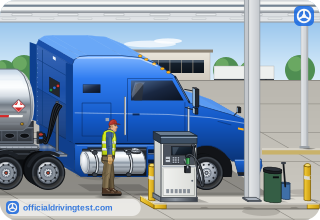
What must you do with the engine before putting fuel into a vehicle that is carrying hazardous materials?
- Switch it off
- Leave it idling at low speed
- Keep it running if someone holds the nozzle
Show answer
Correct answer: Switch it off
The engine must be off while fueling a vehicle that carries hazardous materials. Someone must also stay at the nozzle controlling the fuel flow.
Source: CDL manual, national model as printed by New Jersey, Section 9 (July 2017)
-
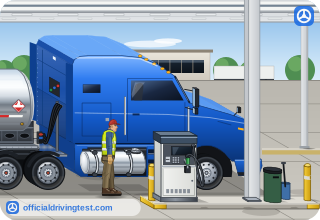
While a hazmat vehicle is being fueled, who has to be at the nozzle?
- Nobody, if the nozzle has an automatic shut-off
- Someone, who controls the fuel flow the whole time
- Only the shipper's representative
Show answer
Correct answer: Someone, who controls the fuel flow the whole time
A person must stay at the nozzle during the whole fueling and control how the fuel flows. The nozzle must never be left running unattended.
Source: CDL manual, national model as printed by New Jersey, Section 9 (July 2017)
-
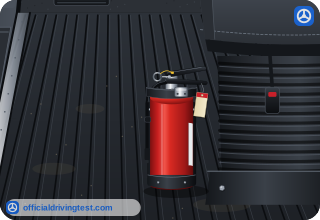
What is the minimum UL rating of the fire extinguisher on the power unit of a placarded vehicle?
- 5 B:C
- 20 B:C
- 10 B:C
Show answer
Correct answer: 10 B:C
A placarded vehicle's power unit needs an extinguisher rated at least 10 B:C. A higher rating also meets the requirement.
Source: CDL manual, national model as printed by New Jersey, Section 9 (July 2017)
-
When must you look at each tire of a vehicle that carries hazardous materials?
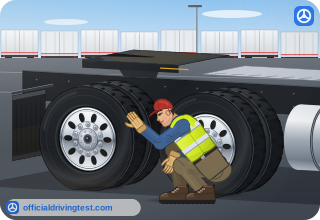
- At the start of each trip and every time you park
- Only at the start of the day's first trip
- Only when a tire seems low while driving
Show answer
Correct answer: At the start of each trip and every time you park
Every tire must be examined when a trip begins and again each time the vehicle is parked.
Source: CDL manual, national model as printed by New Jersey, Section 9 (July 2017)
-
Which method is acceptable for checking how much air is in a tire?
- Tapping the tire with a tool and listening
- Reading a tire pressure gauge
- Looking at how much the tire bulges
Show answer
Correct answer: Reading a tire pressure gauge
Only a tire pressure gauge gives an acceptable pressure check. Looking at or hitting the tire does not.
Source: CDL manual, national model as printed by New Jersey, Section 9 (July 2017)
-
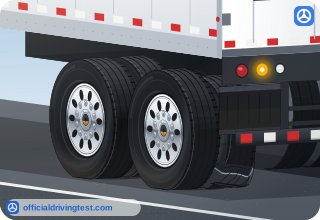
One tire on your hazmat truck is flat. How far may you drive on it?
- To the next scheduled delivery stop
- Not at all, even for a short distance
- Only to the nearest safe place to repair it
Show answer
Correct answer: Only to the nearest safe place to repair it
A leaking or flat tire may be driven on only far enough to reach the nearest safe spot for repair.
Source: CDL manual, national model as printed by New Jersey, Section 9 (July 2017)
-
What should be done with a tire that has overheated on a hazmat vehicle?
- Pour water on it and keep driving
- Remove it and set it well away from the truck
- Leave it on and let it cool while loaded
Show answer
Correct answer: Remove it and set it well away from the truck
An overheated tire is removed and put a safe distance from the vehicle. You must also find and fix the cause of the overheating before driving on.
Source: CDL manual, national model as printed by New Jersey, Section 9 (July 2017)
-
After an overheated tire has been taken off, when may you drive again?
- Once the tire has cooled for an hour
- Right away, if the spare tire is fitted
- After the cause is corrected
Show answer
Correct answer: After the cause is corrected
Driving must wait until the cause of the overheating has been corrected.
Source: CDL manual, national model as printed by New Jersey, Section 9 (July 2017)