Hazardous Materials: Driving and parking with hazardous materials — Part 1
Questions in this part include: “Your job forces you to stop with a load of Division 1.1 explosives. How long should the stop last?” · “A person who attends a parked placarded vehicle from inside it must be where and in what state?”
Independent educational site · not affiliated with any government agency or DMV
Ready? Test yourself
Answer to start, or tap Start below:
You park a vehicle loaded with Division 1.1 explosives. Who must keep watch over it?
- Instant feedback with an explanation
- Every answer cites its source in the manual
- Your best score is saved on this device
- Keyboard: press 1 to 3 to answer and Enter for the next question
Questions are written in our own words from the CDL manual; they are not the real test's questions. With your state chosen, every answer gives its page in your state's CDL manual. Without a state, answers cite the CDL manual, national model as printed by New Jersey (July 2017).
All 20 questions in this practice test
Take the test above first, then use this list to study. Tap “Show answer” to see the correct answer and explanation.
Show the questions and answersHide the questions
-
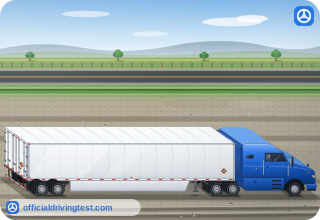
A truck hauling Division 1.1, 1.2, or 1.3 explosives is never to be parked close to the traveled part of the road. What distance does the rule name?
- Twenty feet
- Fifty feet
- Five feet
Show answer
Correct answer: Five feet
Explosives of these divisions must not be parked within five feet of the traveled road surface.
Source: CDL manual, national model as printed by New Jersey, Section 9 (July 2017)
-
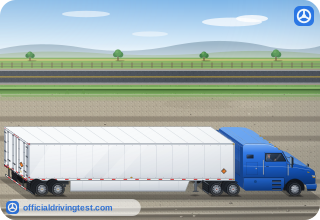
Apart from short stops for vehicle needs such as fueling, how far from a bridge, tunnel or building must you keep a vehicle carrying Division 1.1 explosives?
- 150 feet
- 300 feet
- 500 feet
Show answer
Correct answer: 300 feet
Do not park explosives within 300 feet of a bridge, tunnel, building, place where people gather, or open fire, except for brief operating needs.
Source: CDL manual, national model as printed by New Jersey, Section 9 (July 2017)
-
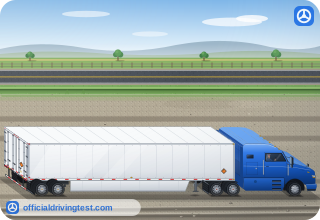
Your job forces you to stop with a load of Division 1.1 explosives. How long should the stop last?
- As long as the work needs, if someone watches
- Up to the end of your driving shift
- Only a short time
Show answer
Correct answer: Only a short time
When parking cannot be avoided with this cargo, keep the stop as short as possible.
Source: CDL manual, national model as printed by New Jersey, Section 9 (July 2017)
-
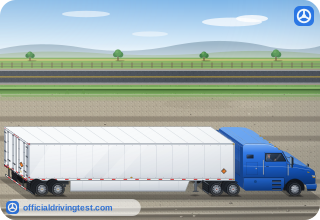
When may you park a vehicle loaded with Division 1.1 explosives on private property?
- When the owner knows about the danger
- When the property is a closed business lot
- When the vehicle has its placards displayed
Show answer
Correct answer: When the owner knows about the danger
The property owner must know about the danger of the explosives before you park there.
Source: CDL manual, national model as printed by New Jersey, Section 9 (July 2017)
-
You park a vehicle loaded with Division 1.1 explosives. Who must keep watch over it?
- Nobody, if the doors are locked
- Someone, but only at night
- Someone, at all times
Show answer
Correct answer: Someone, at all times
A parked explosives load must always be watched by someone, unless it is in a safe haven.
Source: CDL manual, national model as printed by New Jersey, Section 9 (July 2017)
-
You are parked with Division 1.1 explosives and want another person to watch the vehicle for you. Where must the vehicle be?
- On a public road shoulder
- On the consignee's property
- In a rest stop lot
Show answer
Correct answer: On the consignee's property
Someone else may watch the vehicle only on the shipper's, carrier's, or consignee's property. Elsewhere, the driver must watch it.
Source: CDL manual, national model as printed by New Jersey, Section 9 (July 2017)
-
What is a safe haven?
- A weigh station that inspects hazardous loads
- A place approved for leaving explosives loads unattended
- A terminal where drivers may sleep with the load
Show answer
Correct answer: A place approved for leaving explosives loads unattended
A safe haven is an approved parking place where an explosives-loaded vehicle may be left unattended. Local authorities usually name them.
Source: CDL manual, national model as printed by New Jersey, Section 9 (July 2017)
-
A placarded vehicle that carries no Division 1.1, 1.2 or 1.3 explosives may be parked within five feet of the traveled road under what condition?
- Only if your work requires it
- Only if it is daylight
- Only if the load is under 1,000 pounds
Show answer
Correct answer: Only if your work requires it
Even without explosives, a placarded vehicle stops that close to the road only when the work needs it, and only briefly.
Source: CDL manual, national model as printed by New Jersey, Section 9 (July 2017)
-
A placarded vehicle without explosives is parked on a public roadway shoulder. What is required?
- The hazard flashers must stay on
- Its placards must be covered
- Someone must always watch it
Show answer
Correct answer: Someone must always watch it
On a public road or shoulder, a placarded vehicle must have someone watching it at all times.
Source: CDL manual, national model as printed by New Jersey, Section 9 (July 2017)
-
You are done driving for the moment and your trailer holds hazardous materials. What may you not do?
- Leave the trailer uncoupled on a public street
- Leave the trailer coupled while you watch it
- Keep the trailer with you at a loading dock
Show answer
Correct answer: Leave the trailer uncoupled on a public street
A trailer holding hazardous materials must never be dropped and left on a public street.
Source: CDL manual, national model as printed by New Jersey, Section 9 (July 2017)
-
What is the minimum distance from an open fire for parking a placarded vehicle?
- 300 feet
- 100 feet
- 500 feet
Show answer
Correct answer: 300 feet
A placarded vehicle must not be parked within 300 feet of an open fire.
Source: CDL manual, national model as printed by New Jersey, Section 9 (July 2017)
-
A person who attends a parked placarded vehicle from inside it must be where and in what state?
- Awake in the cab, outside the sleeping area
- In the cab, allowed to nap if the doors are locked
- Resting in the sleeper berth of the cab
Show answer
Correct answer: Awake in the cab, outside the sleeping area
An attendant inside the vehicle must be awake and outside the sleeper berth.
Source: CDL manual, national model as printed by New Jersey, Section 9 (July 2017)
-
A person watching a parked placarded vehicle is not inside it. How near must that person be, with the vehicle in clear view?
- 50 feet
- 150 feet
- 100 feet
Show answer
Correct answer: 100 feet
An attendant outside the vehicle must stay within 100 feet and be able to see it clearly.
Source: CDL manual, national model as printed by New Jersey, Section 9 (July 2017)
-
What must a person who attends a parked placarded vehicle know about the load?
- The weight of each package
- The hazards of the materials
- The consignee's delivery hours
Show answer
Correct answer: The hazards of the materials
The attendant must understand the cargo hazards and what to do in an emergency, and must be capable of moving the truck when necessary.
Source: CDL manual, national model as printed by New Jersey, Section 9 (July 2017)
-
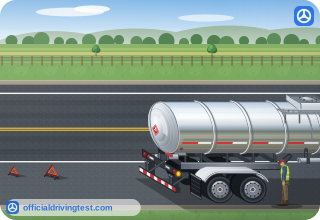
When are burning signals such as flares barred around a tank used for flammable liquids or flammable gas?
- Only while the tank is loaded
- Only while the tank is being filled
- Whether the tank is loaded or empty
Show answer
Correct answer: Whether the tank is loaded or empty
Never use flares or fusees near such a tank, even an empty one.
Source: CDL manual, national model as printed by New Jersey, Section 9 (July 2017)
-
You break down with a load of Division 1.1 explosives. What kind of warning signal must you not use?
- A reflective triangle
- A red electric light
- A burning fusee
Show answer
Correct answer: A burning fusee
Burning signals such as flares or fusees are banned around a vehicle loaded with these explosives.
Source: CDL manual, national model as printed by New Jersey, Section 9 (July 2017)
-
Local permit and route rules for hazardous materials change often. Who is responsible for learning which apply to your trip?
- The shipper
- You, the driver
- The local police
Show answer
Correct answer: You, the driver
The driver must find out about needed permits and special routes, and have all papers before starting.
Source: CDL manual, national model as printed by New Jersey, Section 9 (July 2017)
-
When should you make sure you have all the permits and other papers a hazardous materials trip needs?
- Before you reach the first state line
- Before you start the trip
- Before you unload at delivery
Show answer
Correct answer: Before you start the trip
Have every needed permit and paper in hand before the trip begins.
Source: CDL manual, national model as printed by New Jersey, Section 9 (July 2017)
-
You drive for a carrier and need to know about route restrictions or permits. Who do you ask?
- The nearest weigh station
- The consignee
- Your dispatcher
Show answer
Correct answer: Your dispatcher
A carrier's driver asks the dispatcher. An independent trucker planning a new route checks with state agencies along it.
Source: CDL manual, national model as printed by New Jersey, Section 9 (July 2017)
-
You are an independent trucker planning a new route for a hazardous materials load. Where do you check for restrictions?
- The shipper's insurance company
- State agencies where you will travel
- Your trucking school
Show answer
Correct answer: State agencies where you will travel
An independent trucker must check with the state agencies in the places the route passes through.
Source: CDL manual, national model as printed by New Jersey, Section 9 (July 2017)