Hazardous Materials: Hazardous materials emergencies — Part 1
Questions in this part include: “How can a firefighter look up a product in the Emergency Response Guidebook?” · “What is the rule when the cargo itself is already burning?”
Independent educational site · not affiliated with any government agency or DMV
Ready? Test yourself
Answer to start, or tap Start below:
How can a firefighter look up a product in the Emergency Response Guidebook?
- Instant feedback with an explanation
- Every answer cites its source in the manual
- Your best score is saved on this device
- Keyboard: press 1 to 3 to answer and Enter for the next question
Questions are written in our own words from the CDL manual; they are not the real test's questions. With your state chosen, every answer gives its page in your state's CDL manual. Without a state, answers cite the CDL manual, national model as printed by New Jersey (July 2017).
All 20 questions in this practice test
Take the test above first, then use this list to study. Tap “Show answer” to see the correct answer and explanation.
Show the questions and answersHide the questions
-
How can a firefighter look up a product in the Emergency Response Guidebook?
- By the carrier's name and the truck's license plate
- By the proper shipping name or the identification number
- By the color of the placard and the size of the package
Show answer
Correct answer: By the proper shipping name or the identification number
Responders look up the product by its proper shipping name or its identification number, taken from the shipping paper, so those must be right.
Source: CDL manual, national model as printed by New Jersey, Section 9 (July 2017)
-
At the scene of a crash with hazardous materials, what is one of your jobs as the driver?
- Move the load to another truck yourself
- Keep bystanders away from the scene
- Open the cargo area to look at the damage
Show answer
Correct answer: Keep bystanders away from the scene
A driver must keep people back from the scene so that nobody is hurt by the hazardous materials.
Source: CDL manual, national model as printed by New Jersey, Section 9 (July 2017)
-
When may you try to limit the spread of a hazardous material at a crash scene?
- Only when you can do it safely
- Whenever the load belongs to your employer
- Only after the police have left the scene
Show answer
Correct answer: Only when you can do it safely
Limiting the spread of the material is part of the driver's job, but only if it can be done without putting yourself at risk.
Source: CDL manual, national model as printed by New Jersey, Section 9 (July 2017)
-
Besides handing over papers, what must you pass on to responders about the load?
- The route the truck took before the incident
- The danger the hazardous materials present
- Your hours of service for the day
Show answer
Correct answer: The danger the hazardous materials present
A driver at the scene must tell the emergency personnel how dangerous the hazardous materials are.
Source: CDL manual, national model as printed by New Jersey, Section 9 (July 2017)
-
What should you hand to emergency responders when they arrive at a hazardous materials crash?
- Your trip log and your fuel receipts
- Your medical card and insurance policy
- The shipping papers and response information
Show answer
Correct answer: The shipping papers and response information
Responders need the shipping papers and the emergency response information to know what the load is and how to deal with it.
Source: CDL manual, national model as printed by New Jersey, Section 9 (July 2017)
-
Where should people be kept in relation to the wind at a hazardous materials incident?
- Downwind, so they can see what is happening
- Upwind and far away from the incident
- Beside the vehicle, in a single group
Show answer
Correct answer: Upwind and far away from the incident
Bystanders belong far away and upwind, so any fumes are blown away from them.
Source: CDL manual, national model as printed by New Jersey, Section 9 (July 2017)
-
You are not trained or equipped for it. What should you do about a fire in a load of hazardous materials?
- Use the fire extinguisher until the flames are out
- Do not try to fight it; call for help instead
- Drive to a truck stop where there is water
Show answer
Correct answer: Do not try to fight it; call for help instead
Hazardous materials fires need special training and protective gear. Without them, do not fight the fire.
Source: CDL manual, national model as printed by New Jersey, Section 9 (July 2017)
-
What may you use the fire extinguisher for on a small truck fire?
- To put out a fire that is burning in the cargo
- To cool the cargo area before opening the doors
- To keep the fire from reaching the cargo
Show answer
Correct answer: To keep the fire from reaching the cargo
A small truck fire may be fought with the extinguisher to stop it from spreading to the cargo until the fire department comes.
Source: CDL manual, national model as printed by New Jersey, Section 9 (July 2017)
-
You suspect a fire in the trailer. The trailer doors feel hot. What do you do?
- Open them quickly and use the extinguisher inside
- Keep them closed, because there may be a cargo fire
- Open them a little to let the heat escape
Show answer
Correct answer: Keep them closed, because there may be a cargo fire
Hot doors point to a cargo fire. Leave them shut and wait for the firefighters.
Source: CDL manual, national model as printed by New Jersey, Section 9 (July 2017)
-
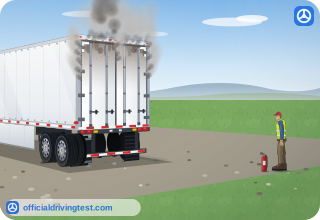
Why is it better not to open the doors of a trailer that has a cargo fire?
- Fresh air can make the fire burn harder
- The smoke will turn the cargo toxic
- The doors may be locked by the heat
Show answer
Correct answer: Fresh air can make the fire burn harder
Fresh air feeds a fire. With the doors shut, many fires only smolder and do less damage until help arrives.
Source: CDL manual, national model as printed by New Jersey, Section 9 (July 2017)
-
What is the rule when the cargo itself is already burning?
- Fight it only if the extinguisher is full
- Do not fight it, because it is not safe
- Fight it from the upwind side of the truck
Show answer
Correct answer: Do not fight it, because it is not safe
A burning cargo is too dangerous for the driver to fight. Warn others, keep them away and give the papers to the responders.
Source: CDL manual, national model as printed by New Jersey, Section 9 (July 2017)
-
How should you find out what material is leaking from your cargo?
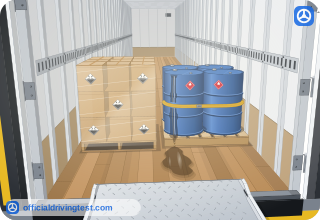
- Check the papers, labels or package location
- Smell the leak from a short distance
- Take a sample and check it in the guidebook
Show answer
Correct answer: Check the papers, labels or package location
Use the paperwork, the labels or the position of the package to identify the material. Never touch or sniff it.
Source: CDL manual, national model as printed by New Jersey, Section 9 (July 2017)
-
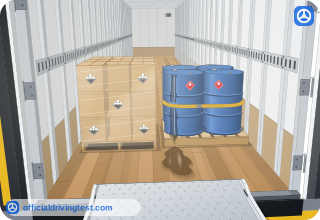
What should you do about touching a material that is leaking from your cargo?
- Touch it only while wearing work gloves
- Never touch it, since people often get hurt that way
- Touch it briefly to find where it comes from
Show answer
Correct answer: Never touch it, since people often get hurt that way
Do not touch leaking material; many people have been injured by doing so.
Source: CDL manual, national model as printed by New Jersey, Section 9 (July 2017)
-
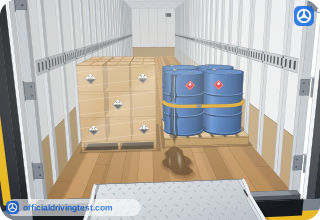
Why must you not use smell to find a leak or to tell what is leaking?
- Most hazardous materials have no smell at all
- Toxic gases can ruin smell and still harm you
- The smell of fuel would hide the material
Show answer
Correct answer: Toxic gases can ruin smell and still harm you
Poisonous gas can ruin your ability to smell it, and it may injure or kill you even when it has no odor.
Source: CDL manual, national model as printed by New Jersey, Section 9 (July 2017)
-
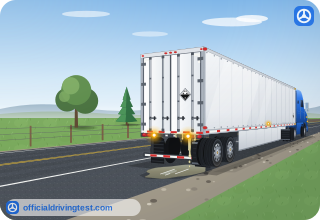
What must you never do near a leak or spill of hazardous materials?
- Use your phone or radio
- Stand upwind of the spill
- Eat, drink or smoke
Show answer
Correct answer: Eat, drink or smoke
Eating, drinking and smoking are all forbidden anywhere near a leak or spill of hazardous materials.
Source: CDL manual, national model as printed by New Jersey, Section 9 (July 2017)
-
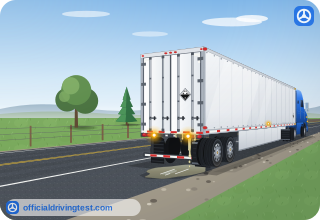
Hazardous materials are spilling from your truck. How far should you move it?
- As far as the next exit
- Back to the shipper's loading dock
- No more than safety requires
Show answer
Correct answer: No more than safety requires
Moving a spilling vehicle spreads the contamination. Move it only as much as safety demands, such as off the road and away from people.
Source: CDL manual, national model as printed by New Jersey, Section 9 (July 2017)
-
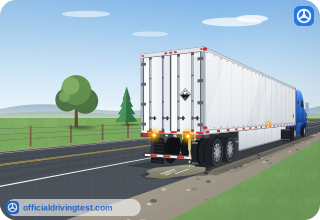
Your load is leaking and you have no phone. Why not keep driving to find help?
- The shipper would not pay for the delay
- Your hours of service would run out sooner
- The leak would spread contamination on the way
Show answer
Correct answer: The leak would spread contamination on the way
Driving on leaves a long trail of contamination, and the carrier pays for the cleanup of roads, lots and ditches. The costs are enormous.
Source: CDL manual, national model as printed by New Jersey, Section 9 (July 2017)
-
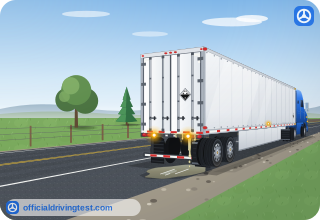
Your vehicle is spilling hazardous materials. Which order of actions is right?
- Drive to the nearest truck stop, then call for help
- Park, then walk to the nearest phone and wait there
- Park, secure the area, stay, then get help
Show answer
Correct answer: Park, secure the area, stay, then get help
Park the vehicle, secure the area and stay there while you call for help or send someone else.
Source: CDL manual, national model as printed by New Jersey, Section 9 (July 2017)
-
You send someone to get help for a spill. Which item should you give that person?
- The weight of the full trailer
- Your exact location and direction of travel
- The date of your last vehicle inspection
Show answer
Correct answer: Your exact location and direction of travel
Responders need your exact location and direction of travel, along with a description of the emergency, so they can find you.
Source: CDL manual, national model as printed by New Jersey, Section 9 (July 2017)
-
There is a lot of information to pass on when you send someone for help. What is wise to do?
- Give it by radio before the person leaves
- Write it down for the person to carry
- Let the person ask the dispatcher for it
Show answer
Correct answer: Write it down for the person to carry
A written note helps the messenger report everything, so the response team can bring the right equipment the first time.
Source: CDL manual, national model as printed by New Jersey, Section 9 (July 2017)