Hazardous Materials: Driving and parking with hazardous materials
Parking and attending a placarded vehicle, flares, route restrictions, smoking, refueling, the fire extinguisher, tire checks, where to keep shipping papers, chlorine, and railroad crossings. Split into 3 shorter tests so you're not stuck in one long quiz.
Independent educational site · not affiliated with any government agency or DMV
Choose a part
Driving and parking with hazardous materials — Part 1
Questions in this part include: “Your job forces you to stop with a load of Division 1.1 explosives. How long should the stop last?”
Driving and parking with hazardous materials — Part 2
Questions in this part include: “Some local areas ban hazardous materials in tunnels or on bridges. When should you check this?”
Driving and parking with hazardous materials — Part 3
Questions in this part include: “You stop on the shoulder to change a tire on a placarded truck. Do the rules for parking and attending it still apply?”
Questions are written in our own words from the CDL manual; they are not the real test's questions. With your state chosen, every answer gives its page in your state's CDL manual. Without a state, answers cite the CDL manual, national model as printed by New Jersey (July 2017).
All 58 Driving and parking with hazardous materials questions with answers
Choose a part above to take a practice test, or study every question and answer here.
Show the questions and answersHide the questions
1Part 120 questions
-
A truck hauling Division 1.1, 1.2, or 1.3 explosives is never to be parked close to the traveled part of the road. What distance does the rule name?
- Twenty feet
- Fifty feet
- Five feet
Show answer
Correct answer: Five feet
Explosives of these divisions must not be parked within five feet of the traveled road surface.
Source: CDL manual, national model as printed by New Jersey, Section 9 (July 2017)
-
Apart from short stops for vehicle needs such as fueling, how far from a bridge, tunnel or building must you keep a vehicle carrying Division 1.1 explosives?
- 150 feet
- 300 feet
- 500 feet
Show answer
Correct answer: 300 feet
Do not park explosives within 300 feet of a bridge, tunnel, building, place where people gather, or open fire, except for brief operating needs.
Source: CDL manual, national model as printed by New Jersey, Section 9 (July 2017)
-
Your job forces you to stop with a load of Division 1.1 explosives. How long should the stop last?
- As long as the work needs, if someone watches
- Up to the end of your driving shift
- Only a short time
Show answer
Correct answer: Only a short time
When parking cannot be avoided with this cargo, keep the stop as short as possible.
Source: CDL manual, national model as printed by New Jersey, Section 9 (July 2017)
-
When may you park a vehicle loaded with Division 1.1 explosives on private property?
- When the owner knows about the danger
- When the property is a closed business lot
- When the vehicle has its placards displayed
Show answer
Correct answer: When the owner knows about the danger
The property owner must know about the danger of the explosives before you park there.
Source: CDL manual, national model as printed by New Jersey, Section 9 (July 2017)
-
You park a vehicle loaded with Division 1.1 explosives. Who must keep watch over it?
- Nobody, if the doors are locked
- Someone, but only at night
- Someone, at all times
Show answer
Correct answer: Someone, at all times
A parked explosives load must always be watched by someone, unless it is in a safe haven.
Source: CDL manual, national model as printed by New Jersey, Section 9 (July 2017)
-
You are parked with Division 1.1 explosives and want another person to watch the vehicle for you. Where must the vehicle be?
- On a public road shoulder
- On the consignee's property
- In a rest stop lot
Show answer
Correct answer: On the consignee's property
Someone else may watch the vehicle only on the shipper's, carrier's, or consignee's property. Elsewhere, the driver must watch it.
Source: CDL manual, national model as printed by New Jersey, Section 9 (July 2017)
-
What is a safe haven?
- A weigh station that inspects hazardous loads
- A place approved for leaving explosives loads unattended
- A terminal where drivers may sleep with the load
Show answer
Correct answer: A place approved for leaving explosives loads unattended
A safe haven is an approved parking place where an explosives-loaded vehicle may be left unattended. Local authorities usually name them.
Source: CDL manual, national model as printed by New Jersey, Section 9 (July 2017)
-
A placarded vehicle that carries no Division 1.1, 1.2 or 1.3 explosives may be parked within five feet of the traveled road under what condition?
- Only if your work requires it
- Only if it is daylight
- Only if the load is under 1,000 pounds
Show answer
Correct answer: Only if your work requires it
Even without explosives, a placarded vehicle stops that close to the road only when the work needs it, and only briefly.
Source: CDL manual, national model as printed by New Jersey, Section 9 (July 2017)
-
A placarded vehicle without explosives is parked on a public roadway shoulder. What is required?
- The hazard flashers must stay on
- Its placards must be covered
- Someone must always watch it
Show answer
Correct answer: Someone must always watch it
On a public road or shoulder, a placarded vehicle must have someone watching it at all times.
Source: CDL manual, national model as printed by New Jersey, Section 9 (July 2017)
-
You are done driving for the moment and your trailer holds hazardous materials. What may you not do?
- Leave the trailer uncoupled on a public street
- Leave the trailer coupled while you watch it
- Keep the trailer with you at a loading dock
Show answer
Correct answer: Leave the trailer uncoupled on a public street
A trailer holding hazardous materials must never be dropped and left on a public street.
Source: CDL manual, national model as printed by New Jersey, Section 9 (July 2017)
-
What is the minimum distance from an open fire for parking a placarded vehicle?
- 300 feet
- 100 feet
- 500 feet
Show answer
Correct answer: 300 feet
A placarded vehicle must not be parked within 300 feet of an open fire.
Source: CDL manual, national model as printed by New Jersey, Section 9 (July 2017)
-
A person who attends a parked placarded vehicle from inside it must be where and in what state?
- Awake in the cab, outside the sleeping area
- In the cab, allowed to nap if the doors are locked
- Resting in the sleeper berth of the cab
Show answer
Correct answer: Awake in the cab, outside the sleeping area
An attendant inside the vehicle must be awake and outside the sleeper berth.
Source: CDL manual, national model as printed by New Jersey, Section 9 (July 2017)
-
A person watching a parked placarded vehicle is not inside it. How near must that person be, with the vehicle in clear view?
- 50 feet
- 150 feet
- 100 feet
Show answer
Correct answer: 100 feet
An attendant outside the vehicle must stay within 100 feet and be able to see it clearly.
Source: CDL manual, national model as printed by New Jersey, Section 9 (July 2017)
-
What must a person who attends a parked placarded vehicle know about the load?
- The weight of each package
- The hazards of the materials
- The consignee's delivery hours
Show answer
Correct answer: The hazards of the materials
The attendant must understand the cargo hazards and what to do in an emergency, and must be capable of moving the truck when necessary.
Source: CDL manual, national model as printed by New Jersey, Section 9 (July 2017)
-
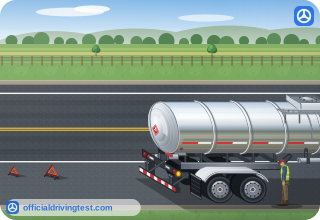
When are burning signals such as flares barred around a tank used for flammable liquids or flammable gas?
- Only while the tank is loaded
- Only while the tank is being filled
- Whether the tank is loaded or empty
Show answer
Correct answer: Whether the tank is loaded or empty
Never use flares or fusees near such a tank, even an empty one.
Source: CDL manual, national model as printed by New Jersey, Section 9 (July 2017)
-
You break down with a load of Division 1.1 explosives. What kind of warning signal must you not use?
- A reflective triangle
- A red electric light
- A burning fusee
Show answer
Correct answer: A burning fusee
Burning signals such as flares or fusees are banned around a vehicle loaded with these explosives.
Source: CDL manual, national model as printed by New Jersey, Section 9 (July 2017)
-
Local permit and route rules for hazardous materials change often. Who is responsible for learning which apply to your trip?
- The shipper
- You, the driver
- The local police
Show answer
Correct answer: You, the driver
The driver must find out about needed permits and special routes, and have all papers before starting.
Source: CDL manual, national model as printed by New Jersey, Section 9 (July 2017)
-
When should you make sure you have all the permits and other papers a hazardous materials trip needs?
- Before you reach the first state line
- Before you start the trip
- Before you unload at delivery
Show answer
Correct answer: Before you start the trip
Have every needed permit and paper in hand before the trip begins.
Source: CDL manual, national model as printed by New Jersey, Section 9 (July 2017)
-
You drive for a carrier and need to know about route restrictions or permits. Who do you ask?
- The nearest weigh station
- The consignee
- Your dispatcher
Show answer
Correct answer: Your dispatcher
A carrier's driver asks the dispatcher. An independent trucker planning a new route checks with state agencies along it.
Source: CDL manual, national model as printed by New Jersey, Section 9 (July 2017)
-
You are an independent trucker planning a new route for a hazardous materials load. Where do you check for restrictions?
- The shipper's insurance company
- State agencies where you will travel
- Your trucking school
Show answer
Correct answer: State agencies where you will travel
An independent trucker must check with the state agencies in the places the route passes through.
Source: CDL manual, national model as printed by New Jersey, Section 9 (July 2017)
2Part 219 questions
-
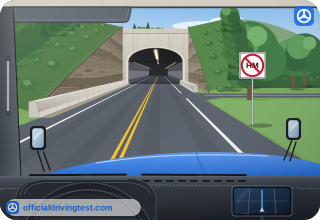
Some local areas ban hazardous materials in tunnels or on bridges. When should you check this?
- Only when crossing a state line
- Always, before you start
- Only when the load is explosives
Show answer
Correct answer: Always, before you start
Local bans can apply to tunnels, bridges and other roads, so check for them before every trip.
Source: CDL manual, national model as printed by New Jersey, Section 9 (July 2017)
-
Your vehicle is placarded and another road exists that is longer but avoids crowds and tunnels. What should you do?
- Take the shorter route through town
- Use the tunnel but drive slowly now
- Take the longer road, though inconvenient
Show answer
Correct answer: Take the longer road, though inconvenient
A placarded vehicle should stay away from crowded areas, tunnels, and tight streets, even on a less convenient route, unless there is no other way.
Source: CDL manual, national model as printed by New Jersey, Section 9 (July 2017)
-
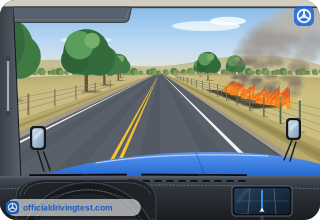
When may a placarded vehicle be driven near an open fire?
- When the fire is small and attended
- When you have slowed to a crawl
- When you can pass safely without stopping
Show answer
Correct answer: When you can pass safely without stopping
Drive near an open fire only if you can get past safely without having to stop.
Source: CDL manual, national model as printed by New Jersey, Section 9 (July 2017)
-
What must a driver have in hand when hauling Division 1.1, 1.2, or 1.3 explosives?
- A written route plan, which the driver follows
- A verbal route agreement with the shipper
- A map marked by the dispatcher
Show answer
Correct answer: A written route plan, which the driver follows
The explosives driver must carry a written route plan and keep to it.
Source: CDL manual, national model as printed by New Jersey, Section 9 (July 2017)
-
On an explosives trip, who normally prepares the route plan and what does the driver receive?
- The driver writes it at the delivery site
- The shipper mails it after the trip starts
- The carrier prepares it ahead and gives a copy
Show answer
Correct answer: The carrier prepares it ahead and gives a copy
The carrier normally prepares the plan in advance and hands the driver a copy, which the driver carries during the trip.
Source: CDL manual, national model as printed by New Jersey, Section 9 (July 2017)
-
When may an explosives driver plan the route personally instead of getting a plan from the carrier?
- The trip is shorter than one hundred miles
- The load was picked up away from the terminal
- The delivery is in the same state as pickup
Show answer
Correct answer: The load was picked up away from the terminal
If the explosives are picked up somewhere other than the employer's terminal, the driver may write the route plan in advance.
Source: CDL manual, national model as printed by New Jersey, Section 9 (July 2017)
-
Where or to whom may a driver deliver a shipment of explosives?
- To authorized persons, or into a locked explosives room
- To any adult found at the delivery address
- To anyone holding a copy of the shipping papers
Show answer
Correct answer: To authorized persons, or into a locked explosives room
Explosives go only to authorized people or into locked rooms designed to store them.
Source: CDL manual, national model as printed by New Jersey, Section 9 (July 2017)
-
For placarded radioactive materials, who must choose the safest route?
- The driver
- The shipper
- The carrier
Show answer
Correct answer: The carrier
The carrier picks the safest route, then tells the driver about the radioactive materials and shows the route plan.
Source: CDL manual, national model as printed by New Jersey, Section 9 (July 2017)
-
After a carrier picks a route for placarded radioactive materials, what must it do for the driver?
- Tell the driver about the materials and show the route plan
- Send the route plan to the shipper, not the driver
- Have the driver choose the route without the carrier
Show answer
Correct answer: Tell the driver about the materials and show the route plan
The carrier must inform the driver about the radioactive cargo and show the planned route.
Source: CDL manual, national model as printed by New Jersey, Section 9 (July 2017)
-
What is the closest you may smoke to a placarded cargo tank that carries flammable liquids?
- 10 feet away
- 50 feet away
- 25 feet away
Show answer
Correct answer: 25 feet away
Smoking is not allowed within 25 feet of a placarded tank carrying flammable liquids or flammable gases.
Source: CDL manual, national model as printed by New Jersey, Section 9 (July 2017)
-
You carry a load of Class 5 oxidizers. May someone stand 10 feet from your truck holding a lit pipe?
- Yes, as long as it is not inside the cab
- No, a lit pipe must stay at least 25 feet away
- Yes, if the engine is switched off
Show answer
Correct answer: No, a lit pipe must stay at least 25 feet away
A lighted cigarette, cigar or pipe must be kept at least 25 feet from a vehicle carrying oxidizers, and the same goes for explosives, flammable liquids, flammable solids and spontaneously combustible materials.
Source: CDL manual, national model as printed by New Jersey, Section 9 (July 2017)
-
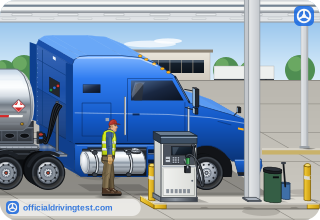
What must you do with the engine before putting fuel into a vehicle that is carrying hazardous materials?
- Switch it off
- Leave it idling at low speed
- Keep it running if someone holds the nozzle
Show answer
Correct answer: Switch it off
The engine must be off while fueling a vehicle that carries hazardous materials. Someone must also stay at the nozzle controlling the fuel flow.
Source: CDL manual, national model as printed by New Jersey, Section 9 (July 2017)
-
While a hazmat vehicle is being fueled, who has to be at the nozzle?
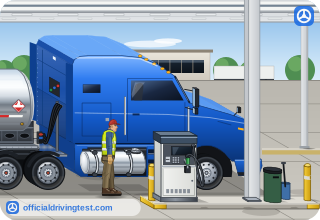
- Nobody, if the nozzle has an automatic shut-off
- Someone, who controls the fuel flow the whole time
- Only the shipper's representative
Show answer
Correct answer: Someone, who controls the fuel flow the whole time
A person must stay at the nozzle during the whole fueling and control how the fuel flows. The nozzle must never be left running unattended.
Source: CDL manual, national model as printed by New Jersey, Section 9 (July 2017)
-
What is the minimum UL rating of the fire extinguisher on the power unit of a placarded vehicle?
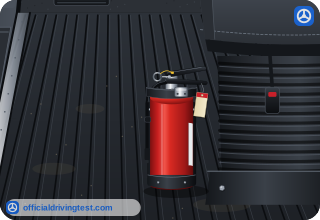
- 5 B:C
- 20 B:C
- 10 B:C
Show answer
Correct answer: 10 B:C
A placarded vehicle's power unit needs an extinguisher rated at least 10 B:C. A higher rating also meets the requirement.
Source: CDL manual, national model as printed by New Jersey, Section 9 (July 2017)
-
When must you look at each tire of a vehicle that carries hazardous materials?
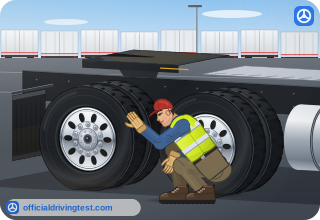
- At the start of each trip and every time you park
- Only at the start of the day's first trip
- Only when a tire seems low while driving
Show answer
Correct answer: At the start of each trip and every time you park
Every tire must be examined when a trip begins and again each time the vehicle is parked.
Source: CDL manual, national model as printed by New Jersey, Section 9 (July 2017)
-
Which method is acceptable for checking how much air is in a tire?
- Tapping the tire with a tool and listening
- Reading a tire pressure gauge
- Looking at how much the tire bulges
Show answer
Correct answer: Reading a tire pressure gauge
Only a tire pressure gauge gives an acceptable pressure check. Looking at or hitting the tire does not.
Source: CDL manual, national model as printed by New Jersey, Section 9 (July 2017)
-
One tire on your hazmat truck is flat. How far may you drive on it?
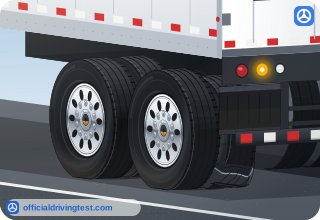
- To the next scheduled delivery stop
- Not at all, even for a short distance
- Only to the nearest safe place to repair it
Show answer
Correct answer: Only to the nearest safe place to repair it
A leaking or flat tire may be driven on only far enough to reach the nearest safe spot for repair.
Source: CDL manual, national model as printed by New Jersey, Section 9 (July 2017)
-
What should be done with a tire that has overheated on a hazmat vehicle?
- Pour water on it and keep driving
- Remove it and set it well away from the truck
- Leave it on and let it cool while loaded
Show answer
Correct answer: Remove it and set it well away from the truck
An overheated tire is removed and put a safe distance from the vehicle. You must also find and fix the cause of the overheating before driving on.
Source: CDL manual, national model as printed by New Jersey, Section 9 (July 2017)
-
After an overheated tire has been taken off, when may you drive again?
- Once the tire has cooled for an hour
- Right away, if the spare tire is fitted
- After the cause is corrected
Show answer
Correct answer: After the cause is corrected
Driving must wait until the cause of the overheating has been corrected.
Source: CDL manual, national model as printed by New Jersey, Section 9 (July 2017)
3Part 319 questions
-
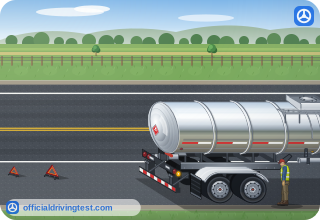
You stop on the shoulder to change a tire on a placarded truck. Do the rules for parking and attending it still apply?
- No, they apply to long-term parking only
- Only if the tire is on a trailer
- Yes, they still apply during tire work
Show answer
Correct answer: Yes, they still apply during tire work
The parking and attendance rules for placarded vehicles remain in force during any tire check, repair or change.
Source: CDL manual, national model as printed by New Jersey, Section 9 (July 2017)
-
A shipper hands you a hazardous materials load but no shipping paper. What should you do?
- Refuse it until a paper is prepared
- Take it and get the paper at delivery
- Take it if the packages are labeled
Show answer
Correct answer: Refuse it until a paper is prepared
A hazardous materials shipment must not be accepted without a properly prepared shipping paper.
Source: CDL manual, national model as printed by New Jersey, Section 9 (July 2017)
-
How can you make hazmat shipping papers stand out from your other papers?
- Put them in the bottom of the pile with a clip
- Store them in a separate envelope in the sleeper
- Tab them or keep them on top of the pile
Show answer
Correct answer: Tab them or keep them on top of the pile
Marking the hazmat papers with tabs, or placing them at the top of the pile, lets others find them quickly, for example after a crash.
Source: CDL manual, national model as printed by New Jersey, Section 9 (July 2017)
-
While you are at the wheel, where must hazmat shipping papers be kept?
- Within reach while belted in, or in the door pouch
- In the sleeper berth, where they are protected
- In a locked box at the rear of the trailer
Show answer
Correct answer: Within reach while belted in, or in the door pouch
The papers must be reachable while you are belted in, or sit in the driver's door pouch, and anyone entering the cab must be able to see them easily.
Source: CDL manual, national model as printed by New Jersey, Section 9 (July 2017)
-
Which rule applies to where hazmat shipping papers are placed in the cab?
- They must be kept in a sealed envelope
- They must be easy to see on entering
- They must be filed behind the other papers
Show answer
Correct answer: They must be easy to see on entering
Shipping papers must be placed where a person entering the cab can see them easily.
Source: CDL manual, national model as printed by New Jersey, Section 9 (July 2017)
-
When you leave the driver's seat, where should the hazmat shipping papers be left?
- On the dashboard, facing the windshield
- In the glove box, out of sight
- In the door pouch or on the seat
Show answer
Correct answer: In the door pouch or on the seat
Away from the wheel, the papers go in the pouch on the driver's door or on the seat, so other people can find them quickly after a crash.
Source: CDL manual, national model as printed by New Jersey, Section 9 (July 2017)
-
Where must the emergency response information for a hazmat load be kept?
- In the trailer's cargo area
- With the carrier's office records
- With the shipping paper
Show answer
Correct answer: With the shipping paper
Emergency response information goes in the same place as the shipping paper, so both are found together.
Source: CDL manual, national model as printed by New Jersey, Section 9 (July 2017)
-
Which copy must a carrier hand to a driver hauling Division 1.1, 1.2 or 1.3 explosives?
- The Federal Motor Carrier Safety Regulations, Part 391
- The Federal Motor Carrier Safety Regulations, Part 397
- The Federal Motor Carrier Safety Regulations, Part 383
Show answer
Correct answer: The Federal Motor Carrier Safety Regulations, Part 397
Drivers of these explosives receive a copy of Part 397 of the Federal Motor Carrier Safety Regulations, together with written instructions for delays or accidents.
Source: CDL manual, national model as printed by New Jersey, Section 9 (July 2017)
-
Written instructions for an explosives driver in case of delay or accident must say what about emergencies?
- What to do in a fire, accident or leak
- Which repair shops to use
- How to bill the shipper for losses
Show answer
Correct answer: What to do in a fire, accident or leak
The instructions list who to contact, what the explosives are, and the precautions for fires, accidents and leaks.
Source: CDL manual, national model as printed by New Jersey, Section 9 (July 2017)
-
What must an explosives driver do when the carrier hands over the required documents?
- Mail a copy to the shipper
- Sign a receipt for them
- Leave them at the terminal
Show answer
Correct answer: Sign a receipt for them
The driver signs a receipt for the documents and must then know them and carry them while driving.
Source: CDL manual, national model as printed by New Jersey, Section 9 (July 2017)
-
Which item must an explosives driver carry while driving, besides the shipping papers and written emergency instructions?
- A copy of the driver's medical records
- A list of every nearby safe haven
- A written route plan
Show answer
Correct answer: A written route plan
While driving with these explosives you carry the shipping papers, the written emergency instructions, the written route plan and a copy of Part 397.
Source: CDL manual, national model as printed by New Jersey, Section 9 (July 2017)
-
What must a driver hauling chlorine in cargo tanks keep in the vehicle?
- An approved gas mask
- A portable eyewash station
- A second fire extinguisher
Show answer
Correct answer: An approved gas mask
Chlorine tank drivers need an approved gas mask in the vehicle, plus a kit for controlling leaks in the dome cover plate fittings.
Source: CDL manual, national model as printed by New Jersey, Section 9 (July 2017)
-
A chlorine tank driver must carry an emergency kit to control leaks at which place?
- The vehicle's fuel line fittings and hoses
- The dome cover plate fittings
- The bottom drain valve of the tank
Show answer
Correct answer: The dome cover plate fittings
The kit is meant for leaks in the fittings of the dome cover plate on the cargo tank.
Source: CDL manual, national model as printed by New Jersey, Section 9 (July 2017)
-
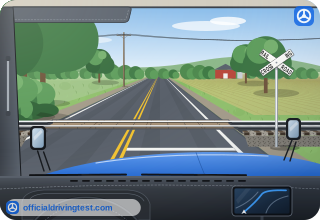
Does a placarded vehicle have to stop before a railroad crossing?
- Yes, it must stop
- Only if a train is in sight
- Only if the crossing has no gates
Show answer
Correct answer: Yes, it must stop
A placarded vehicle must always stop before a railroad crossing, whatever the signals show.
Source: CDL manual, national model as printed by New Jersey, Section 9 (July 2017)
-
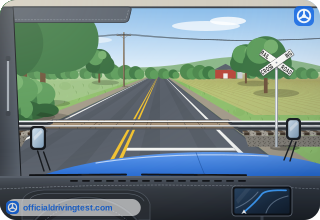
Your unplacarded truck carries a small amount of chlorine. Must you stop before a railroad crossing?
- Yes, any amount of chlorine requires a stop
- No, only a full load requires a stop
- No, if the crossing has flashing lights
Show answer
Correct answer: Yes, any amount of chlorine requires a stop
Carrying any amount of chlorine means you must stop before a railroad crossing.
Source: CDL manual, national model as printed by New Jersey, Section 9 (July 2017)
-
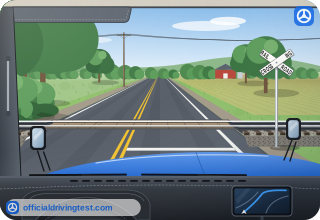
Your cargo tank for hazardous materials is empty. Do you still stop before a railroad crossing?
- Yes, loaded or empty, the stop is required
- No, an empty tank needs no stop
- Only if the tank was last loaded with gas
Show answer
Correct answer: Yes, loaded or empty, the stop is required
Cargo tanks used for hazardous materials must stop at railroad crossings whether they are loaded or empty.
Source: CDL manual, national model as printed by New Jersey, Section 9 (July 2017)
-
Where must a hazmat vehicle stop for a railroad crossing?
- 5 to 15 feet from the nearest rail
- 50 to 100 feet short of the nearest rail
- 15 to 50 feet short of the nearest rail
Show answer
Correct answer: 15 to 50 feet short of the nearest rail
The stop is made between 15 and 50 feet short of the first rail.
Source: CDL manual, national model as printed by New Jersey, Section 9 (July 2017)
-
After stopping at a railroad crossing in a placarded truck, when may you go across?
- When the crossing signals have turned off
- As soon as the vehicle ahead has fully crossed
- When no train is near and you can clear the tracks
Show answer
Correct answer: When no train is near and you can clear the tracks
Cross only when no train is coming and you can get completely over the tracks without having to stop on them.
Source: CDL manual, national model as printed by New Jersey, Section 9 (July 2017)
-
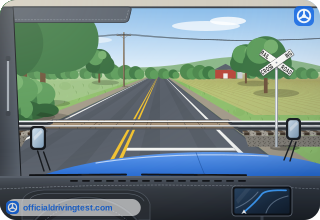
What should you avoid doing while your hazmat vehicle is on railroad tracks?
- Using the horn
- Turning on the hazard lights
- Changing gears
Show answer
Correct answer: Changing gears
Gears must not be shifted while the vehicle is crossing the tracks.
Source: CDL manual, national model as printed by New Jersey, Section 9 (July 2017)