General Knowledge: Vehicle inspection
Why and when to inspect, what to look for on each part of the vehicle, and the step-by-step inspection. Split into 5 shorter tests so you're not stuck in one long quiz.
Independent educational site · not affiliated with any government agency or DMV
Choose a part
Vehicle inspection — Part 1
Questions in this part include: “What is the most important reason a driver inspects the vehicle?”
Vehicle inspection — Part 2
Questions in this part include: “Why is a broken exhaust system a danger to the driver?”
Vehicle inspection — Part 3
Questions in this part include: “How soon after the engine starts should the oil pressure gauge reach normal?”
Vehicle inspection — Part 4
Questions in this part include: “What color should the parking, clearance, and identification lights be at the front?”
Vehicle inspection — Part 5
Questions in this part include: “To test for hydraulic leaks, how many times do you pump the brake pedal first?”
Questions are written in our own words from the CDL manual; they are not the real test's questions. With your state chosen, every answer gives its page in your state's CDL manual. Without a state, answers cite the CDL manual, national model as printed by New Jersey (July 2017).
All 87 Vehicle inspection questions with answers
Choose a part above to take a practice test, or study every question and answer here.
Show the questions and answersHide the questions
1Part 118 questions
-
What is the most important reason a driver inspects the vehicle?
- To avoid fines at weigh stations
- To keep repair bills as low as possible
- To protect yourself and others
Show answer
Correct answer: To protect yourself and others
Safety comes first: an inspection protects the driver and everyone else on the road.
Source: CDL manual, national model as printed by New Jersey, Sections 1 to 3 (July 2017)
-
Where does the requirement for a driver to inspect the vehicle come from?
- Only the insurance company's policy
- Only the employer's own rules
- Federal and state laws
Show answer
Correct answer: Federal and state laws
Both federal and state laws require drivers to inspect their vehicles, so it is not just company policy.
Source: CDL manual, national model as printed by New Jersey, Sections 1 to 3 (July 2017)
-
A federal or state inspector decides your vehicle is unsafe. What happens to the vehicle?
- It is placed out of service until it is fixed
- It may finish the trip and be repaired afterward
- It is given a warning and sent back on the road
Show answer
Correct answer: It is placed out of service until it is fixed
When inspectors decide a vehicle is unsafe, it is taken out of service and stays that way until the defect is repaired.
Source: CDL manual, national model as printed by New Jersey, Sections 1 to 3 (July 2017)
-
What kind of problems can a vehicle inspection help a driver find?
- Defects that might cause a crash or breakdown
- Ways to lower the vehicle's fuel costs
- Problems that only a mechanic's shop can find
Show answer
Correct answer: Defects that might cause a crash or breakdown
An inspection is meant to catch vehicle problems before they lead to a crash or a breakdown.
Source: CDL manual, national model as printed by New Jersey, Sections 1 to 3 (July 2017)
-
While driving, how can you notice trouble with the vehicle besides watching the gauges?
- Only by waiting for a warning light
- By looking, listening, smelling, feeling
- Only at the next scheduled stop
Show answer
Correct answer: By looking, listening, smelling, feeling
Drivers should watch the gauges and also use their senses: look, listen, smell and feel for anything unusual.
Source: CDL manual, national model as printed by New Jersey, Sections 1 to 3 (July 2017)
-
When should you do an after-trip inspection?
- When the trip, the day or the duty shift is over
- Only when you noticed a defect during the trip
- Once a week, on the last day of work
Show answer
Correct answer: When the trip, the day or the duty shift is over
The inspection is done on every vehicle you drove, once the trip, the day or your duty shift ends.
Source: CDL manual, national model as printed by New Jersey, Sections 1 to 3 (July 2017)
-
What may an after-trip inspection include?
- Taking the vehicle to a state inspector
- Filling out a report listing problems found
- Writing down the trip's total fuel cost
Show answer
Correct answer: Filling out a report listing problems found
After the trip you may complete a vehicle condition report that lists any problems you found.
Source: CDL manual, national model as printed by New Jersey, Sections 1 to 3 (July 2017)
-
What does the after-trip inspection report help the motor carrier know?
- How many miles the driver covered
- When the vehicle needs repairs
- How much fuel the vehicle used
Show answer
Correct answer: When the vehicle needs repairs
The report lists any problems found, so the motor carrier knows when the vehicle needs repairs.
Source: CDL manual, national model as printed by New Jersey, Sections 1 to 3 (July 2017)
-
What is the smallest tread depth a front tire may have in each major groove?
- 2/32 inch
- 4/32 inch
- 6/32 inch
Show answer
Correct answer: 4/32 inch
Front tires need at least 4/32 inch of tread in every major groove. Other tires need at least 2/32 inch.
Source: CDL manual, national model as printed by New Jersey, Sections 1 to 3 (July 2017)
-
During a tire check, what should you never be able to see through the tread or the sidewall?
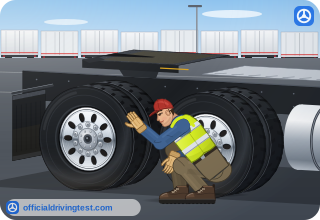
- An inner tube
- The wear bars
- Fabric
Show answer
Correct answer: Fabric
If fabric shows through the tread or sidewall, the tire is badly worn and is a defect.
Source: CDL manual, national model as printed by New Jersey, Sections 1 to 3 (July 2017)
-
Which tires are not allowed on the front wheels of a bus?
- Tubeless tires or radial tires
- Recapped or retreaded tires
- Tires of a wider size than the rear
Show answer
Correct answer: Recapped or retreaded tires
A bus may not use re-grooved, recapped or retreaded tires on its front wheels.
Source: CDL manual, national model as printed by New Jersey, Sections 1 to 3 (July 2017)
-
You see rust around the wheel nuts. What might it mean?
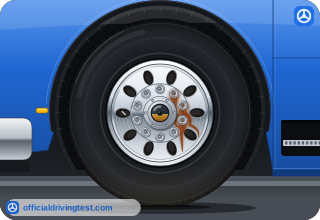
- The tire is overinflated
- The nuts may be loose
- The brake drum is cracked
Show answer
Correct answer: The nuts may be loose
Rust around wheel nuts can be a sign the nuts are loose, so you should check how tight they are.
Source: CDL manual, national model as printed by New Jersey, Sections 1 to 3 (July 2017)
-
A tire on your vehicle has just been changed. What should you do a short time after you start driving?
- Add air to the new tire
- Stop and check the tread depth of the new tire
- Stop and check that the wheel nuts are tight
Show answer
Correct answer: Stop and check that the wheel nuts are tight
After a tire change, stop a short while later and check that the wheel nuts are tight.
Source: CDL manual, national model as printed by New Jersey, Sections 1 to 3 (July 2017)
-
A wheel or rim has been repaired by welding. How should you treat it?
- It is not safe
- It is fine if the weld looks smooth
- It is safe if the nuts are tight
Show answer
Correct answer: It is not safe
Wheels or rims with welding repairs are not safe to use.
Source: CDL manual, national model as printed by New Jersey, Sections 1 to 3 (July 2017)
-
What is a defect when you find it on brake shoes or pads?
- A thin film of road dust
- Oil, grease or brake fluid
- Light surface rust
Show answer
Correct answer: Oil, grease or brake fluid
Oil, grease or brake fluid on brake shoes or pads is a brake defect to look for.
Source: CDL manual, national model as printed by New Jersey, Sections 1 to 3 (July 2017)
-
Above how many degrees of steering wheel play can steering become hard?
- 5 degrees
- 20 degrees
- 10 degrees
Show answer
Correct answer: 10 degrees
Play of more than 10 degrees, about 2 inches at the rim of a 20-inch wheel, can make steering difficult.
Source: CDL manual, national model as printed by New Jersey, Sections 1 to 3 (July 2017)
-
Why can broken suspension parts be extremely dangerous?
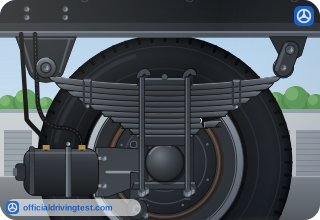
- They hold the axles in place and carry the load
- They keep exhaust fumes from entering the cab
- They supply power to the steering when you turn
Show answer
Correct answer: They hold the axles in place and carry the load
The suspension holds up the vehicle and its load and keeps the axles in position, so a broken part is very dangerous.
Source: CDL manual, national model as printed by New Jersey, Sections 1 to 3 (July 2017)
-
What is the smallest share of missing leaves in a leaf spring that puts the vehicle out of service?
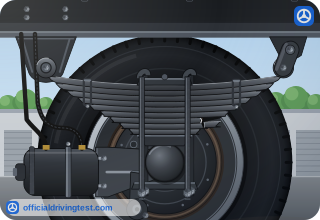
- One-eighth or more
- One-half or more
- One-fourth or more
Show answer
Correct answer: One-fourth or more
When one-fourth or more of the leaves in a leaf spring are missing, the vehicle is placed out of service.
Source: CDL manual, national model as printed by New Jersey, Sections 1 to 3 (July 2017)
2Part 218 questions
-
Why is a broken exhaust system a danger to the driver?
- Poison fumes may leak into the cab or berth
- It can make the engine overheat very quickly
- It can let fuel drain slowly from the tank
Show answer
Correct answer: Poison fumes may leak into the cab or berth
A damaged exhaust can allow poisonous fumes to get into the cab or sleeper berth.
Source: CDL manual, national model as printed by New Jersey, Sections 1 to 3 (July 2017)
-
When does a vehicle not need to carry spare electrical fuses?
- When it has circuit breakers
- When it has a fire extinguisher
- When it is on a short trip
Show answer
Correct answer: When it has circuit breakers
Spare fuses are required unless the vehicle is equipped with circuit breakers.
Source: CDL manual, national model as printed by New Jersey, Sections 1 to 3 (July 2017)
-
If a vehicle uses reflective triangles as its warning devices for parked vehicles, how many must it carry?
- Three
- Two
- Six
Show answer
Correct answer: Three
A vehicle can carry three reflective triangles as warning devices for when it is parked. Other options are at least six fusees (road flares) or three liquid burning flares.
Source: CDL manual, national model as printed by New Jersey, Sections 1 to 3 (July 2017)
-
Before each trip, what must you make sure about the cargo on a truck?
- It is balanced and secured, and the truck is not overloaded
- It is sorted by weight and labeled
- It is covered and the truck is parked on level ground
Show answer
Correct answer: It is balanced and secured, and the truck is not overloaded
Before every trip you must be sure the truck is not overloaded and that the cargo is balanced and secured.
Source: CDL manual, national model as printed by New Jersey, Sections 1 to 3 (July 2017)
-
Your cargo includes hazardous materials. What must you inspect for?
- A second fire extinguisher
- Proper papers and placarding
- Extra tire tread depth
Show answer
Correct answer: Proper papers and placarding
With hazardous materials on board, you must check that the proper papers and placards are in place.
Source: CDL manual, national model as printed by New Jersey, Sections 1 to 3 (July 2017)
-
Why should you inspect your vehicle in the same order every time?
- The inspector expects the same order on every vehicle
- It saves time by letting you skip steps you checked yesterday
- You learn the steps well and are less likely to skip one
Show answer
Correct answer: You learn the steps well and are less likely to skip one
A fixed routine helps you learn every step, so you are less likely to forget something.
Source: CDL manual, national model as printed by New Jersey, Sections 1 to 3 (July 2017)
-
As you walk up to the vehicle, what body condition should catch your eye?
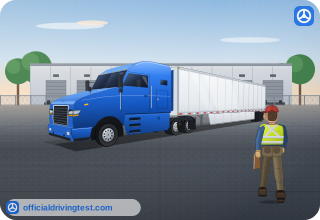
- Damage, or leaning to one side
- Frost on the windshield
- A low fuel level on the tank gauge
Show answer
Correct answer: Damage, or leaning to one side
A damaged body or a vehicle that leans to one side can point to a problem, so look for both on approach.
Source: CDL manual, national model as printed by New Jersey, Sections 1 to 3 (July 2017)
-
As you walk up to your vehicle, what should you look for underneath it?
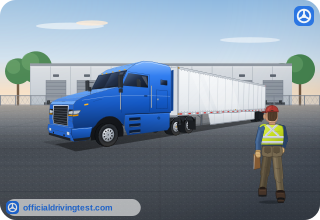
- Worn paint and small dents on the lower body
- Fresh oil, coolant, grease, or fuel leaks
- Loose cargo straps lying on the ground
Show answer
Correct answer: Fresh oil, coolant, grease, or fuel leaks
Fresh fluid under the vehicle shows a leak. Look for oil, coolant, grease, or fuel.
Source: CDL manual, national model as printed by New Jersey, Sections 1 to 3 (July 2017)
-
When you first approach the vehicle, what else should you check around it?
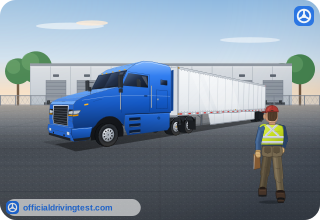
- Whether the ground is dry enough to walk on
- Hazards such as people, objects, or low wires
- Whether the parking lot has marked spaces
Show answer
Correct answer: Hazards such as people, objects, or low wires
Look around for anything that could block or hit the vehicle when it moves, such as people, other vehicles, objects, wires, and limbs.
Source: CDL manual, national model as printed by New Jersey, Sections 1 to 3 (July 2017)
-
Who must repair safety-related defects found on a vehicle inspection report?
- The motor carrier
- The driver who wrote the report
- The next driver who uses the vehicle
Show answer
Correct answer: The motor carrier
Safety defects are fixed by the carrier, which then records on the report that the work was done or not needed.
Source: CDL manual, national model as printed by New Jersey, Sections 1 to 3 (July 2017)
-
When may you sign the last vehicle inspection report?
- Whenever you have read the report from top to bottom
- As soon as the carrier hands it to you, before any repair
- Only if defects were certified as repaired or not needed
Show answer
Correct answer: Only if defects were certified as repaired or not needed
Sign only when any defects in the report have been certified as fixed or as not needing repair.
Source: CDL manual, national model as printed by New Jersey, Sections 1 to 3 (July 2017)
-
What should you confirm before you open the engine compartment?
- The parking brake is on or the wheels are chocked
- The tires are cold and the lights are off
- The engine is running at a fast idle
Show answer
Correct answer: The parking brake is on or the wheels are chocked
Before working in the engine area, make sure the parking brake is on, the wheels are chocked, or both.
Source: CDL manual, national model as printed by New Jersey, Sections 1 to 3 (July 2017)
-
Before you tilt the cab to see the engine, what should you do?
- Start the engine so the fluids warm up
- Secure loose items so they cannot fall
- Remove the battery so it cannot spill
Show answer
Correct answer: Secure loose items so they cannot fall
Items left loose in the cab can fall when it tilts and break something, so secure them first.
Source: CDL manual, national model as printed by New Jersey, Sections 1 to 3 (July 2017)
-
When you check the alternator, water pump, and air compressor belts, what should you know?
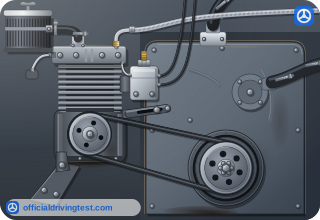
- How many belts the engine should have in total
- How loud each belt should sound while the engine runs
- How much give each belt should have when properly adjusted
Show answer
Correct answer: How much give each belt should have when properly adjusted
Belts need the right tightness and little wear, so learn how much they should give when adjusted correctly.
Source: CDL manual, national model as printed by New Jersey, Sections 1 to 3 (July 2017)
-
Before starting the engine, where do you put the gearshift?
- In first gear, with the clutch released
- In neutral, or in park if it is an automatic
- In reverse, to hold the vehicle in place
Show answer
Correct answer: In neutral, or in park if it is an automatic
Start the engine with the gearshift in neutral, or in park on an automatic.
Source: CDL manual, national model as printed by New Jersey, Sections 1 to 3 (July 2017)
-
What should you listen for right after you start the engine?
- The sound of the fuel pump priming
- Gear whine from the transmission
- Unusual noises
Show answer
Correct answer: Unusual noises
Unusual engine noises at start-up can signal a problem, so listen as it starts.
Source: CDL manual, national model as printed by New Jersey, Sections 1 to 3 (July 2017)
-
On a vehicle with ABS, what does it mean if the dash light stays on after the engine starts?
- The ABS is working and ready
- The ABS is not working properly
- The air pressure is still building
Show answer
Correct answer: The ABS is not working properly
The ABS dash light should come on briefly and go off. If it stays on, the system is not working properly.
Source: CDL manual, national model as printed by New Jersey, Sections 1 to 3 (July 2017)
-
A trailer has a yellow ABS light on its left side, and it stays on. What does that tell you?
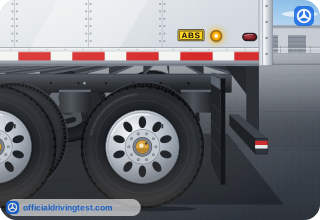
- The trailer brakes are running hot
- The trailer is coupled incorrectly
- The trailer ABS is not working properly
Show answer
Correct answer: The trailer ABS is not working properly
A yellow ABS lamp on the trailer that stays lit means its antilock system has a fault.
Source: CDL manual, national model as printed by New Jersey, Sections 1 to 3 (July 2017)
3Part 317 questions
-
How soon after the engine starts should the oil pressure gauge reach normal?
- Within seconds
- After the engine has warmed up for several minutes
- Only after the vehicle starts moving
Show answer
Correct answer: Within seconds
A healthy engine shows normal oil pressure a few seconds after starting.
Source: CDL manual, national model as printed by New Jersey, Sections 1 to 3 (July 2017)
-
With the engine running, how fast should air pressure rise from 50 to 90 psi?
- Within 30 seconds
- Within 3 minutes
- Within 10 minutes
Show answer
Correct answer: Within 3 minutes
The pressure should climb from 50 psi to 90 psi in no more than 3 minutes.
Source: CDL manual, national model as printed by New Jersey, Sections 1 to 3 (July 2017)
-
At about what pressure does the air governor usually cut out?
- Around 90 to 100 psi
- Around 120 to 140 psi
- Around 160 to 180 psi
Show answer
Correct answer: Around 120 to 140 psi
The governor usually cuts out at about 120 to 140 psi, but you should know your own vehicle's requirement.
Source: CDL manual, national model as printed by New Jersey, Sections 1 to 3 (July 2017)
-
What should the ammeter or voltmeter show once the engine is running?
- A reading at the top of the scale
- A reading in the normal range
- A reading near zero until you drive
Show answer
Correct answer: A reading in the normal range
The charging gauge should sit in its normal range after the engine starts.
Source: CDL manual, national model as printed by New Jersey, Sections 1 to 3 (July 2017)
-
What should the coolant temperature gauge do after the engine starts?
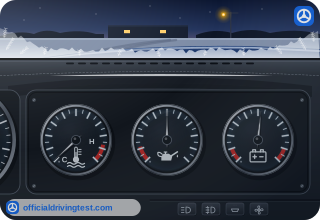
- Jump to the top of the range right away
- Rise gradually toward the normal range
- Stay at the bottom until you start driving
Show answer
Correct answer: Rise gradually toward the normal range
Coolant temperature should rise gradually into the normal operating range.
Source: CDL manual, national model as printed by New Jersey, Sections 1 to 3 (July 2017)
-
After the engine starts, what should the oil, coolant, charging, and ABS warning lights do?
- Go out right away
- Stay lit until the engine is fully warm
- Flash for about a minute
Show answer
Correct answer: Go out right away
These warning lights should turn off right away after the engine starts.
Source: CDL manual, national model as printed by New Jersey, Sections 1 to 3 (July 2017)
-
When you check the controls in the cab, what problems do you look for?
- Faded labels, dust, or odd colors on them
- Fresh paint, clean labels, and a new cover
- Looseness, sticking, damage, or bad setting
Show answer
Correct answer: Looseness, sticking, damage, or bad setting
Each control should be checked for being loose, stuck, damaged, or set wrongly.
Source: CDL manual, national model as printed by New Jersey, Sections 1 to 3 (July 2017)
-
What should you look for when you inspect the mirrors and windshield?
- Water spots, scratches, and the age of the glass
- Cracks, dirt, illegal stickers, or a blocked view
- Tint level, glass brand, and where it was made
Show answer
Correct answer: Cracks, dirt, illegal stickers, or a blocked view
Cracks, dirt, illegal stickers, and other obstructions can keep you from seeing clearly, so clean and adjust as needed.
Source: CDL manual, national model as printed by New Jersey, Sections 1 to 3 (July 2017)
-
What must be true of the fire extinguisher during the safety equipment check?
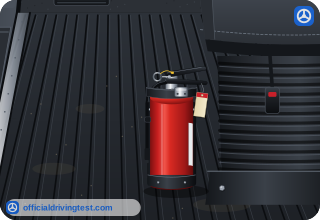
- It is properly charged and rated
- It is mounted outside the cab
- It was inspected within the month
Show answer
Correct answer: It is properly charged and rated
The extinguisher must be properly charged and properly rated.
Source: CDL manual, national model as printed by New Jersey, Sections 1 to 3 (July 2017)
-
Which condition means a safety belt passes your inspection?
- It is clean and has been replaced within the year
- Secure, adjustable, latches, and not frayed
- It is long enough to reach across the passenger seat
Show answer
Correct answer: Secure, adjustable, latches, and not frayed
A belt passes when it is firmly mounted, can be adjusted, latches, and shows no rips or fraying.
Source: CDL manual, national model as printed by New Jersey, Sections 1 to 3 (July 2017)
-
In Step 4 of the inspection, you set the parking brake and shut the engine off. What do you do with the ignition key before you get out?
- Leave it in the switch in the off position
- Hand it to a helper who stays inside the cab
- Take it with you when you leave the cab
Show answer
Correct answer: Take it with you when you leave the cab
The key goes with you when you get out, as part of shutting the vehicle down before the walk-around.
Source: CDL manual, national model as printed by New Jersey, Sections 1 to 3 (July 2017)
-
Which lights do you switch on in Step 4, before you get out to start the walk-around?
- High beam headlights and the right turn signal
- Only the parking and clearance lights
- Low beam headlights and the four-way flashers
Show answer
Correct answer: Low beam headlights and the four-way flashers
You switch on the low beams and the four-way flashers, then check them from the front of the vehicle.
Source: CDL manual, national model as printed by New Jersey, Sections 1 to 3 (July 2017)
-
How do you make the high beams come on so you can check them?
- Press the dimmer switch
- Switch on the four-way flashers
- Turn on the clearance lights
Show answer
Correct answer: Press the dimmer switch
Pressing the dimmer switch lets you see whether the high beams light.
Source: CDL manual, national model as printed by New Jersey, Sections 1 to 3 (July 2017)
-
Just before you start the walk-around, which signal do you switch on?
- The four-way flashers
- The high beam headlights
- The right turn signal
Show answer
Correct answer: The right turn signal
You turn on the right turn signal and then begin the walk-around.
Source: CDL manual, national model as printed by New Jersey, Sections 1 to 3 (July 2017)
-
When do you clean the lights, reflectors and glass during the inspection?
- Before you start the engine in Step 3
- After you finish checking the signal lights
- As you reach each one on the walk-around
Show answer
Correct answer: As you reach each one on the walk-around
Wipe each light, reflector and window as you reach it on the walk-around.
Source: CDL manual, national model as printed by New Jersey, Sections 1 to 3 (July 2017)
-
You see rust streaks around some lug nuts on a front wheel. What does this suggest, and what do you do?
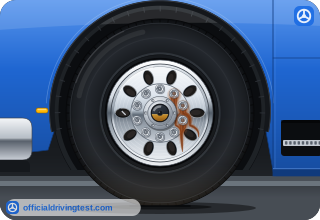
- The nuts are over-tightened, so leave them alone
- The hub seal is leaking, so check the oil
- The nuts may be loose, so test them with a wrench
Show answer
Correct answer: The nuts may be loose, so test them with a wrench
Rust streaks around lug nuts point to looseness, so you test those nuts with a wrench.
Source: CDL manual, national model as printed by New Jersey, Sections 1 to 3 (July 2017)
-
At the front of the vehicle, how must you check the steering mechanism for looseness?
- Look at it closely with a flashlight
- Take hold of it and test it by hand
- Look for fresh grease on the joints
Show answer
Correct answer: Take hold of it and test it by hand
You have to take hold of the steering parts by hand to feel for play.
Source: CDL manual, national model as printed by New Jersey, Sections 1 to 3 (July 2017)
4Part 417 questions
-
What color should the parking, clearance, and identification lights be at the front?
- Red
- White
- Amber
Show answer
Correct answer: Amber
Front parking, clearance, and identification lights should be amber.
Source: CDL manual, national model as printed by New Jersey, Sections 1 to 3 (July 2017)
-
What are the proper colors for turn signals that face forward?
- Red or yellow
- Amber or white
- Blue or white
Show answer
Correct answer: Amber or white
Turn signals facing forward should be amber or white.
Source: CDL manual, national model as printed by New Jersey, Sections 1 to 3 (July 2017)
-
On a cab-over-engine truck, what extra items do you check on the right side?
- The primary and secondary safety cab locks
- The hood hinge and the engine mounts
- A second set of clearance lights and flags
Show answer
Correct answer: The primary and secondary safety cab locks
On a cab-over-engine design, the primary and secondary safety cab locks must be engaged.
Source: CDL manual, national model as printed by New Jersey, Sections 1 to 3 (July 2017)
-
The exhaust system must be fastened firmly and must not leak. What else must it stay clear of?
- Electrical wires, fuel and air-lines
- The frame and its cross members at all times
- The spare tire carrier or the rack
Show answer
Correct answer: Electrical wires, fuel and air-lines
The exhaust must be fastened and leak-free, and kept away from wiring, fuel and air-lines.
Source: CDL manual, national model as printed by New Jersey, Sections 1 to 3 (July 2017)
-
A tarp covers your load. What must its securing prevent?
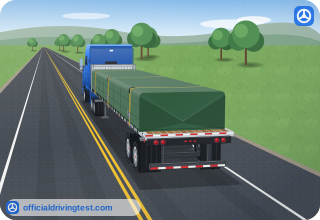
- Tearing, flapping, or hiding the mirrors
- Touching the side boards or the stakes
- Letting any air get to the cargo at all
Show answer
Correct answer: Tearing, flapping, or hiding the mirrors
A loose tarp can tear, billow out, or hide your mirrors, so it must be tied down properly.
Source: CDL manual, national model as printed by New Jersey, Sections 1 to 3 (July 2017)
-
Besides being closed and latched or locked, what must be in place on curbside cargo compartment doors when required?
- Orange warning flags
- Reflective warning tape
- Security seals
Show answer
Correct answer: Security seals
Curbside cargo doors must be in good condition, closed and latched or locked, with any required security seals in place.
Source: CDL manual, national model as printed by New Jersey, Sections 1 to 3 (July 2017)
-
When you inspect the tires on the right rear wheels, what should you confirm about the tire types?
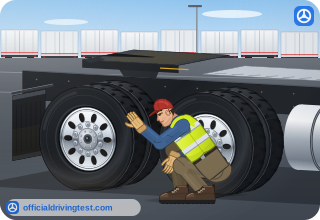
- Radial tires are on the outer wheels only
- Bias tires are fitted on the drive axle only
- They are all one type, not radial mixed with bias
Show answer
Correct answer: They are all one type, not radial mixed with bias
Mixing radial and bias tires on a vehicle is a defect. All the tires should be the same type.
Source: CDL manual, national model as printed by New Jersey, Sections 1 to 3 (July 2017)
-
What should you check for on a powered axle during the inspection?
- Cracks in the axle housing paint
- Gear oil leaking out
- Air escaping from the hub
Show answer
Correct answer: Gear oil leaking out
A powered axle must not leak lube (gear oil). A leak is a defect to find before you drive.
Source: CDL manual, national model as printed by New Jersey, Sections 1 to 3 (July 2017)
-
A vehicle has a retractable axle with an air-powered lift mechanism. What do you look for besides its general condition?
- Air leaks
- Oil on the drum
- Loose lug nuts
Show answer
Correct answer: Air leaks
The lift mechanism of a retractable axle must be in good condition. If it runs on air, check it for air leaks.
Source: CDL manual, national model as printed by New Jersey, Sections 1 to 3 (July 2017)
-
During the walk-around, what color should the side-marker lights at the rear of the vehicle be?
- Amber
- Red
- White
Show answer
Correct answer: Red
Side-marker lights are red at the rear. The other side-marker lights are amber.
Source: CDL manual, national model as printed by New Jersey, Sections 1 to 3 (July 2017)
-
Which colors are proper for a turn signal at the rear of the vehicle?
- Red, yellow or amber
- Amber or white
- White or green
Show answer
Correct answer: Red, yellow or amber
A rear turn signal may be red, yellow or amber.
Source: CDL manual, national model as printed by New Jersey, Sections 1 to 3 (July 2017)
-
Besides tearing, what should a properly secured tarp keep from happening?
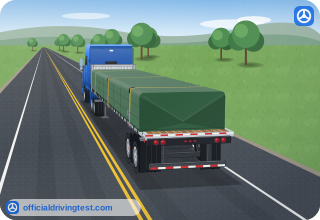
- Rubbing against the splash guards
- Resting against the stake sockets and gates
- Blocking the rearview mirrors or rear lights
Show answer
Correct answer: Blocking the rearview mirrors or rear lights
A tarp must be tied down so it does not tear or billow and does not hide the rearview mirrors or the rear lights.
Source: CDL manual, national model as printed by New Jersey, Sections 1 to 3 (July 2017)
-
Your vehicle is over-length or over-width. Besides mounted signs, flags and extra lights, what must you have with you?
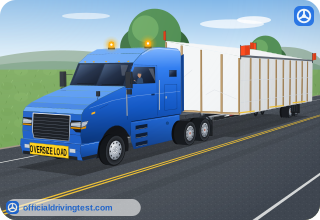
- A written escort-car contract
- A photo of the signs and flags as mounted
- The permits for the oversize load
Show answer
Correct answer: The permits for the oversize load
An oversize vehicle needs its signs, flags and extra lights properly mounted, and the driver must carry every required permit.
Source: CDL manual, national model as printed by New Jersey, Sections 1 to 3 (July 2017)
-
Which kind of battery does NOT need its fluid level checked during the inspection?
- Any battery in a battery box
- A battery with a secure cover
- A maintenance-free battery
Show answer
Correct answer: A maintenance-free battery
The fluid level check and the cell cap checks do not apply to maintenance-free batteries.
Source: CDL manual, national model as printed by New Jersey, Sections 1 to 3 (July 2017)
-
You are checking the signal lights. How can you turn on the stop lights?
- Set the parking brake on the tractor and wait
- Use the trailer hand brake or ask a helper to press the pedal
- Pull the headlight switch to its first stop and wait
Show answer
Correct answer: Use the trailer hand brake or ask a helper to press the pedal
Apply the trailer hand brake, or have a helper press the brake pedal, so the stop lights are on when you get out and check them.
Source: CDL manual, national model as printed by New Jersey, Sections 1 to 3 (July 2017)
-
Before you start the engine, which paperwork should you make sure you have in the cab?
- Trip manifests and permits
- Fuel receipts and the last repair invoice
- The route map and the loading dock log
Show answer
Correct answer: Trip manifests and permits
Check that you carry every required paper, including trip manifests and permits, before you drive.
Source: CDL manual, national model as printed by New Jersey, Sections 1 to 3 (July 2017)
-
Why should you secure loose articles in the cab before you start the engine?
- They can drain the battery while you drive the route
- They can block the heater vents and fog the windshield
- They can block a control or strike you in a collision
Show answer
Correct answer: They can block a control or strike you in a collision
Loose items can interfere with the controls, and they can strike you if you crash.
Source: CDL manual, national model as printed by New Jersey, Sections 1 to 3 (July 2017)
5Part 517 questions
-
To test for hydraulic leaks, how many times do you pump the brake pedal first?
- Three times
- Five times
- Ten times
Show answer
Correct answer: Three times
Pump the pedal three times, then press firmly and hold it to see whether it sinks.
Source: CDL manual, national model as printed by New Jersey, Sections 1 to 3 (July 2017)
-
After pumping a hydraulic brake pedal, how long do you hold firm pressure on it?
- Five seconds
- Two seconds
- Fifteen seconds
Show answer
Correct answer: Five seconds
Keep firm pressure on the pedal for five seconds; a pedal that stays put is what you want to see.
Source: CDL manual, national model as printed by New Jersey, Sections 1 to 3 (July 2017)
-
You hold firm pressure on a hydraulic brake pedal and it slowly sinks. What does that suggest?
- The brakes are working normally
- The brake lining is newly adjusted and fine
- A leak or another problem in the brake system
Show answer
Correct answer: A leak or another problem in the brake system
The pedal should stay still under firm pressure. If it moves, there may be a leak or another problem to fix before driving.
Source: CDL manual, national model as printed by New Jersey, Sections 1 to 3 (July 2017)
-
What do you do first when you begin testing the parking brake?
- Fasten your safety belt
- Place the vehicle in a low gear
- Release the trailer parking brake
Show answer
Correct answer: Fasten your safety belt
Before testing the parking brake, fasten your safety belt.
Source: CDL manual, national model as printed by New Jersey, Sections 1 to 3 (July 2017)
-
How do you test whether the parking brake holds the vehicle?
- Push the brake pedal hard in a low gear
- Pull forward hard against it in a high gear
- Pull gently forward against it in a low gear
Show answer
Correct answer: Pull gently forward against it in a low gear
With the parking brake set and the vehicle in a low gear, pull forward gently. The brake should hold the vehicle in place.
Source: CDL manual, national model as printed by New Jersey, Sections 1 to 3 (July 2017)
-
How do you test the trailer's parking brake on its own?
- Set the trailer brake and release the power unit's parking brakes
- Set both parking brakes and shift to neutral
- Release the trailer brake and set the power unit's brakes
Show answer
Correct answer: Set the trailer brake and release the power unit's parking brakes
Test the trailer alone by setting its parking brake while the power unit's parking brakes are released.
Source: CDL manual, national model as printed by New Jersey, Sections 1 to 3 (July 2017)
-
During the test, the parking brake does not hold the vehicle. What should be done?
- Get the faulty brake fixed
- Chock the wheels and continue the trip
- Report it at the end of the trip and drive on
Show answer
Correct answer: Get the faulty brake fixed
A parking brake that does not hold the vehicle is faulty and has to be repaired.
Source: CDL manual, national model as printed by New Jersey, Sections 1 to 3 (July 2017)
-
At about what speed do you test the stopping action of the service brake?
- 25 miles per hour
- 5 miles per hour
- 15 miles per hour
Show answer
Correct answer: 5 miles per hour
Move at about five miles per hour and push the brake pedal firmly to check the stopping action.
Source: CDL manual, national model as printed by New Jersey, Sections 1 to 3 (July 2017)
-
During the brake test, the vehicle pulls to one side. What can this mean?
- Trouble with the brakes
- The fuel tank is nearly empty
- The road crown is too steep
Show answer
Correct answer: Trouble with the brakes
Pulling to the left or right when you brake can be a sign of brake trouble.
Source: CDL manual, national model as printed by New Jersey, Sections 1 to 3 (July 2017)
-
Which signs during the brake test can mean there is a problem?
- The pedal feels firm and the vehicle stops straight
- The vehicle stops within one truck length
- An unusual pedal feel or a delay before the vehicle stops
Show answer
Correct answer: An unusual pedal feel or a delay before the vehicle stops
An unusual pedal feel or a delayed stopping action can both point to brake trouble.
Source: CDL manual, national model as printed by New Jersey, Sections 1 to 3 (July 2017)
-
You find something unsafe during your inspection. What must you do?
- Drive carefully and report it at the end of the trip
- Continue if it is a small problem and the load is light
- Get it fixed, because the law forbids operating an unsafe vehicle
Show answer
Correct answer: Get it fixed, because the law forbids operating an unsafe vehicle
Unsafe items must be repaired, since both federal and state law prohibit driving an unsafe vehicle.
Source: CDL manual, national model as printed by New Jersey, Sections 1 to 3 (July 2017)
-
Which group of items should a driver keep checking at regular times on the road?
- Spare fuses, triangles and fire extinguisher
- Gauges, mirrors, tires and cargo covers
- Fluid levels under the hood and belt tension
Show answer
Correct answer: Gauges, mirrors, tires and cargo covers
On the road a driver keeps watching the gauges, mirrors, tires, cargo and cargo covers, and lights, not only before the trip.
Source: CDL manual, national model as printed by New Jersey, Sections 1 to 3 (July 2017)
-
While driving, you notice an unusual smell or a strange vibration. What should you do?
- Note it for the after-trip report and keep driving
- Check it only if a gauge also shows a problem
- Look into the cause of it right away
Show answer
Correct answer: Look into the cause of it right away
Anything you see, hear, smell or feel that might mean trouble should be checked out, not ignored.
Source: CDL manual, national model as printed by New Jersey, Sections 1 to 3 (July 2017)
-
A truck driver is hauling cargo. How soon after the trip begins must the driver first check that the cargo is secure?
- Within the first 25 miles
- Within the first 100 miles
- Within the first 50 miles
Show answer
Correct answer: Within the first 50 miles
A driver carrying cargo in a truck or truck tractor must check the cargo securement within the first 50 miles of the trip.
Source: CDL manual, national model as printed by New Jersey, Sections 1 to 3 (July 2017)
-
After the first cargo securement check, how often must a truck driver check the cargo again?
- Every 200 miles or four hours, whichever is first
- Every 150 miles or three hours, whichever is first
- Every 300 miles or five hours, whichever is first
Show answer
Correct answer: Every 150 miles or three hours, whichever is first
Once the first check is done, check the cargo again after 150 miles of driving or three hours, whichever passes first.
Source: CDL manual, national model as printed by New Jersey, Sections 1 to 3 (July 2017)
-
How often may a driver be required to write a report on the condition of the vehicles driven?
- Each day
- Once a week
- Once a month
Show answer
Correct answer: Each day
A driver may have to write a report on the condition of the vehicle or vehicles driven every day.
Source: CDL manual, national model as printed by New Jersey, Sections 1 to 3 (July 2017)
-
What kinds of problems belong in a driver's end-of-day report on the vehicle?
- Only problems that already forced the vehicle to stop
- Any problem that affects safety or could cause a breakdown
- Only problems the motor carrier has already heard about
Show answer
Correct answer: Any problem that affects safety or could cause a breakdown
The report should list anything that affects safety or could lead to a mechanical breakdown, even if the vehicle still runs.
Source: CDL manual, national model as printed by New Jersey, Sections 1 to 3 (July 2017)
-
Only in Alabama's manual
Which of these is a critical item to check each time you stop during a trip?
- The cargo securement devices
- The condition of the seat upholstery
- The radio and antenna
Show answer
Correct answer: The cargo securement devices
Stops are the time to look at tires, wheels, brakes, lights, trailer connections, coupling devices and the devices that hold the cargo in place.
Source: CDL manual, national model as printed by New Jersey, Sections 1 to 3 (July 2017)
-
Only in Alaska's manual
During a trip, when should you check critical items such as the brakes, lights, trailer couplings and cargo securement devices?
- Only before the trip starts
- Only at the end of the workday
- Each time you stop
Show answer
Correct answer: Each time you stop
Stops during a trip are the time to check critical items: the tires, wheels and rims, the brakes, the lights and reflectors, the trailer connections and couplings, and the cargo securement devices.
Source: CDL manual, national model as printed by New Jersey, Sections 1 to 3 (July 2017)
-
Only in Alaska's manual
When you inspect the fuel tanks, what must you confirm besides having enough fuel?
- The caps are on and secure
- The caps are off to let the tanks vent
- The tank drain valves are open
Show answer
Correct answer: The caps are on and secure
Fuel tanks must hold enough fuel, and their caps must be on and secure.
Source: CDL manual, national model as printed by New Jersey, Sections 1 to 3 (July 2017)