General Knowledge: Basic control and shifting gears — Part 1
Questions in this part include: “When should a commercial driver have the seatbelt fastened?” · “With a manual transmission, when do you push the clutch in while stopping?”
Independent educational site · not affiliated with any government agency or DMV
Ready? Test yourself
Answer to start, or tap Start below:
When should a commercial driver have the seatbelt fastened?
- Instant feedback with an explanation
- Every answer cites its source in the manual
- Your best score is saved on this device
- Keyboard: press 1 to 3 to answer and Enter for the next question
Questions are written in our own words from the CDL manual; they are not the real test's questions. With your state chosen, every answer gives its page in your state's CDL manual. Without a state, answers cite the CDL manual, national model as printed by New Jersey (July 2017).
All 23 questions in this practice test
Take the test above first, then use this list to study. Tap “Show answer” to see the correct answer and explanation.
Show the questions and answersHide the questions
-
When should a commercial driver have the seatbelt fastened?
- Only when driving on a highway
- Whenever the vehicle is on the road
- Only when carrying a loaded trailer
Show answer
Correct answer: Whenever the vehicle is on the road
The seatbelt is fastened any time you are driving on the road, not only in certain places or with certain loads.
Source: CDL manual, national model as printed by New Jersey, Sections 1 to 3 (July 2017)
-
What should you do with the parking brake before you walk away from your vehicle?
- Leave it off so the brakes do not stick
- Apply it every time you leave the vehicle
- Apply it only if you are on a slope
Show answer
Correct answer: Apply it every time you leave the vehicle
Apply the parking brake whenever you leave your vehicle.
Source: CDL manual, national model as printed by New Jersey, Sections 1 to 3 (July 2017)
-
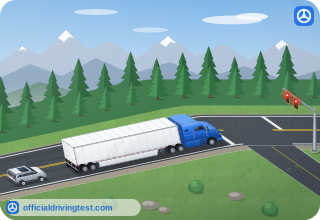
You drive a manual transmission and start moving from a stop on a slope. What helps keep the vehicle from rolling back?
- Take your foot off the brake, then find the clutch
- Partly engage the clutch before leaving the brake
- Shift to neutral before leaving the brake pedal
Show answer
Correct answer: Partly engage the clutch before leaving the brake
Partly engaging the clutch while your foot is still on the brake keeps the vehicle from rolling back into someone behind you.
Source: CDL manual, national model as printed by New Jersey, Sections 1 to 3 (July 2017)
-
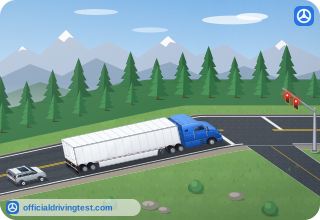
When is it right to release the parking brake while starting uphill?
- Before you touch the accelerator, to avoid brake wear
- Once you have applied enough engine power to hold the vehicle
- Right after you shift into the starting gear
Show answer
Correct answer: Once you have applied enough engine power to hold the vehicle
Release the parking brake only after you have enough engine power applied, so the vehicle does not roll backward.
Source: CDL manual, national model as printed by New Jersey, Sections 1 to 3 (July 2017)
-
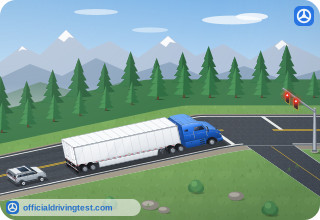
A tractor-trailer has a trailer brake hand valve. How can it help when you start moving?
- It replaces the parking brake when you leave the cab
- Setting it holds the rig so it does not roll backward
- It keeps the trailer from jackknifing on a curve
Show answer
Correct answer: Setting it holds the rig so it does not roll backward
Applying the trailer brake hand valve holds the combination in place so it does not roll backward as you start.
Source: CDL manual, national model as printed by New Jersey, Sections 1 to 3 (July 2017)
-
How should you speed up a commercial vehicle?
- As quickly as the engine allows, then level off
- Smoothly, adding speed in a gradual way
- In steps, pausing between each increase in speed
Show answer
Correct answer: Smoothly, adding speed in a gradual way
Smooth, gradual acceleration keeps the vehicle from jerking. Rough acceleration can cause mechanical damage.
Source: CDL manual, national model as printed by New Jersey, Sections 1 to 3 (July 2017)
-
What can harsh acceleration damage when you are pulling a trailer?
- The landing gear that supports the trailer
- The trailer's tires and the road surface
- The coupling between the vehicle and the trailer
Show answer
Correct answer: The coupling between the vehicle and the trailer
Rough acceleration puts a heavy strain on the coupling, so you should speed up smoothly and gradually.
Source: CDL manual, national model as printed by New Jersey, Sections 1 to 3 (July 2017)
-
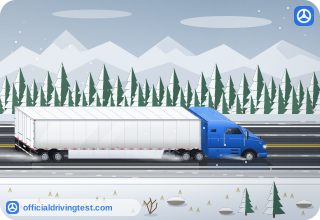
How should you accelerate when traction is poor, such as in rain or snow?
- Steadily, with the same power used on dry roads
- Very gradually, adding power a little at a time
- Normally, but with the clutch partly engaged
Show answer
Correct answer: Very gradually, adding power a little at a time
On a slippery road, add speed very gradually. Using too much power can make the drive wheels spin.
Source: CDL manual, national model as printed by New Jersey, Sections 1 to 3 (July 2017)
-
You are pulling away on a snowy road and the drive wheels start to spin. What should you do?
- Shift up one gear to cut the power
- Take your foot off the accelerator
- Hold the accelerator still until they grip
Show answer
Correct answer: Take your foot off the accelerator
Too much power can make the drive wheels spin, and you could lose control. When they start spinning, ease off the accelerator completely.
Source: CDL manual, national model as printed by New Jersey, Sections 1 to 3 (July 2017)
-
How should you hold the steering wheel?
- With one hand on top and the other free
- With both hands firmly on opposite sides
- With both hands close together at the top
Show answer
Correct answer: With both hands firmly on opposite sides
A firm two-handed grip on opposite sides stops the wheel from being yanked out of your hands when a wheel strikes a curb or a pothole.
Source: CDL manual, national model as printed by New Jersey, Sections 1 to 3 (July 2017)
-
What decides how much brake pressure you need for a normal stop?
- The vehicle's speed and how quickly you must stop
- The type of tires and the width of the lane
- The engine size and the outside temperature
Show answer
Correct answer: The vehicle's speed and how quickly you must stop
The pressure you need depends on your speed and how fast you need to stop. Push the pedal down gradually for a smooth, safe stop.
Source: CDL manual, national model as printed by New Jersey, Sections 1 to 3 (July 2017)
-
With a manual transmission, when do you push the clutch in while stopping?
- As soon as you begin to press the brake pedal
- Only after the vehicle has come to a full stop
- When the engine is close to idle
Show answer
Correct answer: When the engine is close to idle
Push the clutch in when the engine speed has dropped close to idle, as you finish bringing the vehicle to a stop.
Source: CDL manual, national model as printed by New Jersey, Sections 1 to 3 (July 2017)
-
Why should you try to park so that you can pull forward when you leave?
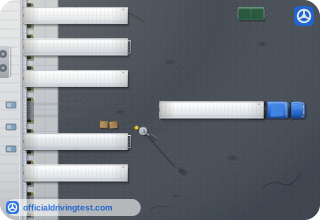
- Backing is always dangerous because you cannot see everything behind
- Pulling forward saves fuel when the engine is cold
- Backing wears out the transmission faster than driving forward
Show answer
Correct answer: Backing is always dangerous because you cannot see everything behind
You cannot see everything behind the vehicle, so backing is always dangerous. Park so you can drive out forward.
Source: CDL manual, national model as printed by New Jersey, Sections 1 to 3 (July 2017)
-
What decides the best starting position for a backing move?
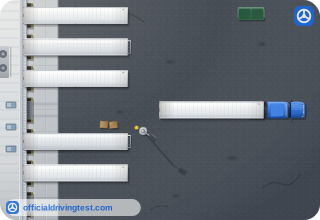
- The weight of the cargo you are carrying
- The type of backing you are going to do
- Whether the trailer has air brakes or not
Show answer
Correct answer: The type of backing you are going to do
The best spot to begin a safe backing move depends on what kind of backing you need to do.
Source: CDL manual, national model as printed by New Jersey, Sections 1 to 3 (July 2017)
-
Before you back up, what should you do about your path?
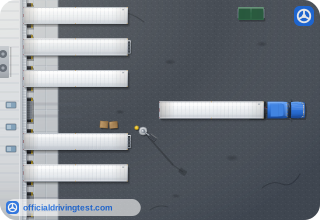
- Get out, walk around, and check clearance to the sides and overhead
- Sound the horn twice and begin backing when nobody answers
- Check the mirrors once and then back at a steady pace
Show answer
Correct answer: Get out, walk around, and check clearance to the sides and overhead
Walking around the vehicle lets you see obstacles and low clearances in and near the path before you start to move.
Source: CDL manual, national model as printed by New Jersey, Sections 1 to 3 (July 2017)
-
While backing, you cannot be sure the path is clear. What should you do?
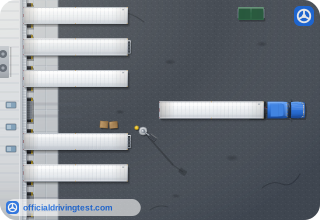
- Back slowly and rely on the horn
- Keep going and watch only the driver's side mirror
- Stop, step out, and look over the path yourself
Show answer
Correct answer: Stop, step out, and look over the path yourself
Check the outside mirrors on both sides often, and if you are unsure, step out and look at the path yourself.
Source: CDL manual, national model as printed by New Jersey, Sections 1 to 3 (July 2017)
-
Which gear should you use when backing, and why?
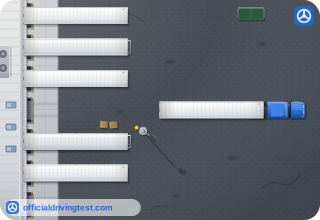
- The lowest reverse gear, so errors are easy to correct
- The highest reverse gear, to finish the move sooner
- Neutral, rolling back with the brakes lightly applied
Show answer
Correct answer: The lowest reverse gear, so errors are easy to correct
The lowest reverse gear keeps your speed as slow as possible. That makes steering errors easier to fix and lets you stop quickly.
Source: CDL manual, national model as printed by New Jersey, Sections 1 to 3 (July 2017)
-
Which direction is safest to turn when you back up, if you have a choice?
- Toward the passenger side, near the curb
- Either side, since the mirrors show both equally
- Toward the driver's side, where you see better
Show answer
Correct answer: Toward the driver's side, where you see better
Backing toward the driver's side lets you watch the rear of the vehicle through the side window. Even going around the block to set this up is worth it.
Source: CDL manual, national model as printed by New Jersey, Sections 1 to 3 (July 2017)
-
Getting into position to back toward the driver's side means driving around the block. What should you do?
- Back toward the right side to save time
- Go around it; the safer view is worth it
- Back straight in without turning at all
Show answer
Correct answer: Go around it; the safer view is worth it
Driver-side backing gives you a better view, so it is worth going around the block to set it up.
Source: CDL manual, national model as printed by New Jersey, Sections 1 to 3 (July 2017)
-
What is the main reason to use a helper when you back up?
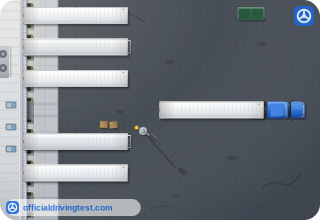
- A helper lets you skip checking your mirrors
- Some blind spots cannot be seen from the driver's seat
- Most states require a helper for every backing move
Show answer
Correct answer: Some blind spots cannot be seen from the driver's seat
There are blind spots you cannot see from the cab, so a helper is important whenever you can have one.
Source: CDL manual, national model as printed by New Jersey, Sections 1 to 3 (July 2017)
-
Where should a helper stand while you are reversing?
- Beside the driver's door so you can talk
- In front of the cab, facing the driver
- Near the rear of your vehicle
Show answer
Correct answer: Near the rear of your vehicle
A helper near the rear can see the blind spots you cannot, and the helper should stand where you can see them.
Source: CDL manual, national model as printed by New Jersey, Sections 1 to 3 (July 2017)
-
When should you and your helper agree on hand signals for backing?
- After the first few feet of movement
- Before you begin backing
- Only if the mirrors are not working
Show answer
Correct answer: Before you begin backing
Agree on hand signals, including one for stop, before backing starts, so both of you understand each other during the move.
Source: CDL manual, national model as printed by New Jersey, Sections 1 to 3 (July 2017)
-
What is the result if you cannot get the vehicle into the right gear while driving?
- You will have less control
- You will use less fuel
- You will have more braking power
Show answer
Correct answer: You will have less control
Shifting correctly matters because the wrong gear leaves you with less control of the vehicle.
Source: CDL manual, national model as printed by New Jersey, Sections 1 to 3 (July 2017)