General Knowledge: Vehicle inspection — Part 3
Questions in this part include: “How soon after the engine starts should the oil pressure gauge reach normal?” · “What must be true of the fire extinguisher during the safety equipment check?”
Independent educational site · not affiliated with any government agency or DMV
Ready? Test yourself
Answer to start, or tap Start below:
How soon after the engine starts should the oil pressure gauge reach normal?
- Instant feedback with an explanation
- Every answer cites its source in the manual
- Your best score is saved on this device
- Keyboard: press 1 to 3 to answer and Enter for the next question
Questions are written in our own words from the CDL manual; they are not the real test's questions. With your state chosen, every answer gives its page in your state's CDL manual. Without a state, answers cite the CDL manual, national model as printed by New Jersey (July 2017).
All 17 questions in this practice test
Take the test above first, then use this list to study. Tap “Show answer” to see the correct answer and explanation.
Show the questions and answersHide the questions
-
How soon after the engine starts should the oil pressure gauge reach normal?
- Within seconds
- After the engine has warmed up for several minutes
- Only after the vehicle starts moving
Show answer
Correct answer: Within seconds
A healthy engine shows normal oil pressure a few seconds after starting.
Source: CDL manual, national model as printed by New Jersey, Sections 1 to 3 (July 2017)
-
With the engine running, how fast should air pressure rise from 50 to 90 psi?
- Within 30 seconds
- Within 3 minutes
- Within 10 minutes
Show answer
Correct answer: Within 3 minutes
The pressure should climb from 50 psi to 90 psi in no more than 3 minutes.
Source: CDL manual, national model as printed by New Jersey, Sections 1 to 3 (July 2017)
-
At about what pressure does the air governor usually cut out?
- Around 90 to 100 psi
- Around 120 to 140 psi
- Around 160 to 180 psi
Show answer
Correct answer: Around 120 to 140 psi
The governor usually cuts out at about 120 to 140 psi, but you should know your own vehicle's requirement.
Source: CDL manual, national model as printed by New Jersey, Sections 1 to 3 (July 2017)
-
What should the ammeter or voltmeter show once the engine is running?
- A reading at the top of the scale
- A reading in the normal range
- A reading near zero until you drive
Show answer
Correct answer: A reading in the normal range
The charging gauge should sit in its normal range after the engine starts.
Source: CDL manual, national model as printed by New Jersey, Sections 1 to 3 (July 2017)
-
What should the coolant temperature gauge do after the engine starts?
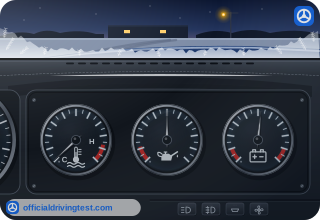
- Jump to the top of the range right away
- Rise gradually toward the normal range
- Stay at the bottom until you start driving
Show answer
Correct answer: Rise gradually toward the normal range
Coolant temperature should rise gradually into the normal operating range.
Source: CDL manual, national model as printed by New Jersey, Sections 1 to 3 (July 2017)
-
After the engine starts, what should the oil, coolant, charging, and ABS warning lights do?
- Go out right away
- Stay lit until the engine is fully warm
- Flash for about a minute
Show answer
Correct answer: Go out right away
These warning lights should turn off right away after the engine starts.
Source: CDL manual, national model as printed by New Jersey, Sections 1 to 3 (July 2017)
-
When you check the controls in the cab, what problems do you look for?
- Faded labels, dust, or odd colors on them
- Fresh paint, clean labels, and a new cover
- Looseness, sticking, damage, or bad setting
Show answer
Correct answer: Looseness, sticking, damage, or bad setting
Each control should be checked for being loose, stuck, damaged, or set wrongly.
Source: CDL manual, national model as printed by New Jersey, Sections 1 to 3 (July 2017)
-
What should you look for when you inspect the mirrors and windshield?
- Water spots, scratches, and the age of the glass
- Cracks, dirt, illegal stickers, or a blocked view
- Tint level, glass brand, and where it was made
Show answer
Correct answer: Cracks, dirt, illegal stickers, or a blocked view
Cracks, dirt, illegal stickers, and other obstructions can keep you from seeing clearly, so clean and adjust as needed.
Source: CDL manual, national model as printed by New Jersey, Sections 1 to 3 (July 2017)
-
What must be true of the fire extinguisher during the safety equipment check?
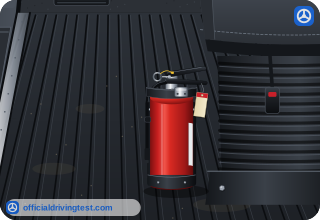
- It is properly charged and rated
- It is mounted outside the cab
- It was inspected within the month
Show answer
Correct answer: It is properly charged and rated
The extinguisher must be properly charged and properly rated.
Source: CDL manual, national model as printed by New Jersey, Sections 1 to 3 (July 2017)
-
Which condition means a safety belt passes your inspection?
- It is clean and has been replaced within the year
- Secure, adjustable, latches, and not frayed
- It is long enough to reach across the passenger seat
Show answer
Correct answer: Secure, adjustable, latches, and not frayed
A belt passes when it is firmly mounted, can be adjusted, latches, and shows no rips or fraying.
Source: CDL manual, national model as printed by New Jersey, Sections 1 to 3 (July 2017)
-
In Step 4 of the inspection, you set the parking brake and shut the engine off. What do you do with the ignition key before you get out?
- Leave it in the switch in the off position
- Hand it to a helper who stays inside the cab
- Take it with you when you leave the cab
Show answer
Correct answer: Take it with you when you leave the cab
The key goes with you when you get out, as part of shutting the vehicle down before the walk-around.
Source: CDL manual, national model as printed by New Jersey, Sections 1 to 3 (July 2017)
-
Which lights do you switch on in Step 4, before you get out to start the walk-around?
- High beam headlights and the right turn signal
- Only the parking and clearance lights
- Low beam headlights and the four-way flashers
Show answer
Correct answer: Low beam headlights and the four-way flashers
You switch on the low beams and the four-way flashers, then check them from the front of the vehicle.
Source: CDL manual, national model as printed by New Jersey, Sections 1 to 3 (July 2017)
-
How do you make the high beams come on so you can check them?
- Press the dimmer switch
- Switch on the four-way flashers
- Turn on the clearance lights
Show answer
Correct answer: Press the dimmer switch
Pressing the dimmer switch lets you see whether the high beams light.
Source: CDL manual, national model as printed by New Jersey, Sections 1 to 3 (July 2017)
-
Just before you start the walk-around, which signal do you switch on?
- The four-way flashers
- The high beam headlights
- The right turn signal
Show answer
Correct answer: The right turn signal
You turn on the right turn signal and then begin the walk-around.
Source: CDL manual, national model as printed by New Jersey, Sections 1 to 3 (July 2017)
-
When do you clean the lights, reflectors and glass during the inspection?
- Before you start the engine in Step 3
- After you finish checking the signal lights
- As you reach each one on the walk-around
Show answer
Correct answer: As you reach each one on the walk-around
Wipe each light, reflector and window as you reach it on the walk-around.
Source: CDL manual, national model as printed by New Jersey, Sections 1 to 3 (July 2017)
-
You see rust streaks around some lug nuts on a front wheel. What does this suggest, and what do you do?
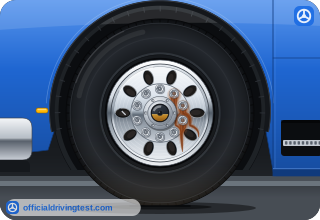
- The nuts are over-tightened, so leave them alone
- The hub seal is leaking, so check the oil
- The nuts may be loose, so test them with a wrench
Show answer
Correct answer: The nuts may be loose, so test them with a wrench
Rust streaks around lug nuts point to looseness, so you test those nuts with a wrench.
Source: CDL manual, national model as printed by New Jersey, Sections 1 to 3 (July 2017)
-
At the front of the vehicle, how must you check the steering mechanism for looseness?
- Look at it closely with a flashlight
- Take hold of it and test it by hand
- Look for fresh grease on the joints
Show answer
Correct answer: Take hold of it and test it by hand
You have to take hold of the steering parts by hand to feel for play.
Source: CDL manual, national model as printed by New Jersey, Sections 1 to 3 (July 2017)