General Knowledge: Vehicle inspection — Part 2
Questions in this part include: “Why is a broken exhaust system a danger to the driver?” · “Who must repair safety-related defects found on a vehicle inspection report?”
Independent educational site · not affiliated with any government agency or DMV
Ready? Test yourself
Answer to start, or tap Start below:
Why is a broken exhaust system a danger to the driver?
- Instant feedback with an explanation
- Every answer cites its source in the manual
- Your best score is saved on this device
- Keyboard: press 1 to 3 to answer and Enter for the next question
Questions are written in our own words from the CDL manual; they are not the real test's questions. With your state chosen, every answer gives its page in your state's CDL manual. Without a state, answers cite the CDL manual, national model as printed by New Jersey (July 2017).
All 18 questions in this practice test
Take the test above first, then use this list to study. Tap “Show answer” to see the correct answer and explanation.
Show the questions and answersHide the questions
-
Why is a broken exhaust system a danger to the driver?
- Poison fumes may leak into the cab or berth
- It can make the engine overheat very quickly
- It can let fuel drain slowly from the tank
Show answer
Correct answer: Poison fumes may leak into the cab or berth
A damaged exhaust can allow poisonous fumes to get into the cab or sleeper berth.
Source: CDL manual, national model as printed by New Jersey, Sections 1 to 3 (July 2017)
-
When does a vehicle not need to carry spare electrical fuses?
- When it has circuit breakers
- When it has a fire extinguisher
- When it is on a short trip
Show answer
Correct answer: When it has circuit breakers
Spare fuses are required unless the vehicle is equipped with circuit breakers.
Source: CDL manual, national model as printed by New Jersey, Sections 1 to 3 (July 2017)
-
If a vehicle uses reflective triangles as its warning devices for parked vehicles, how many must it carry?
- Three
- Two
- Six
Show answer
Correct answer: Three
A vehicle can carry three reflective triangles as warning devices for when it is parked. Other options are at least six fusees (road flares) or three liquid burning flares.
Source: CDL manual, national model as printed by New Jersey, Sections 1 to 3 (July 2017)
-
Before each trip, what must you make sure about the cargo on a truck?
- It is balanced and secured, and the truck is not overloaded
- It is sorted by weight and labeled
- It is covered and the truck is parked on level ground
Show answer
Correct answer: It is balanced and secured, and the truck is not overloaded
Before every trip you must be sure the truck is not overloaded and that the cargo is balanced and secured.
Source: CDL manual, national model as printed by New Jersey, Sections 1 to 3 (July 2017)
-
Your cargo includes hazardous materials. What must you inspect for?
- A second fire extinguisher
- Proper papers and placarding
- Extra tire tread depth
Show answer
Correct answer: Proper papers and placarding
With hazardous materials on board, you must check that the proper papers and placards are in place.
Source: CDL manual, national model as printed by New Jersey, Sections 1 to 3 (July 2017)
-
Why should you inspect your vehicle in the same order every time?
- The inspector expects the same order on every vehicle
- It saves time by letting you skip steps you checked yesterday
- You learn the steps well and are less likely to skip one
Show answer
Correct answer: You learn the steps well and are less likely to skip one
A fixed routine helps you learn every step, so you are less likely to forget something.
Source: CDL manual, national model as printed by New Jersey, Sections 1 to 3 (July 2017)
-
As you walk up to the vehicle, what body condition should catch your eye?
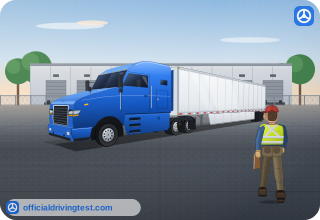
- Damage, or leaning to one side
- Frost on the windshield
- A low fuel level on the tank gauge
Show answer
Correct answer: Damage, or leaning to one side
A damaged body or a vehicle that leans to one side can point to a problem, so look for both on approach.
Source: CDL manual, national model as printed by New Jersey, Sections 1 to 3 (July 2017)
-
As you walk up to your vehicle, what should you look for underneath it?
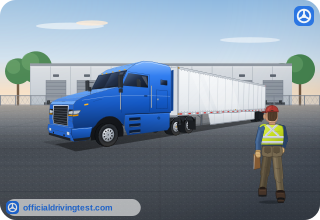
- Worn paint and small dents on the lower body
- Fresh oil, coolant, grease, or fuel leaks
- Loose cargo straps lying on the ground
Show answer
Correct answer: Fresh oil, coolant, grease, or fuel leaks
Fresh fluid under the vehicle shows a leak. Look for oil, coolant, grease, or fuel.
Source: CDL manual, national model as printed by New Jersey, Sections 1 to 3 (July 2017)
-
When you first approach the vehicle, what else should you check around it?
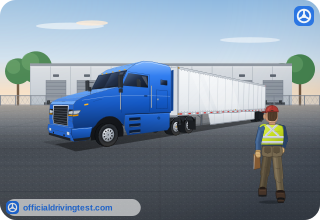
- Whether the ground is dry enough to walk on
- Hazards such as people, objects, or low wires
- Whether the parking lot has marked spaces
Show answer
Correct answer: Hazards such as people, objects, or low wires
Look around for anything that could block or hit the vehicle when it moves, such as people, other vehicles, objects, wires, and limbs.
Source: CDL manual, national model as printed by New Jersey, Sections 1 to 3 (July 2017)
-
Who must repair safety-related defects found on a vehicle inspection report?
- The motor carrier
- The driver who wrote the report
- The next driver who uses the vehicle
Show answer
Correct answer: The motor carrier
Safety defects are fixed by the carrier, which then records on the report that the work was done or not needed.
Source: CDL manual, national model as printed by New Jersey, Sections 1 to 3 (July 2017)
-
When may you sign the last vehicle inspection report?
- Whenever you have read the report from top to bottom
- As soon as the carrier hands it to you, before any repair
- Only if defects were certified as repaired or not needed
Show answer
Correct answer: Only if defects were certified as repaired or not needed
Sign only when any defects in the report have been certified as fixed or as not needing repair.
Source: CDL manual, national model as printed by New Jersey, Sections 1 to 3 (July 2017)
-
What should you confirm before you open the engine compartment?
- The parking brake is on or the wheels are chocked
- The tires are cold and the lights are off
- The engine is running at a fast idle
Show answer
Correct answer: The parking brake is on or the wheels are chocked
Before working in the engine area, make sure the parking brake is on, the wheels are chocked, or both.
Source: CDL manual, national model as printed by New Jersey, Sections 1 to 3 (July 2017)
-
Before you tilt the cab to see the engine, what should you do?
- Start the engine so the fluids warm up
- Secure loose items so they cannot fall
- Remove the battery so it cannot spill
Show answer
Correct answer: Secure loose items so they cannot fall
Items left loose in the cab can fall when it tilts and break something, so secure them first.
Source: CDL manual, national model as printed by New Jersey, Sections 1 to 3 (July 2017)
-
When you check the alternator, water pump, and air compressor belts, what should you know?
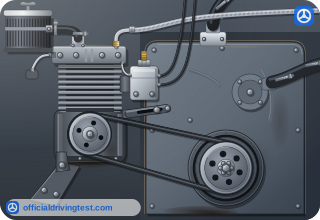
- How many belts the engine should have in total
- How loud each belt should sound while the engine runs
- How much give each belt should have when properly adjusted
Show answer
Correct answer: How much give each belt should have when properly adjusted
Belts need the right tightness and little wear, so learn how much they should give when adjusted correctly.
Source: CDL manual, national model as printed by New Jersey, Sections 1 to 3 (July 2017)
-
Before starting the engine, where do you put the gearshift?
- In first gear, with the clutch released
- In neutral, or in park if it is an automatic
- In reverse, to hold the vehicle in place
Show answer
Correct answer: In neutral, or in park if it is an automatic
Start the engine with the gearshift in neutral, or in park on an automatic.
Source: CDL manual, national model as printed by New Jersey, Sections 1 to 3 (July 2017)
-
What should you listen for right after you start the engine?
- The sound of the fuel pump priming
- Gear whine from the transmission
- Unusual noises
Show answer
Correct answer: Unusual noises
Unusual engine noises at start-up can signal a problem, so listen as it starts.
Source: CDL manual, national model as printed by New Jersey, Sections 1 to 3 (July 2017)
-
On a vehicle with ABS, what does it mean if the dash light stays on after the engine starts?
- The ABS is working and ready
- The ABS is not working properly
- The air pressure is still building
Show answer
Correct answer: The ABS is not working properly
The ABS dash light should come on briefly and go off. If it stays on, the system is not working properly.
Source: CDL manual, national model as printed by New Jersey, Sections 1 to 3 (July 2017)
-
A trailer has a yellow ABS light on its left side, and it stays on. What does that tell you?
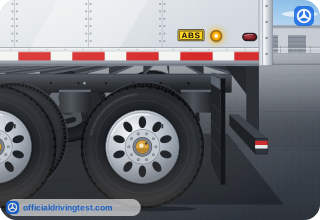
- The trailer brakes are running hot
- The trailer is coupled incorrectly
- The trailer ABS is not working properly
Show answer
Correct answer: The trailer ABS is not working properly
A yellow ABS lamp on the trailer that stays lit means its antilock system has a fault.
Source: CDL manual, national model as printed by New Jersey, Sections 1 to 3 (July 2017)