General Knowledge: Vehicle inspection — Part 1
Questions in this part include: “What is the most important reason a driver inspects the vehicle?” · “During a tire check, what should you never be able to see through the tread or the sidewall?”
Independent educational site · not affiliated with any government agency or DMV
Ready? Test yourself
Answer to start, or tap Start below:
What is the most important reason a driver inspects the vehicle?
- Instant feedback with an explanation
- Every answer cites its source in the manual
- Your best score is saved on this device
- Keyboard: press 1 to 3 to answer and Enter for the next question
Questions are written in our own words from the CDL manual; they are not the real test's questions. With your state chosen, every answer gives its page in your state's CDL manual. Without a state, answers cite the CDL manual, national model as printed by New Jersey (July 2017).
All 18 questions in this practice test
Take the test above first, then use this list to study. Tap “Show answer” to see the correct answer and explanation.
Show the questions and answersHide the questions
-
What is the most important reason a driver inspects the vehicle?
- To avoid fines at weigh stations
- To keep repair bills as low as possible
- To protect yourself and others
Show answer
Correct answer: To protect yourself and others
Safety comes first: an inspection protects the driver and everyone else on the road.
Source: CDL manual, national model as printed by New Jersey, Sections 1 to 3 (July 2017)
-
Where does the requirement for a driver to inspect the vehicle come from?
- Only the insurance company's policy
- Only the employer's own rules
- Federal and state laws
Show answer
Correct answer: Federal and state laws
Both federal and state laws require drivers to inspect their vehicles, so it is not just company policy.
Source: CDL manual, national model as printed by New Jersey, Sections 1 to 3 (July 2017)
-
A federal or state inspector decides your vehicle is unsafe. What happens to the vehicle?
- It is placed out of service until it is fixed
- It may finish the trip and be repaired afterward
- It is given a warning and sent back on the road
Show answer
Correct answer: It is placed out of service until it is fixed
When inspectors decide a vehicle is unsafe, it is taken out of service and stays that way until the defect is repaired.
Source: CDL manual, national model as printed by New Jersey, Sections 1 to 3 (July 2017)
-
What kind of problems can a vehicle inspection help a driver find?
- Defects that might cause a crash or breakdown
- Ways to lower the vehicle's fuel costs
- Problems that only a mechanic's shop can find
Show answer
Correct answer: Defects that might cause a crash or breakdown
An inspection is meant to catch vehicle problems before they lead to a crash or a breakdown.
Source: CDL manual, national model as printed by New Jersey, Sections 1 to 3 (July 2017)
-
While driving, how can you notice trouble with the vehicle besides watching the gauges?
- Only by waiting for a warning light
- By looking, listening, smelling, feeling
- Only at the next scheduled stop
Show answer
Correct answer: By looking, listening, smelling, feeling
Drivers should watch the gauges and also use their senses: look, listen, smell and feel for anything unusual.
Source: CDL manual, national model as printed by New Jersey, Sections 1 to 3 (July 2017)
-
When should you do an after-trip inspection?
- When the trip, the day or the duty shift is over
- Only when you noticed a defect during the trip
- Once a week, on the last day of work
Show answer
Correct answer: When the trip, the day or the duty shift is over
The inspection is done on every vehicle you drove, once the trip, the day or your duty shift ends.
Source: CDL manual, national model as printed by New Jersey, Sections 1 to 3 (July 2017)
-
What may an after-trip inspection include?
- Taking the vehicle to a state inspector
- Filling out a report listing problems found
- Writing down the trip's total fuel cost
Show answer
Correct answer: Filling out a report listing problems found
After the trip you may complete a vehicle condition report that lists any problems you found.
Source: CDL manual, national model as printed by New Jersey, Sections 1 to 3 (July 2017)
-
What does the after-trip inspection report help the motor carrier know?
- How many miles the driver covered
- When the vehicle needs repairs
- How much fuel the vehicle used
Show answer
Correct answer: When the vehicle needs repairs
The report lists any problems found, so the motor carrier knows when the vehicle needs repairs.
Source: CDL manual, national model as printed by New Jersey, Sections 1 to 3 (July 2017)
-
What is the smallest tread depth a front tire may have in each major groove?
- 2/32 inch
- 4/32 inch
- 6/32 inch
Show answer
Correct answer: 4/32 inch
Front tires need at least 4/32 inch of tread in every major groove. Other tires need at least 2/32 inch.
Source: CDL manual, national model as printed by New Jersey, Sections 1 to 3 (July 2017)
-
During a tire check, what should you never be able to see through the tread or the sidewall?
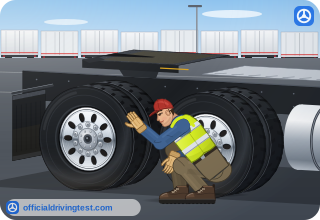
- An inner tube
- The wear bars
- Fabric
Show answer
Correct answer: Fabric
If fabric shows through the tread or sidewall, the tire is badly worn and is a defect.
Source: CDL manual, national model as printed by New Jersey, Sections 1 to 3 (July 2017)
-
Which tires are not allowed on the front wheels of a bus?
- Tubeless tires or radial tires
- Recapped or retreaded tires
- Tires of a wider size than the rear
Show answer
Correct answer: Recapped or retreaded tires
A bus may not use re-grooved, recapped or retreaded tires on its front wheels.
Source: CDL manual, national model as printed by New Jersey, Sections 1 to 3 (July 2017)
-
You see rust around the wheel nuts. What might it mean?
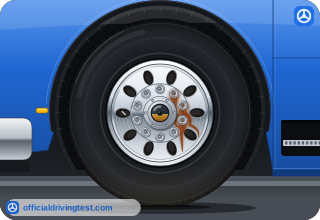
- The tire is overinflated
- The nuts may be loose
- The brake drum is cracked
Show answer
Correct answer: The nuts may be loose
Rust around wheel nuts can be a sign the nuts are loose, so you should check how tight they are.
Source: CDL manual, national model as printed by New Jersey, Sections 1 to 3 (July 2017)
-
A tire on your vehicle has just been changed. What should you do a short time after you start driving?
- Add air to the new tire
- Stop and check the tread depth of the new tire
- Stop and check that the wheel nuts are tight
Show answer
Correct answer: Stop and check that the wheel nuts are tight
After a tire change, stop a short while later and check that the wheel nuts are tight.
Source: CDL manual, national model as printed by New Jersey, Sections 1 to 3 (July 2017)
-
A wheel or rim has been repaired by welding. How should you treat it?
- It is not safe
- It is fine if the weld looks smooth
- It is safe if the nuts are tight
Show answer
Correct answer: It is not safe
Wheels or rims with welding repairs are not safe to use.
Source: CDL manual, national model as printed by New Jersey, Sections 1 to 3 (July 2017)
-
What is a defect when you find it on brake shoes or pads?
- A thin film of road dust
- Oil, grease or brake fluid
- Light surface rust
Show answer
Correct answer: Oil, grease or brake fluid
Oil, grease or brake fluid on brake shoes or pads is a brake defect to look for.
Source: CDL manual, national model as printed by New Jersey, Sections 1 to 3 (July 2017)
-
Above how many degrees of steering wheel play can steering become hard?
- 5 degrees
- 20 degrees
- 10 degrees
Show answer
Correct answer: 10 degrees
Play of more than 10 degrees, about 2 inches at the rim of a 20-inch wheel, can make steering difficult.
Source: CDL manual, national model as printed by New Jersey, Sections 1 to 3 (July 2017)
-
Why can broken suspension parts be extremely dangerous?
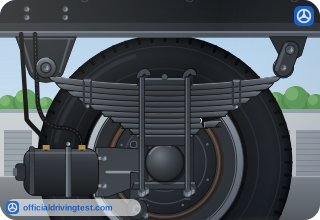
- They hold the axles in place and carry the load
- They keep exhaust fumes from entering the cab
- They supply power to the steering when you turn
Show answer
Correct answer: They hold the axles in place and carry the load
The suspension holds up the vehicle and its load and keeps the axles in position, so a broken part is very dangerous.
Source: CDL manual, national model as printed by New Jersey, Sections 1 to 3 (July 2017)
-
What is the smallest share of missing leaves in a leaf spring that puts the vehicle out of service?
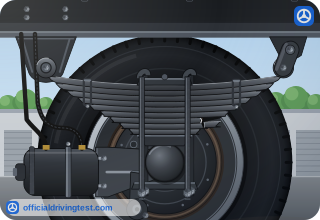
- One-eighth or more
- One-half or more
- One-fourth or more
Show answer
Correct answer: One-fourth or more
When one-fourth or more of the leaves in a leaf spring are missing, the vehicle is placed out of service.
Source: CDL manual, national model as printed by New Jersey, Sections 1 to 3 (July 2017)