Combination Vehicles: Driving combination vehicles safely — Part 2
Questions in this part include: “Your rig is stuck on a railroad crossing. What do you do first?” · “Why should the rear of your rig stay near the curb while you turn?”
Independent educational site · not affiliated with any government agency or DMV
Ready? Test yourself
Answer to start, or tap Start below:
Your rig is stuck on a railroad crossing. What do you do first?
- Instant feedback with an explanation
- Every answer cites its source in the manual
- Your best score is saved on this device
- Keyboard: press 1 to 3 to answer and Enter for the next question
Questions are written in our own words from the CDL manual; they are not the real test's questions. With your state chosen, every answer gives its page in your state's CDL manual. Without a state, answers cite the CDL manual, national model as printed by New Jersey (July 2017).
All 22 questions in this practice test
Take the test above first, then use this list to study. Tap “Show answer” to see the correct answer and explanation.
Show the questions and answersHide the questions
-
Your rig is stuck on a railroad crossing. What do you do first?
- Stay in the cab and wait for help
- Try to rock the rig free with the clutch
- Leave the vehicle and move away from the tracks
Show answer
Correct answer: Leave the vehicle and move away from the tracks
Leave the rig and move clear of the tracks, then phone 911 or another emergency number.
Source: CDL manual, national model as printed by New Jersey, Section 6 (July 2017)
-
Your rig is stuck on the tracks. Where can you find emergency notification information?
- On signposts or signal housing at the crossing
- On the railroad sign at the nearest station
- In the shipping papers for your load
Show answer
Correct answer: On signposts or signal housing at the crossing
Signposts or the signal housing at the crossing carry emergency notification details to use when you call.
Source: CDL manual, national model as printed by New Jersey, Section 6 (July 2017)
-
When you report a rig stuck on a crossing, which detail should you give if one is posted?
- The weight of your cargo
- The name of the railroad's owner
- The DOT number of the crossing
Show answer
Correct answer: The DOT number of the crossing
Call the emergency number and describe the crossing with landmarks, above all its DOT number when it is posted.
Source: CDL manual, national model as printed by New Jersey, Section 6 (July 2017)
-
In which condition is a trailer most likely to swing around when its wheels lock?
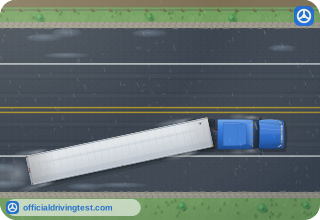
- Empty or lightly loaded
- Fully loaded to its gross weight
- Loaded with its weight at the front
Show answer
Correct answer: Empty or lightly loaded
Locked trailer wheels make it swing around, and an empty or lightly loaded trailer does this most.
Source: CDL manual, national model as printed by New Jersey, Section 6 (July 2017)
-
How can you first tell that your trailer is beginning to skid?
- Feeling the steering wheel go light
- Seeing the trailer in your mirrors
- Hearing the trailer tires squeal
Show answer
Correct answer: Seeing the trailer in your mirrors
Check your mirrors whenever you brake hard, so you can see the trailer swing out at once.
Source: CDL manual, national model as printed by New Jersey, Section 6 (July 2017)
-
Once a skidding trailer has swung out of your lane, what is the situation?
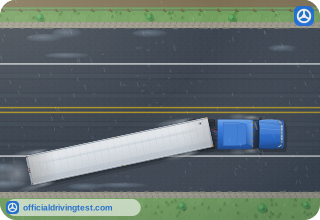
- A jackknife is then very hard to prevent
- The skid will correct itself by itself
- Light braking will always straighten the rig
Show answer
Correct answer: A jackknife is then very hard to prevent
After the trailer leaves your lane, stopping a jackknife is very difficult, so catch the skid early.
Source: CDL manual, national model as printed by New Jersey, Section 6 (July 2017)
-
Once you see the trailer skidding, what should you do with the brakes?
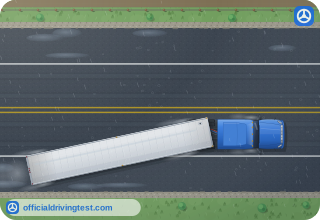
- Press the brake pedal down harder
- Let off the brakes to regain grip
- Hold the brakes steady until it stops
Show answer
Correct answer: Let off the brakes to regain grip
Letting off the brakes lets the wheels grip again, after which the trailer follows the tractor and straightens out.
Source: CDL manual, national model as printed by New Jersey, Section 6 (July 2017)
-
Why is the trailer hand brake the wrong tool for straightening out a skidding trailer?
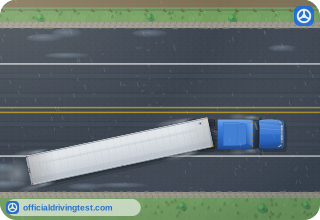
- It cuts the air supply to the tractor
- It only works when the rig is parked
- The trailer wheel brakes caused the skid
Show answer
Correct answer: The trailer wheel brakes caused the skid
Braking the trailer wheels started the skid, so applying them again makes the skid worse.
Source: CDL manual, national model as printed by New Jersey, Section 6 (July 2017)
-
What name is given to the rear wheels following a different path than the front wheels in a corner?
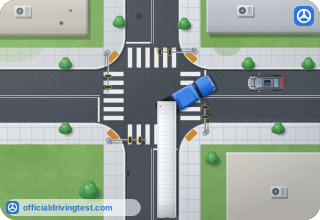
- Off-tracking
- Rearward amplification
- Jackknifing
Show answer
Correct answer: Off-tracking
Off-tracking, also called cheating, is the way the rear wheels take a different path from the front wheels around a corner.
Source: CDL manual, national model as printed by New Jersey, Section 6 (July 2017)
-
In a rig with several trailers, which wheels off-track the most in a turn?
- The rear wheels of the tractor
- The front wheels of the first trailer
- The rear wheels of the last trailer
Show answer
Correct answer: The rear wheels of the last trailer
Each unit off-tracks more than the one ahead of it, so the last trailer's rear wheels cut in the farthest.
Source: CDL manual, national model as printed by New Jersey, Section 6 (July 2017)
-
Why do you steer the front of a long rig wide in a corner?
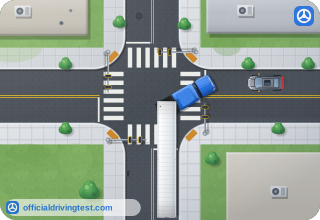
- So the trailer wheels track exactly behind the tractor
- So the rear end does not hit the curb or pedestrians
- So the tractor stays well clear of oncoming traffic
Show answer
Correct answer: So the rear end does not hit the curb or pedestrians
The rear wheels cut inside the front wheels, so the front must swing wide to keep the back off the curb and people.
Source: CDL manual, national model as printed by New Jersey, Section 6 (July 2017)
-
Why should the rear of your rig stay near the curb while you turn?
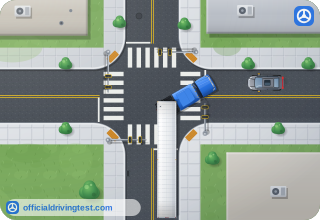
- To keep the trailer tires from touching the curb
- So that other vehicles cannot pass you on your right side
- To let the tractor's mirrors clear the pavement
Show answer
Correct answer: So that other vehicles cannot pass you on your right side
A gap beside the rear of the rig invites other vehicles to squeeze by on the right, so stay close to the curb.
Source: CDL manual, national model as printed by New Jersey, Section 6 (July 2017)
-
If a turn cannot be finished within your lane, when should you swing wide?
- As you finish the turn
- Before you begin the turn
- Halfway through the turn
Show answer
Correct answer: As you finish the turn
Swinging wide at the end of the turn keeps the gap closed, while a wide swing before the turn lets other vehicles pass on the right.
Source: CDL manual, national model as printed by New Jersey, Section 6 (July 2017)
-
To make the back of a trailer go left, which way do you first turn the top of the wheel?
- To the left
- Either way, then correct as it moves
- To the right
Show answer
Correct answer: To the right
Backing a trailer reverses the usual steering: you turn the wheel opposite to the direction you want the trailer to go.
Source: CDL manual, national model as printed by New Jersey, Section 6 (July 2017)
-
While backing a trailer, what do you do once the trailer begins to turn?
- Steer the opposite way so the tractor follows it
- Keep the wheel where it is until the end
- Straighten the wheel and stop backing
Show answer
Correct answer: Steer the opposite way so the tractor follows it
After the trailer begins to turn, steer the opposite way so the tractor follows the trailer.
Source: CDL manual, national model as printed by New Jersey, Section 6 (July 2017)
-
How should you position the vehicle before backing with a trailer?
- Angled toward the passenger side
- So the backing path is a straight line
- Along a curved path whenever possible
Show answer
Correct answer: So the backing path is a straight line
A straight-line path is easiest to control, so line the vehicle up before you start backing.
Source: CDL manual, national model as printed by New Jersey, Section 6 (July 2017)
-
If you have to back a trailer along a curve, which direction should the curve go?
- Toward the passenger side
- Whichever side has more room
- Toward the driver's side
Show answer
Correct answer: Toward the driver's side
Backing toward the driver's side lets you see where the trailer is going.
Source: CDL manual, national model as printed by New Jersey, Section 6 (July 2017)
-
What should you do before you begin backing a trailer?
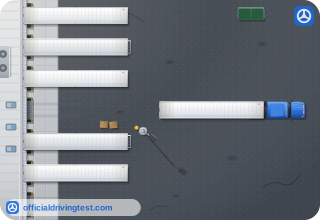
- Check the path and walk around the vehicle
- Rely on a quick look in the mirrors
- Back a few feet to see what happens
Show answer
Correct answer: Check the path and walk around the vehicle
Get out and walk the path first, checking the clearance at the sides and overhead.
Source: CDL manual, national model as printed by New Jersey, Section 6 (July 2017)
-
While you back a trailer, what should you do if you are unsure about your path?
- Keep backing and check your left mirror only
- Get out and look over the route once more
- Sound the horn and keep backing slowly
Show answer
Correct answer: Get out and look over the route once more
Use the mirrors on both sides often, and if you doubt your path, stop, get out and look again.
Source: CDL manual, national model as printed by New Jersey, Section 6 (July 2017)
-
Why should you back a trailer slowly?
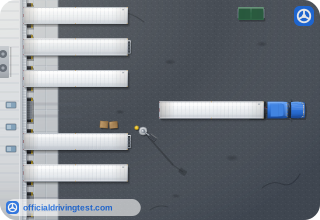
- It keeps the air brakes from overheating on the way
- It makes the trailer turn more sharply in reverse
- It lets you fix your path before you go far off course
Show answer
Correct answer: It lets you fix your path before you go far off course
A slow speed gives time to make corrections before the trailer drifts far off the path.
Source: CDL manual, national model as printed by New Jersey, Section 6 (July 2017)
-
The trailer begins drifting off its path while you back. How do you correct it?
- Turn the top of the wheel away from the drift
- Turn the top of the wheel toward the drift
- Stop and pull the trailer hand valve
Show answer
Correct answer: Turn the top of the wheel toward the drift
Fix a drift at once: move the top of the wheel the same way the trailer is drifting.
Source: CDL manual, national model as printed by New Jersey, Section 6 (July 2017)
-
If you cannot hold your line while backing a trailer, what can you do?
- Keep going back until you reach the dock
- Steer the same way as you would in a car
- Pull forward to re-position the vehicle
Show answer
Correct answer: Pull forward to re-position the vehicle
Pull-ups let you move forward and set up the vehicle again for a better line.
Source: CDL manual, national model as printed by New Jersey, Section 6 (July 2017)