Combination Vehicles: Driving combination vehicles safely — Part 1
Questions in this part include: “What share of truck driver crash deaths comes from rollovers?” · “With triples, how much more easily can the last trailer roll over than a five-axle tractor?”
Independent educational site · not affiliated with any government agency or DMV
Ready? Test yourself
Answer to start, or tap Start below:
What share of truck driver crash deaths comes from rollovers?
- Instant feedback with an explanation
- Every answer cites its source in the manual
- Your best score is saved on this device
- Keyboard: press 1 to 3 to answer and Enter for the next question
Questions are written in our own words from the CDL manual; they are not the real test's questions. With your state chosen, every answer gives its page in your state's CDL manual. Without a state, answers cite the CDL manual, national model as printed by New Jersey (July 2017).
All 22 questions in this practice test
Take the test above first, then use this list to study. Tap “Show answer” to see the correct answer and explanation.
Show the questions and answersHide the questions
-
What share of truck driver crash deaths comes from rollovers?
- Less than a quarter
- About one tenth
- More than half
Show answer
Correct answer: More than half
Rollovers cause over half of the crash deaths of truck drivers, which is why preventing them matters so much.
Source: CDL manual, national model as printed by New Jersey, Section 6 (July 2017)
-
What happens to a truck's center of gravity when more cargo is stacked up in it?
- It shifts toward the rear axle and stays stable
- It sinks lower and the truck grips the road better
- It rises, so the truck tips over more easily
Show answer
Correct answer: It rises, so the truck tips over more easily
Stacking cargo higher lifts the center of gravity away from the road. A truck with a high center of gravity rolls over more easily.
Source: CDL manual, national model as printed by New Jersey, Section 6 (July 2017)
-
Compared with an empty rig, how likely is a fully loaded rig to roll over in a crash?
- Ten times as likely
- Twice as likely
- Three times as likely
Show answer
Correct answer: Ten times as likely
Compared with an empty one, a loaded rig is ten times as prone to rolling in a crash.
Source: CDL manual, national model as printed by New Jersey, Section 6 (July 2017)
-
Which pair of habits best helps a driver prevent a rollover?
- Keep the cargo low and take turns slowly
- Keep the cargo high and take turns slowly
- Keep the cargo low and take turns briskly
Show answer
Correct answer: Keep the cargo low and take turns slowly
Low cargo keeps the center of gravity down, and a slow speed in turns keeps the rig from tipping.
Source: CDL manual, national model as printed by New Jersey, Section 6 (July 2017)
-
For which vehicles is keeping the cargo low even more important?
- Combination vehicles rather than straight trucks
- Straight trucks rather than combination vehicles
- Both types of vehicle equally
Show answer
Correct answer: Combination vehicles rather than straight trucks
Low cargo matters for every truck, but it matters even more for a combination vehicle than for a straight truck.
Source: CDL manual, national model as printed by New Jersey, Section 6 (July 2017)
-
Why is a load that sits to one side of the trailer a danger?
- It lets the trailer lean, which makes a rollover more likely
- It makes the tires wear on one side only
- It moves the trailer's weight onto the tractor's steer axle
Show answer
Correct answer: It lets the trailer lean, which makes a rollover more likely
A load pushed to one side makes the trailer lean. A leaning trailer is much closer to tipping over.
Source: CDL manual, national model as printed by New Jersey, Section 6 (July 2017)
-
How should cargo be placed on a rig to lower rollover risk?
- Centered and spread out as widely as possible
- Piled in a tight stack near the middle
- Grouped on the side nearest the driver
Show answer
Correct answer: Centered and spread out as widely as possible
A centered, spread-out load keeps the trailer from leaning, which lowers the risk of a rollover.
Source: CDL manual, national model as printed by New Jersey, Section 6 (July 2017)
-
When is a quick lane change especially risky for a combination vehicle?
- When the rig is fully loaded
- When the rig is empty and moving slowly
- When the trailer is a short one
Show answer
Correct answer: When the rig is fully loaded
Sudden lane changes should be avoided in any rig, and most of all when it is fully loaded.
Source: CDL manual, national model as printed by New Jersey, Section 6 (July 2017)
-
What can a quick lane change cause in a truck pulling a trailer?
- A crack-the-whip effect that can tip the trailer
- The tractor to lose its fifth wheel lock
- The brakes on the trailer to release by themselves
Show answer
Correct answer: A crack-the-whip effect that can tip the trailer
A sudden lane change can make the trailer whip sideways and overturn, even when the tractor stays upright.
Source: CDL manual, national model as printed by New Jersey, Section 6 (July 2017)
-
Which effect is behind the crack-the-whip movement of a trailer?
- Rearward amplification
- Trailer jackknife
- Center of gravity height
Show answer
Correct answer: Rearward amplification
Rearward amplification is the cause of the whip-like swing of a trailer. The greater it is, the more easily the rear trailer overturns.
Source: CDL manual, national model as printed by New Jersey, Section 6 (July 2017)
-
A rig has a rearward amplification of 2.0 in a quick lane change. What does that tell you?
- The rear trailer has double the tipping risk of the tractor
- The rear trailer is half as likely to tip as the tractor
- The rear trailer is four times as likely to tip as the tractor
Show answer
Correct answer: The rear trailer has double the tipping risk of the tractor
A rating of 2.0 means the rear trailer is two times more likely to turn over than the tractor.
Source: CDL manual, national model as printed by New Jersey, Section 6 (July 2017)
-
With triples, how much more easily can the last trailer roll over than a five-axle tractor?
- 3.5 times as easily
- 2 times as easily
- 5 times as easily
Show answer
Correct answer: 3.5 times as easily
With triples, the last trailer can be rolled 3.5 times more easily than a tractor with five axles.
Source: CDL manual, national model as printed by New Jersey, Section 6 (July 2017)
-
What is the minimum following distance for a combination vehicle going faster than 40 mph?
- 1 second per 10 feet of vehicle length, with 1 extra second
- 1 second per 20 feet of vehicle length, with 2 extra seconds
- 1 second per 10 feet of vehicle length, with no extra time
Show answer
Correct answer: 1 second per 10 feet of vehicle length, with 1 extra second
Allow one second for every 10 feet of vehicle length. Above 40 mph, add one more second.
Source: CDL manual, national model as printed by New Jersey, Section 6 (July 2017)
-
How does looking far down the road help a combination driver?
- It avoids surprises that force a sudden lane change
- It lets you drive closer behind other vehicles
- It shortens the time needed to brake
Show answer
Correct answer: It avoids surprises that force a sudden lane change
A far view lets you see trouble early, so you never have to swerve into another lane at the last moment.
Source: CDL manual, national model as printed by New Jersey, Section 6 (July 2017)
-
How fast should you drive a trailer rig at night?
- Slow enough to spot obstacles in your headlights with time to react
- Slow enough that the taillights ahead stay in view
- At whatever speed keeps pace with the traffic around you
Show answer
Correct answer: Slow enough to spot obstacles in your headlights with time to react
Your headlights must show you a hazard early enough for a gentle stop or lane change, so speed has to match what the lights reveal.
Source: CDL manual, national model as printed by New Jersey, Section 6 (July 2017)
-
When should you reduce speed for a turn in a rig pulling a trailer?
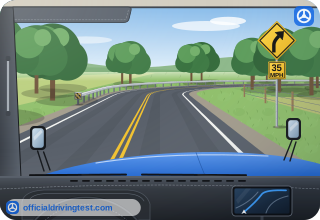
- Before you enter the turn
- Partway through the turn
- Just as you leave the turn
Show answer
Correct answer: Before you enter the turn
Reach a safe speed before the turn begins, so you do not need to brake hard in the curve.
Source: CDL manual, national model as printed by New Jersey, Section 6 (July 2017)
-
How does the stopping distance of an empty large combination compare with a full one?
- Longer for the empty one
- The same, since the brakes are equally strong
- Longer for the loaded one
Show answer
Correct answer: Longer for the empty one
An empty combination needs more distance to stop than a loaded one.
Source: CDL manual, national model as printed by New Jersey, Section 6 (July 2017)
-
Why is a lightly loaded combination easy to lock up when braking?
- Soft springs let the tires press into the road
- Stiff springs and strong brakes give poor traction
- Small loads overheat the brake drums at once
Show answer
Correct answer: Stiff springs and strong brakes give poor traction
With little weight on them, the stiff springs and strong brakes leave the tires with poor grip, so the wheels lock easily.
Source: CDL manual, national model as printed by New Jersey, Section 6 (July 2017)
-
How does a bobtail tractor's stopping distance compare with a tractor-semitrailer loaded to its maximum gross weight?
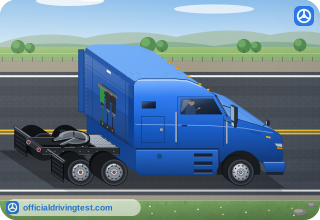
- The bobtail needs a longer distance
- The bobtail needs a shorter distance
- The bobtail needs the same distance
Show answer
Correct answer: The bobtail needs a longer distance
A tractor with no semitrailer is hard to stop smoothly and takes longer to stop than a fully loaded tractor-semitrailer.
Source: CDL manual, national model as printed by New Jersey, Section 6 (July 2017)
-
What lets a combination driver avoid a sudden panic stop?
- Leaving a big gap and watching far ahead
- Using the trailer hand valve more often
- Staying in the right lane at all times
Show answer
Correct answer: Leaving a big gap and watching far ahead
A long following distance and a long view ahead give you time to brake early and gently.
Source: CDL manual, national model as printed by New Jersey, Section 6 (July 2017)
-
Which of these can get stuck on a raised railroad crossing?
- A possum-belly livestock trailer
- A tanker trailer
- A flatbed with its landing gear fully raised
Show answer
Correct answer: A possum-belly livestock trailer
Low slung units, such as a lowboy, car carrier, moving van or possum-belly livestock trailer, can get stuck on a raised crossing.
Source: CDL manual, national model as printed by New Jersey, Section 6 (July 2017)
-
Which rig can get stuck on a raised crossing because of where its landing gear is set?
- A single-axle tractor pulling a long trailer set up for a tandem
- A tandem-axle tractor pulling a short trailer with gear raised
- A bobtail tractor whose fifth wheel is slid far to the back
Show answer
Correct answer: A single-axle tractor pulling a long trailer set up for a tandem
When a long trailer's landing gear is set for a tandem-axle tractor and a single-axle tractor pulls it, the gear can catch on the crossing.
Source: CDL manual, national model as printed by New Jersey, Section 6 (July 2017)