Air Brakes: Using air brakes — Part 3
Questions in this part include: “When can brakes get out of adjustment especially quickly?” · “When is controlled braking possible after the low air pressure warning has come on?”
Independent educational site · not affiliated with any government agency or DMV
Ready? Test yourself
Answer to start, or tap Start below:
When can brakes get out of adjustment especially quickly?
- Instant feedback with an explanation
- Every answer cites its source in the manual
- Your best score is saved on this device
- Keyboard: press 1 to 3 to answer and Enter for the next question
Questions are written in our own words from the CDL manual; they are not the real test's questions. With your state chosen, every answer gives its page in your state's CDL manual. Without a state, answers cite the CDL manual, national model as printed by New Jersey (July 2017).
All 16 questions in this practice test
Take the test above first, then use this list to study. Tap “Show answer” to see the correct answer and explanation.
Show the questions and answersHide the questions
-
When can brakes get out of adjustment especially quickly?
- When they are hot
- When the air tanks are full
- When they are cold
Show answer
Correct answer: When they are hot
Hot brakes can slip out of adjustment quickly, so check the adjustment often.
Source: CDL manual, national model as printed by New Jersey, Section 5 (July 2017)
-
On a long, steep downgrade, what is the role of your brakes?
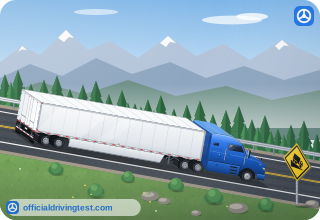
- They are the main control and the engine only helps
- They only add to the slowing done by the engine
- They replace the need for a low gear
Show answer
Correct answer: They only add to the slowing done by the engine
The engine does the main work of holding your speed on a long or steep downgrade, and the brakes only add to it.
Source: CDL manual, national model as printed by New Jersey, Section 5 (July 2017)
-
On a long downgrade in the proper low gear, how hard should you apply the brakes?
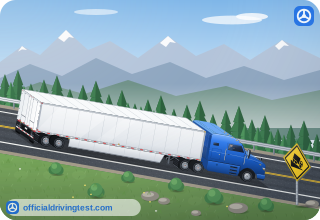
- As hard as you can to stop quickly
- Hard enough to feel a clear slowdown
- Lightly enough that you barely notice them
Show answer
Correct answer: Hard enough to feel a clear slowdown
Use enough pressure that you clearly feel the vehicle slow.
Source: CDL manual, national model as printed by New Jersey, Section 5 (July 2017)
-
You are braking on a downgrade. When should you release the brakes?
- When you are about five mph below your safe speed
- When you are about ten mph below your safe speed
- When you have slowed to half your safe speed
Show answer
Correct answer: When you are about five mph below your safe speed
Release the brakes once speed is about five mph below your safe speed.
Source: CDL manual, national model as printed by New Jersey, Section 5 (July 2017)
-
About how long should each brake application last on a downgrade?
- About one second
- About ten seconds
- About three seconds
Show answer
Correct answer: About three seconds
Each application should last about three seconds.
Source: CDL manual, national model as printed by New Jersey, Section 5 (July 2017)
-
Your safe speed on a downgrade is 40 mph and you released the brakes at 35 mph. When do you brake again?
- When your speed is back up to 40 mph
- Right away, and keep braking down to 25 mph
- When your speed has climbed to 45 mph
Show answer
Correct answer: When your speed is back up to 40 mph
Wait until the speed has risen back to your safe speed, then apply the brakes again.
Source: CDL manual, national model as printed by New Jersey, Section 5 (July 2017)
-
The low air pressure warning comes on while you are driving. What should you do?
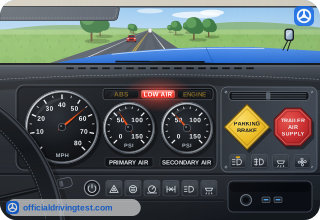
- Stop and park safely as soon as possible
- Keep driving to the next shop and watch the gauge
- Pump the brake pedal to rebuild pressure
Show answer
Correct answer: Stop and park safely as soon as possible
Low pressure may mean an air leak, so stop and park safely while you still have air to use the foot brakes.
Source: CDL manual, national model as printed by New Jersey, Section 5 (July 2017)
-
When is controlled braking possible after the low air pressure warning has come on?
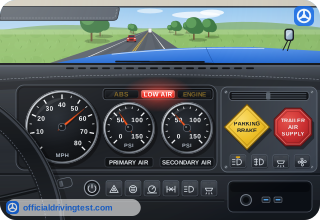
- Only after the parking brake is applied
- Only once the vehicle is below 20 mph
- As long as the tanks still hold enough air
Show answer
Correct answer: As long as the tanks still hold enough air
Controlled braking with the foot brakes works only while the tanks still hold enough air.
Source: CDL manual, national model as printed by New Jersey, Section 5 (July 2017)
-
Why does a heavily loaded vehicle take a long distance to stop when the spring brakes come on?
- The spring brakes release as pressure drops
- Spring brakes act on only some of the axles
- The compressor shuts off the service brakes
Show answer
Correct answer: Spring brakes act on only some of the axles
Spring brakes act on only some axles, so a heavy load takes a long way to stop.
Source: CDL manual, national model as printed by New Jersey, Section 5 (July 2017)
-
Which vehicle is at risk of skidding when the spring brakes apply?
- A heavily loaded vehicle on a dry level road
- Only a vehicle pulling a trailer
- A lightly loaded vehicle, or one on a slippery road
Show answer
Correct answer: A lightly loaded vehicle, or one on a slippery road
When the spring brakes apply, a lightly loaded vehicle or one on a slick road can skid and get out of control.
Source: CDL manual, national model as printed by New Jersey, Section 5 (July 2017)
-
On some older vehicles the parking brake control is a lever. How does it move?
- It swings sideways, or up and down
- It twists to the right, like a key
- It slides in and out, like a drawer
Show answer
Correct answer: It swings sideways, or up and down
On older vehicles the control may be a round blue knob or another shape, such as a lever that swings sideways or up and down.
Source: CDL manual, national model as printed by New Jersey, Section 5 (July 2017)
-
In which situation should you avoid applying the parking brakes?
- The vehicle is fully loaded and on a gentle slope
- The engine has just been shut off
- The brakes are very hot from a steep downgrade
Show answer
Correct answer: The brakes are very hot from a steep downgrade
Very hot brakes can be damaged by the heat if the parking brakes are applied, so let them cool first.
Source: CDL manual, national model as printed by New Jersey, Section 5 (July 2017)
-
What can happen if you use the parking brakes when the brakes are very wet and the weather is freezing?
- They can freeze and keep the vehicle from moving
- The air tanks drain themselves and pressure drops
- The spring brakes release by themselves
Show answer
Correct answer: They can freeze and keep the vehicle from moving
Wet brakes can freeze in cold weather and keep the vehicle from moving.
Source: CDL manual, national model as printed by New Jersey, Section 5 (July 2017)
-
You cannot use the parking brakes because the brakes are too hot or wet in freezing weather. What should you use to hold the vehicle?
- Leave the transmission in neutral with the engine running
- Wheel chocks on a level surface
- The service brake pedal held down
Show answer
Correct answer: Wheel chocks on a level surface
Chock the wheels on a level surface instead of relying on the parking brakes.
Source: CDL manual, national model as printed by New Jersey, Section 5 (July 2017)
-
How can you dry out very wet brakes before parking in freezing weather?
- Press the pedal hard several times while stopped
- Brake gently while driving in a low gear
- Set the parking brakes and let the engine idle
Show answer
Correct answer: Brake gently while driving in a low gear
Light braking in low gear warms the brakes and dries them.
Source: CDL manual, national model as printed by New Jersey, Section 5 (July 2017)
-
What must you do before you leave a vehicle unattended?
- Apply the parking brakes or chock the wheels
- Leave the engine running to keep air pressure up
- Shift to neutral and release the clutch
Show answer
Correct answer: Apply the parking brakes or chock the wheels
An unattended vehicle that is not held may roll away and cause injury and damage.
Source: CDL manual, national model as printed by New Jersey, Section 5 (July 2017)