Air Brakes: Using air brakes — Part 1
Questions in this part include: “You are making a normal stop in a truck with a manual transmission. When should you press the clutch in?” · “Only the tractor has ABS. While you brake, the trailer starts to swing out. What should you do?”
Independent educational site · not affiliated with any government agency or DMV
Ready? Test yourself
Answer to start, or tap Start below:
After a normal stop is complete, what should you do with the transmission?
- Instant feedback with an explanation
- Every answer cites its source in the manual
- Your best score is saved on this device
- Keyboard: press 1 to 3 to answer and Enter for the next question
Questions are written in our own words from the CDL manual; they are not the real test's questions. With your state chosen, every answer gives its page in your state's CDL manual. Without a state, answers cite the CDL manual, national model as printed by New Jersey (July 2017).
All 16 questions in this practice test
Take the test above first, then use this list to study. Tap “Show answer” to see the correct answer and explanation.
Show the questions and answersHide the questions
-
You are making a normal stop in a truck with a manual transmission. When should you press the clutch in?
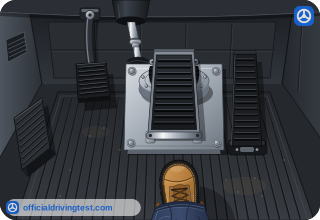
- As soon as your foot touches the brake pedal
- When the engine speed is down close to idle
- When the truck has slowed to about half speed
Show answer
Correct answer: When the engine speed is down close to idle
Keep the clutch engaged while the truck slows, and press it in only when engine rpm is down close to idle.
Source: CDL manual, national model as printed by New Jersey, Section 5 (July 2017)
-
After a normal stop is complete, what should you do with the transmission?
- Shift to neutral and leave the engine running
- Leave it in the gear you used for braking
- Select a starting gear
Show answer
Correct answer: Select a starting gear
Once the vehicle has stopped, select a starting gear so you are ready to move off.
Source: CDL manual, national model as printed by New Jersey, Section 5 (July 2017)
-
A vehicle has no ABS and you brake hard on a slippery road. What happens if the steering wheels lock up?
- The vehicle turns more sharply than usual
- The brakes release and you coast freely
- You lose steering control
Show answer
Correct answer: You lose steering control
Once the steering wheels lock, the driver can no longer steer the vehicle.
Source: CDL manual, national model as printed by New Jersey, Section 5 (July 2017)
-
Without ABS, what can happen when wheels other than the steering wheels lock up during hard braking?
- The steering becomes lighter but the vehicle stays straight
- The vehicle slows faster and stays in its lane
- The vehicle may skid, jackknife, or spin
Show answer
Correct answer: The vehicle may skid, jackknife, or spin
If wheels other than the steering wheels lock, the vehicle may skid, jackknife or even spin.
Source: CDL manual, national model as printed by New Jersey, Section 5 (July 2017)
-
What does the ABS computer do when it senses that wheels are about to lock up?
- It cuts the brake pressure to a level that is safe
- It raises the braking pressure to stop faster
- It applies only the trailer brakes
Show answer
Correct answer: It cuts the brake pressure to a level that is safe
ABS lowers the brake pressure so the wheels keep turning and you keep control.
Source: CDL manual, national model as printed by New Jersey, Section 5 (July 2017)
-
What can ABS help a driver do during hard braking?
- Always stop in a shorter distance
- Take downgrades at a higher speed
- Steer around an obstacle while braking
Show answer
Correct answer: Steer around an obstacle while braking
ABS may or may not shorten the stop, but it lets you steer around an obstacle and avoid skids caused by over braking.
Source: CDL manual, national model as printed by New Jersey, Section 5 (July 2017)
-
A combination vehicle has ABS on only one axle. How does that affect your control while braking?
- It gives no help unless every axle has ABS
- It makes the vehicle harder to steer
- It gives you more control than no ABS at all
Show answer
Correct answer: It gives you more control than no ABS at all
Even partial ABS, on one unit or a single axle, helps you control the vehicle when you brake.
Source: CDL manual, national model as printed by New Jersey, Section 5 (July 2017)
-
When only the tractor has ABS, what should you still be able to do?
- Keep steering control, with less risk of a jackknife
- Stop in a shorter distance on any road surface
- Brake hard without watching the trailer at all
Show answer
Correct answer: Keep steering control, with less risk of a jackknife
ABS on the tractor alone lets you keep steering, and a jackknife is less likely.
Source: CDL manual, national model as printed by New Jersey, Section 5 (July 2017)
-
Only the tractor has ABS. While you brake, the trailer starts to swing out. What should you do?
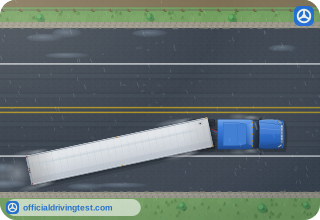
- Brake harder to pull the trailer straight
- Turn the steering wheel sharply the other way
- Back off the brake pedal if that can be done safely
Show answer
Correct answer: Back off the brake pedal if that can be done safely
Even with ABS on the tractor, ease off the brakes, if it is safe, when the trailer begins to swing out.
Source: CDL manual, national model as printed by New Jersey, Section 5 (July 2017)
-
What is a benefit when only the trailer of a combination has ABS?
- The tractor can never jackknife
- The trailer has less chance of swinging out
- The tractor keeps full steering control in every stop
Show answer
Correct answer: The trailer has less chance of swinging out
ABS on the trailer lowers the chance of it swinging out, but you must still ease off the brakes if the tractor starts to jackknife.
Source: CDL manual, national model as printed by New Jersey, Section 5 (July 2017)
-
Only the trailer has ABS. You lose steering control, or the tractor starts to jackknife. What should you do?
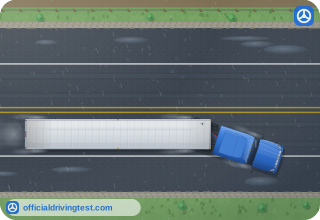
- Press the brake pedal harder to straighten the tractor
- Pull the parking brake knob to slow the trailer first
- Ease off the brakes, if it is safe, until you regain control
Show answer
Correct answer: Ease off the brakes, if it is safe, until you regain control
Letting up on the brakes, when that is safe, lets you get control back.
Source: CDL manual, national model as printed by New Jersey, Section 5 (July 2017)
-
How should you brake a tractor-trailer combination that has ABS?
- Use only the force needed to stop safely and keep control
- Press harder than usual, since ABS prevents skids
- Change your braking style depending on which unit has ABS
Show answer
Correct answer: Use only the force needed to stop safely and keep control
Brake as you always have, with only the force you need, whether ABS is on the tractor, the trailer or both.
Source: CDL manual, national model as printed by New Jersey, Section 5 (July 2017)
-
In an emergency stop, who may press the brakes fully instead of using only the force needed?
- A driver whose vehicle has ABS only on the trailer
- Any driver of a vehicle that has ABS on at least one axle
- A driver whose vehicles always have working ABS on every axle
Show answer
Correct answer: A driver whose vehicles always have working ABS on every axle
Only a driver whose vehicle always has working ABS on every axle may brake fully in an emergency stop; everyone else uses only the force needed.
Source: CDL manual, national model as printed by New Jersey, Section 5 (July 2017)
-
The ABS on your vehicle stops working. What is the right way to handle it?
- Drive as usual, and have the system serviced soon
- Stop driving at once because no brakes will work
- Pump the brake pedal constantly to replace ABS
Show answer
Correct answer: Drive as usual, and have the system serviced soon
The regular brakes still work when ABS fails, so you can drive as usual and have the system serviced soon.
Source: CDL manual, national model as printed by New Jersey, Section 5 (July 2017)
-
Someone pulls out suddenly in front of you. When is hitting the brakes a good response?
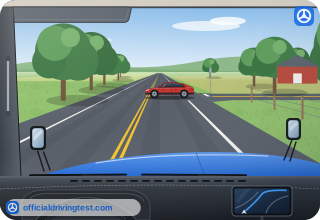
- When you have room to stop and brake correctly
- Only when the road is dry and the ABS lamp is off
- Only after you have first tried to steer around
Show answer
Correct answer: When you have room to stop and brake correctly
Braking is a good response when there is enough distance to stop and the brakes are used correctly.
Source: CDL manual, national model as printed by New Jersey, Section 5 (July 2017)
-
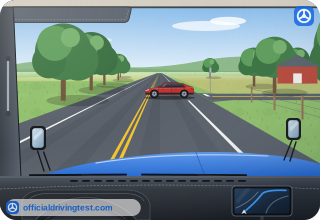
When you must stop in an emergency, how should you brake?
- Lock the wheels so the vehicle stops sooner
- Rely mainly on the parking brake
- Keep the vehicle straight and able to turn
Show answer
Correct answer: Keep the vehicle straight and able to turn
Brake so the vehicle stays in a straight line and you can still steer if you have to.
Source: CDL manual, national model as printed by New Jersey, Section 5 (July 2017)