Air Brakes: 20 Hardest Questions
Questions that need a second thought, picked for close numbers, exceptions and easy-to-confuse rules. Take your time.
Independent educational site · not affiliated with any government agency or DMV
Ready? Test yourself
Answer to start, or tap Start below:
In which tank is the safety relief valve installed?
- Instant feedback with an explanation
- Every answer cites its source in the manual
- Your best score is saved on this device
- Keyboard: press 1 to 3 to answer and Enter for the next question
Questions are written in our own words from the CDL manual; they are not the real test's questions. With your state chosen, every answer gives its page in your state's CDL manual. Without a state, answers cite the CDL manual, national model as printed by New Jersey (July 2017).
All 20 questions in this practice test
Take the test above first, then use this list to study. Tap “Show answer” to see the correct answer and explanation.
Show the questions and answersHide the questions
-
In which tank is the safety relief valve installed?
- The tank farthest from the compressor
- The tank used only for the parking brakes
- The first tank the compressor fills
Show answer
Correct answer: The first tank the compressor fills
The valve sits in the first tank filled by the compressor.
Source: CDL manual, national model as printed by New Jersey, Section 5 (July 2017)
-
Which of these gauges or devices is missing on some air brake vehicles?
- The supply pressure gauge
- The low air pressure warning signal
- The application pressure gauge
Show answer
Correct answer: The application pressure gauge
Every air brake vehicle has a supply gauge and a low pressure warning, but the application pressure gauge is not fitted on all vehicles.
Source: CDL manual, national model as printed by New Jersey, Section 5 (July 2017)
-
How does ABS change the braking power of your normal brakes?
- It makes the normal brakes stronger
- It adds to them without raising or lowering their power
- It replaces the normal brakes when they are hot
Show answer
Correct answer: It adds to them without raising or lowering their power
ABS works on top of the normal brakes. It does not make them stronger or weaker.
Source: CDL manual, national model as printed by New Jersey, Section 5 (July 2017)
-
Why can brakes that are out of adjustment cause the other brakes to fade?
- They take too much air from the other brakes
- They do less work, so other brakes overheat
- They lock first and slow the whole vehicle
Show answer
Correct answer: They do less work, so other brakes overheat
Brakes that are out of adjustment do less work, so the remaining brakes carry more load and can overheat and fade.
Source: CDL manual, national model as printed by New Jersey, Section 5 (July 2017)
-
What is routine hand adjustment of most automatic slack adjusters likely to cause?
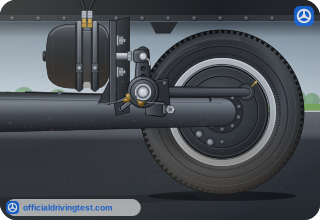
- Early wear of the adjuster itself
- Longer life for the brake linings
- A shorter push rod stroke for good
Show answer
Correct answer: Early wear of the adjuster itself
Adjusting most automatic adjusters by hand as a routine will probably wear the adjuster out early.
Source: CDL manual, national model as printed by New Jersey, Section 5 (July 2017)
-
What does the air compressor governor do?
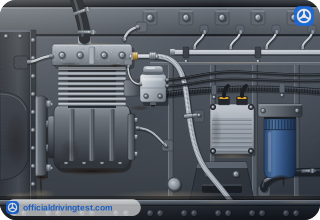
- Opens to release air when tank pressure is too high
- Decides when the compressor pumps air into the tanks
- Lets air out of the tanks at the end of the day
Show answer
Correct answer: Decides when the compressor pumps air into the tanks
The governor turns the compressor's pumping on and off. Letting out excess air is the job of the safety valve.
Source: CDL manual, national model as printed by New Jersey, Section 5 (July 2017)
-
In a dual air brake, which system supplies air to a trailer?
- Only the primary system
- Only the secondary system
- Both systems
Show answer
Correct answer: Both systems
Both the primary and the secondary system feed any attached trailer.
Source: CDL manual, national model as printed by New Jersey, Section 5 (July 2017)
-
With dual parking control valves, what happens when you let go of the spring-loaded valve?
- The spring brakes stay released
- The separate tank refills at once
- The spring brakes come on again
Show answer
Correct answer: The spring brakes come on again
The spring-loaded valve frees the spring brakes only while you hold it in. Let go and they apply again.
Source: CDL manual, national model as printed by New Jersey, Section 5 (July 2017)
-
What happens in stab braking if you apply the brakes again before the wheels start rolling?
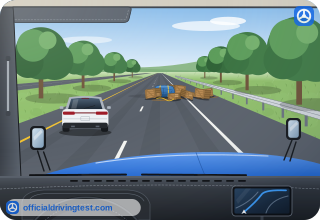
- The brakes overheat and fade at once
- The vehicle will not straighten out
- The ABS malfunction lamp comes on
Show answer
Correct answer: The vehicle will not straighten out
Braking again while the wheels are still locked keeps the vehicle sliding, so it does not straighten out.
Source: CDL manual, national model as printed by New Jersey, Section 5 (July 2017)
-
In a dual air system, the low pressure warning test is judged by which tank?
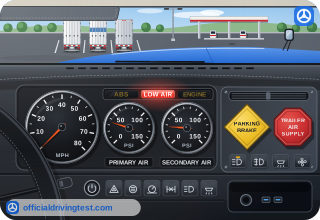
- The tank with the highest pressure
- The tank with the lowest pressure
- Only the tank of the primary system
Show answer
Correct answer: The tank with the lowest pressure
In a dual system the signal must come on before the tank with the lowest pressure falls below the warning level.
Source: CDL manual, national model as printed by New Jersey, Section 5 (July 2017)
-
Does an alcohol evaporator remove the need to drain the air tanks?
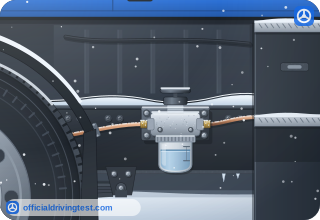
- Yes, alcohol dries the air in the tanks before it can settle
- Yes, but only on days when it is cold enough to freeze
- No, daily draining is still needed without automatic drains
Show answer
Correct answer: No, daily draining is still needed without automatic drains
Alcohol only lowers the risk of ice. Water and oil still collect, so the tanks are drained every day unless they have automatic drain valves.
Source: CDL manual, national model as printed by New Jersey, Section 5 (July 2017)
-
Where should you keep the cab control of a front brake limiting valve?
- In the slippery position
- Halfway between the two positions
- In the normal position
Show answer
Correct answer: In the normal position
Keep the control in the normal position. The slippery position cuts front brake pressure and weakens stopping.
Source: CDL manual, national model as printed by New Jersey, Section 5 (July 2017)
-
What could happen if you push the brake pedal down while the spring brakes are on?
- The spring brakes would let go of the wheels right away
- The brakes could be damaged by springs and air pushing together
- The air tanks would lose all of their pressure at once
Show answer
Correct answer: The brakes could be damaged by springs and air pushing together
The spring force and the pedal's air pressure add together and can damage the brakes, so keep your foot off the pedal while the spring brakes are on.
Source: CDL manual, national model as printed by New Jersey, Section 5 (July 2017)
-
Your safe speed on a downgrade is 40 mph and you released the brakes at 35 mph. When do you brake again?
- When your speed is back up to 40 mph
- Right away, and keep braking down to 25 mph
- When your speed has climbed to 45 mph
Show answer
Correct answer: When your speed is back up to 40 mph
Wait until the speed has risen back to your safe speed, then apply the brakes again.
Source: CDL manual, national model as printed by New Jersey, Section 5 (July 2017)
-
In a dual air system at operating rpms, how fast should pressure rise from 85 to 100 psi?
- Within 20 seconds
- Within 45 seconds
- Within 90 seconds
Show answer
Correct answer: Within 45 seconds
In a dual system, pressure should climb to 100 psi from 85 in 45 seconds or less with the engine at operating rpms.
Source: CDL manual, national model as printed by New Jersey, Section 5 (July 2017)
-
On older vehicles, the low pressure warning is tied to which pressure instead of a fixed number?
- Half of the compressor governor cutout pressure
- Half of the governor cut-in pressure
- A quarter of the governor cutout pressure
Show answer
Correct answer: Half of the compressor governor cutout pressure
On older vehicles the warning must come on before pressure falls below half of the governor cutout pressure.
Source: CDL manual, national model as printed by New Jersey, Section 5 (July 2017)
-
Air brake truck tractors built on or after which date must have antilock brakes?
- March 1, 1997
- March 1, 1995
- March 1, 1999
Show answer
Correct answer: March 1, 1997
Air brake truck tractors built on or after March 1, 1997 must have ABS.
Source: CDL manual, national model as printed by New Jersey, Section 5 (July 2017)
-
In an emergency stop, who may press the brakes fully instead of using only the force needed?
- A driver whose vehicle has ABS only on the trailer
- Any driver of a vehicle that has ABS on at least one axle
- A driver whose vehicles always have working ABS on every axle
Show answer
Correct answer: A driver whose vehicles always have working ABS on every axle
Only a driver whose vehicle always has working ABS on every axle may brake fully in an emergency stop; everyone else uses only the force needed.
Source: CDL manual, national model as printed by New Jersey, Section 5 (July 2017)
-
In the first leakage test (engine off, parking brake released, foot off the brake), a combination vehicle should lose less than how much air pressure in one minute?
- Less than 6 psi
- Less than 3 psi
- Less than 8 psi
Show answer
Correct answer: Less than 3 psi
For a combination vehicle the loss should be under 3 psi in one minute.
Source: CDL manual, national model as printed by New Jersey, Section 5 (July 2017)
-
With the foot brake held fully applied, a single vehicle losing more than how much pressure in one minute is losing too much?
- More than 6 psi
- More than 3 psi
- More than 8 psi
Show answer
Correct answer: More than 3 psi
For a single vehicle, a drop of more than 3 psi in one minute with the foot brake applied is too much.
Source: CDL manual, national model as printed by New Jersey, Section 5 (July 2017)