Air Brakes: Exam simulator
40 random questions from every topic of this test, like a mini exam.
Independent educational site · not affiliated with any government agency or DMV
Ready? Test yourself
40 questions in this practice test; pass mark 80%, as on the real test.
- Instant feedback with an explanation
- Every answer cites its source in the manual
- Your best score is saved on this device
- Keyboard: press 1 to 3 to answer and Enter for the next question
Questions are written in our own words from the CDL manual; they are not the real test's questions. With your state chosen, every answer gives its page in your state's CDL manual. Without a state, answers cite the CDL manual, national model as printed by New Jersey (July 2017).
Sample questions
The exam simulator picks 40 random questions from every topic each time you start. Here are a few examples.
Show the questions and answersHide the questions
-
What do air brakes use to make the brakes work?
- Hydraulic fluid
- Compressed air
- Engine vacuum
Show answer
Correct answer: Compressed air
Air brakes work by using compressed air.
Source: CDL manual, national model as printed by New Jersey, Section 5 (July 2017)
-
A truck has a dual air brake system. How is its supply pressure shown?
- A separate gauge for each half, or one gauge with two needles
- One gauge with a single needle for both halves
- One gauge for the front half and a warning light for the rear half
Show answer
Correct answer: A separate gauge for each half, or one gauge with two needles
Each half of a dual system has its own reading, either on two gauges or on one gauge with two needles.
Source: CDL manual, national model as printed by New Jersey, Section 5 (July 2017)
-
Why are spring brakes the usual choice for a truck's emergency and parking brakes?
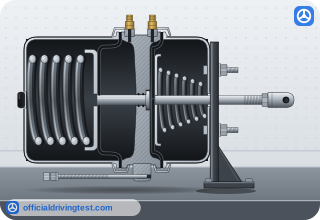
- They use less air than the service brakes when stopping the truck
- They are held on mechanically, not by air that can leak away
- They give a stronger stop than the service brakes
Show answer
Correct answer: They are held on mechanically, not by air that can leak away
Emergency and parking brakes must be held on mechanically, because air can slowly leak out. Springs do this job.
Source: CDL manual, national model as printed by New Jersey, Section 5 (July 2017)
-
What do you check on a belt-driven air compressor during the engine compartment inspection?
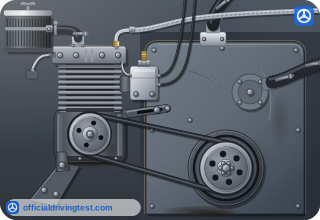
- The compressor's intake filter and hoses
- The governor's cut-out adjusting screw
- The belt's condition and its tightness
Show answer
Correct answer: The belt's condition and its tightness
On a belt-driven compressor you check how good the belt is and how tight it is.
Source: CDL manual, national model as printed by New Jersey, Section 5 (July 2017)
-
You are making a normal stop in a truck with a manual transmission. When should you press the clutch in?
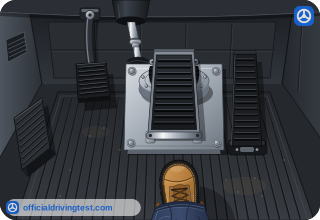
- As soon as your foot touches the brake pedal
- When the engine speed is down close to idle
- When the truck has slowed to about half speed
Show answer
Correct answer: When the engine speed is down close to idle
Keep the clutch engaged while the truck slows, and press it in only when engine rpm is down close to idle.
Source: CDL manual, national model as printed by New Jersey, Section 5 (July 2017)