Air Brakes: Air brake system parts
The compressor and its governor, air tanks and their drains, the alcohol evaporator, the safety valve, the brake pedal and the foundation brakes. Split into 3 shorter tests so you're not stuck in one long quiz.
Independent educational site · not affiliated with any government agency or DMV
Choose a part
Air brake system parts — Part 1
Questions in this part include: “What do air brakes use to make the brakes work?”
Air brake system parts — Part 2
Questions in this part include: “How often must you drain air tanks that have manual drain valves?”
Air brake system parts — Part 3
Questions in this part include: “What is the most common type of foundation brake?”
Questions are written in our own words from the CDL manual; they are not the real test's questions. With your state chosen, every answer gives its page in your state's CDL manual. Without a state, answers cite the CDL manual, national model as printed by New Jersey (July 2017).
All 49 Air brake system parts questions with answers
Choose a part above to take a practice test, or study every question and answer here.
Show the questions and answersHide the questions
1Part 117 questions
-
What do air brakes use to make the brakes work?
- Hydraulic fluid
- Compressed air
- Engine vacuum
Show answer
Correct answer: Compressed air
Air brakes work by using compressed air.
Source: CDL manual, national model as printed by New Jersey, Section 5 (July 2017)
-
Which set lists the three braking systems that make up air brakes?
- Service, parking and auxiliary brake systems
- Service, parking and emergency brake systems
- Primary, parking and emergency brake systems
Show answer
Correct answer: Service, parking and emergency brake systems
Air brakes are made of a service brake system, a parking brake system and an emergency brake system.
Source: CDL manual, national model as printed by New Jersey, Section 5 (July 2017)
-
Which braking system works the brakes when you press the brake pedal in everyday driving?
- The parking brake system
- The emergency brake system
- The service brake system
Show answer
Correct answer: The service brake system
The service brake system is the one the brake pedal controls during normal driving.
Source: CDL manual, national model as printed by New Jersey, Section 5 (July 2017)
-
How does the emergency brake system stop the vehicle?
- It works from its own set of brakes and tanks
- It uses parts of both the service and parking systems
- It relies only on the service brake system
Show answer
Correct answer: It uses parts of both the service and parking systems
If the brake system fails, the emergency system stops the vehicle with parts borrowed from the service and parking brake systems.
Source: CDL manual, national model as printed by New Jersey, Section 5 (July 2017)
-
What is the job of the air compressor?
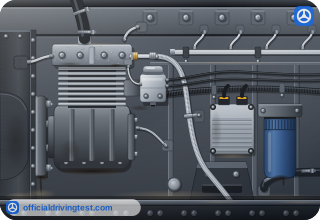
- It releases air from the tanks to the brake chambers
- It pumps air into the air storage tanks
- It decides when the air tanks are filled
Show answer
Correct answer: It pumps air into the air storage tanks
The compressor is the part that fills the storage tanks with air.
Source: CDL manual, national model as printed by New Jersey, Section 5 (July 2017)
-
How is the air compressor driven by the engine?
- By its own electric motor
- By a chain from the transmission
- Through gears or a v-belt
Show answer
Correct answer: Through gears or a v-belt
The compressor is linked to the engine by gears or by a v-belt.
Source: CDL manual, national model as printed by New Jersey, Section 5 (July 2017)
-
How can an air compressor be cooled?
- By its own water pump only
- By air taken from the storage tanks
- By air or by the engine cooling system
Show answer
Correct answer: By air or by the engine cooling system
Some compressors are cooled by air and others use the engine's cooling system.
Source: CDL manual, national model as printed by New Jersey, Section 5 (July 2017)
-
How may an air compressor be lubricated?
- By oil mist carried from the air tanks
- By its own oil supply or by engine oil
- By the engine's cooling system
Show answer
Correct answer: By its own oil supply or by engine oil
A compressor either carries its own oil or shares the engine's oil.
Source: CDL manual, national model as printed by New Jersey, Section 5 (July 2017)
-
A compressor has its own oil supply. When should you check the oil level?
- Once a week after driving
- Before you drive
- When the low air warning comes on
Show answer
Correct answer: Before you drive
A compressor with its own oil supply needs its oil level checked before the vehicle is driven.
Source: CDL manual, national model as printed by New Jersey, Section 5 (July 2017)
-
What does the air compressor governor do?
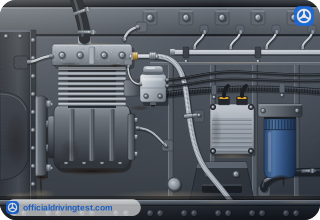
- Opens to release air when tank pressure is too high
- Decides when the compressor pumps air into the tanks
- Lets air out of the tanks at the end of the day
Show answer
Correct answer: Decides when the compressor pumps air into the tanks
The governor turns the compressor's pumping on and off. Letting out excess air is the job of the safety valve.
Source: CDL manual, national model as printed by New Jersey, Section 5 (July 2017)
-
At about what tank pressure does the governor stop the compressor from pumping?
- About 155 psi
- About 175 psi
- About 125 psi
Show answer
Correct answer: About 125 psi
The governor stops the compressor when tank pressure reaches the cut-out level, around 125 psi.
Source: CDL manual, national model as printed by New Jersey, Section 5 (July 2017)
-
When tank pressure falls to about what level does the governor let the compressor start pumping again?
- About 65 psi
- About 100 psi
- About 75 psi
Show answer
Correct answer: About 100 psi
The cut-in pressure, around 100 psi, is the level at which pumping restarts.
Source: CDL manual, national model as printed by New Jersey, Section 5 (July 2017)
-
What can full air tanks still provide if the compressor stops working?
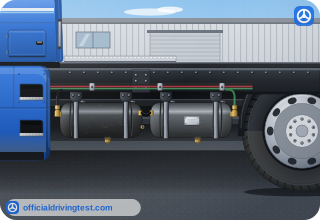
- Air for one brake application only
- Air for several brake applications
- Air for the rear axle brakes only
Show answer
Correct answer: Air for several brake applications
The stored air lets you use the brakes more than once even with a dead compressor.
Source: CDL manual, national model as printed by New Jersey, Section 5 (July 2017)
-
What does compressed air usually carry that harms the air brake system?
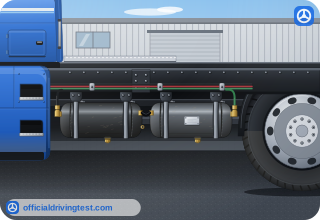
- Some alcohol and some engine coolant
- Some water and some compressor oil
- Some brake dust and some road salt
Show answer
Correct answer: Some water and some compressor oil
Compressed air usually holds a little water and compressor oil, and both are bad for the system.
Source: CDL manual, national model as printed by New Jersey, Section 5 (July 2017)
-
Why is water in the compressed air a danger in cold weather?

- It can thicken the compressor oil and stall the engine
- It can freeze and cause brake failure
- It can turn to steam and raise tank pressure
Show answer
Correct answer: It can freeze and cause brake failure
Water in the air system can freeze when it is cold, and frozen water can make the brakes fail.
Source: CDL manual, national model as printed by New Jersey, Section 5 (July 2017)
-
Where do water and oil collect in an air tank?
- Near the top of the tank
- In the bottom of the tank
- Around the tank's safety valve
Show answer
Correct answer: In the bottom of the tank
Water and oil settle at the bottom, which is why each tank has a drain valve there.
Source: CDL manual, national model as printed by New Jersey, Section 5 (July 2017)
-
How is a manual air tank drain valve operated?
- By unscrewing a plug with a wrench
- By pressing a button on the dash
- With a quarter turn or a pull on a cable
Show answer
Correct answer: With a quarter turn or a pull on a cable
You open a manual drain with a quarter turn, or you pull its cable.
Source: CDL manual, national model as printed by New Jersey, Section 5 (July 2017)
2Part 216 questions
-
How often must you drain air tanks that have manual drain valves?
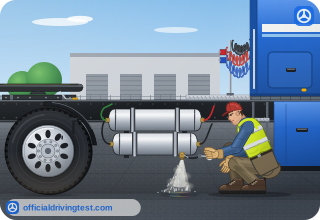
- Every day when you finish driving
- Once a week
- Whenever the gauge shows a drop
Show answer
Correct answer: Every day when you finish driving
Tanks with manual drains must be drained by the driver once each driving day, at the end of the day.
Source: CDL manual, national model as printed by New Jersey, Section 5 (July 2017)
-
What does an automatic air tank drain do?
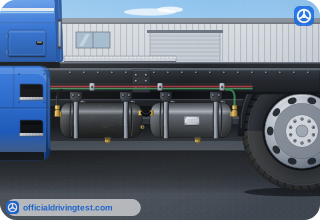
- It warns you when water is in the tank
- It expels water and oil on its own
- It adds alcohol to the air system
Show answer
Correct answer: It expels water and oil on its own
An automatic drain pushes water and oil out of the tank without the driver doing anything.
Source: CDL manual, national model as printed by New Jersey, Section 5 (July 2017)
-
Can an air tank with an automatic drain also be drained by hand?
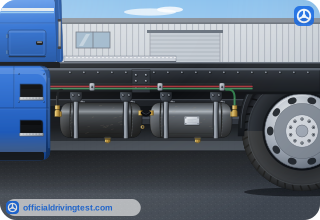
- Yes, it may be fitted for manual draining too
- No, an automatic drain is sealed at the factory
- Only after the alcohol evaporator is emptied
Show answer
Correct answer: Yes, it may be fitted for manual draining too
A tank with an automatic drain may also have a way to drain it by hand.
Source: CDL manual, national model as printed by New Jersey, Section 5 (July 2017)
-
What are electric heating devices on some automatic air tank drains for?
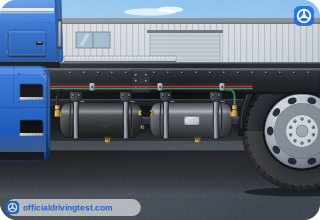
- To dry the air before it enters the tank
- To raise the air pressure in cold weather
- To keep the drain from freezing in cold weather
Show answer
Correct answer: To keep the drain from freezing in cold weather
The heater stops the automatic drain from freezing when the weather is cold.
Source: CDL manual, national model as printed by New Jersey, Section 5 (July 2017)
-
What is an alcohol evaporator used for in an air brake system?
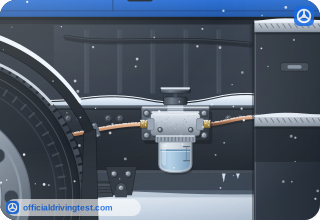
- To clean oil out of the compressed air
- To lower the risk of ice in valves
- To raise the air pressure in cold weather
Show answer
Correct answer: To lower the risk of ice in valves
Alcohol in the air system lowers the chance of ice forming, and ice can make the brakes stop working.
Source: CDL manual, national model as printed by New Jersey, Section 5 (July 2017)
-
How often should you check the alcohol container in cold weather?
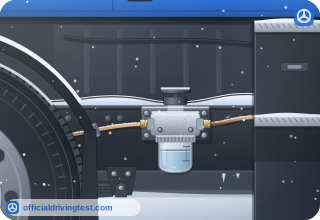
- Once a week
- Only when the drain valves freeze
- Every day
Show answer
Correct answer: Every day
In cold weather the container should be checked and filled up every day.
Source: CDL manual, national model as printed by New Jersey, Section 5 (July 2017)
-
Does an alcohol evaporator remove the need to drain the air tanks?
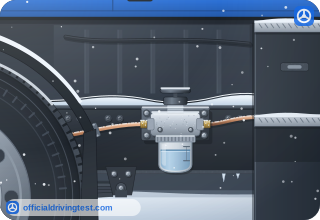
- Yes, alcohol dries the air in the tanks before it can settle
- Yes, but only on days when it is cold enough to freeze
- No, daily draining is still needed without automatic drains
Show answer
Correct answer: No, daily draining is still needed without automatic drains
Alcohol only lowers the risk of ice. Water and oil still collect, so the tanks are drained every day unless they have automatic drain valves.
Source: CDL manual, national model as printed by New Jersey, Section 5 (July 2017)
-
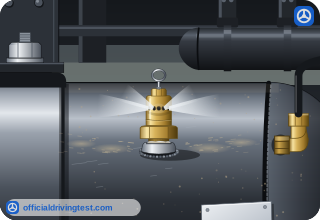
In which tank is the safety relief valve installed?
- The tank farthest from the compressor
- The tank used only for the parking brakes
- The first tank the compressor fills
Show answer
Correct answer: The first tank the compressor fills
The valve sits in the first tank filled by the compressor.
Source: CDL manual, national model as printed by New Jersey, Section 5 (July 2017)
-
What does the safety valve protect the air system against?
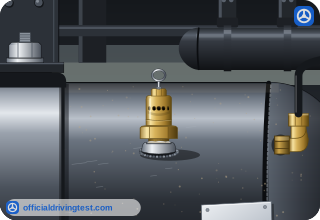
- Water collecting in the tanks
- Too much pressure in the tanks and system
- Air leaking from the brake chambers
Show answer
Correct answer: Too much pressure in the tanks and system
It keeps the tank and the other parts from taking in too much pressure.
Source: CDL manual, national model as printed by New Jersey, Section 5 (July 2017)
-
At about what pressure is a safety relief valve usually set to open?
- 175 psi
- 200 psi
- 150 psi
Show answer
Correct answer: 150 psi
A safety valve usually opens at 150 psi.
Source: CDL manual, national model as printed by New Jersey, Section 5 (July 2017)
-
The safety valve keeps letting air out. What should you do?
- Keep driving, since the valve is working as designed
- Have a mechanic fix the fault
- Drain the tanks and carry on
Show answer
Correct answer: Have a mechanic fix the fault
Air released by the safety valve means something is wrong, so a mechanic must repair the fault.
Source: CDL manual, national model as printed by New Jersey, Section 5 (July 2017)
-
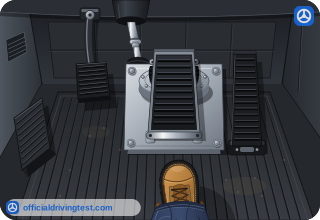
Which name is another term for the brake pedal in an air brake system?
- Relay valve
- Treadle valve
- Check valve
Show answer
Correct answer: Treadle valve
The brake pedal is also known as the foot valve or the treadle valve.
Source: CDL manual, national model as printed by New Jersey, Section 5 (July 2017)
-
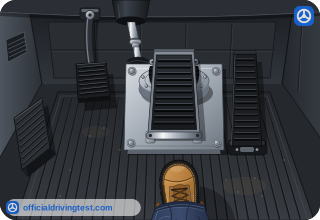
What happens when you let up on the brake pedal?
- Air pressure rises and the brakes hold
- Air pressure drops and the brakes release
- The spring brakes take over the stop
Show answer
Correct answer: Air pressure drops and the brakes release
Easing off the pedal lowers the air pressure at the brakes, so they release.
Source: CDL manual, national model as printed by New Jersey, Section 5 (July 2017)
-
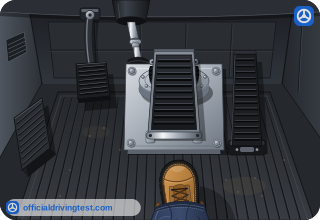
What happens to the air in the system each time you release the brakes?
- Some compressed air goes out, lowering tank pressure
- The air returns to the tanks
- The air is held in the lines for the next stop
Show answer
Correct answer: Some compressed air goes out, lowering tank pressure
Releasing the brakes vents some air, so the compressor has to make up the loss.
Source: CDL manual, national model as printed by New Jersey, Section 5 (July 2017)
-
Why should you avoid pressing and releasing the brake pedal when it is not needed?
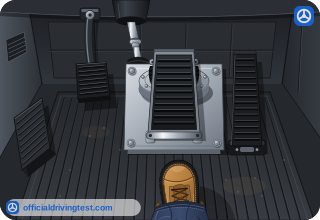
- It makes the compressor overheat
- Air can leave faster than it is replaced
- It wears out the pedal spring sooner
Show answer
Correct answer: Air can leave faster than it is replaced
Needless pedal use can drain the air faster than it is replaced, and if pressure gets too low the brakes will not work.
Source: CDL manual, national model as printed by New Jersey, Section 5 (July 2017)
-
Where are foundation brakes used?
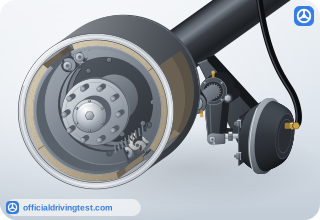
- Only on the drive axles
- Only on the front axle
- At each wheel
Show answer
Correct answer: At each wheel
Every wheel has its own foundation brake.
Source: CDL manual, national model as printed by New Jersey, Section 5 (July 2017)
3Part 316 questions
-
What is the most common type of foundation brake?
- Wedge brake
- S-cam drum brake
- Disc brake
Show answer
Correct answer: S-cam drum brake
Most foundation brakes are the s-cam drum type. Wedge and disc brakes are less common.
Source: CDL manual, national model as printed by New Jersey, Section 5 (July 2017)
-
In a drum brake, what are the wheels bolted to?
- The brake shoes
- The brake drums
- The slack adjusters
Show answer
Correct answer: The brake drums
Wheels are bolted to the brake drums, which are on each end of the axles.
Source: CDL manual, national model as printed by New Jersey, Section 5 (July 2017)
-
In a drum brake, where is the braking mechanism?
- Inside the brake chamber
- Inside the brake drum
- Behind the slack adjuster
Show answer
Correct answer: Inside the brake drum
The shoes and linings that do the braking sit inside the drum.
Source: CDL manual, national model as printed by New Jersey, Section 5 (July 2017)
-
What slows the vehicle when brake shoes and linings are pressed against the drum?
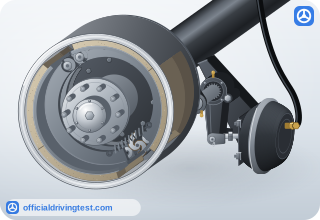
- Air pressure
- Engine vacuum
- Friction
Show answer
Correct answer: Friction
The shoes rubbing the drum cause friction, which slows the vehicle and makes heat.
Source: CDL manual, national model as printed by New Jersey, Section 5 (July 2017)
-
What decides how much heat a brake drum can take without damage?
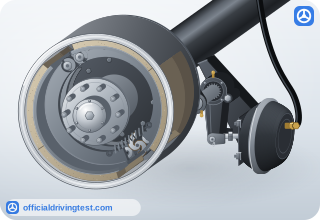
- The size of the slack adjuster stroke
- The amount of air left in the tanks
- The force and the time of brake use
Show answer
Correct answer: The force and the time of brake use
A drum's heat limit depends on the force and the length of time the brakes are used.
Source: CDL manual, national model as printed by New Jersey, Section 5 (July 2017)
-
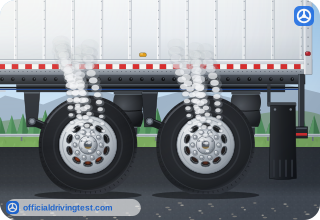
What can happen if brake drums get too hot?
- The brake shoes grip harder
- The brakes can stop working
- Air pressure rises in the tanks
Show answer
Correct answer: The brakes can stop working
Too much heat can make the brakes fail.
Source: CDL manual, national model as printed by New Jersey, Section 5 (July 2017)
-
In an s-cam brake, what does air pressure in the brake chamber push out?
- A wedge that spreads the shoes
- A power screw that clamps the pads
- A rod that moves the slack adjuster
Show answer
Correct answer: A rod that moves the slack adjuster
The chamber pushes out a rod, which moves the slack adjuster and twists the camshaft that turns the s-cam.
Source: CDL manual, national model as printed by New Jersey, Section 5 (July 2017)
-
Why is the s-cam called an s-cam?
- It is shaped like the letter S
- It is made for a single wheel set
- It is used only on a single axle
Show answer
Correct answer: It is shaped like the letter S
The cam has an S shape, which gives it its name.
Source: CDL manual, national model as printed by New Jersey, Section 5 (July 2017)
-
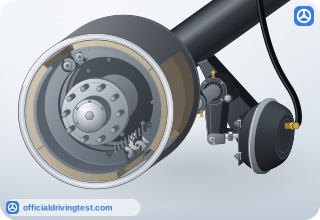
What does the s-cam do to the brake shoes?
- Squeezes them together around the drum
- Pulls them away from the drum
- Spreads them apart against the drum
Show answer
Correct answer: Spreads them apart against the drum
The turning cam spreads the shoes apart so they press on the drum's inner surface.
Source: CDL manual, national model as printed by New Jersey, Section 5 (July 2017)
-
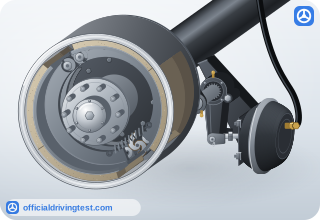
When you let up on the pedal, what draws the shoes off the drum?
- Air pressure
- A spring
- The slack adjuster
Show answer
Correct answer: A spring
When the pedal is released, a spring pulls the shoes off the drum so the wheels turn freely.
Source: CDL manual, national model as printed by New Jersey, Section 5 (July 2017)
-
How does a wedge brake spread the brake shoes?
- A power screw turns and clamps a disc
- A push rod pushes a wedge between the shoe ends
- A cam shaped like an S twists between them
Show answer
Correct answer: A push rod pushes a wedge between the shoe ends
The push rod drives a wedge between the shoe ends and shoves the shoes against the drum.
Source: CDL manual, national model as printed by New Jersey, Section 5 (July 2017)
-
How many brake chambers can a wedge brake have?
- One or two
- Always two
- Always one
Show answer
Correct answer: One or two
A wedge brake can have one chamber, or two chambers pushing wedges in at both shoe ends.
Source: CDL manual, national model as printed by New Jersey, Section 5 (July 2017)
-
How are wedge brakes adjusted?
- Some adjust themselves and some are set by hand
- Only those with two chambers adjust themselves
- Only those with one chamber are set by hand
Show answer
Correct answer: Some adjust themselves and some are set by hand
Some wedge brakes are self-adjusting while others must be adjusted by hand.
Source: CDL manual, national model as printed by New Jersey, Section 5 (July 2017)
-
Which parts does an air disc brake have in common with an s-cam brake?
- A brake chamber and a slack adjuster
- A wedge and a pair of brake shoes
- A brake drum and a return spring
Show answer
Correct answer: A brake chamber and a slack adjuster
In both kinds, air pressure works on a brake chamber and a slack adjuster.
Source: CDL manual, national model as printed by New Jersey, Section 5 (July 2017)
-
What replaces the s-cam in an air-operated disc brake?
- A wedge
- A two-lobed camshaft
- A power screw
Show answer
Correct answer: A power screw
Air disc brakes use a power screw where s-cam brakes use the s-cam.
Source: CDL manual, national model as printed by New Jersey, Section 5 (July 2017)
-
How does an air disc brake slow the wheel?
- Shoes spread out inside a drum
- A wedge pushes between two shoes
- Pads in a caliper clamp the disc
Show answer
Correct answer: Pads in a caliper clamp the disc
The power screw makes the caliper pads clamp the disc, much like a large c-clamp.
Source: CDL manual, national model as printed by New Jersey, Section 5 (July 2017)