Air Brakes: Air brake system parts — Part 2
Questions in this part include: “How often must you drain air tanks that have manual drain valves?” · “What does the safety valve protect the air system against?”
Independent educational site · not affiliated with any government agency or DMV
Ready? Test yourself
Answer to start, or tap Start below:
In which tank is the safety relief valve installed?
- Instant feedback with an explanation
- Every answer cites its source in the manual
- Your best score is saved on this device
- Keyboard: press 1 to 3 to answer and Enter for the next question
Questions are written in our own words from the CDL manual; they are not the real test's questions. With your state chosen, every answer gives its page in your state's CDL manual. Without a state, answers cite the CDL manual, national model as printed by New Jersey (July 2017).
All 16 questions in this practice test
Take the test above first, then use this list to study. Tap “Show answer” to see the correct answer and explanation.
Show the questions and answersHide the questions
-
How often must you drain air tanks that have manual drain valves?
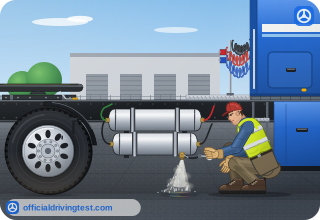
- Every day when you finish driving
- Once a week
- Whenever the gauge shows a drop
Show answer
Correct answer: Every day when you finish driving
Tanks with manual drains must be drained by the driver once each driving day, at the end of the day.
Source: CDL manual, national model as printed by New Jersey, Section 5 (July 2017)
-
What does an automatic air tank drain do?
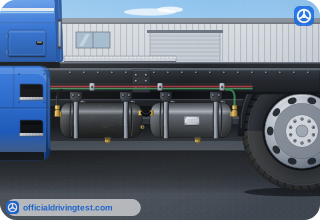
- It warns you when water is in the tank
- It expels water and oil on its own
- It adds alcohol to the air system
Show answer
Correct answer: It expels water and oil on its own
An automatic drain pushes water and oil out of the tank without the driver doing anything.
Source: CDL manual, national model as printed by New Jersey, Section 5 (July 2017)
-
Can an air tank with an automatic drain also be drained by hand?
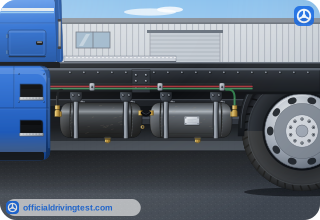
- Yes, it may be fitted for manual draining too
- No, an automatic drain is sealed at the factory
- Only after the alcohol evaporator is emptied
Show answer
Correct answer: Yes, it may be fitted for manual draining too
A tank with an automatic drain may also have a way to drain it by hand.
Source: CDL manual, national model as printed by New Jersey, Section 5 (July 2017)
-
What are electric heating devices on some automatic air tank drains for?
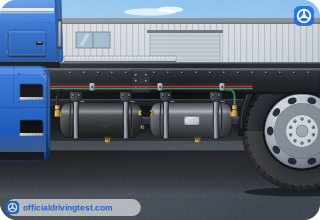
- To dry the air before it enters the tank
- To raise the air pressure in cold weather
- To keep the drain from freezing in cold weather
Show answer
Correct answer: To keep the drain from freezing in cold weather
The heater stops the automatic drain from freezing when the weather is cold.
Source: CDL manual, national model as printed by New Jersey, Section 5 (July 2017)
-
What is an alcohol evaporator used for in an air brake system?
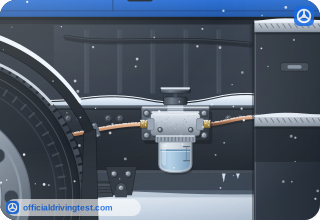
- To clean oil out of the compressed air
- To lower the risk of ice in valves
- To raise the air pressure in cold weather
Show answer
Correct answer: To lower the risk of ice in valves
Alcohol in the air system lowers the chance of ice forming, and ice can make the brakes stop working.
Source: CDL manual, national model as printed by New Jersey, Section 5 (July 2017)
-
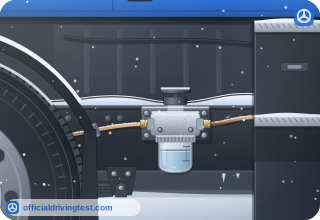
How often should you check the alcohol container in cold weather?
- Once a week
- Only when the drain valves freeze
- Every day
Show answer
Correct answer: Every day
In cold weather the container should be checked and filled up every day.
Source: CDL manual, national model as printed by New Jersey, Section 5 (July 2017)
-
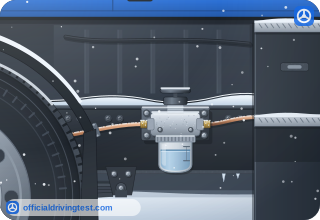
Does an alcohol evaporator remove the need to drain the air tanks?
- Yes, alcohol dries the air in the tanks before it can settle
- Yes, but only on days when it is cold enough to freeze
- No, daily draining is still needed without automatic drains
Show answer
Correct answer: No, daily draining is still needed without automatic drains
Alcohol only lowers the risk of ice. Water and oil still collect, so the tanks are drained every day unless they have automatic drain valves.
Source: CDL manual, national model as printed by New Jersey, Section 5 (July 2017)
-
In which tank is the safety relief valve installed?
- The tank farthest from the compressor
- The tank used only for the parking brakes
- The first tank the compressor fills
Show answer
Correct answer: The first tank the compressor fills
The valve sits in the first tank filled by the compressor.
Source: CDL manual, national model as printed by New Jersey, Section 5 (July 2017)
-
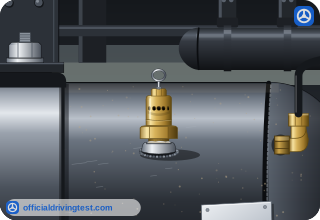
What does the safety valve protect the air system against?
- Water collecting in the tanks
- Too much pressure in the tanks and system
- Air leaking from the brake chambers
Show answer
Correct answer: Too much pressure in the tanks and system
It keeps the tank and the other parts from taking in too much pressure.
Source: CDL manual, national model as printed by New Jersey, Section 5 (July 2017)
-
At about what pressure is a safety relief valve usually set to open?
- 175 psi
- 200 psi
- 150 psi
Show answer
Correct answer: 150 psi
A safety valve usually opens at 150 psi.
Source: CDL manual, national model as printed by New Jersey, Section 5 (July 2017)
-
The safety valve keeps letting air out. What should you do?
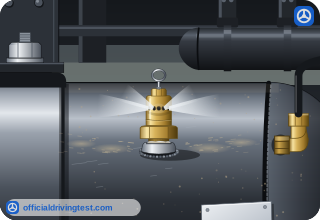
- Keep driving, since the valve is working as designed
- Have a mechanic fix the fault
- Drain the tanks and carry on
Show answer
Correct answer: Have a mechanic fix the fault
Air released by the safety valve means something is wrong, so a mechanic must repair the fault.
Source: CDL manual, national model as printed by New Jersey, Section 5 (July 2017)
-
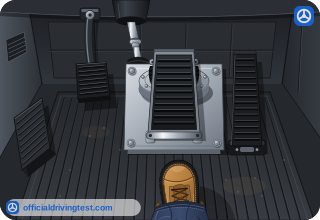
Which name is another term for the brake pedal in an air brake system?
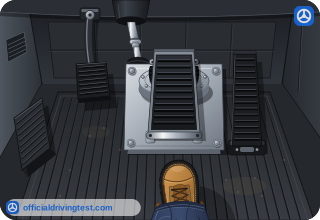
- Relay valve
- Treadle valve
- Check valve
Show answer
Correct answer: Treadle valve
The brake pedal is also known as the foot valve or the treadle valve.
Source: CDL manual, national model as printed by New Jersey, Section 5 (July 2017)
-
What happens when you let up on the brake pedal?
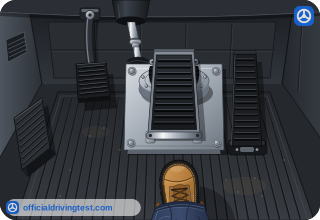
- Air pressure rises and the brakes hold
- Air pressure drops and the brakes release
- The spring brakes take over the stop
Show answer
Correct answer: Air pressure drops and the brakes release
Easing off the pedal lowers the air pressure at the brakes, so they release.
Source: CDL manual, national model as printed by New Jersey, Section 5 (July 2017)
-
What happens to the air in the system each time you release the brakes?
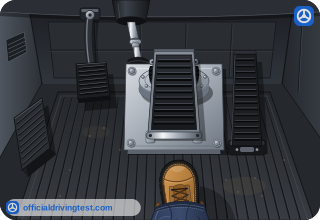
- Some compressed air goes out, lowering tank pressure
- The air returns to the tanks
- The air is held in the lines for the next stop
Show answer
Correct answer: Some compressed air goes out, lowering tank pressure
Releasing the brakes vents some air, so the compressor has to make up the loss.
Source: CDL manual, national model as printed by New Jersey, Section 5 (July 2017)
-
Why should you avoid pressing and releasing the brake pedal when it is not needed?
- It makes the compressor overheat
- Air can leave faster than it is replaced
- It wears out the pedal spring sooner
Show answer
Correct answer: Air can leave faster than it is replaced
Needless pedal use can drain the air faster than it is replaced, and if pressure gets too low the brakes will not work.
Source: CDL manual, national model as printed by New Jersey, Section 5 (July 2017)
-
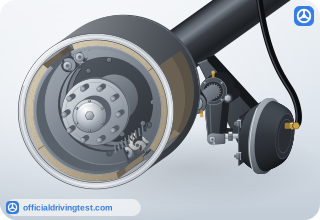
Where are foundation brakes used?
- Only on the drive axles
- Only on the front axle
- At each wheel
Show answer
Correct answer: At each wheel
Every wheel has its own foundation brake.
Source: CDL manual, national model as printed by New Jersey, Section 5 (July 2017)