Air Brakes: Gauges, warnings and dual air systems — Part 1
Questions in this part include: “A truck has a dual air brake system. How is its supply pressure shown?” · “What does the low air pressure warning usually look like?”
Independent educational site · not affiliated with any government agency or DMV
Ready? Test yourself
Answer to start, or tap Start below:
A truck has a dual air brake system. How is its supply pressure shown?
- Instant feedback with an explanation
- Every answer cites its source in the manual
- Your best score is saved on this device
- Keyboard: press 1 to 3 to answer and Enter for the next question
Questions are written in our own words from the CDL manual; they are not the real test's questions. With your state chosen, every answer gives its page in your state's CDL manual. Without a state, answers cite the CDL manual, national model as printed by New Jersey (July 2017).
All 17 questions in this practice test
Take the test above first, then use this list to study. Tap “Show answer” to see the correct answer and explanation.
Show the questions and answersHide the questions
-
A truck has a dual air brake system. How is its supply pressure shown?
- A separate gauge for each half, or one gauge with two needles
- One gauge with a single needle for both halves
- One gauge for the front half and a warning light for the rear half
Show answer
Correct answer: A separate gauge for each half, or one gauge with two needles
Each half of a dual system has its own reading, either on two gauges or on one gauge with two needles.
Source: CDL manual, national model as printed by New Jersey, Section 5 (July 2017)
-
What does the supply pressure gauge on an air brake vehicle show you?
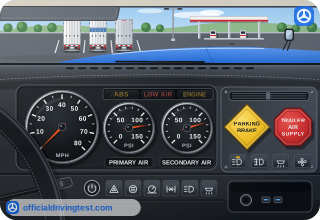
- The air pressure your foot sends to the brakes
- The air pressure where the governor starts the compressor
- The air pressure waiting in the air tanks
Show answer
Correct answer: The air pressure waiting in the air tanks
The supply gauges report how much pressure is stored in the air tanks. A different gauge, not found on every vehicle, shows how hard you are applying the brakes.
Source: CDL manual, national model as printed by New Jersey, Section 5 (July 2017)
-
What does an application pressure gauge tell the driver?
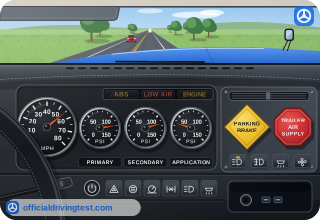
- The air pressure being sent to the brakes
- The amount of air left in the tanks
- The pressure level where the low air warning starts
Show answer
Correct answer: The air pressure being sent to the brakes
The application gauge reports how much air pressure the driver is sending to the brakes while braking.
Source: CDL manual, national model as printed by New Jersey, Section 5 (July 2017)
-
Which of these gauges or devices is missing on some air brake vehicles?
- The supply pressure gauge
- The low air pressure warning signal
- The application pressure gauge
Show answer
Correct answer: The application pressure gauge
Every air brake vehicle has a supply gauge and a low pressure warning, but the application pressure gauge is not fitted on all vehicles.
Source: CDL manual, national model as printed by New Jersey, Section 5 (July 2017)
-
You must keep pressing harder, so the application gauge climbs, just to hold the same speed. What does this mean?
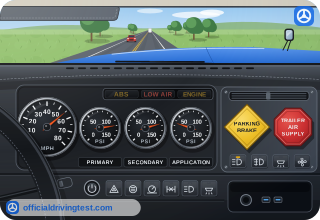
- The air compressor is cutting in
- The brakes are fading
- The air tanks are overfilled
Show answer
Correct answer: The brakes are fading
Needing more and more application pressure to keep the same speed is a sign the brakes are fading from heat.
Source: CDL manual, national model as printed by New Jersey, Section 5 (July 2017)
-
The application gauge shows the brakes are fading. What should you do?

- Keep your speed and press the pedal harder
- Shift to a higher gear and hold your speed
- Slow down and shift to a lower gear
Show answer
Correct answer: Slow down and shift to a lower gear
When brakes fade, reduce speed and use a lower gear so the engine helps hold the vehicle back.
Source: CDL manual, national model as printed by New Jersey, Section 5 (July 2017)
-
Besides fade, which problem can also make you need more application pressure?
- Brakes that are out of adjustment
- A governor set to cut out too high
- An alcohol evaporator that needs filling
Show answer
Correct answer: Brakes that are out of adjustment
Brakes that are out of adjustment, air leaks and mechanical problems can all make you need more application pressure.
Source: CDL manual, national model as printed by New Jersey, Section 5 (July 2017)
-
A vehicle with air brakes has a visible low pressure warning. It must come on before tank pressure falls below what level?
- 40 psi
- 70 psi
- 55 psi
Show answer
Correct answer: 55 psi
The visible warning signal must come on before the tank pressure drops below 55 psi.
Source: CDL manual, national model as printed by New Jersey, Section 5 (July 2017)
-
On older vehicles, the low pressure warning is tied to which pressure instead of a fixed number?
- Half of the compressor governor cutout pressure
- Half of the governor cut-in pressure
- A quarter of the governor cutout pressure
Show answer
Correct answer: Half of the compressor governor cutout pressure
On older vehicles the warning must come on before pressure falls below half of the governor cutout pressure.
Source: CDL manual, national model as printed by New Jersey, Section 5 (July 2017)
-
What does the low air pressure warning usually look like?
- A red light, sometimes with a buzzer
- A yellow light beside the mirror
- A gauge needle that glows amber
Show answer
Correct answer: A red light, sometimes with a buzzer
The low air pressure warning is normally a red light, and a buzzer may sound as well.
Source: CDL manual, national model as printed by New Jersey, Section 5 (July 2017)
-
How does a wig wag warn the driver of low air pressure?
- A mechanical arm falls into the driver's view
- A metal flag pops out beside the mirror
- A lever pushes the parking brake knob out
Show answer
Correct answer: A mechanical arm falls into the driver's view
A wig wag is a mechanical arm that drops into the driver's line of sight when system pressure is low.
Source: CDL manual, national model as printed by New Jersey, Section 5 (July 2017)
-
An automatic wig wag has dropped into view. When does it lift back out of view?
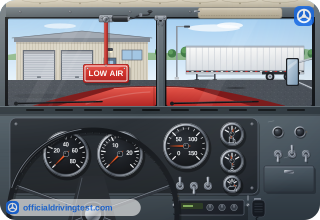
- When system pressure climbs past 55 psi
- When the driver presses a reset button
- When the parking brake knob is pushed in
Show answer
Correct answer: When system pressure climbs past 55 psi
An automatic wig wag lifts out of view by itself once system pressure rises above 55 psi.
Source: CDL manual, national model as printed by New Jersey, Section 5 (July 2017)
-
How do you put a manual reset wig wag back out of view?
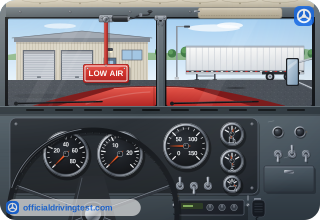
- Move it to the out of view position by hand
- Wait until it rises on its own as pressure builds
- Press the brake pedal several times quickly
Show answer
Correct answer: Move it to the out of view position by hand
A manual reset wig wag does not rise by itself. The driver must place it in the out of view position.
Source: CDL manual, national model as printed by New Jersey, Section 5 (July 2017)
-
At about what pressure do the low pressure warning devices on large buses commonly signal?
- 40 to 45 psi
- 80 to 85 psi
- 100 to 105 psi
Show answer
Correct answer: 80 to 85 psi
Large buses commonly signal low pressure at 80 to 85 psi.
Source: CDL manual, national model as printed by New Jersey, Section 5 (July 2017)
-
What turns on the brake lights when you apply the air brakes?
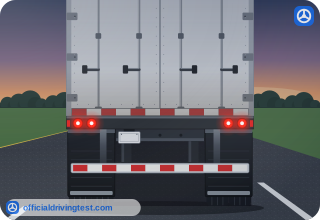
- A cable attached to the brake pedal
- A sensor inside each brake drum
- An electric switch worked by air pressure
Show answer
Correct answer: An electric switch worked by air pressure
The stop light switch is an electric switch operated by air pressure. It lights the brake lights to warn drivers behind you.
Source: CDL manual, national model as printed by New Jersey, Section 5 (July 2017)
-
Front brake limiting valves with a cab control are found on vehicles made before which year?
- 1975
- 1965
- 1985
Show answer
Correct answer: 1975
Some vehicles built before 1975 had a limiting valve with a control in the cab.
Source: CDL manual, national model as printed by New Jersey, Section 5 (July 2017)
-
Which two words usually mark the cab control of a front brake limiting valve?
- City and highway
- Loaded and empty
- Normal and slippery
Show answer
Correct answer: Normal and slippery
Its two positions are labeled normal and slippery.
Source: CDL manual, national model as printed by New Jersey, Section 5 (July 2017)