Air Brakes: Inspecting air brakes — Part 2
Questions in this part include: “Before the leakage test with the foot brake applied, air pressure is built up to governor cutoff. What range is that?” · “On a single vehicle, which valve should pop out when you fan the air pressure down far enough?”
Independent educational site · not affiliated with any government agency or DMV
Ready? Test yourself
Answer to start, or tap Start below:
Before the leakage test with the foot brake applied, air pressure is built up to governor cutoff. What range is that?
- Instant feedback with an explanation
- Every answer cites its source in the manual
- Your best score is saved on this device
- Keyboard: press 1 to 3 to answer and Enter for the next question
Questions are written in our own words from the CDL manual; they are not the real test's questions. With your state chosen, every answer gives its page in your state's CDL manual. Without a state, answers cite the CDL manual, national model as printed by New Jersey (July 2017).
All 21 questions in this practice test
Take the test above first, then use this list to study. Tap “Show answer” to see the correct answer and explanation.
Show the questions and answersHide the questions
-
Before the leakage test with the foot brake applied, air pressure is built up to governor cutoff. What range is that?
- 120 to 140 psi
- 60 to 80 psi
- 150 to 170 psi
Show answer
Correct answer: 120 to 140 psi
For this test the pressure is first built up to governor cutoff, which is 120 to 140 psi.
Source: CDL manual, national model as printed by New Jersey, Section 5 (July 2017)
-
In the foot-brake leakage test on a combination vehicle, which valve do you release along with the parking brake?
- The tractor protection valve
- The air tank safety valve
- The front brake limiting valve
Show answer
Correct answer: The tractor protection valve
On a combination vehicle you release both the parking brake and the tractor protection valve before applying the foot brake.
Source: CDL manual, national model as printed by New Jersey, Section 5 (July 2017)
-
In the leakage test with the foot brake applied, how long do you hold the brake?
- Ten seconds
- One minute
- Five minutes
Show answer
Correct answer: One minute
You fully apply the foot brake, hold it for one minute, and watch the air gauge.
Source: CDL manual, national model as printed by New Jersey, Section 5 (July 2017)
-
With the foot brake held fully applied, a single vehicle losing more than how much pressure in one minute is losing too much?
- More than 6 psi
- More than 3 psi
- More than 8 psi
Show answer
Correct answer: More than 3 psi
For a single vehicle, a drop of more than 3 psi in one minute with the foot brake applied is too much.
Source: CDL manual, national model as printed by New Jersey, Section 5 (July 2017)
-
With the foot brake held fully applied, a combination vehicle losing more than how much pressure in one minute is losing too much?
- More than 4 psi
- More than 7 psi
- More than 10 psi
Show answer
Correct answer: More than 4 psi
For a combination vehicle, a drop of more than 4 psi in one minute with the foot brake applied is too much.
Source: CDL manual, national model as printed by New Jersey, Section 5 (July 2017)
-
The air loss rate is too high. What must you do?
- Drive on, but stay below normal speed
- Find and fix the leaks before driving
- Drive to a shop with the engine running
Show answer
Correct answer: Find and fix the leaks before driving
Too much air loss means you could lose your brakes while driving, so the leaks must be found and fixed first.
Source: CDL manual, national model as printed by New Jersey, Section 5 (July 2017)
-
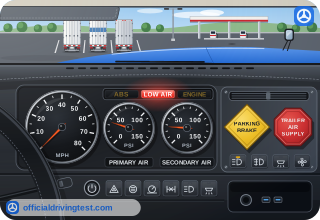
In the low pressure warning test, how do you lower the tank pressure once the engine is off?
- Open the manual drain valve on each tank
- Rev the engine and let it idle
- Turn the power on and pump the brake pedal
Show answer
Correct answer: Turn the power on and pump the brake pedal
With the engine off and the electrical power on, pumping the brake pedal reduces the tank pressure so you can see when the signal comes on.
Source: CDL manual, national model as printed by New Jersey, Section 5 (July 2017)
-
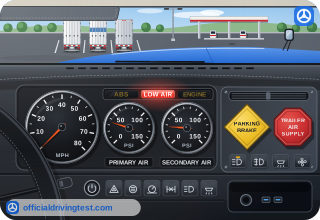
In a dual air system, the low pressure warning test is judged by which tank?
- The tank with the highest pressure
- The tank with the lowest pressure
- Only the tank of the primary system
Show answer
Correct answer: The tank with the lowest pressure
In a dual system the signal must come on before the tank with the lowest pressure falls below the warning level.
Source: CDL manual, national model as printed by New Jersey, Section 5 (July 2017)
-
The low pressure warning signal does not work. What could happen in a single-circuit air system?
- The brake pedal becoming very hard to push
- The compressor shutting off at once
- Sudden emergency braking
Show answer
Correct answer: Sudden emergency braking
Without a working warning you could lose air without knowing it, and a single-circuit system could brake suddenly and hard.
Source: CDL manual, national model as printed by New Jersey, Section 5 (July 2017)
-
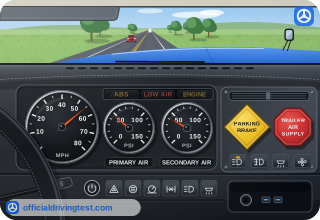
The low pressure warning signal does not work. What happens in a dual air system when pressure is lost?
- The stopping distance gets longer
- The vehicle stops sooner than normal
- The compressor cuts out early
Show answer
Correct answer: The stopping distance gets longer
In a dual system the stopping distance increases, and only limited braking is possible before the spring brakes come on.
Source: CDL manual, national model as printed by New Jersey, Section 5 (July 2017)
-
On a tractor-trailer, which valves should pop out as you keep fanning off the air pressure?
- Only the tractor protection valve and the foot valve
- The foot valve and the air tank drain valve
- The tractor protection and parking brake valves
Show answer
Correct answer: The tractor protection and parking brake valves
On a tractor-trailer both the tractor protection valve and the parking brake valve close and pop out when the pressure falls low enough, which puts the spring brakes on.
Source: CDL manual, national model as printed by New Jersey, Section 5 (July 2017)
-
On a single vehicle, which valve should pop out when you fan the air pressure down far enough?
- The parking brake valve
- The tractor protection valve
- The safety relief valve
Show answer
Correct answer: The parking brake valve
On single vehicles, and on combinations other than tractor-trailers, the parking brake valve is the one that closes.
Source: CDL manual, national model as printed by New Jersey, Section 5 (July 2017)
-
As you fan off the air pressure, at about what range of pressure should the valves pop out so the spring brakes come on?
- 5 to 15 psi
- 90 to 110 psi
- 20 to 45 psi
Show answer
Correct answer: 20 to 45 psi
The parking brake valve closes when the pressure falls to the maker’s specification of 20 to 45 psi, and the spring brakes come on.
Source: CDL manual, national model as printed by New Jersey, Section 5 (July 2017)
-
In a dual air system at operating rpms, how fast should pressure rise from 85 to 100 psi?
- Within 20 seconds
- Within 45 seconds
- Within 90 seconds
Show answer
Correct answer: Within 45 seconds
In a dual system, pressure should climb to 100 psi from 85 in 45 seconds or less with the engine at operating rpms.
Source: CDL manual, national model as printed by New Jersey, Section 5 (July 2017)
-
Why might a vehicle safely take longer than the usual time to build up air pressure?
- Its air tanks are larger than the minimum size
- It has an automatic wig wag warning device
- It uses a modulating control valve to park
Show answer
Correct answer: Its air tanks are larger than the minimum size
With air tanks larger than the minimum, a longer build-up time can still be safe. The manufacturer's specifications apply.
Source: CDL manual, national model as printed by New Jersey, Section 5 (July 2017)
-
In an older single air system, what is the typical time for pressure to build from 50 to 90 psi?
- Within 1 minute
- Within 3 minutes
- Within 6 minutes
Show answer
Correct answer: Within 3 minutes
An older single air system typically needs 3 minutes or less to go from 50 to 90 psi, with the engine idling.
Source: CDL manual, national model as printed by New Jersey, Section 5 (July 2017)
-
For the pressure build-up check on an older single air system, at what engine speed is the build-up timed?
- An idle speed of 600 to 900 rpm
- A fast idle of 1,200 to 1,500 rpm
- Full governed engine speed
Show answer
Correct answer: An idle speed of 600 to 900 rpm
Single air systems made before 1975 are typically timed with the engine idling at 600 to 900 rpm.
Source: CDL manual, national model as printed by New Jersey, Section 5 (July 2017)
-
The air pressure builds up too slowly. What should you do?
- Drive, but avoid long hills
- Drive, and drain the tanks at the end of the day
- Do not drive until it is fixed
Show answer
Correct answer: Do not drive until it is fixed
Slow build-up means pressure could fall too low on the road and force an emergency stop, so the problem must be fixed before driving.
Source: CDL manual, national model as printed by New Jersey, Section 5 (July 2017)
-
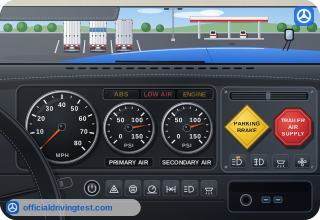
How do you test that the parking brake will hold?
- Set it and tug gently against it in low gear
- Set it and push the brake pedal firmly
- Set it and rev the engine in neutral
Show answer
Correct answer: Set it and tug gently against it in low gear
You stop, set the parking brake, and gently try to pull forward in a low gear. If the vehicle stays put, the brake holds.
Source: CDL manual, national model as printed by New Jersey, Section 5 (July 2017)
-
About how fast should you be moving when you test the service brakes?
- About 15 mph
- About 5 mph
- About 25 mph
Show answer
Correct answer: About 5 mph
You roll forward slowly at about 5 mph and press the brake pedal firmly.
Source: CDL manual, national model as printed by New Jersey, Section 5 (July 2017)
-
What should you watch for when you test the service brakes at low speed?
- Compressor noise or a squealing drive belt
- Tank drain valves leaking water or oil
- A pull to one side or a late stop
Show answer
Correct answer: A pull to one side or a late stop
During the low-speed test, notice if the vehicle pulls to one side, if the brakes feel unusual, or if they are slow to stop the vehicle.
Source: CDL manual, national model as printed by New Jersey, Section 5 (July 2017)