Air Brakes: Inspecting air brakes — Part 1
Questions in this part include: “What do you check on a belt-driven air compressor during the engine compartment inspection?” · “Brakes with automatic adjusters are found out of adjustment. What is the recommended action?”
Independent educational site · not affiliated with any government agency or DMV
Ready? Test yourself
Answer to start, or tap Start below:
How should the vehicle be set up before you pull on the slack adjusters by hand?
- Instant feedback with an explanation
- Every answer cites its source in the manual
- Your best score is saved on this device
- Keyboard: press 1 to 3 to answer and Enter for the next question
Questions are written in our own words from the CDL manual; they are not the real test's questions. With your state chosen, every answer gives its page in your state's CDL manual. Without a state, answers cite the CDL manual, national model as printed by New Jersey (July 2017).
All 21 questions in this practice test
Take the test above first, then use this list to study. Tap “Show answer” to see the correct answer and explanation.
Show the questions and answersHide the questions
-
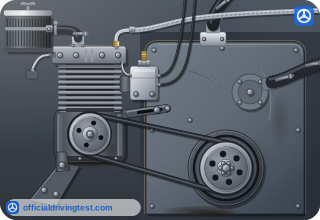
What do you check on a belt-driven air compressor during the engine compartment inspection?
- The compressor's intake filter and hoses
- The governor's cut-out adjusting screw
- The belt's condition and its tightness
Show answer
Correct answer: The belt's condition and its tightness
On a belt-driven compressor you check how good the belt is and how tight it is.
Source: CDL manual, national model as printed by New Jersey, Section 5 (July 2017)
-
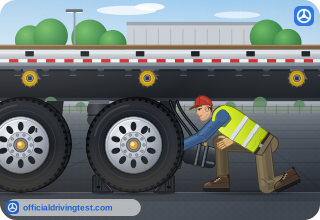
How should the vehicle be set up before you pull on the slack adjusters by hand?
- On level ground, wheels chocked, parking brakes released
- On level ground, wheels chocked, parking brakes applied
- On level ground, wheels not chocked, parking brakes released
Show answer
Correct answer: On level ground, wheels chocked, parking brakes released
The wheels are chocked so the vehicle cannot move, and the parking brakes are released so the slack adjusters are free to move.
Source: CDL manual, national model as printed by New Jersey, Section 5 (July 2017)
-
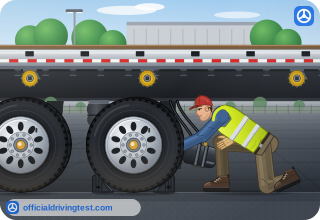
You pull hard on an S-cam slack adjuster. How much movement at the push rod means it probably needs adjusting?
- More than about one inch
- More than about two inches
- More than about three inches
Show answer
Correct answer: More than about one inch
Movement of more than about one inch at the point where the push rod attaches means the brake is probably out of adjustment.
Source: CDL manual, national model as printed by New Jersey, Section 5 (July 2017)
-
What can happen to a vehicle whose brakes have too much slack?
- Its brakes release too slowly
- It can be very hard to stop
- Its compressor runs all the time
Show answer
Correct answer: It can be very hard to stop
Brakes with too much slack are out of adjustment, and the vehicle can be very hard to stop.
Source: CDL manual, national model as printed by New Jersey, Section 5 (July 2017)
-
Which brake problem do roadside inspections find most often?
- Cracked brake drums
- Brakes out of adjustment
- Air hoses cut by rubbing
Show answer
Correct answer: Brakes out of adjustment
Brakes out of adjustment are the most common problem found at roadside inspections, so slack adjusters should always be checked.
Source: CDL manual, national model as printed by New Jersey, Section 5 (July 2017)
-
Vehicles built since which year all have automatic slack adjusters?
- 1984
- 2004
- 1994
Show answer
Correct answer: 1994
Every vehicle built since 1994 has automatic slack adjusters.
Source: CDL manual, national model as printed by New Jersey, Section 5 (July 2017)
-
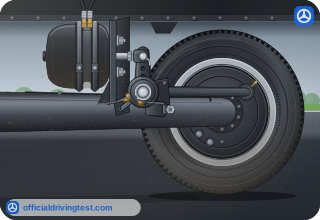
A vehicle has self-adjusting slack adjusters. Do you still have to check them?
- No, they adjust themselves, so checking is skipped
- Yes, they must still be checked
- Only when you hear air leaking
Show answer
Correct answer: Yes, they must still be checked
Even self-adjusting slack adjusters have to be checked. They adjust only during full brake applications.
Source: CDL manual, national model as printed by New Jersey, Section 5 (July 2017)
-
On a vehicle with automatic adjusters, the push rod stroke goes past the legal limit. What does this tell you?
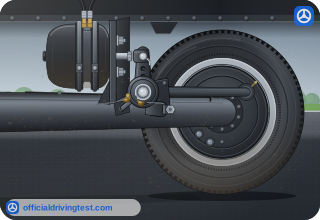
- The adjusters need a routine turn by hand
- A fault in the adjuster or brake parts
- The brake chambers got too much air
Show answer
Correct answer: A fault in the adjuster or brake parts
Automatic adjusters should keep the stroke in limits, so an over-limit stroke points to a fault in the adjuster, in the foundation brake parts, or to bad installation.
Source: CDL manual, national model as printed by New Jersey, Section 5 (July 2017)
-
What is routine hand adjustment of most automatic slack adjusters likely to cause?
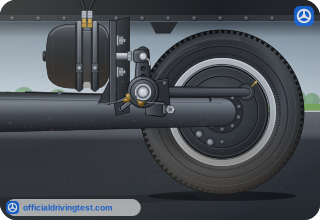
- Early wear of the adjuster itself
- Longer life for the brake linings
- A shorter push rod stroke for good
Show answer
Correct answer: Early wear of the adjuster itself
Adjusting most automatic adjusters by hand as a routine will probably wear the adjuster out early.
Source: CDL manual, national model as printed by New Jersey, Section 5 (July 2017)
-
Brakes with automatic adjusters are found out of adjustment. What is the recommended action?
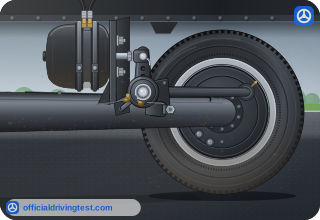
- Turn the adjusters by hand and keep driving
- Take the vehicle to a repair facility soon
- Wait for the next scheduled inspection
Show answer
Correct answer: Take the vehicle to a repair facility soon
Automatic adjusters that are out of adjustment point to a hidden fault, so the driver should get the vehicle to a shop soon.
Source: CDL manual, national model as printed by New Jersey, Section 5 (July 2017)
-
Why is turning an automatic slack adjuster by hand dangerous?
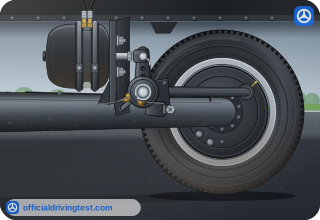
- It can make the brakes seem safe when they are not
- It can cause the compressor to cut in too early
- It always shortens the push rod stroke too far
Show answer
Correct answer: It can make the brakes seem safe when they are not
Hand adjustment hides the real problem, so the driver may wrongly trust the braking system.
Source: CDL manual, national model as printed by New Jersey, Section 5 (July 2017)
-
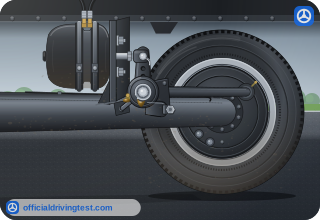
On the road, brakes with automatic slack adjusters are found out of adjustment. When may they be adjusted by hand?
- Only as a short-term fix in an emergency
- Every time you do a pre-trip inspection
- Any time the brakes feel a little soft
Show answer
Correct answer: Only as a short-term fix in an emergency
Hand adjustment of an automatic adjuster is only a temporary emergency measure, because the brake will likely soon be out of adjustment again.
Source: CDL manual, national model as printed by New Jersey, Section 5 (July 2017)
-
How long may a crack in a brake drum or disc be before it is a defect?
- No longer than the full width of the friction area
- No longer than half the width of the friction area
- No longer than one inch in total
Show answer
Correct answer: No longer than half the width of the friction area
Any crack over half the width of the friction area means the drum or disc is unfit.
Source: CDL manual, national model as printed by New Jersey, Section 5 (July 2017)
-
Which condition of a brake lining is a defect?
- Loose, or soaked with oil or grease
- Worn evenly but still above the limit
- A lighter color than the brake shoe
Show answer
Correct answer: Loose, or soaked with oil or grease
Linings that are loose or soaked with oil or grease cannot be used. They also must not be dangerously thin.
Source: CDL manual, national model as printed by New Jersey, Section 5 (July 2017)
-
On an air brake vehicle, the final air brake check takes the place of which check?
- The hydraulic brake check
- The walk-around slack adjuster check
- The engine compartment belt check
Show answer
Correct answer: The hydraulic brake check
In the last step of the inspection, the air brake checks are done instead of the hydraulic brake check.
Source: CDL manual, national model as printed by New Jersey, Section 5 (July 2017)
-
How should the engine run while you check where the governor cuts out the compressor?
- At a fast idle
- At a slow idle
- At full throttle in neutral
Show answer
Correct answer: At a fast idle
You run the engine at a fast idle and watch the gauge. The reading should stop rising when the governor cuts out the compressor.
Source: CDL manual, national model as printed by New Jersey, Section 5 (July 2017)
-
In the governor check, how do you lower tank pressure to see the compressor cut in?
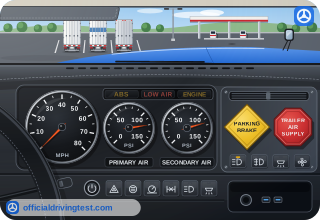
- Press and release the brake with the engine idling
- Pull the parking brake control out, then in
- Switch the engine off and wait a while
Show answer
Correct answer: Press and release the brake with the engine idling
Pumping the brake pedal with the engine idling drops the pressure until the compressor cuts in and the gauge starts to rise.
Source: CDL manual, national model as printed by New Jersey, Section 5 (July 2017)
-
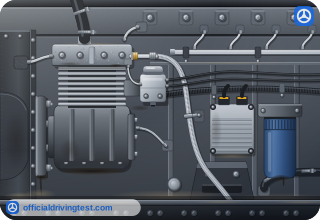
What can a badly working air governor cause?
- Brake lights that stay on all the time
- Spring brakes that never come on
- Too little air pressure kept for safe driving
Show answer
Correct answer: Too little air pressure kept for safe driving
If the governor does not cut the compressor in and out properly, the system may not hold enough air pressure to drive safely.
Source: CDL manual, national model as printed by New Jersey, Section 5 (July 2017)
-
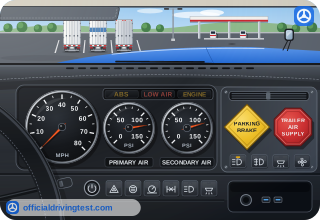
In the first air leakage test, what do you do before timing the pressure drop?
- Keep the engine running and pull the parking brake out
- Turn off the engine and pull the parking brake out
- Turn off the engine and push the parking brake in
Show answer
Correct answer: Turn off the engine and push the parking brake in
The system is fully charged, the engine is off and the parking brake is released (pushed in), then you time the drop in air pressure.
Source: CDL manual, national model as printed by New Jersey, Section 5 (July 2017)
-
In the first leakage test (engine off, parking brake released, foot off the brake), a single vehicle should lose less than how much air pressure in one minute?
- Less than 5 psi
- Less than 2 psi
- Less than 8 psi
Show answer
Correct answer: Less than 2 psi
For a single vehicle the loss should be under 2 psi in one minute.
Source: CDL manual, national model as printed by New Jersey, Section 5 (July 2017)
-
In the first leakage test (engine off, parking brake released, foot off the brake), a combination vehicle should lose less than how much air pressure in one minute?
- Less than 6 psi
- Less than 3 psi
- Less than 8 psi
Show answer
Correct answer: Less than 3 psi
For a combination vehicle the loss should be under 3 psi in one minute.
Source: CDL manual, national model as printed by New Jersey, Section 5 (July 2017)