Alaska: Sharing the road
Bicycles, motorcycles, school buses, slow-moving vehicles, large trucks, passing and litter. Split into 6 shorter tests so you're not stuck in one long quiz.
Independent educational site · not affiliated with any government agency or DMV
Choose a part
Sharing the road — Part 1
Questions in this part include: “When towing more than one vehicle on the roadway, what must the towing vehicle weigh?”
StartSharing the road — Part 2
Questions in this part include: “In which direction do bicyclists have the right to travel on the road?”
StartSharing the road — Part 3
Questions in this part include: “To whom should bicyclists give the right-of-way?”
StartSharing the road — Part 4
Questions in this part include: “When meeting a school bus on an undivided two-way road, when must you bring your vehicle to a complete stop?”
StartSharing the road — Part 5
Questions in this part include: “What often prevents truck drivers from hearing your horn?”
StartSharing the road — Part 6
Questions in this part include: “Why are the results too often deadly when a car is hit from behind by a truck?”
StartAll 110 Sharing the road questions with answers
Choose a part above to take a practice test, or study every question and answer here.
Show the questions and answersHide the questions
-
When towing more than one vehicle on the roadway, what must the towing vehicle weigh?
- More than 10,000 pounds
- More than 20,000 pounds
- More than 26,000 pounds
- More than 15,000 pounds
Show answer
Correct answer: More than 15,000 pounds
The rule on towing triples requires a towing vehicle that weighs more than 15,000 pounds.
Source: Alaska Driver Manual (Revised October 2025), page 30 · Open this page in the manual (Manual page 30)
-
When towing more than one vehicle on the roadway, how many axles must the towing vehicle have?
- Two or more axles
- Four or more axles
- Three or more axles
- Five or more axles
Show answer
Correct answer: Three or more axles
The towing vehicle must have three or more axles.
Source: Alaska Driver Manual (Revised October 2025), page 30 · Open this page in the manual (Manual page 30)
-
To tow more than one vehicle on the roadway, the towing vehicle must have what braking equipment?
- An air brake system for both the towing and towed vehicles
- A hydraulic brake system on the towing vehicle only
- An air brake system on the towing vehicle only
- A separate air brake system on the last towed vehicle only
Show answer
Correct answer: An air brake system for both the towing and towed vehicles
The towing vehicle must be equipped with an air brake system for both the towing and the towed vehicles.
Source: Alaska Driver Manual (Revised October 2025), page 30 · Open this page in the manual (Manual page 30)
-
When must you stop for a school bus?
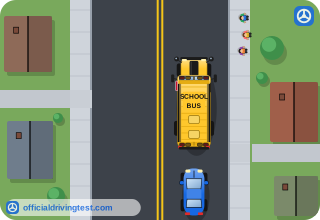
- Only when children are visibly standing outside the bus
- Only when the bus driver signals you with a hand signal
- When its red lights flash and its stop arm is extended
- Only when the bus is stopped in the right lane
Show answer
Correct answer: When its red lights flash and its stop arm is extended
You stop when the bus’s red flashing lights are in operation and the stop arm is extended.
Source: Alaska Driver Manual (Revised October 2025), page 36 · Open this page in the manual (Manual page 36)
-
Why are collisions resulting from improper passing often fatal?
- Passing drivers are usually traveling over the speed limit
- Most passing takes place on roads without any shoulders
- The impact force is great in this type of collision
- Oncoming drivers rarely have time to sound a horn
Show answer
Correct answer: The impact force is great in this type of collision
The manual says such collisions are often fatal since the impact force is great.
Source: Alaska Driver Manual (Revised October 2025), page 36 · Open this page in the manual (Manual page 36)
-
According to the manual, what determines the decision whether to pass another vehicle?
- The judgment and attitude of the driver
- The posted speed limit on that road section
- The speed of the vehicle you are following
- The number of vehicles behind you
Show answer
Correct answer: The judgment and attitude of the driver
The decision to pass is determined by the judgment and attitude of the driver.
Source: Alaska Driver Manual (Revised October 2025), page 36 · Open this page in the manual (Manual page 36)
-
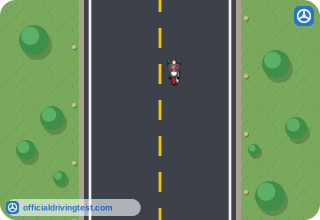
Before you pass, how should you position your vehicle behind the vehicle ahead?
- Drive as close as possible to its bumper
- Stay beside its rear wheel for a better view
- Straddle the center line to look ahead
- Stay well back for better sight distance
Show answer
Correct answer: Stay well back for better sight distance
The first passing rule is to stay well back from the vehicle ahead for better sight distance.
Source: Alaska Driver Manual (Revised October 2025), page 36 · Open this page in the manual (Manual page 36)
-
While checking ahead before passing, what should you not do?
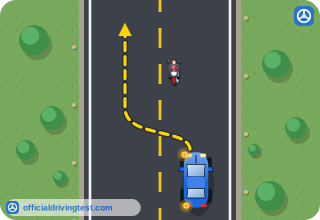
- Swing out across the center line for a look
- Look well ahead of the vehicle you are passing
- Stay well back from the vehicle ahead
- Check for a no passing zone and oncoming vehicles
Show answer
Correct answer: Swing out across the center line for a look
The manual says not to swing out across the center line for a look.
Source: Alaska Driver Manual (Revised October 2025), page 36 · Open this page in the manual (Manual page 36)
-
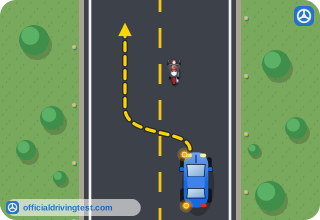
What does the manual tell you to do to warn the driver ahead of your intention to pass?
- Flash your headlights twice
- Tap your brakes three times
- Sound your horn
- Turn on your hazard flashers
Show answer
Correct answer: Sound your horn
The passing rules say to sound your horn to warn the driver ahead.
Source: Alaska Driver Manual (Revised October 2025), page 36 · Open this page in the manual (Manual page 36)
-
When may you return to the right lane after passing on the left?
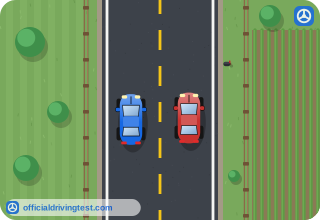
- As soon as your car is level with its front bumper
- Only when you are safely clear of the overtaken vehicle
- As soon as you have reached the speed limit
- After you have signaled right once
Show answer
Correct answer: Only when you are safely clear of the overtaken vehicle
You pass on the left at a safe distance and do not return to the right lane until safely clear of the overtaken vehicle.
Source: Alaska Driver Manual (Revised October 2025), page 36 · Open this page in the manual (Manual page 36)
-
Where is passing prohibited?
- On a straight road with a clear view ahead
- In the left lane of a road with a broken center line
- On the right shoulder of the highway
- Anywhere on a multilane road when traffic is light
Show answer
Correct answer: On the right shoulder of the highway
The do-not-pass list begins with passing on the right shoulder of the highway.
Source: Alaska Driver Manual (Revised October 2025), page 37 · Open this page in the manual (Manual page 37)
-
You may not pass when approaching a hill or curve where what is true?
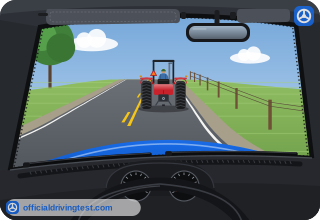
- There is not sufficient clear view ahead
- Another vehicle is following you closely
- The road surface is wet
- The speed limit is lower than the posted maximum
Show answer
Correct answer: There is not sufficient clear view ahead
You may not pass on approaching a hill or curve where there is not sufficient clear view ahead.
Source: Alaska Driver Manual (Revised October 2025), page 37 · Open this page in the manual (Manual page 37)
-
You may pass only if you can complete the pass without interfering with the safety of whom?
- The vehicle behind you
- Parked vehicles
- Pedestrians on the shoulder
- Oncoming vehicles
Show answer
Correct answer: Oncoming vehicles
The pass must be completed without interfering with the safety of oncoming vehicles.
Source: Alaska Driver Manual (Revised October 2025), page 37 · Open this page in the manual (Manual page 37)
-
What is unlawful when another driver is passing you?
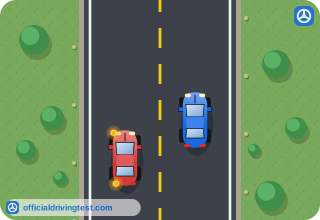
- Slowing down to let them by
- Increasing your speed
- Signaling a left turn
- Looking in your mirror
Show answer
Correct answer: Increasing your speed
The manual says that when being passed it is unlawful to increase your speed.
Source: Alaska Driver Manual (Revised October 2025), page 37 · Open this page in the manual (Manual page 37)
-
On a divided road, when are you not allowed to pass a school bus that has red flashing lights and an extended stop arm?
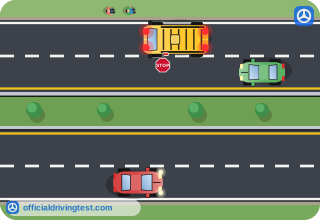
- Only when you are on the opposite side of the divided road
- Only when children are visibly standing outside the bus
- When you are traveling within the same divided travel way as the bus
- Only when the bus is stopped in the lane right next to yours
Show answer
Correct answer: When you are traveling within the same divided travel way as the bus
You may not pass a school bus with red flashing lights and an extended stop arm on an undivided two-way roadway or within the same divided travel way as the bus.
Source: Alaska Driver Manual (Revised October 2025), page 37 · Open this page in the manual (Manual page 37)
-
You may not pass when approaching within how many feet of an intersection or railroad crossing?
- 50 feet
- 100 feet
- 200 feet
- 300 feet
Show answer
Correct answer: 100 feet
Passing is not allowed when approaching within 100 feet of, or traversing, an intersection or railroad crossing.
Source: Alaska Driver Manual (Revised October 2025), page 37 · Open this page in the manual (Manual page 37)
-
You may not pass within 100 feet of what kind of structure?
- Any bridge that is wider than two lanes
- A pedestrian overpass of any width or height
- A parking garage entrance or exit ramp
- A posted narrow bridge, viaduct, or tunnel
Show answer
Correct answer: A posted narrow bridge, viaduct, or tunnel
Passing is not allowed when approaching within 100 feet of a posted narrow bridge, viaduct, or tunnel.
Source: Alaska Driver Manual (Revised October 2025), page 37 · Open this page in the manual (Manual page 37)
-
What are center lanes reserved for?
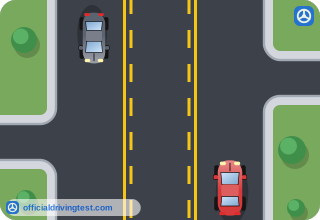
- Passing slower vehicles on the left
- Accelerating after turning right
- Decelerating in advance of turning left
- Emergency vehicles only
Show answer
Correct answer: Decelerating in advance of turning left
Center lanes are reserved for decelerating in advance of turning left, and may not be used for passing.
Source: Alaska Driver Manual (Revised October 2025), page 37 · Open this page in the manual (Manual page 37)
-
What does the end of a “no passing zone” mean?
- There is increased visibility ahead
- It is now safe to pass
- Oncoming traffic is no longer allowed
- The speed limit is increasing
Show answer
Correct answer: There is increased visibility ahead
The end of a no passing zone does not mean it is safe to pass; it means there is increased visibility ahead.
Source: Alaska Driver Manual (Revised October 2025), page 37 · Open this page in the manual (Manual page 37)
-
Why does the manual call people walking, people biking, and people using a mobility device vulnerable road users?
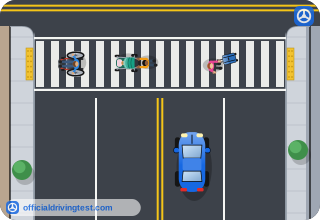
- They are unprotected against motor vehicles in collisions
- They are not required to obey traffic signals
- They always travel faster than the cars around them
- They are not allowed to use roads shared with cars
Show answer
Correct answer: They are unprotected against motor vehicles in collisions
The manual says these users are most vulnerable because they have no protection against motor vehicles in a collision.
Source: Alaska Driver Manual (Revised October 2025), page 43 · Open this page in the manual (Manual page 43)
-
Which of these does the manual list among the vulnerable road users that drivers of passenger vehicles share the roadway with?
- Drivers of other passenger vehicles
- Passengers riding inside a school bus
- Highway workers on foot in work zones
- Drivers of large trucks on the highway
Show answer
Correct answer: Highway workers on foot in work zones
The manual names people walking and biking, highway workers on foot in work zones, and people using mobility devices.
Source: Alaska Driver Manual (Revised October 2025), page 43 · Open this page in the manual (Manual page 43)
-
According to the manual, what happens to a vulnerable road user's chance of surviving a crash as the car's collision speed increases?
- It stays about the same
- It decreases enormously
- It increases because the driver brakes harder
- It depends only on the road surface
Show answer
Correct answer: It decreases enormously
The manual states that the survival rate decreases enormously as the car's collision speed increases.
Source: Alaska Driver Manual (Revised October 2025), page 43 · Open this page in the manual (Manual page 43)
-
In which direction do bicyclists have the right to travel on the road?
- Facing oncoming motor vehicles
- In either direction, whichever is safer
- Only on sidewalks, never on the road
- In the same direction as motor vehicles
Show answer
Correct answer: In the same direction as motor vehicles
The manual says bicyclists have the right to share the road and travel in the same direction as motor vehicles.
Source: Alaska Driver Manual (Revised October 2025), page 44 · Open this page in the manual (Manual page 44)
-
Before which of these actions does the manual tell drivers to check their blind spots for bicyclists?
- Opening a car door
- Turning on your headlights
- Adjusting the radio
- Fastening your seat belt
Show answer
Correct answer: Opening a car door
Drivers must check blind spots before a turn, parallel parking, opening a door or leaving a curb.
Source: Alaska Driver Manual (Revised October 2025), page 44 · Open this page in the manual (Manual page 44)
-
How should you check for bicyclists that may be next to your vehicle or approaching?
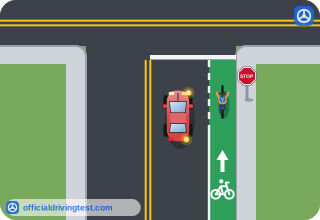
- Rely on your rearview mirror and sound your horn
- Look only in your side mirrors before moving
- Turn your head to look, not only use your mirrors
- Wait for the bicyclist to signal before looking
Show answer
Correct answer: Turn your head to look, not only use your mirrors
The manual says not to depend on only your mirrors but to turn your head to look for bicyclists.
Source: Alaska Driver Manual (Revised October 2025), page 44 · Open this page in the manual (Manual page 44)
-
How must a driver treat the right-of-way of bicyclists and other highway users?
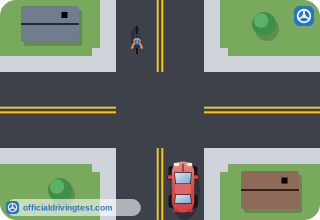
- Bicyclists must always yield to motor vehicles
- Yield to them just as you would to another vehicle
- Right-of-way rules apply only between motor vehicles
- Yield only when a bicyclist is in a bike lane
Show answer
Correct answer: Yield to them just as you would to another vehicle
The rules of the road and right-of-way apply to and protect bicyclists, so drivers yield as they would to another vehicle.
Source: Alaska Driver Manual (Revised October 2025), page 44 · Open this page in the manual (Manual page 44)
-
The manual reminds drivers that a bicycle is what?
- A pedestrian
- A mobility device
- A moving obstacle
- A vehicle
Show answer
Correct answer: A vehicle
The manual says to remember that a bicycle is a vehicle.
Source: Alaska Driver Manual (Revised October 2025), page 44 · Open this page in the manual (Manual page 44)
-
Under what age does the manual say youngsters lack the physical and mental development to interact safely in a complex traffic environment?
- Nine
- Six
- Twelve
- Fifteen
Show answer
Correct answer: Nine
The manual says youngsters under age nine lack that development, so drivers should be careful near children riding bikes.
Source: Alaska Driver Manual (Revised October 2025), page 44 · Open this page in the manual (Manual page 44)
-
What traffic rules must bicyclists obey?
- Only traffic signals at intersections
- Only the laws that apply to pedestrians
- Traffic signs, signals, and all other traffic laws
- None, because bicycles are not motor vehicles
Show answer
Correct answer: Traffic signs, signals, and all other traffic laws
The manual states that bicyclists are required to obey traffic signs, signals, and all other traffic laws.
Source: Alaska Driver Manual (Revised October 2025), page 45 · Open this page in the manual (Manual page 45)
-
What does the manual say bicyclists should always wear?
- A reflective vest
- Bright gloves
- A face mask
- A helmet
Show answer
Correct answer: A helmet
The first bicycle safety tip is to always wear a helmet.
Source: Alaska Driver Manual (Revised October 2025), page 45 · Open this page in the manual (Manual page 45)
-
Near which part of the road should a bicyclist ride?
- Near the right-hand edge
- Near the left-hand edge
- In the center of the lane
- Close to the center line
Show answer
Correct answer: Near the right-hand edge
The safety tips say to ride your bicycle near the right-hand edge of the road.
Source: Alaska Driver Manual (Revised October 2025), page 45 · Open this page in the manual (Manual page 45)
-
What does the manual say about carrying a passenger on a bicycle?
- It is allowed on roads with low speed limits
- It is allowed if the passenger wears a helmet
- Never carry another person on your bicycle
- It is allowed during daylight hours only
Show answer
Correct answer: Never carry another person on your bicycle
The bicycle safety tips say never to carry another person on your bicycle.
Source: Alaska Driver Manual (Revised October 2025), page 45 · Open this page in the manual (Manual page 45)
-
When should a bicyclist use hand signals?
- Only when cars are close behind
- Always when turning or stopping
- Only when riding at night
- Only when turning left
Show answer
Correct answer: Always when turning or stopping
The manual says to always use hand signals when turning or stopping.
Source: Alaska Driver Manual (Revised October 2025), page 45 · Open this page in the manual (Manual page 45)
-
What hand signal does a bicyclist use for a left turn?
- Right arm fully extended to the right
- Left arm extended and bent down at the elbow
- Left arm extended and bent up at the elbow
- Left arm fully extended to the left
Show answer
Correct answer: Left arm fully extended to the left
The manual lists a left turn as the left arm fully extended to the left.
Source: Alaska Driver Manual (Revised October 2025), page 45 · Open this page in the manual (Manual page 45)
-
What hand signal does a bicyclist use to stop?
- Left arm extended and bent down at the elbow
- Left arm fully extended to the left
- Left arm extended and bent up at the elbow
- Right arm fully extended to the right
Show answer
Correct answer: Left arm extended and bent down at the elbow
The manual lists stop as the left arm extended and bent down at the elbow.
Source: Alaska Driver Manual (Revised October 2025), page 45 · Open this page in the manual (Manual page 45)
-
Which of these is a hand signal a bicyclist can use for a right turn?
- Left arm fully extended to the left
- Left arm extended and bent down at the elbow
- Left arm extended and bent up at the elbow
- Right arm extended and bent down at the elbow
Show answer
Correct answer: Left arm extended and bent up at the elbow
A right turn is signaled with the right arm fully extended to the right or the left arm extended and bent up at the elbow.
Source: Alaska Driver Manual (Revised October 2025), page 45 · Open this page in the manual (Manual page 45)
-
Where should a bicyclist look out for cars?
- Only at traffic signals and in school zones
- At cross streets, driveways, and parking places
- Only on bridges and on freeway on-ramps
- Only where a bicycle lane is painted
Show answer
Correct answer: At cross streets, driveways, and parking places
The manual says to look out for cars at cross streets, driveways, and parking places.
Source: Alaska Driver Manual (Revised October 2025), page 45 · Open this page in the manual (Manual page 45)
-
What should a bicyclist avoid doing when looking over a shoulder to check traffic?
- Slowing down
- Signaling
- Stopping
- Swerving
Show answer
Correct answer: Swerving
The manual says to be careful when checking traffic and not to swerve when looking over your shoulder.
Source: Alaska Driver Manual (Revised October 2025), page 45 · Open this page in the manual (Manual page 45)
-
To whom should bicyclists give the right-of-way?
- Pedestrians
- Motorists in every case
- Other bicyclists only
- No one, because bicycles are vehicles
Show answer
Correct answer: Pedestrians
The safety tips tell bicyclists to give pedestrians the right-of-way.
Source: Alaska Driver Manual (Revised October 2025), page 45 · Open this page in the manual (Manual page 45)
-
What should a bicyclist not do when vehicles are turning?
- Stay behind them until they have finished turning
- Wait for the turn to be completed before moving on
- Pass them, especially on the side to which they are turning
- Make eye contact with the driver before riding on
Show answer
Correct answer: Pass them, especially on the side to which they are turning
Turning cars, trucks and buses cannot see a bicycle in their blind spot, so do not pass them when they are turning.
Source: Alaska Driver Manual (Revised October 2025), page 45 · Open this page in the manual (Manual page 45)
-
What should a bicyclist do before crossing in front of a driver, even with the right of way?
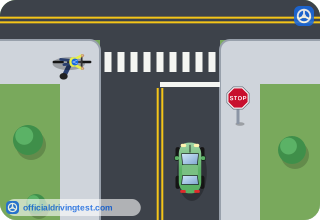
- Ring a bell and proceed
- Make eye contact with the driver
- Speed up to cross before the car arrives
- Wave the driver through and ride off
Show answer
Correct answer: Make eye contact with the driver
The manual says to make eye contact with drivers before crossing in front of them, even if you have the right of way.
Source: Alaska Driver Manual (Revised October 2025), page 45 · Open this page in the manual (Manual page 45)
-
If a bicyclist wears headphones, what does the manual say to do?
- Keep the volume low in both ears
- Wear them only on quiet roads
- Use only over-the-ear headphones
- Always keep one earbud out
Show answer
Correct answer: Always keep one earbud out
The manual says to always keep one earbud out so the biker can hear traffic and other hazards.
Source: Alaska Driver Manual (Revised October 2025), page 45 · Open this page in the manual (Manual page 45)
-
How does the manual suggest bicyclists thank motorists who have been considerate?
- With a wave or a nod
- With a short ring of a bell
- By flashing a light at them
- With a tap of the horn
Show answer
Correct answer: With a wave or a nod
The manual suggests thanking considerate motorists with a wave or a nod.
Source: Alaska Driver Manual (Revised October 2025), page 45 · Open this page in the manual (Manual page 45)
-
Which driver action causes a large percentage of car/motorcycle crashes?
- Drivers backing out of a parking space onto the road
- Drivers merging onto the freeway from an on-ramp
- Drivers turning left in front of oncoming motorcyclists
- Drivers stopping suddenly for a school bus
Show answer
Correct answer: Drivers turning left in front of oncoming motorcyclists
The manual says drivers turning left in front of oncoming motorcyclists cause a large percentage of car/cycle crashes.
Source: Alaska Driver Manual (Revised October 2025), page 46 · Open this page in the manual (Manual page 46)
-
What do many drivers say about motorcyclists, even when they see them?
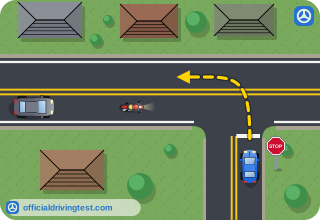
- Their headlights are too bright to judge their direction at night
- It is difficult to judge how far away they are or how fast they are traveling
- They are hard to hear, so drivers cannot tell whether they approach
- They usually ride in the center of the lane and cannot be passed
Show answer
Correct answer: It is difficult to judge how far away they are or how fast they are traveling
The manual says many drivers find it difficult to judge a motorcyclist's distance and speed.
Source: Alaska Driver Manual (Revised October 2025), page 46 · Open this page in the manual (Manual page 46)
-
What should you make sure of before you make a left turn in front of an oncoming motorcycle?
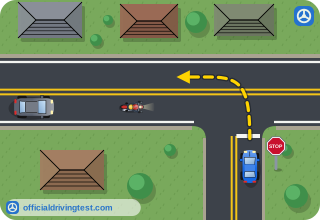
- That the rider has turned on a headlight
- That the rider has seen your vehicle and slowed down
- That you have signaled for at least three seconds
- That you see the motorcycle and know its speed
Show answer
Correct answer: That you see the motorcycle and know its speed
The manual says to look once, then again, and make sure you see the motorcycle and know its speed before turning left.
Source: Alaska Driver Manual (Revised October 2025), page 46 · Open this page in the manual (Manual page 46)
-
Why should you be sure a motorcyclist is actually turning before you turn in front of them?
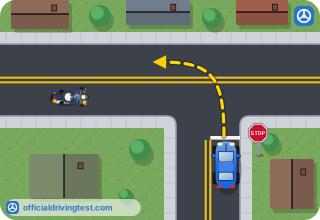
- A forgotten signal may still be blinking, as most do not turn off automatically
- Motorcycles cannot stop quickly enough once the rider has signaled a turn
- Motorcyclists are required to signal for a full block before turning
- Motorcycle turn signals are too dim to be seen from the opposite direction
Show answer
Correct answer: A forgotten signal may still be blinking, as most do not turn off automatically
Turn signals do not turn off automatically on most motorcycles, so the rider may be continuing straight with the signal still blinking.
Source: Alaska Driver Manual (Revised October 2025), page 47 · Open this page in the manual (Manual page 47)
-
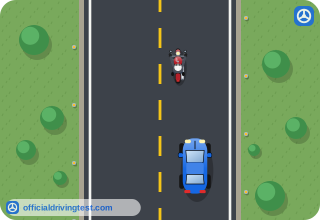
How many seconds of following distance should you give a motorcyclist, the same as other vehicles?
- One second
- Three seconds
- Four seconds
- Eight seconds
Show answer
Correct answer: Four seconds
The manual says the same four second following distance should be given to motorcyclists as to other vehicles.
Source: Alaska Driver Manual (Revised October 2025), page 47 · Open this page in the manual (Manual page 47)
-
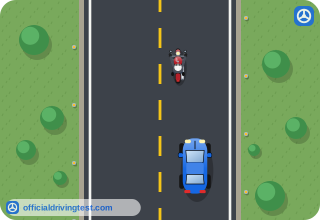
Why should you not follow a motorcyclist too closely?
- The rider cannot see the vehicle's turn signals
- It may distract the rider's attention from the road and traffic ahead
- Motorcyclists cannot use their brakes when followed closely
- The motorcycle's headlight becomes harder to see
Show answer
Correct answer: It may distract the rider's attention from the road and traffic ahead
Following too closely may cause the rider's attention to be distracted from the road and traffic ahead.
Source: Alaska Driver Manual (Revised October 2025), page 47 · Open this page in the manual (Manual page 47)
-
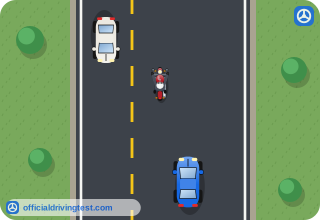
A motorcyclist is riding to one side of a wide lane. What does the manual say about moving into the same lane?
- It is allowed if you stay on the other side of the lane
- It is allowed if the lane is wide enough to share
- It is allowed when you signal first
- Never do it; it is illegal and extremely hazardous
Show answer
Correct answer: Never do it; it is illegal and extremely hazardous
Motorcycles need a full lane width, and moving into the same lane with one is illegal and extremely hazardous.
Source: Alaska Driver Manual (Revised October 2025), page 47 · Open this page in the manual (Manual page 47)
-
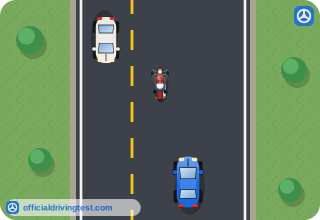
Why does a skilled motorcyclist constantly change positions within a lane?
- To see and be seen better and to avoid objects on the road
- To keep the motorcycle engine from overheating in traffic
- To discourage drivers from following the rider closely
- To save fuel by using less wind resistance on the road
Show answer
Correct answer: To see and be seen better and to avoid objects on the road
The manual says a skilled motorcyclist changes position to increase their ability to see and be seen and to avoid objects on the road.
Source: Alaska Driver Manual (Revised October 2025), page 47 · Open this page in the manual (Manual page 47)
-
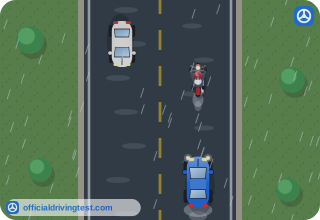
How should your following distance behind a motorcyclist change when the road is wet and slippery?
- Keep the same distance as on dry roads
- Allow less distance because the rider will slow down
- Allow more following distance
- Follow in the next lane instead
Show answer
Correct answer: Allow more following distance
The manual says to allow more following distance for motorcyclists when the road surface is wet and slippery.
Source: Alaska Driver Manual (Revised October 2025), page 47 · Open this page in the manual (Manual page 47)
-
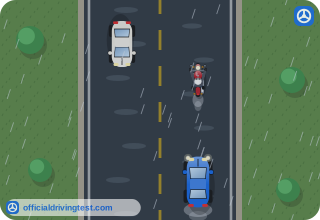
Around motorcyclists, what problem created by rain and wet surfaces should you be alert to, especially at night?
- Fog on the rider's visor
- Glare
- Fading headlights
- Frost on the road
Show answer
Correct answer: Glare
The manual says to be alert to the problem of glare that rain and wet surfaces create, especially at night.
Source: Alaska Driver Manual (Revised October 2025), page 47 · Open this page in the manual (Manual page 47)
-
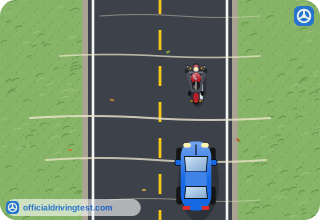
Where can strong cross winds move a motorcycle out of its lane of travel?
- Narrow streets lined with tall buildings
- Short, sheltered stretches of road in forests
- Residential streets with parked cars
- Wide open, long stretches of highways and bridges
Show answer
Correct answer: Wide open, long stretches of highways and bridges
The manual names wide open, long stretches of highways and bridges as places where strong cross winds can push a motorcycle out of its lane.
Source: Alaska Driver Manual (Revised October 2025), page 47 · Open this page in the manual (Manual page 47)
-
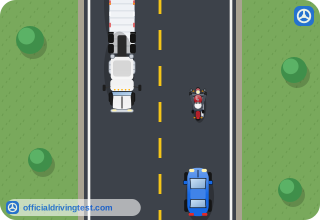
What can large, fast-moving trucks sometimes create that can move a motorcyclist out of their path of travel?
- Wind blasts
- Dust clouds
- Road vibrations
- Exhaust fumes
Show answer
Correct answer: Wind blasts
The manual says large, fast-moving trucks sometimes create wind blasts that can move a motorcyclist out of their path.
Source: Alaska Driver Manual (Revised October 2025), page 47 · Open this page in the manual (Manual page 47)
-
Which of these is listed as a road hazard that may cause a motorcyclist to change speed or direction?
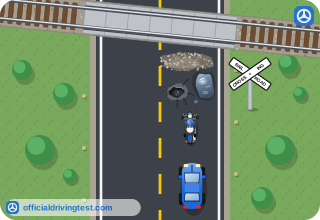
- Wide paved shoulders
- Straight, dry pavement
- Manhole covers
- Clearly marked lanes
Show answer
Correct answer: Manhole covers
The manual lists gravel, debris, pavement seams, rain grooves, small animals and even manhole covers as road hazards.
Source: Alaska Driver Manual (Revised October 2025), page 47 · Open this page in the manual (Manual page 47)
-
What do motorcyclists usually do at railroad grade crossings?
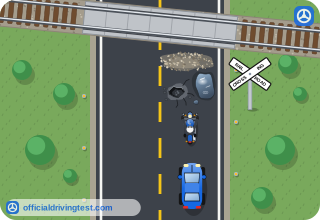
- Speed up so the wheels cross quickly
- Slow down and rise off the seat to cushion the shock
- Stop and walk the motorcycle across
- Cross the tracks at a sharp angle to keep traction
Show answer
Correct answer: Slow down and rise off the seat to cushion the shock
The manual says the rider slows down and rises off the seat to cushion the shock of a rough crossing.
Source: Alaska Driver Manual (Revised October 2025), page 47 · Open this page in the manual (Manual page 47)
-
Why might a motorcyclist change direction at a railroad grade crossing?
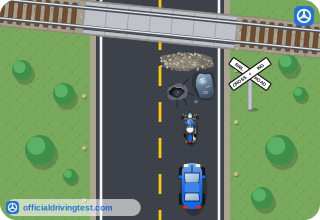
- So the front wheel can slide along the rail
- So the motorcycle stays out of the oncoming lane
- So the rider can avoid slowing down
- So the tracks can be crossed head on
Show answer
Correct answer: So the tracks can be crossed head on
The manual says the rider may change direction so the tracks can be crossed head on.
Source: Alaska Driver Manual (Revised October 2025), page 47 · Open this page in the manual (Manual page 47)
-
Compared with a car, what do metal or grated bridges do to a motorcycle?
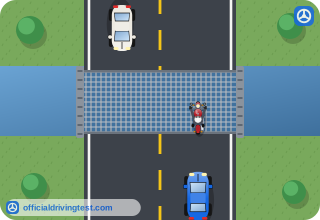
- They cause it to wobble much more
- They cause it to stop more quickly
- They cause it to skid only in the rain
- They have almost no effect on it
Show answer
Correct answer: They cause it to wobble much more
The manual says metal or grated bridges cause a motorcycle to wobble much more than a car.
Source: Alaska Driver Manual (Revised October 2025), page 47 · Open this page in the manual (Manual page 47)
-
How does an experienced motorcyclist handle a metal or grated bridge?
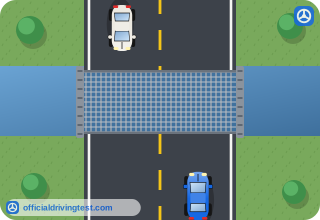
- Speeds up and moves to the edge of the lane
- Stays near the lane edge at the same speed
- Slows down and moves to the center of the lane
- Quickly changes direction to avoid the grating
Show answer
Correct answer: Slows down and moves to the center of the lane
An experienced cyclist slows down and moves to the center of the lane to allow room for handling the uneven surface.
Source: Alaska Driver Manual (Revised October 2025), page 47 · Open this page in the manual (Manual page 47)
-
What may an inexperienced motorcyclist do on a metal or grated bridge?
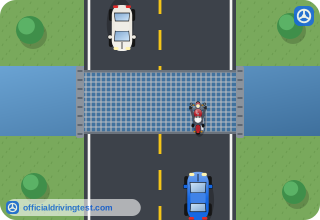
- Stop at the entrance of the bridge
- Become startled and try to quickly change direction
- Move to the center of the lane and slow down
- Ride across at a steady speed with no change
Show answer
Correct answer: Become startled and try to quickly change direction
The manual says an inexperienced cyclist may become startled and try to quickly change direction, and drivers should be prepared for it.
Source: Alaska Driver Manual (Revised October 2025), page 47 · Open this page in the manual (Manual page 47)
-
You approach a school bus from behind and its red signal lights are flashing. What must you do?
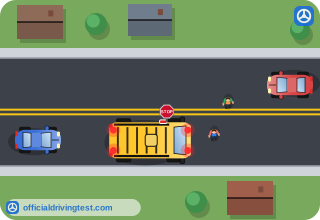
- Slow down and pass it on the left with caution
- Slow to 10 mph and pass if no children are visible
- Stop only if children are crossing in front of you
- Not pass it, and stop before reaching it
Show answer
Correct answer: Not pass it, and stop before reaching it
Drivers approaching from the rear may not pass a school bus with flashing red lights and must stop completely before reaching it.
Source: Alaska Driver Manual (Revised October 2025), page 48 · Open this page in the manual (Manual page 48)
-
Unless the bus driver signals you to go, what must happen before vehicles stopped behind a school bus with flashing red lights may move on?
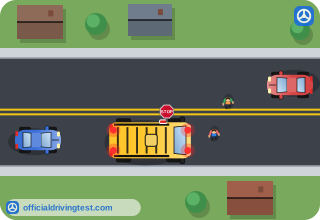
- The stop sign is retracted, the red lights stop flashing, and the bus moves again
- The bus driver turns off the engine and opens the door for the children
- Every child has crossed in front of the bus and reached the far curb
- The first vehicle in line has passed the bus slowly and stopped ahead
Show answer
Correct answer: The stop sign is retracted, the red lights stop flashing, and the bus moves again
The vehicles remain stopped until the stop sign is retracted, the flashing red lights are discontinued and the bus resumes motion, or until signaled by the driver.
Source: Alaska Driver Manual (Revised October 2025), page 48 · Open this page in the manual (Manual page 48)
-
Who can signal vehicles stopped behind a school bus that they may proceed?
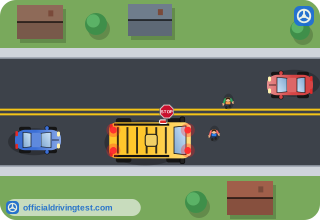
- The nearest pedestrian
- The first vehicle in line
- The school bus driver
- Any child at the curb
Show answer
Correct answer: The school bus driver
The manual says vehicles remain stopped until the stop sign is retracted and the lights stop, or until signaled by the driver to proceed.
Source: Alaska Driver Manual (Revised October 2025), page 48 · Open this page in the manual (Manual page 48)
-
What must you do when approaching a school bus on which the yellow/amber warning signal lights are flashing?
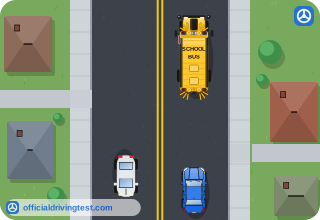
- Speed up to pass
- Reduce your speed
- Keep the same speed
- Pull over and stop at once
Show answer
Correct answer: Reduce your speed
Drivers approaching a school bus with flashing yellow/amber lights shall reduce the speed of their vehicles.
Source: Alaska Driver Manual (Revised October 2025), page 48 · Open this page in the manual (Manual page 48)
-
When meeting a school bus on an undivided two-way road, when must you bring your vehicle to a complete stop?
- As soon as its yellow lights begin to flash, even if it keeps moving
- Only when you can see children standing on the roadway
- Only when the bus driver sounds the horn to warn you
- When the bus stops, its red lights flash, and its stop sign is extended
Show answer
Correct answer: When the bus stops, its red lights flash, and its stop sign is extended
The manual says to come to a complete stop when the school bus stops, red lights flash, and the stop sign is extended.
Source: Alaska Driver Manual (Revised October 2025), page 48 · Open this page in the manual (Manual page 48)
-
After the stop sign of a school bus is retracted and its red lights are discontinued, how may you proceed?
- With due caution
- At normal speed immediately
- Only after waiting another full minute
- Only after the bus is out of sight
Show answer
Correct answer: With due caution
The manual says vehicles may proceed with due caution once the stop sign is retracted and the red lights are discontinued.
Source: Alaska Driver Manual (Revised October 2025), page 48 · Open this page in the manual (Manual page 48)
-
When do you not need to stop for a school bus headed in the opposite direction with its stop arm extended and red lights flashing?
- On any highway that has two lanes in each direction, divided or not
- On a road with a center turn lane and a speed limit above 35 mph
- On a highway with separated roadways of two or more lanes each way
- On any road with a posted limit above 35 mph and no children visible
Show answer
Correct answer: On a highway with separated roadways of two or more lanes each way
The manual says drivers on a highway with separated roadways of two or more lanes in each direction need not stop for a bus headed the opposite way.
Source: Alaska Driver Manual (Revised October 2025), page 48 · Open this page in the manual (Manual page 48)
-
At what speed or less is a vehicle considered slow-moving and required to display the slow-moving vehicle (SMV) emblem?
- 15 mph or less
- 25 mph or less
- 35 mph or less
- 45 mph or less
Show answer
Correct answer: 25 mph or less
The manual says the SMV emblem is required on all slow-moving (25 mph or less) vehicles.
Source: Alaska Driver Manual (Revised October 2025), page 49 · Open this page in the manual (Manual page 49)
-
In daylight, which part of the slow-moving vehicle (SMV) emblem is highly visible?
- The reflective red border around the edge of the emblem
- A white reflective strip below the orange triangle
- A flashing yellow light on top of the emblem triangle
- The bright fluorescent orange solid triangle in the center
Show answer
Correct answer: The bright fluorescent orange solid triangle in the center
During daylight the bright fluorescent orange solid triangle in the center of the SMV emblem is highly visible.
Source: Alaska Driver Manual (Revised October 2025), page 49 · Open this page in the manual (Manual page 49)
-
In daylight, at what distance does the slow-moving vehicle (SMV) emblem gain the attention of approaching motorists?
- At distances exceeding one-fifth mile
- Only within about one-tenth of a mile
- Only within about 100 yards of the emblem
- Only within a few car lengths of the vehicle
Show answer
Correct answer: At distances exceeding one-fifth mile
The manual says the emblem gains attention at distances exceeding one-fifth mile, giving ample time to slow down.
Source: Alaska Driver Manual (Revised October 2025), page 49 · Open this page in the manual (Manual page 49)
-
At night, which part of the slow-moving vehicle (SMV) emblem glows in the path of approaching headlights?
- The fluorescent orange center triangle
- A white reflective strip beneath it
- The reflective red border
- A yellow reflective circle
Show answer
Correct answer: The reflective red border
At night the reflective red border of the SMV emblem glows brilliantly in the path of approaching headlights.
Source: Alaska Driver Manual (Revised October 2025), page 49 · Open this page in the manual (Manual page 49)
-
What does the manual say to do about the headlights of approaching vehicles at night?
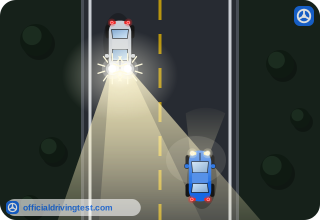
- Stare at them to stay alert
- Close one eye as they pass
- Do not look straight into them
- Turn on your high beams in response
Show answer
Correct answer: Do not look straight into them
One of the night driving safety tips is not to look straight into approaching vehicles headlights.
Source: Alaska Driver Manual (Revised October 2025), page 54 · Open this page in the manual (Manual page 54 · PDF 66)
-
When meeting vehicles at night, what should you do instead of staring at their headlights?
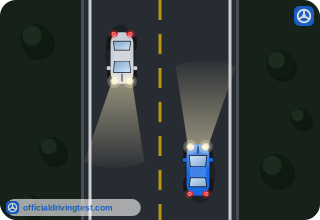
- Turn your head away from the road
- Flash your headlights repeatedly
- Use quick glances
- Look only at the center line
Show answer
Correct answer: Use quick glances
The manual says not to stare at headlights but to use quick glances.
Source: Alaska Driver Manual (Revised October 2025), page 55 · Open this page in the manual (Manual page 55 · PDF 67)
-
When meeting vehicles at night, which of these is one of the things the manual says to check with quick glances?
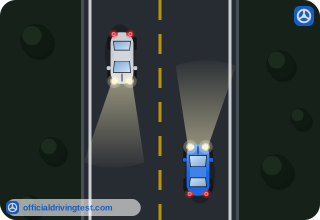
- The oncoming driver’s face
- The right edge of the road
- Your speedometer reading
- The oncoming vehicle’s license plate
Show answer
Correct answer: The right edge of the road
The manual lists checking the right edge of the road among the quick glances at night.
Source: Alaska Driver Manual (Revised October 2025), page 55 · Open this page in the manual (Manual page 55 · PDF 67)
-
What often prevents truck drivers from hearing your horn?
- The noise of the truck’s engine at highway speed
- The truck’s closed windows and cab insulation
- The wind noise from passing traffic
- A partial vacuum, called the truck’s deaf spot
Show answer
Correct answer: A partial vacuum, called the truck’s deaf spot
The manual says to be aware of a truck’s deaf spot, where partial vacuum often prevents truck drivers from hearing your horn.
Source: Alaska Driver Manual (Revised October 2025), page 57 · Open this page in the manual (Manual page 57 · PDF 69)
-
According to the manual, when do most vehicle-moose accidents occur?
- At dawn and dusk
- At noon, when the sun is highest
- Only after midnight
- During the afternoon commute
Show answer
Correct answer: At dawn and dusk
Most vehicle-moose accidents happen at dawn and dusk, when light is low and moose are most active.
Source: Alaska Driver Manual (Revised October 2025), page 60 · Open this page in the manual (Manual page 60)
-
Moose can be difficult to see. What does the manual tell you to keep clean?
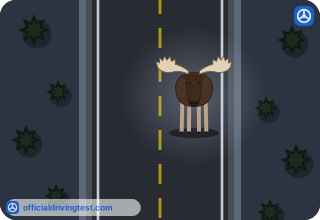
- Your license plates and mirrors
- Your tires and hubcaps
- Your headlights and windshield
- Your dashboard and gauges
Show answer
Correct answer: Your headlights and windshield
The manual says to keep vehicle headlights and windshields clean because moose can be difficult to see.
Source: Alaska Driver Manual (Revised October 2025), page 60 · Open this page in the manual (Manual page 60)
-
What does the manual advise you to do at night to help prevent an animal collision?
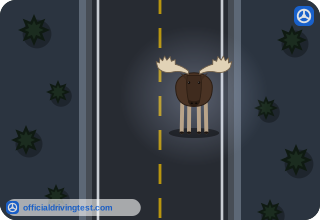
- Drive faster to get through animal areas quickly
- Reduce your speed and use high beams when possible
- Use only parking lights to avoid startling animals
- Stay in the center of the road at all times
Show answer
Correct answer: Reduce your speed and use high beams when possible
The manual says to reduce your speed at night and use high beams when possible.
Source: Alaska Driver Manual (Revised October 2025), page 60 · Open this page in the manual (Manual page 60)
-
Why should you slow down when approaching deer or moose standing near the roadside?
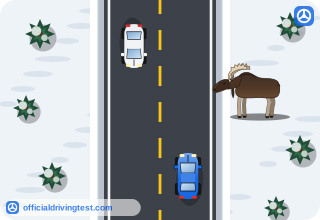
- They always cross in a straight line
- They will not move if you honk
- They are attracted to slow vehicles
- They may suddenly bolt into the road
Show answer
Correct answer: They may suddenly bolt into the road
The manual says to slow down because deer and moose standing near the roadside may suddenly bolt into the road.
Source: Alaska Driver Manual (Revised October 2025), page 60 · Open this page in the manual (Manual page 60)
-
You see an animal cross the road ahead of you. What should you do?
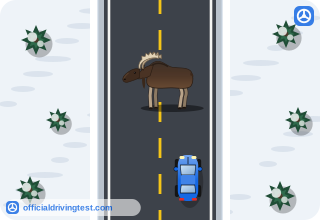
- Speed up to get past the area quickly
- Stop in the lane and wait for it to return
- Slow down and be alert for others that may follow
- Assume the road is clear once it has crossed
Show answer
Correct answer: Slow down and be alert for others that may follow
Deer and moose often travel in pairs or groups, so after one crosses you should slow down and watch for others.
Source: Alaska Driver Manual (Revised October 2025), page 60 · Open this page in the manual (Manual page 60)
-
How does the manual say to warn approaching drivers when deer or moose are in or near the highway?
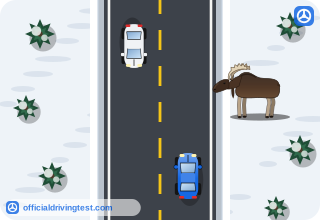
- Briefly use flashers or a headlight signal
- Sound the horn continuously
- Switch the headlights off until they pass
- Stop and wave oncoming traffic down
Show answer
Correct answer: Briefly use flashers or a headlight signal
The manual says to briefly use flashers or a headlight signal to warn approaching drivers.
Source: Alaska Driver Manual (Revised October 2025), page 60 · Open this page in the manual (Manual page 60)
-
What does the manual warn drivers to be careful of when people want to view wildlife?
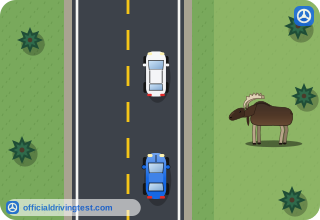
- Other vehicles signaling well in advance
- Pedestrians blocking the highway lanes
- Animals following the vehicle
- Other vehicles pulling over suddenly
Show answer
Correct answer: Other vehicles pulling over suddenly
The manual tells drivers to be careful of other vehicles pulling over suddenly to view wildlife.
Source: Alaska Driver Manual (Revised October 2025), page 60 · Open this page in the manual (Manual page 60)
-
Areas with frequent deer or moose crossings are usually marked with what?
- Orange warning flags on the roadside
- "Leaping stag" or moose signs
- Rumble strips across the lane
- Flashing red lights on posts
Show answer
Correct answer: "Leaping stag" or moose signs
The manual says frequent deer or moose crossing areas are usually marked with "leaping stag" or moose signs.
Source: Alaska Driver Manual (Revised October 2025), page 60 · Open this page in the manual (Manual page 60)
-
Which of these does the manual say you should NOT rely on to deter animals?
- Deer whistles, extra lights, or reflectors
- Scanning the roadsides ahead for animals
- Slowing down at dawn and dusk
- Your own cautious, responsible driving
Show answer
Correct answer: Deer whistles, extra lights, or reflectors
The manual says not to rely on devices such as deer whistles, extra lights, or reflectors to deter animals.
Source: Alaska Driver Manual (Revised October 2025), page 60 · Open this page in the manual (Manual page 60)
-
According to the manual, what is your best defense against an animal collision?
- A deer whistle mounted on the vehicle
- Extra lights on the front of the vehicle
- Your own responsible behavior
- Reflectors along the roadside
Show answer
Correct answer: Your own responsible behavior
The manual says research has shown that your best defense is your own responsible behavior.
Source: Alaska Driver Manual (Revised October 2025), page 60 · Open this page in the manual (Manual page 60)
-
Why should motorcyclists be especially alert for animals?
- Animals are drawn to the sound of motorcycle engines
- Motorcycle collisions with animals have a higher fatality rate
- Motorcycle headlights cannot be seen by animals
- Motorcycles are slower to stop than other vehicles
Show answer
Correct answer: Motorcycle collisions with animals have a higher fatality rate
The manual says motorcycle collisions with animals have a higher fatality rate.
Source: Alaska Driver Manual (Revised October 2025), page 60 · Open this page in the manual (Manual page 60)
-
If an animal runs in front of your vehicle, what should you do?
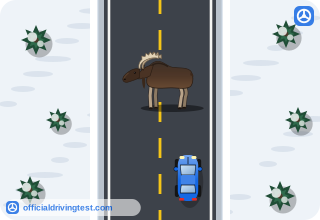
- Swerve quickly to avoid it
- Accelerate to pass ahead of it
- Brake lightly and steer onto the shoulder
- Brake firmly but do not swerve
Show answer
Correct answer: Brake firmly but do not swerve
The manual says to brake firmly but not swerve, because swerving can cause a vehicle-vehicle collision or hitting a pedestrian or fixed object.
Source: Alaska Driver Manual (Revised October 2025), page 60 · Open this page in the manual (Manual page 60)
-
Which animals does the manual say are common in the Southeast?
- Caribou and sheep only
- Mountain goats and deer
- Sheep and bear only
- Caribou and bear only
Show answer
Correct answer: Mountain goats and deer
The manual says mountain goats and deer are common in the Southeast.
Source: Alaska Driver Manual (Revised October 2025), page 60 · Open this page in the manual (Manual page 60)
-
In large truck crashes, what share of the fatalities do the occupants of the car sustain?
- 78%
- 48%
- 58%
- 68%
Show answer
Correct answer: 78%
The manual says the occupants of a car, usually the driver, sustain 78% of fatalities in large truck crashes.
Source: Alaska Driver Manual (Revised October 2025), page 70 · Open this page in the manual (Manual page 70)
-
Compared with any other vehicle on the road, how much time and space do large trucks and buses need to accelerate, slow down, or stop?
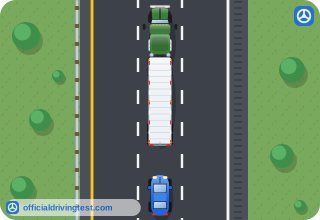
- About the same time but more space
- Less time because they are heavier
- More time and much more space
- More time but about the same space
Show answer
Correct answer: More time and much more space
Accelerating, slowing down, or stopping takes large trucks and buses more time and much more space than any other vehicle.
Source: Alaska Driver Manual (Revised October 2025), page 70 · Open this page in the manual (Manual page 70)
-
What does the No-Zone around a large truck or bus represent?
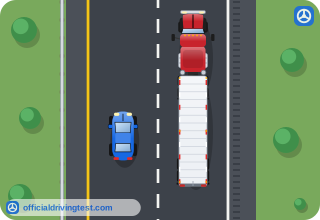
- The distance the truck needs in order to stop
- The blind spots around its front, back, and sides
- The lane space the truck keeps free for passing
- The area where parking next to it is banned
Show answer
Correct answer: The blind spots around its front, back, and sides
The No-Zone is the blind spots around the front, back, and sides of trucks and buses, where crashes are more likely.
Source: Alaska Driver Manual (Revised October 2025), page 70 · Open this page in the manual (Manual page 70)
-
What does it mean if you cannot see a truck or bus driver in their side mirrors?
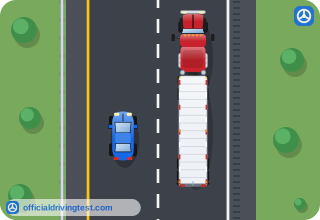
- They are about to slow down
- They are signaling you to pass
- They have left you enough room
- They cannot see you
Show answer
Correct answer: They cannot see you
If you cannot see the driver in the side mirrors, the driver cannot see you.
Source: Alaska Driver Manual (Revised October 2025), page 70 · Open this page in the manual (Manual page 70)
-
If a truck driver faces a potential front-end crash, what might the driver do?
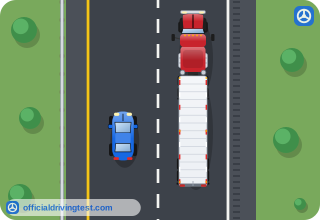
- Turn into your lane, not knowing you are there
- Brake gently and flash the lights to warn you
- Pull onto the shoulder and wait for you to pass
- Stop in its lane and sound the horn at once
Show answer
Correct answer: Turn into your lane, not knowing you are there
The manual warns that the truck driver may turn into your lane not knowing you are there, so do not stay in the No-Zone.
Source: Alaska Driver Manual (Revised October 2025), page 70 · Open this page in the manual (Manual page 70)
-
If you move into the space a truck driver leaves behind the vehicle ahead and must brake suddenly, what happens to the truck's available stopping distance?
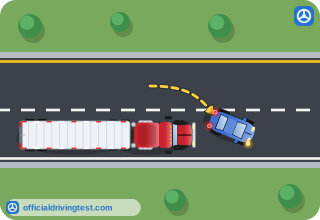
- It is cut by one quarter
- It is cut in half
- It is doubled
- It stays the same
Show answer
Correct answer: It is cut in half
Cutting into that space and braking suddenly cuts the truck's available stopping distance in half.
Source: Alaska Driver Manual (Revised October 2025), page 70 · Open this page in the manual (Manual page 70)
-
Why are the results too often deadly when a car is hit from behind by a truck?
- Trucks lack the same energy-absorbing bumpers cars have
- Truck drivers cannot see the cars directly behind them
- Trucks always travel much faster than the cars around them
- Cars have no bumpers that can absorb any impact at all
Show answer
Correct answer: Trucks lack the same energy-absorbing bumpers cars have
The manual says trucks are not equipped with the same type of energy-absorbing bumpers as cars.
Source: Alaska Driver Manual (Revised October 2025), page 71 · Open this page in the manual (Manual page 71)
-
What share of fatal car/truck crashes involve impacts with the front of the truck?
- About 30%
- Fewer than 40%
- More than 60%
- Exactly 50%
Show answer
Correct answer: More than 60%
More than 60% of fatal car/truck crashes involve impacts with the front of the truck.
Source: Alaska Driver Manual (Revised October 2025), page 71 · Open this page in the manual (Manual page 71)
-
When passing a truck, what should you see in your rear-view mirror before pulling in front of it?
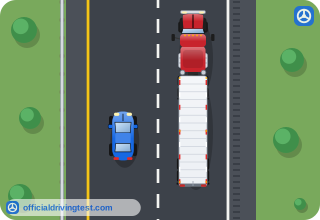
- The truck's left headlight only
- The whole front of the truck
- The truck driver's face
- The truck's hazard flashers
Show answer
Correct answer: The whole front of the truck
Look for the whole front of the truck in your rear-view mirror before pulling in front of it.
Source: Alaska Driver Manual (Revised October 2025), page 71 · Open this page in the manual (Manual page 71)
-
After you pull in front of a truck you have passed, what should you do?
- Slow down to leave room behind you
- Brake lightly to signal the truck
- Move back to the left lane
- Not slow down
Show answer
Correct answer: Not slow down
The manual says to pull in front of the truck only after seeing its whole front in the mirror, and then not to slow down.
Source: Alaska Driver Manual (Revised October 2025), page 71 · Open this page in the manual (Manual page 71)
-
How may a truck's metal bumper compare with your car's bumper in a rear-end crash?
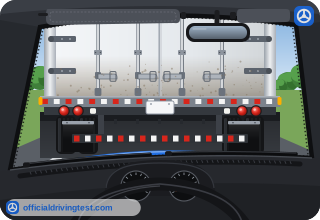
- It always matches the height of yours
- It absorbs the impact for you
- It is always lower than yours
- It may not align with yours
Show answer
Correct answer: It may not align with yours
A truck's metal bumper may not align with a car's bumper.
Source: Alaska Driver Manual (Revised October 2025), page 71 · Open this page in the manual (Manual page 71)
-
What can happen if you get in between a truck making a right turn and the curb?
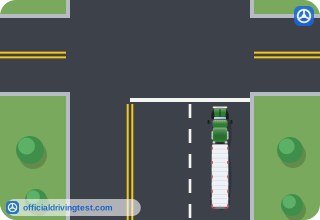
- You can be caught in a “squeeze”
- The truck driver will see you and yield
- You will have more room to turn
- You will be safe if you use your signal
Show answer
Correct answer: You can be caught in a “squeeze”
Getting between the truck and the curb catches you in a “squeeze” and can lead to a serious collision.
Source: Alaska Driver Manual (Revised October 2025), page 71 · Open this page in the manual (Manual page 71)
-
Why might a truck driver swing wide to the left before making a right turn?
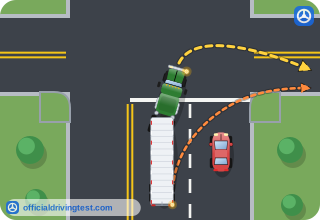
- To let you pass on the right
- To warn you it is about to stop
- To safely negotiate the right turn
- To change into the left lane
Show answer
Correct answer: To safely negotiate the right turn
Truck drivers sometimes need to swing wide to the left so that they can safely negotiate a right turn.
Source: Alaska Driver Manual (Revised October 2025), page 71 · Open this page in the manual (Manual page 71)
-
Which cars can a truck driver not see when making a turn?
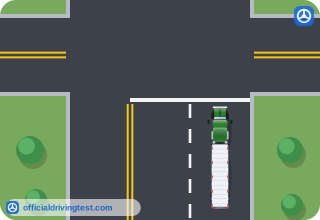
- Cars traveling far ahead of the truck
- Cars directly behind or beside the truck
- Only cars parked at the curb
- Cars that are using their turn signals
Show answer
Correct answer: Cars directly behind or beside the truck
Truck drivers cannot see cars directly behind or beside them.
Source: Alaska Driver Manual (Revised October 2025), page 71 · Open this page in the manual (Manual page 71)
-
What should you do around a truck that is making a turn?
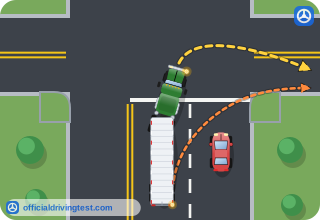
- Speed up and pass it on the right before it turns
- Move close beside it so the driver can see you
- Stay close behind it and follow its path
- Pay attention to its signals and give it lots of room
Show answer
Correct answer: Pay attention to its signals and give it lots of room
The manual says to pay attention to truck signals and give them lots of room to maneuver.
Source: Alaska Driver Manual (Revised October 2025), page 71 · Open this page in the manual (Manual page 71)
-
What does the manual say about traveling Alaska's roads with an unsecured load?
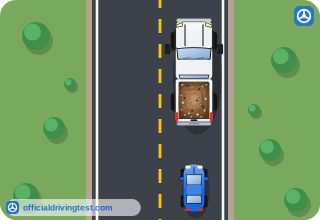
- It is allowed on gravel roads
- It is allowed for light loads
- It is illegal
- It is allowed during daylight hours
Show answer
Correct answer: It is illegal
The manual states that it is illegal to travel Alaska's roads with an unsecured load.
Source: Alaska Driver Manual (Revised October 2025), page 79 · Open this page in the manual (Manual page 79)
-
What does the manual say about roadside litter?
- It is only a problem for pedestrians and cyclists
- It is unsightly and can be dangerous to motorists
- It is unsightly but never a danger to motorists
- It is dangerous only on gravel roads
Show answer
Correct answer: It is unsightly and can be dangerous to motorists
The manual says roadside litter is not only unsightly but can be dangerous to motorists.
Source: Alaska Driver Manual (Revised October 2025), page 79 · Open this page in the manual (Manual page 79)
-
The penalty for littering in Alaska is a fine of up to how much?
- $100
- $250
- $5000
- $1000
Show answer
Correct answer: $1000
The manual states the penalty for littering is a fine up to $1000.
Source: Alaska Driver Manual (Revised October 2025), page 79 · Open this page in the manual (Manual page 79)
-
What is the maximum imprisonment for littering in Alaska, according to the manual?
- 90 days
- 10 days
- 30 days
- 180 days
Show answer
Correct answer: 90 days
The manual states a maximum of 90 days imprisonment for littering.
Source: Alaska Driver Manual (Revised October 2025), page 79 · Open this page in the manual (Manual page 79)
-
Besides a fine and possible imprisonment, what penalty might a court impose for littering in Alaska?
- Paying the full cost of cleaning the entire roadside
- Having your vehicle impounded until the litter is removed
- Gathering litter in a specified area for a specified time
- Writing a letter of apology to the Department of Environmental Conservation
Show answer
Correct answer: Gathering litter in a specified area for a specified time
The manual says a court may also impose a penalty of gathering litter in a specified area for a specified time.
Source: Alaska Driver Manual (Revised October 2025), page 79 · Open this page in the manual (Manual page 79)
-
Which is listed as an earmark of road rage or aggressive driving?
- Signaling well before every lane change
- Keeping a steady speed in the right lane
- Cutting in and cutting other drivers off
- Yielding to merging traffic
Show answer
Correct answer: Cutting in and cutting other drivers off
The manual lists speeding, frequent lane changes, cutting in and cutting other drivers off, and forcing your way ahead as earmarks.
Source: Alaska Driver Manual (Revised October 2025), page 89 · Open this page in the manual (Manual page 89)