Alaska: Sharing the road — Part 2 Practice Test
Questions in this part include: “In which direction do bicyclists have the right to travel on the road?” · “What does the manual say about carrying a passenger on a bicycle?”
Independent educational site · not affiliated with any government agency or DMV
Ready? Test yourself
- Instant feedback with an explanation
- Every answer cites its source in the manual
- Your best score is saved on this device
Questions are original and based on the official manual "Alaska Driver Manual" (Revised October 2025), Alaska Department of Administration, Division of Motor Vehicles (DMV).
All 19 questions in this practice test
Take the test above first, then use this list to study. Tap “Show answer” to see the correct answer and explanation.
Show the questions and answersHide the questions
-
Why does the manual call people walking, people biking, and people using a mobility device vulnerable road users?
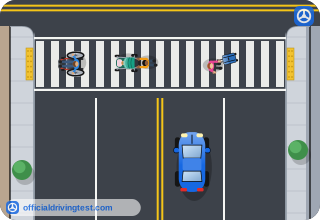
- They are unprotected against motor vehicles in collisions
- They are not required to obey traffic signals
- They always travel faster than the cars around them
- They are not allowed to use roads shared with cars
Show answer
Correct answer: They are unprotected against motor vehicles in collisions
The manual says these users are most vulnerable because they have no protection against motor vehicles in a collision.
Source: Alaska Driver Manual (Revised October 2025), page 43 · Open this page in the manual (Manual page 43)
-
Which of these does the manual list among the vulnerable road users that drivers of passenger vehicles share the roadway with?
- Drivers of other passenger vehicles
- Passengers riding inside a school bus
- Highway workers on foot in work zones
- Drivers of large trucks on the highway
Show answer
Correct answer: Highway workers on foot in work zones
The manual names people walking and biking, highway workers on foot in work zones, and people using mobility devices.
Source: Alaska Driver Manual (Revised October 2025), page 43 · Open this page in the manual (Manual page 43)
-
According to the manual, what happens to a vulnerable road user's chance of surviving a crash as the car's collision speed increases?
- It stays about the same
- It decreases enormously
- It increases because the driver brakes harder
- It depends only on the road surface
Show answer
Correct answer: It decreases enormously
The manual states that the survival rate decreases enormously as the car's collision speed increases.
Source: Alaska Driver Manual (Revised October 2025), page 43 · Open this page in the manual (Manual page 43)
-
In which direction do bicyclists have the right to travel on the road?
- Facing oncoming motor vehicles
- In either direction, whichever is safer
- Only on sidewalks, never on the road
- In the same direction as motor vehicles
Show answer
Correct answer: In the same direction as motor vehicles
The manual says bicyclists have the right to share the road and travel in the same direction as motor vehicles.
Source: Alaska Driver Manual (Revised October 2025), page 44 · Open this page in the manual (Manual page 44)
-
Before which of these actions does the manual tell drivers to check their blind spots for bicyclists?
- Opening a car door
- Turning on your headlights
- Adjusting the radio
- Fastening your seat belt
Show answer
Correct answer: Opening a car door
Drivers must check blind spots before a turn, parallel parking, opening a door or leaving a curb.
Source: Alaska Driver Manual (Revised October 2025), page 44 · Open this page in the manual (Manual page 44)
-
How should you check for bicyclists that may be next to your vehicle or approaching?
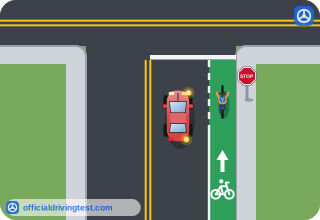
- Rely on your rearview mirror and sound your horn
- Look only in your side mirrors before moving
- Turn your head to look, not only use your mirrors
- Wait for the bicyclist to signal before looking
Show answer
Correct answer: Turn your head to look, not only use your mirrors
The manual says not to depend on only your mirrors but to turn your head to look for bicyclists.
Source: Alaska Driver Manual (Revised October 2025), page 44 · Open this page in the manual (Manual page 44)
-
How must a driver treat the right-of-way of bicyclists and other highway users?
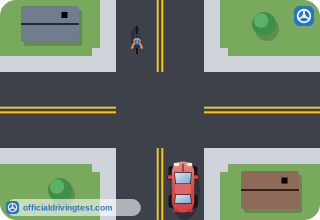
- Bicyclists must always yield to motor vehicles
- Yield to them just as you would to another vehicle
- Right-of-way rules apply only between motor vehicles
- Yield only when a bicyclist is in a bike lane
Show answer
Correct answer: Yield to them just as you would to another vehicle
The rules of the road and right-of-way apply to and protect bicyclists, so drivers yield as they would to another vehicle.
Source: Alaska Driver Manual (Revised October 2025), page 44 · Open this page in the manual (Manual page 44)
-
The manual reminds drivers that a bicycle is what?
- A pedestrian
- A mobility device
- A moving obstacle
- A vehicle
Show answer
Correct answer: A vehicle
The manual says to remember that a bicycle is a vehicle.
Source: Alaska Driver Manual (Revised October 2025), page 44 · Open this page in the manual (Manual page 44)
-
Under what age does the manual say youngsters lack the physical and mental development to interact safely in a complex traffic environment?
- Nine
- Six
- Twelve
- Fifteen
Show answer
Correct answer: Nine
The manual says youngsters under age nine lack that development, so drivers should be careful near children riding bikes.
Source: Alaska Driver Manual (Revised October 2025), page 44 · Open this page in the manual (Manual page 44)
-
What traffic rules must bicyclists obey?
- Only traffic signals at intersections
- Only the laws that apply to pedestrians
- Traffic signs, signals, and all other traffic laws
- None, because bicycles are not motor vehicles
Show answer
Correct answer: Traffic signs, signals, and all other traffic laws
The manual states that bicyclists are required to obey traffic signs, signals, and all other traffic laws.
Source: Alaska Driver Manual (Revised October 2025), page 45 · Open this page in the manual (Manual page 45)
-
What does the manual say bicyclists should always wear?
- A reflective vest
- Bright gloves
- A face mask
- A helmet
Show answer
Correct answer: A helmet
The first bicycle safety tip is to always wear a helmet.
Source: Alaska Driver Manual (Revised October 2025), page 45 · Open this page in the manual (Manual page 45)
-
Near which part of the road should a bicyclist ride?
- Near the right-hand edge
- Near the left-hand edge
- In the center of the lane
- Close to the center line
Show answer
Correct answer: Near the right-hand edge
The safety tips say to ride your bicycle near the right-hand edge of the road.
Source: Alaska Driver Manual (Revised October 2025), page 45 · Open this page in the manual (Manual page 45)
-
What does the manual say about carrying a passenger on a bicycle?
- It is allowed on roads with low speed limits
- It is allowed if the passenger wears a helmet
- Never carry another person on your bicycle
- It is allowed during daylight hours only
Show answer
Correct answer: Never carry another person on your bicycle
The bicycle safety tips say never to carry another person on your bicycle.
Source: Alaska Driver Manual (Revised October 2025), page 45 · Open this page in the manual (Manual page 45)
-
When should a bicyclist use hand signals?
- Only when cars are close behind
- Always when turning or stopping
- Only when riding at night
- Only when turning left
Show answer
Correct answer: Always when turning or stopping
The manual says to always use hand signals when turning or stopping.
Source: Alaska Driver Manual (Revised October 2025), page 45 · Open this page in the manual (Manual page 45)
-
What hand signal does a bicyclist use for a left turn?
- Right arm fully extended to the right
- Left arm extended and bent down at the elbow
- Left arm extended and bent up at the elbow
- Left arm fully extended to the left
Show answer
Correct answer: Left arm fully extended to the left
The manual lists a left turn as the left arm fully extended to the left.
Source: Alaska Driver Manual (Revised October 2025), page 45 · Open this page in the manual (Manual page 45)
-
What hand signal does a bicyclist use to stop?
- Left arm extended and bent down at the elbow
- Left arm fully extended to the left
- Left arm extended and bent up at the elbow
- Right arm fully extended to the right
Show answer
Correct answer: Left arm extended and bent down at the elbow
The manual lists stop as the left arm extended and bent down at the elbow.
Source: Alaska Driver Manual (Revised October 2025), page 45 · Open this page in the manual (Manual page 45)
-
Which of these is a hand signal a bicyclist can use for a right turn?
- Left arm fully extended to the left
- Left arm extended and bent down at the elbow
- Left arm extended and bent up at the elbow
- Right arm extended and bent down at the elbow
Show answer
Correct answer: Left arm extended and bent up at the elbow
A right turn is signaled with the right arm fully extended to the right or the left arm extended and bent up at the elbow.
Source: Alaska Driver Manual (Revised October 2025), page 45 · Open this page in the manual (Manual page 45)
-
Where should a bicyclist look out for cars?
- Only at traffic signals and in school zones
- At cross streets, driveways, and parking places
- Only on bridges and on freeway on-ramps
- Only where a bicycle lane is painted
Show answer
Correct answer: At cross streets, driveways, and parking places
The manual says to look out for cars at cross streets, driveways, and parking places.
Source: Alaska Driver Manual (Revised October 2025), page 45 · Open this page in the manual (Manual page 45)
-
What should a bicyclist avoid doing when looking over a shoulder to check traffic?
- Slowing down
- Signaling
- Stopping
- Swerving
Show answer
Correct answer: Swerving
The manual says to be careful when checking traffic and not to swerve when looking over your shoulder.
Source: Alaska Driver Manual (Revised October 2025), page 45 · Open this page in the manual (Manual page 45)