Alaska: Sharing the road — Part 6 Practice Test
Questions in this part include: “Why are the results too often deadly when a car is hit from behind by a truck?” · “The penalty for littering in Alaska is a fine of up to how much?”
Independent educational site · not affiliated with any government agency or DMV
Ready? Test yourself
- Instant feedback with an explanation
- Every answer cites its source in the manual
- Your best score is saved on this device
Questions are original and based on the official manual "Alaska Driver Manual" (Revised October 2025), Alaska Department of Administration, Division of Motor Vehicles (DMV).
All 18 questions in this practice test
Take the test above first, then use this list to study. Tap “Show answer” to see the correct answer and explanation.
Show the questions and answersHide the questions
-
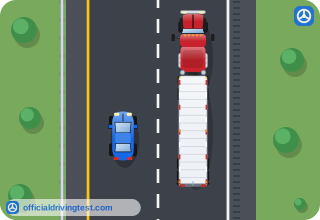
What does it mean if you cannot see a truck or bus driver in their side mirrors?
- They are about to slow down
- They are signaling you to pass
- They have left you enough room
- They cannot see you
Show answer
Correct answer: They cannot see you
If you cannot see the driver in the side mirrors, the driver cannot see you.
Source: Alaska Driver Manual (Revised October 2025), page 70 · Open this page in the manual (Manual page 70)
-
If a truck driver faces a potential front-end crash, what might the driver do?
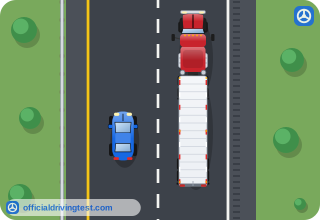
- Turn into your lane, not knowing you are there
- Brake gently and flash the lights to warn you
- Pull onto the shoulder and wait for you to pass
- Stop in its lane and sound the horn at once
Show answer
Correct answer: Turn into your lane, not knowing you are there
The manual warns that the truck driver may turn into your lane not knowing you are there, so do not stay in the No-Zone.
Source: Alaska Driver Manual (Revised October 2025), page 70 · Open this page in the manual (Manual page 70)
-
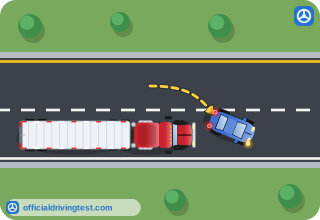
If you move into the space a truck driver leaves behind the vehicle ahead and must brake suddenly, what happens to the truck's available stopping distance?
- It is cut by one quarter
- It is cut in half
- It is doubled
- It stays the same
Show answer
Correct answer: It is cut in half
Cutting into that space and braking suddenly cuts the truck's available stopping distance in half.
Source: Alaska Driver Manual (Revised October 2025), page 70 · Open this page in the manual (Manual page 70)
-
Why are the results too often deadly when a car is hit from behind by a truck?
- Trucks lack the same energy-absorbing bumpers cars have
- Truck drivers cannot see the cars directly behind them
- Trucks always travel much faster than the cars around them
- Cars have no bumpers that can absorb any impact at all
Show answer
Correct answer: Trucks lack the same energy-absorbing bumpers cars have
The manual says trucks are not equipped with the same type of energy-absorbing bumpers as cars.
Source: Alaska Driver Manual (Revised October 2025), page 71 · Open this page in the manual (Manual page 71)
-
What share of fatal car/truck crashes involve impacts with the front of the truck?
- About 30%
- Fewer than 40%
- More than 60%
- Exactly 50%
Show answer
Correct answer: More than 60%
More than 60% of fatal car/truck crashes involve impacts with the front of the truck.
Source: Alaska Driver Manual (Revised October 2025), page 71 · Open this page in the manual (Manual page 71)
-
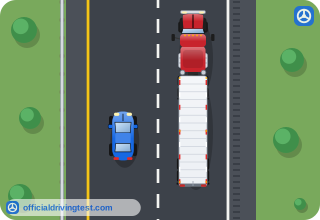
When passing a truck, what should you see in your rear-view mirror before pulling in front of it?
- The truck's left headlight only
- The whole front of the truck
- The truck driver's face
- The truck's hazard flashers
Show answer
Correct answer: The whole front of the truck
Look for the whole front of the truck in your rear-view mirror before pulling in front of it.
Source: Alaska Driver Manual (Revised October 2025), page 71 · Open this page in the manual (Manual page 71)
-
After you pull in front of a truck you have passed, what should you do?
- Slow down to leave room behind you
- Brake lightly to signal the truck
- Move back to the left lane
- Not slow down
Show answer
Correct answer: Not slow down
The manual says to pull in front of the truck only after seeing its whole front in the mirror, and then not to slow down.
Source: Alaska Driver Manual (Revised October 2025), page 71 · Open this page in the manual (Manual page 71)
-
How may a truck's metal bumper compare with your car's bumper in a rear-end crash?
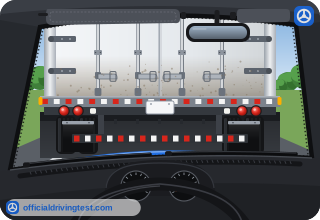
- It always matches the height of yours
- It absorbs the impact for you
- It is always lower than yours
- It may not align with yours
Show answer
Correct answer: It may not align with yours
A truck's metal bumper may not align with a car's bumper.
Source: Alaska Driver Manual (Revised October 2025), page 71 · Open this page in the manual (Manual page 71)
-
What can happen if you get in between a truck making a right turn and the curb?
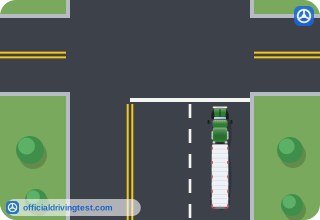
- You can be caught in a “squeeze”
- The truck driver will see you and yield
- You will have more room to turn
- You will be safe if you use your signal
Show answer
Correct answer: You can be caught in a “squeeze”
Getting between the truck and the curb catches you in a “squeeze” and can lead to a serious collision.
Source: Alaska Driver Manual (Revised October 2025), page 71 · Open this page in the manual (Manual page 71)
-
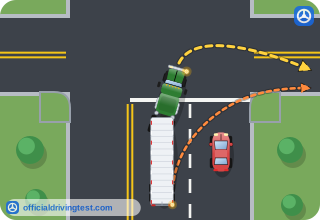
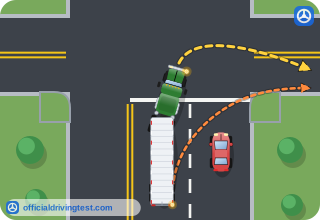
Why might a truck driver swing wide to the left before making a right turn?
- To let you pass on the right
- To warn you it is about to stop
- To safely negotiate the right turn
- To change into the left lane
Show answer
Correct answer: To safely negotiate the right turn
Truck drivers sometimes need to swing wide to the left so that they can safely negotiate a right turn.
Source: Alaska Driver Manual (Revised October 2025), page 71 · Open this page in the manual (Manual page 71)
-
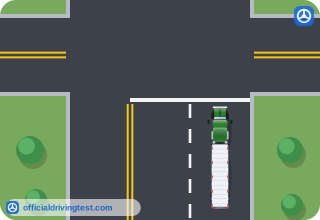
Which cars can a truck driver not see when making a turn?
- Cars traveling far ahead of the truck
- Cars directly behind or beside the truck
- Only cars parked at the curb
- Cars that are using their turn signals
Show answer
Correct answer: Cars directly behind or beside the truck
Truck drivers cannot see cars directly behind or beside them.
Source: Alaska Driver Manual (Revised October 2025), page 71 · Open this page in the manual (Manual page 71)
-
What should you do around a truck that is making a turn?
- Speed up and pass it on the right before it turns
- Move close beside it so the driver can see you
- Stay close behind it and follow its path
- Pay attention to its signals and give it lots of room
Show answer
Correct answer: Pay attention to its signals and give it lots of room
The manual says to pay attention to truck signals and give them lots of room to maneuver.
Source: Alaska Driver Manual (Revised October 2025), page 71 · Open this page in the manual (Manual page 71)
-
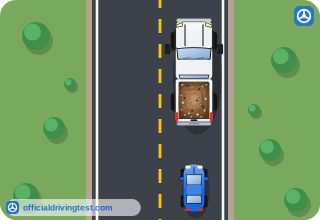
What does the manual say about traveling Alaska's roads with an unsecured load?
- It is allowed on gravel roads
- It is allowed for light loads
- It is illegal
- It is allowed during daylight hours
Show answer
Correct answer: It is illegal
The manual states that it is illegal to travel Alaska's roads with an unsecured load.
Source: Alaska Driver Manual (Revised October 2025), page 79 · Open this page in the manual (Manual page 79)
-
What does the manual say about roadside litter?
- It is only a problem for pedestrians and cyclists
- It is unsightly and can be dangerous to motorists
- It is unsightly but never a danger to motorists
- It is dangerous only on gravel roads
Show answer
Correct answer: It is unsightly and can be dangerous to motorists
The manual says roadside litter is not only unsightly but can be dangerous to motorists.
Source: Alaska Driver Manual (Revised October 2025), page 79 · Open this page in the manual (Manual page 79)
-
The penalty for littering in Alaska is a fine of up to how much?
- $100
- $250
- $5000
- $1000
Show answer
Correct answer: $1000
The manual states the penalty for littering is a fine up to $1000.
Source: Alaska Driver Manual (Revised October 2025), page 79 · Open this page in the manual (Manual page 79)
-
What is the maximum imprisonment for littering in Alaska, according to the manual?
- 90 days
- 10 days
- 30 days
- 180 days
Show answer
Correct answer: 90 days
The manual states a maximum of 90 days imprisonment for littering.
Source: Alaska Driver Manual (Revised October 2025), page 79 · Open this page in the manual (Manual page 79)
-
Besides a fine and possible imprisonment, what penalty might a court impose for littering in Alaska?
- Paying the full cost of cleaning the entire roadside
- Having your vehicle impounded until the litter is removed
- Gathering litter in a specified area for a specified time
- Writing a letter of apology to the Department of Environmental Conservation
Show answer
Correct answer: Gathering litter in a specified area for a specified time
The manual says a court may also impose a penalty of gathering litter in a specified area for a specified time.
Source: Alaska Driver Manual (Revised October 2025), page 79 · Open this page in the manual (Manual page 79)
-
Which is listed as an earmark of road rage or aggressive driving?
- Signaling well before every lane change
- Keeping a steady speed in the right lane
- Cutting in and cutting other drivers off
- Yielding to merging traffic
Show answer
Correct answer: Cutting in and cutting other drivers off
The manual lists speeding, frequent lane changes, cutting in and cutting other drivers off, and forcing your way ahead as earmarks.
Source: Alaska Driver Manual (Revised October 2025), page 89 · Open this page in the manual (Manual page 89)