Alaska: Sharing the road — Part 5 Practice Test
Questions in this part include: “What often prevents truck drivers from hearing your horn?” · “According to the manual, what is your best defense against an animal collision?”
Independent educational site · not affiliated with any government agency or DMV
Ready? Test yourself
- Instant feedback with an explanation
- Every answer cites its source in the manual
- Your best score is saved on this device
Questions are original and based on the official manual "Alaska Driver Manual" (Revised October 2025), Alaska Department of Administration, Division of Motor Vehicles (DMV).
All 18 questions in this practice test
Take the test above first, then use this list to study. Tap “Show answer” to see the correct answer and explanation.
Show the questions and answersHide the questions
-
When meeting vehicles at night, which of these is one of the things the manual says to check with quick glances?
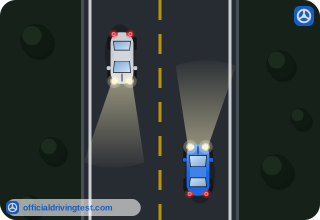
- The oncoming driver’s face
- The right edge of the road
- Your speedometer reading
- The oncoming vehicle’s license plate
Show answer
Correct answer: The right edge of the road
The manual lists checking the right edge of the road among the quick glances at night.
Source: Alaska Driver Manual (Revised October 2025), page 55 · Open this page in the manual (Manual page 55 · PDF 67)
-
What often prevents truck drivers from hearing your horn?
- The noise of the truck’s engine at highway speed
- The truck’s closed windows and cab insulation
- The wind noise from passing traffic
- A partial vacuum, called the truck’s deaf spot
Show answer
Correct answer: A partial vacuum, called the truck’s deaf spot
The manual says to be aware of a truck’s deaf spot, where partial vacuum often prevents truck drivers from hearing your horn.
Source: Alaska Driver Manual (Revised October 2025), page 57 · Open this page in the manual (Manual page 57 · PDF 69)
-
According to the manual, when do most vehicle-moose accidents occur?
- At dawn and dusk
- At noon, when the sun is highest
- Only after midnight
- During the afternoon commute
Show answer
Correct answer: At dawn and dusk
Most vehicle-moose accidents happen at dawn and dusk, when light is low and moose are most active.
Source: Alaska Driver Manual (Revised October 2025), page 60 · Open this page in the manual (Manual page 60)
-
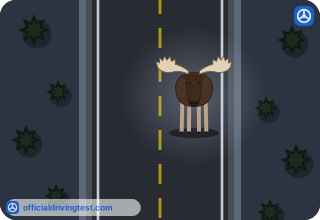
Moose can be difficult to see. What does the manual tell you to keep clean?
- Your license plates and mirrors
- Your tires and hubcaps
- Your headlights and windshield
- Your dashboard and gauges
Show answer
Correct answer: Your headlights and windshield
The manual says to keep vehicle headlights and windshields clean because moose can be difficult to see.
Source: Alaska Driver Manual (Revised October 2025), page 60 · Open this page in the manual (Manual page 60)
-
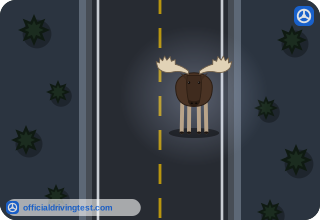
What does the manual advise you to do at night to help prevent an animal collision?
- Drive faster to get through animal areas quickly
- Reduce your speed and use high beams when possible
- Use only parking lights to avoid startling animals
- Stay in the center of the road at all times
Show answer
Correct answer: Reduce your speed and use high beams when possible
The manual says to reduce your speed at night and use high beams when possible.
Source: Alaska Driver Manual (Revised October 2025), page 60 · Open this page in the manual (Manual page 60)
-
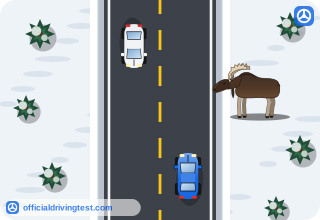
Why should you slow down when approaching deer or moose standing near the roadside?
- They always cross in a straight line
- They will not move if you honk
- They are attracted to slow vehicles
- They may suddenly bolt into the road
Show answer
Correct answer: They may suddenly bolt into the road
The manual says to slow down because deer and moose standing near the roadside may suddenly bolt into the road.
Source: Alaska Driver Manual (Revised October 2025), page 60 · Open this page in the manual (Manual page 60)
-
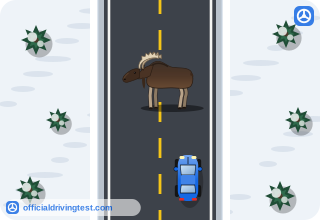
You see an animal cross the road ahead of you. What should you do?
- Speed up to get past the area quickly
- Stop in the lane and wait for it to return
- Slow down and be alert for others that may follow
- Assume the road is clear once it has crossed
Show answer
Correct answer: Slow down and be alert for others that may follow
Deer and moose often travel in pairs or groups, so after one crosses you should slow down and watch for others.
Source: Alaska Driver Manual (Revised October 2025), page 60 · Open this page in the manual (Manual page 60)
-
How does the manual say to warn approaching drivers when deer or moose are in or near the highway?
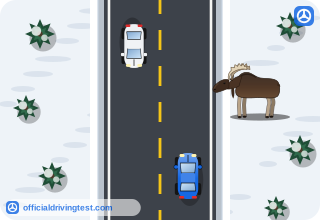
- Briefly use flashers or a headlight signal
- Sound the horn continuously
- Switch the headlights off until they pass
- Stop and wave oncoming traffic down
Show answer
Correct answer: Briefly use flashers or a headlight signal
The manual says to briefly use flashers or a headlight signal to warn approaching drivers.
Source: Alaska Driver Manual (Revised October 2025), page 60 · Open this page in the manual (Manual page 60)
-
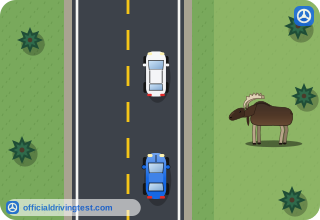
What does the manual warn drivers to be careful of when people want to view wildlife?
- Other vehicles signaling well in advance
- Pedestrians blocking the highway lanes
- Animals following the vehicle
- Other vehicles pulling over suddenly
Show answer
Correct answer: Other vehicles pulling over suddenly
The manual tells drivers to be careful of other vehicles pulling over suddenly to view wildlife.
Source: Alaska Driver Manual (Revised October 2025), page 60 · Open this page in the manual (Manual page 60)
-
Areas with frequent deer or moose crossings are usually marked with what?
- Orange warning flags on the roadside
- "Leaping stag" or moose signs
- Rumble strips across the lane
- Flashing red lights on posts
Show answer
Correct answer: "Leaping stag" or moose signs
The manual says frequent deer or moose crossing areas are usually marked with "leaping stag" or moose signs.
Source: Alaska Driver Manual (Revised October 2025), page 60 · Open this page in the manual (Manual page 60)
-
Which of these does the manual say you should NOT rely on to deter animals?
- Deer whistles, extra lights, or reflectors
- Scanning the roadsides ahead for animals
- Slowing down at dawn and dusk
- Your own cautious, responsible driving
Show answer
Correct answer: Deer whistles, extra lights, or reflectors
The manual says not to rely on devices such as deer whistles, extra lights, or reflectors to deter animals.
Source: Alaska Driver Manual (Revised October 2025), page 60 · Open this page in the manual (Manual page 60)
-
According to the manual, what is your best defense against an animal collision?
- A deer whistle mounted on the vehicle
- Extra lights on the front of the vehicle
- Your own responsible behavior
- Reflectors along the roadside
Show answer
Correct answer: Your own responsible behavior
The manual says research has shown that your best defense is your own responsible behavior.
Source: Alaska Driver Manual (Revised October 2025), page 60 · Open this page in the manual (Manual page 60)
-
Why should motorcyclists be especially alert for animals?
- Animals are drawn to the sound of motorcycle engines
- Motorcycle collisions with animals have a higher fatality rate
- Motorcycle headlights cannot be seen by animals
- Motorcycles are slower to stop than other vehicles
Show answer
Correct answer: Motorcycle collisions with animals have a higher fatality rate
The manual says motorcycle collisions with animals have a higher fatality rate.
Source: Alaska Driver Manual (Revised October 2025), page 60 · Open this page in the manual (Manual page 60)
-
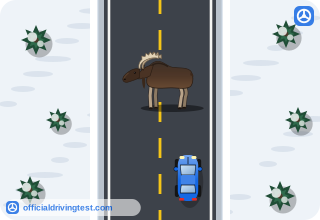
If an animal runs in front of your vehicle, what should you do?
- Swerve quickly to avoid it
- Accelerate to pass ahead of it
- Brake lightly and steer onto the shoulder
- Brake firmly but do not swerve
Show answer
Correct answer: Brake firmly but do not swerve
The manual says to brake firmly but not swerve, because swerving can cause a vehicle-vehicle collision or hitting a pedestrian or fixed object.
Source: Alaska Driver Manual (Revised October 2025), page 60 · Open this page in the manual (Manual page 60)
-
Which animals does the manual say are common in the Southeast?
- Caribou and sheep only
- Mountain goats and deer
- Sheep and bear only
- Caribou and bear only
Show answer
Correct answer: Mountain goats and deer
The manual says mountain goats and deer are common in the Southeast.
Source: Alaska Driver Manual (Revised October 2025), page 60 · Open this page in the manual (Manual page 60)
-
In large truck crashes, what share of the fatalities do the occupants of the car sustain?
- 78%
- 48%
- 58%
- 68%
Show answer
Correct answer: 78%
The manual says the occupants of a car, usually the driver, sustain 78% of fatalities in large truck crashes.
Source: Alaska Driver Manual (Revised October 2025), page 70 · Open this page in the manual (Manual page 70)
-
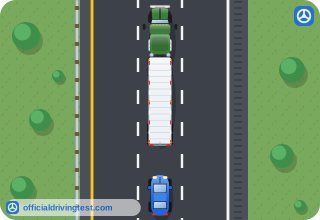
Compared with any other vehicle on the road, how much time and space do large trucks and buses need to accelerate, slow down, or stop?
- About the same time but more space
- Less time because they are heavier
- More time and much more space
- More time but about the same space
Show answer
Correct answer: More time and much more space
Accelerating, slowing down, or stopping takes large trucks and buses more time and much more space than any other vehicle.
Source: Alaska Driver Manual (Revised October 2025), page 70 · Open this page in the manual (Manual page 70)
-
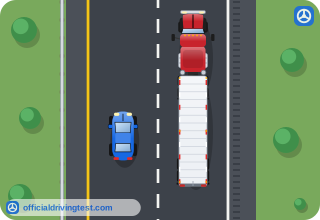
What does the No-Zone around a large truck or bus represent?
- The distance the truck needs in order to stop
- The blind spots around its front, back, and sides
- The lane space the truck keeps free for passing
- The area where parking next to it is banned
Show answer
Correct answer: The blind spots around its front, back, and sides
The No-Zone is the blind spots around the front, back, and sides of trucks and buses, where crashes are more likely.
Source: Alaska Driver Manual (Revised October 2025), page 70 · Open this page in the manual (Manual page 70)