Alaska: Sharing the road — Part 1 Practice Test
Questions in this part include: “When towing more than one vehicle on the roadway, what must the towing vehicle weigh?” · “Where is passing prohibited?”
Independent educational site · not affiliated with any government agency or DMV
Ready? Test yourself
- Instant feedback with an explanation
- Every answer cites its source in the manual
- Your best score is saved on this device
Questions are original and based on the official manual "Alaska Driver Manual" (Revised October 2025), Alaska Department of Administration, Division of Motor Vehicles (DMV).
All 19 questions in this practice test
Take the test above first, then use this list to study. Tap “Show answer” to see the correct answer and explanation.
Show the questions and answersHide the questions
-
When towing more than one vehicle on the roadway, what must the towing vehicle weigh?
- More than 10,000 pounds
- More than 20,000 pounds
- More than 26,000 pounds
- More than 15,000 pounds
Show answer
Correct answer: More than 15,000 pounds
The rule on towing triples requires a towing vehicle that weighs more than 15,000 pounds.
Source: Alaska Driver Manual (Revised October 2025), page 30 · Open this page in the manual (Manual page 30)
-
When towing more than one vehicle on the roadway, how many axles must the towing vehicle have?
- Two or more axles
- Four or more axles
- Three or more axles
- Five or more axles
Show answer
Correct answer: Three or more axles
The towing vehicle must have three or more axles.
Source: Alaska Driver Manual (Revised October 2025), page 30 · Open this page in the manual (Manual page 30)
-
To tow more than one vehicle on the roadway, the towing vehicle must have what braking equipment?
- An air brake system for both the towing and towed vehicles
- A hydraulic brake system on the towing vehicle only
- An air brake system on the towing vehicle only
- A separate air brake system on the last towed vehicle only
Show answer
Correct answer: An air brake system for both the towing and towed vehicles
The towing vehicle must be equipped with an air brake system for both the towing and the towed vehicles.
Source: Alaska Driver Manual (Revised October 2025), page 30 · Open this page in the manual (Manual page 30)
-
When must you stop for a school bus?
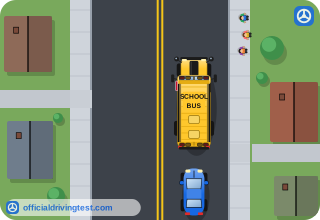
- Only when children are visibly standing outside the bus
- Only when the bus driver signals you with a hand signal
- When its red lights flash and its stop arm is extended
- Only when the bus is stopped in the right lane
Show answer
Correct answer: When its red lights flash and its stop arm is extended
You stop when the bus’s red flashing lights are in operation and the stop arm is extended.
Source: Alaska Driver Manual (Revised October 2025), page 36 · Open this page in the manual (Manual page 36)
-
Why are collisions resulting from improper passing often fatal?
- Passing drivers are usually traveling over the speed limit
- Most passing takes place on roads without any shoulders
- The impact force is great in this type of collision
- Oncoming drivers rarely have time to sound a horn
Show answer
Correct answer: The impact force is great in this type of collision
The manual says such collisions are often fatal since the impact force is great.
Source: Alaska Driver Manual (Revised October 2025), page 36 · Open this page in the manual (Manual page 36)
-
According to the manual, what determines the decision whether to pass another vehicle?
- The judgment and attitude of the driver
- The posted speed limit on that road section
- The speed of the vehicle you are following
- The number of vehicles behind you
Show answer
Correct answer: The judgment and attitude of the driver
The decision to pass is determined by the judgment and attitude of the driver.
Source: Alaska Driver Manual (Revised October 2025), page 36 · Open this page in the manual (Manual page 36)
-
Before you pass, how should you position your vehicle behind the vehicle ahead?
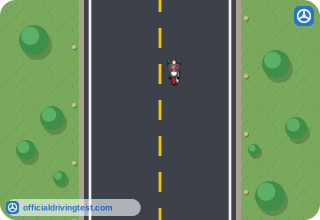
- Drive as close as possible to its bumper
- Stay beside its rear wheel for a better view
- Straddle the center line to look ahead
- Stay well back for better sight distance
Show answer
Correct answer: Stay well back for better sight distance
The first passing rule is to stay well back from the vehicle ahead for better sight distance.
Source: Alaska Driver Manual (Revised October 2025), page 36 · Open this page in the manual (Manual page 36)
-
While checking ahead before passing, what should you not do?
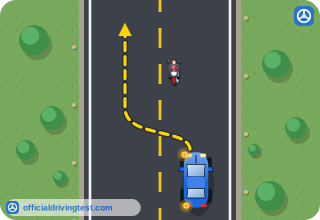
- Swing out across the center line for a look
- Look well ahead of the vehicle you are passing
- Stay well back from the vehicle ahead
- Check for a no passing zone and oncoming vehicles
Show answer
Correct answer: Swing out across the center line for a look
The manual says not to swing out across the center line for a look.
Source: Alaska Driver Manual (Revised October 2025), page 36 · Open this page in the manual (Manual page 36)
-
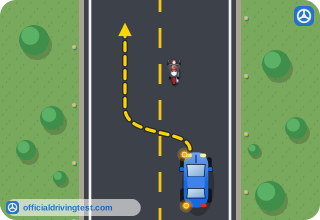
What does the manual tell you to do to warn the driver ahead of your intention to pass?
- Flash your headlights twice
- Tap your brakes three times
- Sound your horn
- Turn on your hazard flashers
Show answer
Correct answer: Sound your horn
The passing rules say to sound your horn to warn the driver ahead.
Source: Alaska Driver Manual (Revised October 2025), page 36 · Open this page in the manual (Manual page 36)
-
When may you return to the right lane after passing on the left?
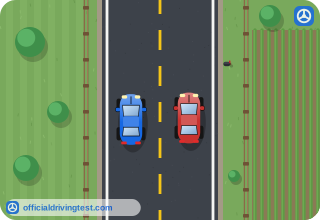
- As soon as your car is level with its front bumper
- Only when you are safely clear of the overtaken vehicle
- As soon as you have reached the speed limit
- After you have signaled right once
Show answer
Correct answer: Only when you are safely clear of the overtaken vehicle
You pass on the left at a safe distance and do not return to the right lane until safely clear of the overtaken vehicle.
Source: Alaska Driver Manual (Revised October 2025), page 36 · Open this page in the manual (Manual page 36)
-
Where is passing prohibited?
- On a straight road with a clear view ahead
- In the left lane of a road with a broken center line
- On the right shoulder of the highway
- Anywhere on a multilane road when traffic is light
Show answer
Correct answer: On the right shoulder of the highway
The do-not-pass list begins with passing on the right shoulder of the highway.
Source: Alaska Driver Manual (Revised October 2025), page 37 · Open this page in the manual (Manual page 37)
-
You may not pass when approaching a hill or curve where what is true?
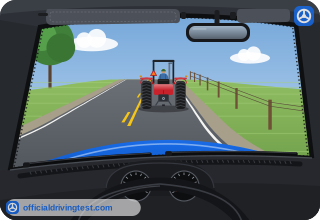
- There is not sufficient clear view ahead
- Another vehicle is following you closely
- The road surface is wet
- The speed limit is lower than the posted maximum
Show answer
Correct answer: There is not sufficient clear view ahead
You may not pass on approaching a hill or curve where there is not sufficient clear view ahead.
Source: Alaska Driver Manual (Revised October 2025), page 37 · Open this page in the manual (Manual page 37)
-
You may pass only if you can complete the pass without interfering with the safety of whom?
- The vehicle behind you
- Parked vehicles
- Pedestrians on the shoulder
- Oncoming vehicles
Show answer
Correct answer: Oncoming vehicles
The pass must be completed without interfering with the safety of oncoming vehicles.
Source: Alaska Driver Manual (Revised October 2025), page 37 · Open this page in the manual (Manual page 37)
-
What is unlawful when another driver is passing you?
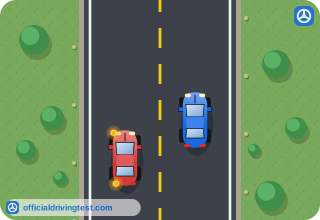
- Slowing down to let them by
- Increasing your speed
- Signaling a left turn
- Looking in your mirror
Show answer
Correct answer: Increasing your speed
The manual says that when being passed it is unlawful to increase your speed.
Source: Alaska Driver Manual (Revised October 2025), page 37 · Open this page in the manual (Manual page 37)
-
On a divided road, when are you not allowed to pass a school bus that has red flashing lights and an extended stop arm?
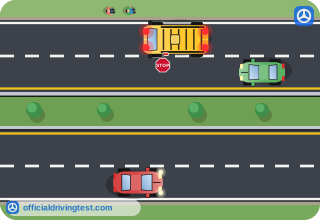
- Only when you are on the opposite side of the divided road
- Only when children are visibly standing outside the bus
- When you are traveling within the same divided travel way as the bus
- Only when the bus is stopped in the lane right next to yours
Show answer
Correct answer: When you are traveling within the same divided travel way as the bus
You may not pass a school bus with red flashing lights and an extended stop arm on an undivided two-way roadway or within the same divided travel way as the bus.
Source: Alaska Driver Manual (Revised October 2025), page 37 · Open this page in the manual (Manual page 37)
-
You may not pass when approaching within how many feet of an intersection or railroad crossing?
- 50 feet
- 100 feet
- 200 feet
- 300 feet
Show answer
Correct answer: 100 feet
Passing is not allowed when approaching within 100 feet of, or traversing, an intersection or railroad crossing.
Source: Alaska Driver Manual (Revised October 2025), page 37 · Open this page in the manual (Manual page 37)
-
You may not pass within 100 feet of what kind of structure?
- Any bridge that is wider than two lanes
- A pedestrian overpass of any width or height
- A parking garage entrance or exit ramp
- A posted narrow bridge, viaduct, or tunnel
Show answer
Correct answer: A posted narrow bridge, viaduct, or tunnel
Passing is not allowed when approaching within 100 feet of a posted narrow bridge, viaduct, or tunnel.
Source: Alaska Driver Manual (Revised October 2025), page 37 · Open this page in the manual (Manual page 37)
-
What are center lanes reserved for?
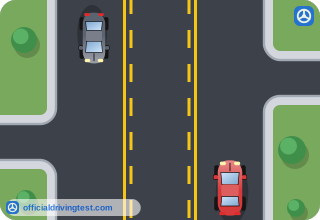
- Passing slower vehicles on the left
- Accelerating after turning right
- Decelerating in advance of turning left
- Emergency vehicles only
Show answer
Correct answer: Decelerating in advance of turning left
Center lanes are reserved for decelerating in advance of turning left, and may not be used for passing.
Source: Alaska Driver Manual (Revised October 2025), page 37 · Open this page in the manual (Manual page 37)
-
What does the end of a “no passing zone” mean?
- There is increased visibility ahead
- It is now safe to pass
- Oncoming traffic is no longer allowed
- The speed limit is increasing
Show answer
Correct answer: There is increased visibility ahead
The end of a no passing zone does not mean it is safe to pass; it means there is increased visibility ahead.
Source: Alaska Driver Manual (Revised October 2025), page 37 · Open this page in the manual (Manual page 37)