Alaska: Sharing the road — Part 4 Practice Test
Questions in this part include: “When meeting a school bus on an undivided two-way road, when must you bring your vehicle to a complete stop?” · “In daylight, which part of the slow-moving vehicle (SMV) emblem is highly visible?”
Independent educational site · not affiliated with any government agency or DMV
Ready? Test yourself
- Instant feedback with an explanation
- Every answer cites its source in the manual
- Your best score is saved on this device
Questions are original and based on the official manual "Alaska Driver Manual" (Revised October 2025), Alaska Department of Administration, Division of Motor Vehicles (DMV).
All 18 questions in this practice test
Take the test above first, then use this list to study. Tap “Show answer” to see the correct answer and explanation.
Show the questions and answersHide the questions
-
What do motorcyclists usually do at railroad grade crossings?
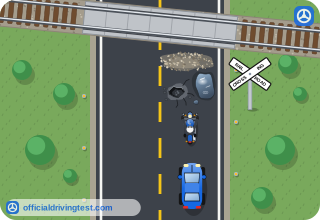
- Speed up so the wheels cross quickly
- Slow down and rise off the seat to cushion the shock
- Stop and walk the motorcycle across
- Cross the tracks at a sharp angle to keep traction
Show answer
Correct answer: Slow down and rise off the seat to cushion the shock
The manual says the rider slows down and rises off the seat to cushion the shock of a rough crossing.
Source: Alaska Driver Manual (Revised October 2025), page 47 · Open this page in the manual (Manual page 47)
-
Why might a motorcyclist change direction at a railroad grade crossing?
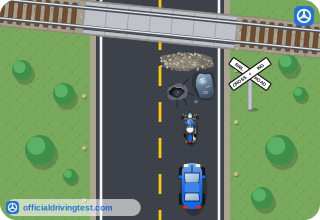
- So the front wheel can slide along the rail
- So the motorcycle stays out of the oncoming lane
- So the rider can avoid slowing down
- So the tracks can be crossed head on
Show answer
Correct answer: So the tracks can be crossed head on
The manual says the rider may change direction so the tracks can be crossed head on.
Source: Alaska Driver Manual (Revised October 2025), page 47 · Open this page in the manual (Manual page 47)
-
Compared with a car, what do metal or grated bridges do to a motorcycle?
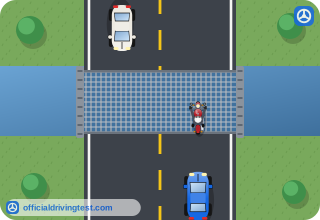
- They cause it to wobble much more
- They cause it to stop more quickly
- They cause it to skid only in the rain
- They have almost no effect on it
Show answer
Correct answer: They cause it to wobble much more
The manual says metal or grated bridges cause a motorcycle to wobble much more than a car.
Source: Alaska Driver Manual (Revised October 2025), page 47 · Open this page in the manual (Manual page 47)
-
How does an experienced motorcyclist handle a metal or grated bridge?
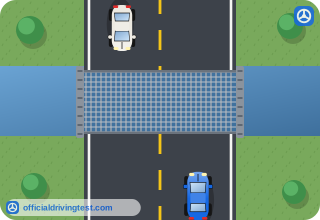
- Speeds up and moves to the edge of the lane
- Stays near the lane edge at the same speed
- Slows down and moves to the center of the lane
- Quickly changes direction to avoid the grating
Show answer
Correct answer: Slows down and moves to the center of the lane
An experienced cyclist slows down and moves to the center of the lane to allow room for handling the uneven surface.
Source: Alaska Driver Manual (Revised October 2025), page 47 · Open this page in the manual (Manual page 47)
-
What may an inexperienced motorcyclist do on a metal or grated bridge?
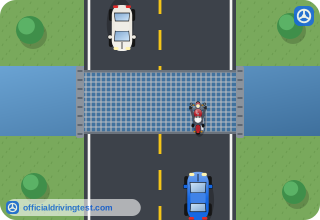
- Stop at the entrance of the bridge
- Become startled and try to quickly change direction
- Move to the center of the lane and slow down
- Ride across at a steady speed with no change
Show answer
Correct answer: Become startled and try to quickly change direction
The manual says an inexperienced cyclist may become startled and try to quickly change direction, and drivers should be prepared for it.
Source: Alaska Driver Manual (Revised October 2025), page 47 · Open this page in the manual (Manual page 47)
-
You approach a school bus from behind and its red signal lights are flashing. What must you do?
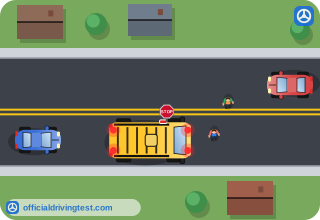
- Slow down and pass it on the left with caution
- Slow to 10 mph and pass if no children are visible
- Stop only if children are crossing in front of you
- Not pass it, and stop before reaching it
Show answer
Correct answer: Not pass it, and stop before reaching it
Drivers approaching from the rear may not pass a school bus with flashing red lights and must stop completely before reaching it.
Source: Alaska Driver Manual (Revised October 2025), page 48 · Open this page in the manual (Manual page 48)
-
Unless the bus driver signals you to go, what must happen before vehicles stopped behind a school bus with flashing red lights may move on?
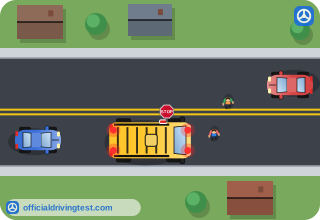
- The stop sign is retracted, the red lights stop flashing, and the bus moves again
- The bus driver turns off the engine and opens the door for the children
- Every child has crossed in front of the bus and reached the far curb
- The first vehicle in line has passed the bus slowly and stopped ahead
Show answer
Correct answer: The stop sign is retracted, the red lights stop flashing, and the bus moves again
The vehicles remain stopped until the stop sign is retracted, the flashing red lights are discontinued and the bus resumes motion, or until signaled by the driver.
Source: Alaska Driver Manual (Revised October 2025), page 48 · Open this page in the manual (Manual page 48)
-
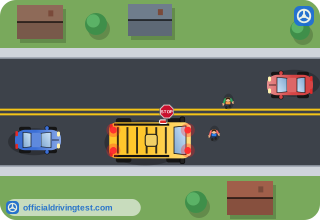
Who can signal vehicles stopped behind a school bus that they may proceed?
- The nearest pedestrian
- The first vehicle in line
- The school bus driver
- Any child at the curb
Show answer
Correct answer: The school bus driver
The manual says vehicles remain stopped until the stop sign is retracted and the lights stop, or until signaled by the driver to proceed.
Source: Alaska Driver Manual (Revised October 2025), page 48 · Open this page in the manual (Manual page 48)
-
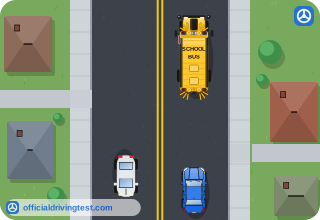
What must you do when approaching a school bus on which the yellow/amber warning signal lights are flashing?
- Speed up to pass
- Reduce your speed
- Keep the same speed
- Pull over and stop at once
Show answer
Correct answer: Reduce your speed
Drivers approaching a school bus with flashing yellow/amber lights shall reduce the speed of their vehicles.
Source: Alaska Driver Manual (Revised October 2025), page 48 · Open this page in the manual (Manual page 48)
-
When meeting a school bus on an undivided two-way road, when must you bring your vehicle to a complete stop?
- As soon as its yellow lights begin to flash, even if it keeps moving
- Only when you can see children standing on the roadway
- Only when the bus driver sounds the horn to warn you
- When the bus stops, its red lights flash, and its stop sign is extended
Show answer
Correct answer: When the bus stops, its red lights flash, and its stop sign is extended
The manual says to come to a complete stop when the school bus stops, red lights flash, and the stop sign is extended.
Source: Alaska Driver Manual (Revised October 2025), page 48 · Open this page in the manual (Manual page 48)
-
After the stop sign of a school bus is retracted and its red lights are discontinued, how may you proceed?
- With due caution
- At normal speed immediately
- Only after waiting another full minute
- Only after the bus is out of sight
Show answer
Correct answer: With due caution
The manual says vehicles may proceed with due caution once the stop sign is retracted and the red lights are discontinued.
Source: Alaska Driver Manual (Revised October 2025), page 48 · Open this page in the manual (Manual page 48)
-
When do you not need to stop for a school bus headed in the opposite direction with its stop arm extended and red lights flashing?
- On any highway that has two lanes in each direction, divided or not
- On a road with a center turn lane and a speed limit above 35 mph
- On a highway with separated roadways of two or more lanes each way
- On any road with a posted limit above 35 mph and no children visible
Show answer
Correct answer: On a highway with separated roadways of two or more lanes each way
The manual says drivers on a highway with separated roadways of two or more lanes in each direction need not stop for a bus headed the opposite way.
Source: Alaska Driver Manual (Revised October 2025), page 48 · Open this page in the manual (Manual page 48)
-
At what speed or less is a vehicle considered slow-moving and required to display the slow-moving vehicle (SMV) emblem?
- 15 mph or less
- 25 mph or less
- 35 mph or less
- 45 mph or less
Show answer
Correct answer: 25 mph or less
The manual says the SMV emblem is required on all slow-moving (25 mph or less) vehicles.
Source: Alaska Driver Manual (Revised October 2025), page 49 · Open this page in the manual (Manual page 49)
-
In daylight, which part of the slow-moving vehicle (SMV) emblem is highly visible?
- The reflective red border around the edge of the emblem
- A white reflective strip below the orange triangle
- A flashing yellow light on top of the emblem triangle
- The bright fluorescent orange solid triangle in the center
Show answer
Correct answer: The bright fluorescent orange solid triangle in the center
During daylight the bright fluorescent orange solid triangle in the center of the SMV emblem is highly visible.
Source: Alaska Driver Manual (Revised October 2025), page 49 · Open this page in the manual (Manual page 49)
-
In daylight, at what distance does the slow-moving vehicle (SMV) emblem gain the attention of approaching motorists?
- At distances exceeding one-fifth mile
- Only within about one-tenth of a mile
- Only within about 100 yards of the emblem
- Only within a few car lengths of the vehicle
Show answer
Correct answer: At distances exceeding one-fifth mile
The manual says the emblem gains attention at distances exceeding one-fifth mile, giving ample time to slow down.
Source: Alaska Driver Manual (Revised October 2025), page 49 · Open this page in the manual (Manual page 49)
-
At night, which part of the slow-moving vehicle (SMV) emblem glows in the path of approaching headlights?
- The fluorescent orange center triangle
- A white reflective strip beneath it
- The reflective red border
- A yellow reflective circle
Show answer
Correct answer: The reflective red border
At night the reflective red border of the SMV emblem glows brilliantly in the path of approaching headlights.
Source: Alaska Driver Manual (Revised October 2025), page 49 · Open this page in the manual (Manual page 49)
-
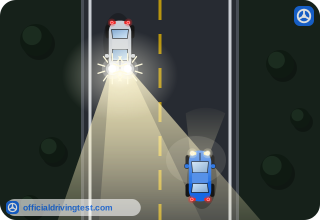
What does the manual say to do about the headlights of approaching vehicles at night?
- Stare at them to stay alert
- Close one eye as they pass
- Do not look straight into them
- Turn on your high beams in response
Show answer
Correct answer: Do not look straight into them
One of the night driving safety tips is not to look straight into approaching vehicles headlights.
Source: Alaska Driver Manual (Revised October 2025), page 54 · Open this page in the manual (Manual page 54 · PDF 66)
-
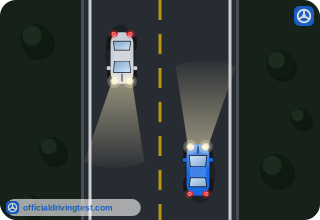
When meeting vehicles at night, what should you do instead of staring at their headlights?
- Turn your head away from the road
- Flash your headlights repeatedly
- Use quick glances
- Look only at the center line
Show answer
Correct answer: Use quick glances
The manual says not to stare at headlights but to use quick glances.
Source: Alaska Driver Manual (Revised October 2025), page 55 · Open this page in the manual (Manual page 55 · PDF 67)