Alaska: Sharing the road — Part 3 Practice Test
Questions in this part include: “To whom should bicyclists give the right-of-way?” · “If a bicyclist wears headphones, what does the manual say to do?”
Independent educational site · not affiliated with any government agency or DMV
Ready? Test yourself
- Instant feedback with an explanation
- Every answer cites its source in the manual
- Your best score is saved on this device
Questions are original and based on the official manual "Alaska Driver Manual" (Revised October 2025), Alaska Department of Administration, Division of Motor Vehicles (DMV).
All 18 questions in this practice test
Take the test above first, then use this list to study. Tap “Show answer” to see the correct answer and explanation.
Show the questions and answersHide the questions
-
To whom should bicyclists give the right-of-way?
- Pedestrians
- Motorists in every case
- Other bicyclists only
- No one, because bicycles are vehicles
Show answer
Correct answer: Pedestrians
The safety tips tell bicyclists to give pedestrians the right-of-way.
Source: Alaska Driver Manual (Revised October 2025), page 45 · Open this page in the manual (Manual page 45)
-
What should a bicyclist not do when vehicles are turning?
- Stay behind them until they have finished turning
- Wait for the turn to be completed before moving on
- Pass them, especially on the side to which they are turning
- Make eye contact with the driver before riding on
Show answer
Correct answer: Pass them, especially on the side to which they are turning
Turning cars, trucks and buses cannot see a bicycle in their blind spot, so do not pass them when they are turning.
Source: Alaska Driver Manual (Revised October 2025), page 45 · Open this page in the manual (Manual page 45)
-
What should a bicyclist do before crossing in front of a driver, even with the right of way?
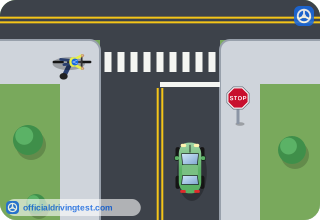
- Ring a bell and proceed
- Make eye contact with the driver
- Speed up to cross before the car arrives
- Wave the driver through and ride off
Show answer
Correct answer: Make eye contact with the driver
The manual says to make eye contact with drivers before crossing in front of them, even if you have the right of way.
Source: Alaska Driver Manual (Revised October 2025), page 45 · Open this page in the manual (Manual page 45)
-
If a bicyclist wears headphones, what does the manual say to do?
- Keep the volume low in both ears
- Wear them only on quiet roads
- Use only over-the-ear headphones
- Always keep one earbud out
Show answer
Correct answer: Always keep one earbud out
The manual says to always keep one earbud out so the biker can hear traffic and other hazards.
Source: Alaska Driver Manual (Revised October 2025), page 45 · Open this page in the manual (Manual page 45)
-
How does the manual suggest bicyclists thank motorists who have been considerate?
- With a wave or a nod
- With a short ring of a bell
- By flashing a light at them
- With a tap of the horn
Show answer
Correct answer: With a wave or a nod
The manual suggests thanking considerate motorists with a wave or a nod.
Source: Alaska Driver Manual (Revised October 2025), page 45 · Open this page in the manual (Manual page 45)
-
Which driver action causes a large percentage of car/motorcycle crashes?
- Drivers backing out of a parking space onto the road
- Drivers merging onto the freeway from an on-ramp
- Drivers turning left in front of oncoming motorcyclists
- Drivers stopping suddenly for a school bus
Show answer
Correct answer: Drivers turning left in front of oncoming motorcyclists
The manual says drivers turning left in front of oncoming motorcyclists cause a large percentage of car/cycle crashes.
Source: Alaska Driver Manual (Revised October 2025), page 46 · Open this page in the manual (Manual page 46)
-
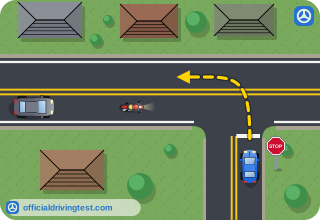
What do many drivers say about motorcyclists, even when they see them?
- Their headlights are too bright to judge their direction at night
- It is difficult to judge how far away they are or how fast they are traveling
- They are hard to hear, so drivers cannot tell whether they approach
- They usually ride in the center of the lane and cannot be passed
Show answer
Correct answer: It is difficult to judge how far away they are or how fast they are traveling
The manual says many drivers find it difficult to judge a motorcyclist's distance and speed.
Source: Alaska Driver Manual (Revised October 2025), page 46 · Open this page in the manual (Manual page 46)
-
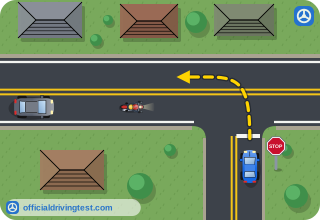
What should you make sure of before you make a left turn in front of an oncoming motorcycle?
- That the rider has turned on a headlight
- That the rider has seen your vehicle and slowed down
- That you have signaled for at least three seconds
- That you see the motorcycle and know its speed
Show answer
Correct answer: That you see the motorcycle and know its speed
The manual says to look once, then again, and make sure you see the motorcycle and know its speed before turning left.
Source: Alaska Driver Manual (Revised October 2025), page 46 · Open this page in the manual (Manual page 46)
-
Why should you be sure a motorcyclist is actually turning before you turn in front of them?
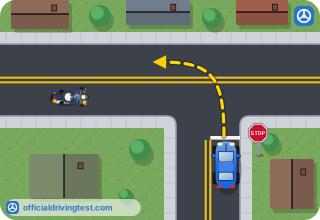
- A forgotten signal may still be blinking, as most do not turn off automatically
- Motorcycles cannot stop quickly enough once the rider has signaled a turn
- Motorcyclists are required to signal for a full block before turning
- Motorcycle turn signals are too dim to be seen from the opposite direction
Show answer
Correct answer: A forgotten signal may still be blinking, as most do not turn off automatically
Turn signals do not turn off automatically on most motorcycles, so the rider may be continuing straight with the signal still blinking.
Source: Alaska Driver Manual (Revised October 2025), page 47 · Open this page in the manual (Manual page 47)
-
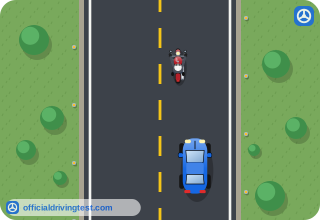
How many seconds of following distance should you give a motorcyclist, the same as other vehicles?
- One second
- Three seconds
- Four seconds
- Eight seconds
Show answer
Correct answer: Four seconds
The manual says the same four second following distance should be given to motorcyclists as to other vehicles.
Source: Alaska Driver Manual (Revised October 2025), page 47 · Open this page in the manual (Manual page 47)
-
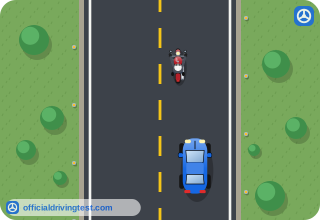
Why should you not follow a motorcyclist too closely?
- The rider cannot see the vehicle's turn signals
- It may distract the rider's attention from the road and traffic ahead
- Motorcyclists cannot use their brakes when followed closely
- The motorcycle's headlight becomes harder to see
Show answer
Correct answer: It may distract the rider's attention from the road and traffic ahead
Following too closely may cause the rider's attention to be distracted from the road and traffic ahead.
Source: Alaska Driver Manual (Revised October 2025), page 47 · Open this page in the manual (Manual page 47)
-
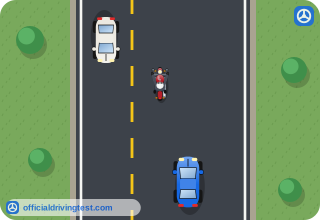
A motorcyclist is riding to one side of a wide lane. What does the manual say about moving into the same lane?
- It is allowed if you stay on the other side of the lane
- It is allowed if the lane is wide enough to share
- It is allowed when you signal first
- Never do it; it is illegal and extremely hazardous
Show answer
Correct answer: Never do it; it is illegal and extremely hazardous
Motorcycles need a full lane width, and moving into the same lane with one is illegal and extremely hazardous.
Source: Alaska Driver Manual (Revised October 2025), page 47 · Open this page in the manual (Manual page 47)
-
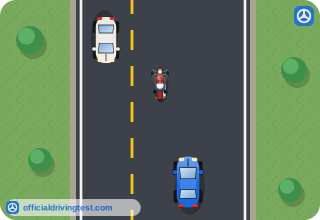
Why does a skilled motorcyclist constantly change positions within a lane?
- To see and be seen better and to avoid objects on the road
- To keep the motorcycle engine from overheating in traffic
- To discourage drivers from following the rider closely
- To save fuel by using less wind resistance on the road
Show answer
Correct answer: To see and be seen better and to avoid objects on the road
The manual says a skilled motorcyclist changes position to increase their ability to see and be seen and to avoid objects on the road.
Source: Alaska Driver Manual (Revised October 2025), page 47 · Open this page in the manual (Manual page 47)
-
How should your following distance behind a motorcyclist change when the road is wet and slippery?
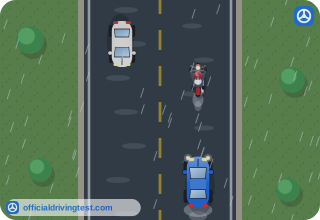
- Keep the same distance as on dry roads
- Allow less distance because the rider will slow down
- Allow more following distance
- Follow in the next lane instead
Show answer
Correct answer: Allow more following distance
The manual says to allow more following distance for motorcyclists when the road surface is wet and slippery.
Source: Alaska Driver Manual (Revised October 2025), page 47 · Open this page in the manual (Manual page 47)
-
Around motorcyclists, what problem created by rain and wet surfaces should you be alert to, especially at night?
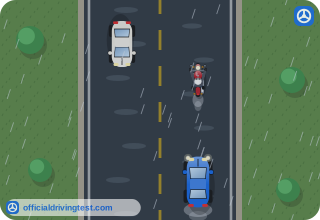
- Fog on the rider's visor
- Glare
- Fading headlights
- Frost on the road
Show answer
Correct answer: Glare
The manual says to be alert to the problem of glare that rain and wet surfaces create, especially at night.
Source: Alaska Driver Manual (Revised October 2025), page 47 · Open this page in the manual (Manual page 47)
-
Where can strong cross winds move a motorcycle out of its lane of travel?
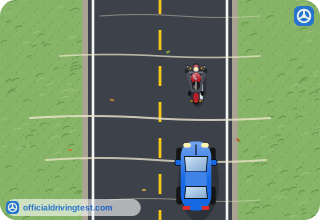
- Narrow streets lined with tall buildings
- Short, sheltered stretches of road in forests
- Residential streets with parked cars
- Wide open, long stretches of highways and bridges
Show answer
Correct answer: Wide open, long stretches of highways and bridges
The manual names wide open, long stretches of highways and bridges as places where strong cross winds can push a motorcycle out of its lane.
Source: Alaska Driver Manual (Revised October 2025), page 47 · Open this page in the manual (Manual page 47)
-
What can large, fast-moving trucks sometimes create that can move a motorcyclist out of their path of travel?
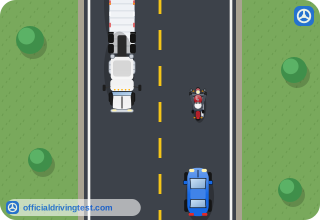
- Wind blasts
- Dust clouds
- Road vibrations
- Exhaust fumes
Show answer
Correct answer: Wind blasts
The manual says large, fast-moving trucks sometimes create wind blasts that can move a motorcyclist out of their path.
Source: Alaska Driver Manual (Revised October 2025), page 47 · Open this page in the manual (Manual page 47)
-
Which of these is listed as a road hazard that may cause a motorcyclist to change speed or direction?
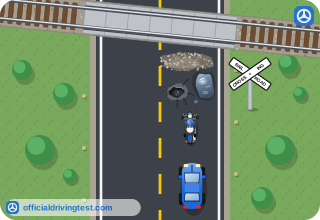
- Wide paved shoulders
- Straight, dry pavement
- Manhole covers
- Clearly marked lanes
Show answer
Correct answer: Manhole covers
The manual lists gravel, debris, pavement seams, rain grooves, small animals and even manhole covers as road hazards.
Source: Alaska Driver Manual (Revised October 2025), page 47 · Open this page in the manual (Manual page 47)