Wyoming: Speed and space — Part 4 Practice Test
Questions in this part include: “What does it mean to "separate risks"?” · “At night, if you drive faster than what speed can you not stop in the distance that you can see ahead?”
Independent educational site · not affiliated with any government agency or DMV
Ready? Test yourself
Answer to start, or tap Start below:
What does it mean to "separate risks"?
- Instant feedback with an explanation
- Every answer cites its source in the manual
- Your best score is saved on this device
- Keyboard: press 1 to 4 to answer and Enter for the next question
Questions are original and based on the official manual "Rules of the Road: State of Wyoming Driver License Manual" (2021 (August 2021)), Wyoming Department of Transportation (WYDOT), Driver Services.
All 19 questions in this practice test
Take the test above first, then use this list to study. Tap “Show answer” to see the correct answer and explanation.
Show the questions and answersHide the questions
-
What does it mean to "separate risks"?
- Deal with all risks at once
- Take risks one at a time whenever possible
- Keep the biggest risk behind you
- Speed up to get away from all risks
Show answer
Correct answer: Take risks one at a time whenever possible
Separating risks means handling risks one at a time when you can.
Source: Rules of the Road: State of Wyoming Driver License Manual (2021 (August 2021)), page 76 · Open this page in the manual (Manual page 76)
-
Joggers on the edge of the road and an oncoming truck will reach you at about the same time. How can you separate the risks?
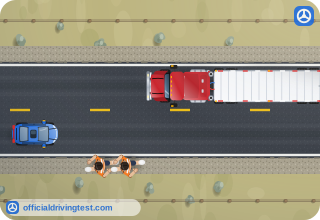
- Keep your speed and pass both at the same time with plenty of room
- Move toward the joggers to stay away from the truck
- Stop and let the truck and the joggers pass
- Speed up or slow down to pass the joggers before or after the truck
Show answer
Correct answer: Speed up or slow down to pass the joggers before or after the truck
By speeding up or slowing down, you can pass the joggers and the truck one at a time.
Source: Rules of the Road: State of Wyoming Driver License Manual (2021 (August 2021)), page 77 · Open this page in the manual (Manual page 77)
-
What should you do to compromise space when you cannot separate risks?
- Give the most room to the worst danger
- Give equal room to every danger
- Give the most room to the nearest danger
- Slow to a stop in your lane
Show answer
Correct answer: Give the most room to the worst danger
When two or more risks must be handled at once, the manual says to give the most room to the worst danger.
Source: Rules of the Road: State of Wyoming Driver License Manual (2021 (August 2021)), page 77 · Open this page in the manual (Manual page 77)
-
You are on a two-lane street with oncoming cars to your left and a child riding a bike to your right, and you cannot separate the risks. What should you do?
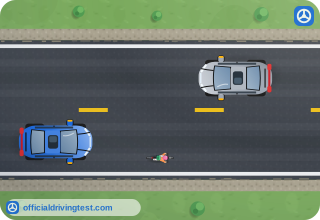
- Move toward the right edge to stay away from the oncoming cars
- Stay in the middle of your lane and keep your speed
- Move closer to the center line to give the child a larger space cushion
- Speed up to pass the child before the oncoming cars arrive
Show answer
Correct answer: Move closer to the center line to give the child a larger space cushion
The child is more likely to move suddenly, so the child is the greater danger and needs more room to the right.
Source: Rules of the Road: State of Wyoming Driver License Manual (2021 (August 2021)), page 77 · Open this page in the manual (Manual page 77)
-
At night, if you drive faster than what speed can you not stop in the distance that you can see ahead?
- 35 mph
- 55 mph
- 45 mph
- 65 mph
Show answer
Correct answer: 55 mph
Headlights show a limited distance, so above 55 mph you cannot stop within the distance you can see.
Source: Rules of the Road: State of Wyoming Driver License Manual (2021 (August 2021)), page 77 · Open this page in the manual (Manual page 77)
-
In fog, the chance of a crash is extremely high whenever the difference between your speed and the speed of other traffic is more than how many mph?
- 5 mph
- 15 mph
- 20 mph
- 25 mph
Show answer
Correct answer: 15 mph
A speed difference of more than 15 mph from other traffic makes a crash extremely likely in fog.
Source: Rules of the Road: State of Wyoming Driver License Manual (2021 (August 2021)), page 78 · Open this page in the manual (Manual page 78)
-
In fog, when you cannot see at least how far ahead should you consider pulling off at the nearest safe spot and stopping?
- 10 seconds ahead
- 2 seconds ahead
- 4 seconds ahead
- 6 seconds ahead
Show answer
Correct answer: 10 seconds ahead
If you cannot see at least 10 seconds ahead in fog, consider pulling off at the nearest safe spot and stopping.
Source: Rules of the Road: State of Wyoming Driver License Manual (2021 (August 2021)), page 78 · Open this page in the manual (Manual page 78)
-
In fog, what size space cushion should you create when scanning ahead for taillights, headlights, pedestrians and stopped vehicles?
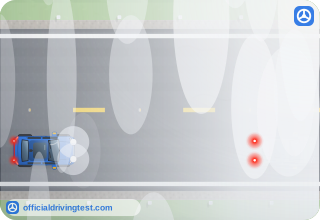
- The same cushion as in clear weather
- A cushion of exactly two seconds
- As big a space cushion as possible
- No cushion, so you can keep up
Show answer
Correct answer: As big a space cushion as possible
Fog hides hazards, so the manual says to create as big a space cushion as possible.
Source: Rules of the Road: State of Wyoming Driver License Manual (2021 (August 2021)), page 79 · Open this page in the manual (Manual page 79)
-
In rain, how much time should you leave between you and the vehicle ahead (cars)?
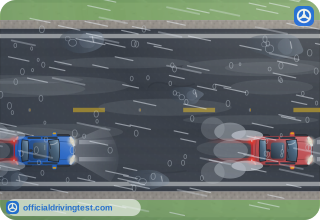
- One second
- Two seconds
- Ten seconds
- Four seconds
Show answer
Correct answer: Four seconds
In rain you double the following time, which is four seconds for cars.
Source: Rules of the Road: State of Wyoming Driver License Manual (2021 (August 2021)), page 79 · Open this page in the manual (Manual page 79)
-
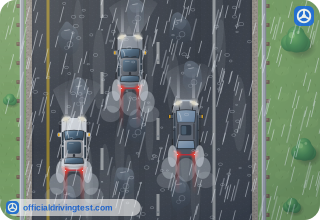
Why is the roadway especially slippery during the first half hour after rain begins?
- Dust and oil mix with the water
- The water freezes on the pavement
- Painted lines wash away
- Tires are cold and stiff
Show answer
Correct answer: Dust and oil mix with the water
Dust and oil mix with the water in the first half hour of rain and make the road slippery.
Source: Rules of the Road: State of Wyoming Driver License Manual (2021 (August 2021)), page 79 · Open this page in the manual (Manual page 79)
-
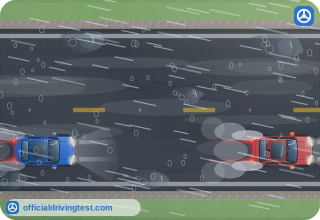
What is hydroplaning, which may occur during rainstorms?
- Tires locking up and sliding on an icy road
- Wipers failing to clear water from the glass
- Brakes fading because they got too wet
- Tires riding on a thin film of water, not the road
Show answer
Correct answer: Tires riding on a thin film of water, not the road
Hydroplaning means the tires ride on a thin film of water instead of the road surface.
Source: Rules of the Road: State of Wyoming Driver License Manual (2021 (August 2021)), page 79 · Open this page in the manual (Manual page 79)
-
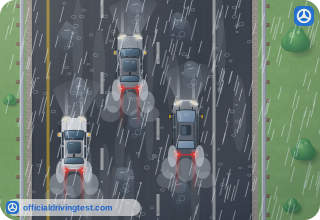
How can you prevent hydroplaning during a rainstorm?
- Turn on your high beams
- Slow down
- Brake hard and steadily
- Use cruise control
Show answer
Correct answer: Slow down
The manual's way to prevent hydroplaning is to slow down.
Source: Rules of the Road: State of Wyoming Driver License Manual (2021 (August 2021)), page 79 · Open this page in the manual (Manual page 79)
-
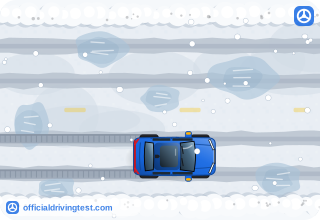
What does the manual say to equip your car with on snow or ice to prevent skidding and reduce stopping distance?
- Snow tires or chains
- Extra weight in the trunk
- Wider rear tires
- Higher tire pressure
Show answer
Correct answer: Snow tires or chains
Snow tires or chains help prevent skidding and shorten stopping distance on snow or ice.
Source: Rules of the Road: State of Wyoming Driver License Manual (2021 (August 2021)), page 79 · Open this page in the manual (Manual page 79)
-
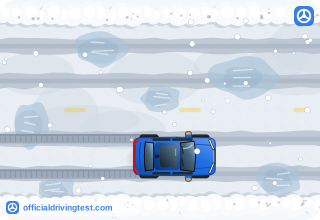
When driving on snow or ice, what should you NOT do suddenly?
- Turn on the windshield wipers
- Use your turn signal
- Change speed or direction
- Check your mirrors
Show answer
Correct answer: Change speed or direction
Sudden changes of speed or direction can cause a skid on snow or ice.
Source: Rules of the Road: State of Wyoming Driver License Manual (2021 (August 2021)), page 79 · Open this page in the manual (Manual page 79)
-
Why should you never lock your brakes on snow or ice?
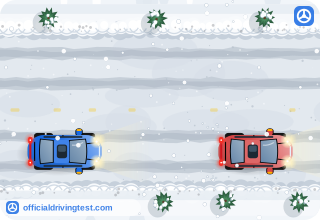
- You have no steering control unless the wheels turn
- Locked brakes overheat the tires and brake fluid
- Locked brakes drain the battery
- Locked brakes turn off the headlights
Show answer
Correct answer: You have no steering control unless the wheels turn
If the wheels are locked and not turning, you cannot steer.
Source: Rules of the Road: State of Wyoming Driver License Manual (2021 (August 2021)), page 79 · Open this page in the manual (Manual page 79)
-
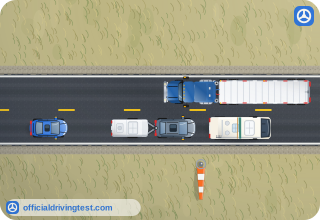
What is the best defense against wind, which is especially hazardous for trucks, recreational vehicles, campers and drivers towing trailers?
- Driving at the speed limit
- Driving at slower speeds
- Driving in the left lane
- Following another truck closely
Show answer
Correct answer: Driving at slower speeds
Slower speeds are the best defense against wind.
Source: Rules of the Road: State of Wyoming Driver License Manual (2021 (August 2021)), page 79 · Open this page in the manual (Manual page 79)
-
In windy conditions, what should you watch for after driving in a protected area?
- Open spaces, where the wind may change
- Wet pavement under bridges and overpasses
- Animals near the roadside
- Sudden stops by other drivers
Show answer
Correct answer: Open spaces, where the wind may change
After a protected area you may hit open spaces where the wind changes, so be ready to make steering corrections.
Source: Rules of the Road: State of Wyoming Driver License Manual (2021 (August 2021)), page 80 · Open this page in the manual (Manual page 80)
-
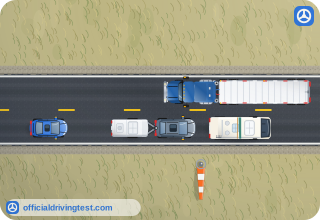
When meeting large trucks and buses in wind, what should you be prepared to do?
- Speed up to pass them as quickly as you can
- Move onto the shoulder
- Make steering corrections for wind changes
- Sound your horn
Show answer
Correct answer: Make steering corrections for wind changes
Large trucks and buses can cause sudden wind changes, so be ready to correct your steering.
Source: Rules of the Road: State of Wyoming Driver License Manual (2021 (August 2021)), page 80 · Open this page in the manual (Manual page 80)
-
What does total stopping distance include?
- Only the distance traveled after the brakes have been applied to the wheels
- The distance traveled while deciding to stop, reacting, and then braking
- Only the distance traveled while the driver is reacting to the danger
- The distance from the stop line to the crosswalk at the intersection
Show answer
Correct answer: The distance traveled while deciding to stop, reacting, and then braking
Total stopping distance is the complete distance traveled while deciding to stop, reacting, and after the brakes are applied.
Source: Rules of the Road: State of Wyoming Driver License Manual (2021 (August 2021)), page 94 · Open this page in the manual (Manual page 94)