Wyoming: Speed and space — Part 3 Practice Test
Questions in this part include: “In the Execute step of IPDE, how should you carry out your decision?” · “What type of crash is very common when drivers follow too closely?”
Independent educational site · not affiliated with any government agency or DMV
Ready? Test yourself
Answer to start, or tap Start below:
In the Execute step of IPDE, how should you carry out your decision?
- Instant feedback with an explanation
- Every answer cites its source in the manual
- Your best score is saved on this device
- Keyboard: press 1 to 4 to answer and Enter for the next question
Questions are original and based on the official manual "Rules of the Road: State of Wyoming Driver License Manual" (2021 (August 2021)), Wyoming Department of Transportation (WYDOT), Driver Services.
All 19 questions in this practice test
Take the test above first, then use this list to study. Tap “Show answer” to see the correct answer and explanation.
Show the questions and answersHide the questions
-
In the Execute step of IPDE, how should you carry out your decision?
- In a smooth, predictable manner and in time to avoid a crash
- As quickly and forcefully as you can
- Only after another driver acts first
- With a sudden reaction once the danger is very close
Show answer
Correct answer: In a smooth, predictable manner and in time to avoid a crash
The final step is to carry out the decision smoothly and predictably, early enough to avoid a crash.
Source: Rules of the Road: State of Wyoming Driver License Manual (2021 (August 2021)), page 73 · Open this page in the manual (Manual page 73)
-
Which of these does driving defensively with IPDE require?
- Matching the speed of the traffic around you
- Staying in the left lane
- Isolating your vehicle in traffic
- Following the vehicle ahead closely
Show answer
Correct answer: Isolating your vehicle in traffic
The manual says IPDE requires scanning, communicating, isolating your vehicle, and separating risks and compromising space.
Source: Rules of the Road: State of Wyoming Driver License Manual (2021 (August 2021)), page 74 · Open this page in the manual (Manual page 74)
-
How far ahead do defensive drivers scan?
- At least 2 to 4 seconds
- At least 10 to 15 seconds
- At least 5 to 6 seconds
- At least 20 to 25 seconds
Show answer
Correct answer: At least 10 to 15 seconds
The manual says defensive drivers scan at least 10 to 15 seconds ahead.
Source: Rules of the Road: State of Wyoming Driver License Manual (2021 (August 2021)), page 74 · Open this page in the manual (Manual page 74)
-
If you are watching far enough ahead, how high will you count before you pass a fixed object beside the road?
- Only to one thousand and three
- Only to one thousand and five
- Only to one thousand and seven
- Past one thousand and ten
Show answer
Correct answer: Past one thousand and ten
Counting past one thousand and ten before reaching the object shows you are looking far enough ahead.
Source: Rules of the Road: State of Wyoming Driver License Manual (2021 (August 2021)), page 74 · Open this page in the manual (Manual page 74)
-
What may be true of drivers who have to react to unexpected traffic situations?
- They may not be checking far enough ahead to identify critical objects
- They are always driving faster than the posted speed limit allows
- They are always following too closely
- They are scanning too far to the sides
Show answer
Correct answer: They may not be checking far enough ahead to identify critical objects
Reacting to surprises can mean a driver is not looking far enough ahead to spot critical objects.
Source: Rules of the Road: State of Wyoming Driver License Manual (2021 (August 2021)), page 74 · Open this page in the manual (Manual page 74)
-
What is a space cushion?
- A padded area built into the front of a vehicle to absorb impacts
- The width of the shoulder beside the road that you can use to pull off
- The gap between your vehicle and the center line of the road
- Space ahead, behind and to the sides that isolates your vehicle from others
Show answer
Correct answer: Space ahead, behind and to the sides that isolates your vehicle from others
A space cushion is the space ahead, behind and to the sides that gives you distance to avoid other drivers' mistakes.
Source: Rules of the Road: State of Wyoming Driver License Manual (2021 (August 2021)), page 75 · Open this page in the manual (Manual page 75)
-
What type of crash is very common when drivers follow too closely?
- Rear-end collisions
- Head-on collisions
- Sideswipe collisions
- Rollover crashes
Show answer
Correct answer: Rear-end collisions
Rear-end collisions caused by following too close are a very common type of crash.
Source: Rules of the Road: State of Wyoming Driver License Manual (2021 (August 2021)), page 75 · Open this page in the manual (Manual page 75)
-
When using the two-second following distance rule, when do you start counting?
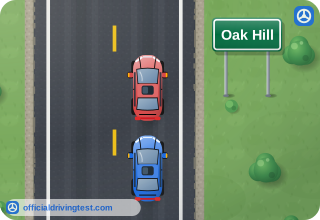
- When the front bumper of the vehicle ahead passes a fixed point
- When the vehicle ahead turns on its brake lights
- When the rear bumper of the vehicle ahead passes a fixed point
- When your front bumper reaches the fixed point
Show answer
Correct answer: When the rear bumper of the vehicle ahead passes a fixed point
You pick a fixed point, and start counting when the rear bumper of the vehicle ahead passes it.
Source: Rules of the Road: State of Wyoming Driver License Manual (2021 (August 2021)), page 75 · Open this page in the manual (Manual page 75)
-
The front of your vehicle passes the fixed point before you count off two seconds. What does this mean?
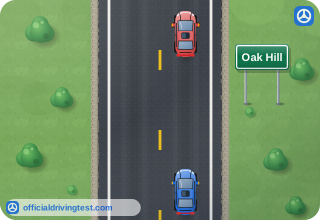
- You have a large enough space cushion
- You are too close to the vehicle ahead
- You are following at the right distance
- You should speed up to pass
Show answer
Correct answer: You are too close to the vehicle ahead
Reaching the fixed point in under two seconds means you are following too closely.
Source: Rules of the Road: State of Wyoming Driver License Manual (2021 (August 2021)), page 75 · Open this page in the manual (Manual page 75)
-
The two-second following distance rule works at which speeds?
- Only below 35 mph
- Only on the Interstate
- Only in good weather
- All speeds
Show answer
Correct answer: All speeds
The manual says the rule is simple and works at all speeds.
Source: Rules of the Road: State of Wyoming Driver License Manual (2021 (August 2021)), page 75 · Open this page in the manual (Manual page 75)
-
If you are driving a car, how far back from the vehicle ahead should you stay at least?
- Two seconds
- Three seconds
- Five seconds
- Six seconds
Show answer
Correct answer: Two seconds
Cars should stay at least two seconds behind the vehicle ahead.
Source: Rules of the Road: State of Wyoming Driver License Manual (2021 (August 2021)), page 75 · Open this page in the manual (Manual page 75)
-
How many seconds back should bus drivers stay at least?
- Two seconds
- Three seconds
- Four seconds
- Five seconds
Show answer
Correct answer: Four seconds
Bus drivers should stay at least four seconds back.
Source: Rules of the Road: State of Wyoming Driver License Manual (2021 (August 2021)), page 75 · Open this page in the manual (Manual page 75)
-
How many seconds back should tractor-trailer drivers stay at least?
- Two seconds
- Six seconds
- Three seconds
- Four seconds
Show answer
Correct answer: Six seconds
Tractor-trailer drivers should stay at least six seconds back.
Source: Rules of the Road: State of Wyoming Driver License Manual (2021 (August 2021)), page 75 · Open this page in the manual (Manual page 75)
-
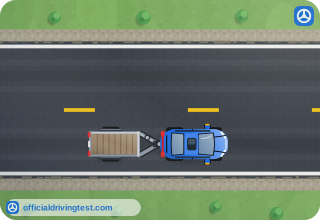
How does towing a boat or trailer affect the following distance you need?
- It lets you use a shorter following distance
- It has no effect on the following distance
- It means you can follow at the same distance at low speeds
- It adds length and weight, so you need more following distance
Show answer
Correct answer: It adds length and weight, so you need more following distance
Towing adds length and weight to your vehicle, so it requires more following distance.
Source: Rules of the Road: State of Wyoming Driver License Manual (2021 (August 2021)), page 75 · Open this page in the manual (Manual page 75)
-
When the roads are wet, what does the manual say it makes sense to do about following distance?
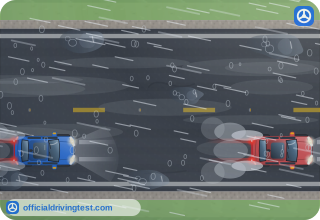
- Double the number of seconds
- Keep the same number of seconds
- Cut the number of seconds in half
- Add one second to the usual number
Show answer
Correct answer: Double the number of seconds
On wet roads, the manual says to double the number of seconds of following distance.
Source: Rules of the Road: State of Wyoming Driver License Manual (2021 (August 2021)), page 75 · Open this page in the manual (Manual page 75)
-
How does a tailgater affect you?
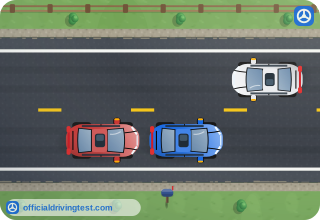
- The tailgater makes it easier for you to change lanes quickly
- The tailgater limits your ability to slow rapidly in an emergency ahead
- The tailgater lets you brake as hard as you want with less risk
- The tailgater gives you more space ahead
Show answer
Correct answer: The tailgater limits your ability to slow rapidly in an emergency ahead
A driver who tailgates limits your ability to slow rapidly if an emergency happens ahead.
Source: Rules of the Road: State of Wyoming Driver License Manual (2021 (August 2021)), page 76 · Open this page in the manual (Manual page 76)
-
Which action can you take when a driver is tailgating you?
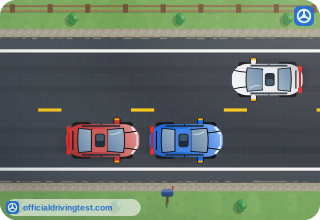
- Brake suddenly to warn the tailgater
- Increase your speed to stay ahead of the tailgater
- Move to the left lane of a multilane highway
- Reduce your speed to encourage the driver behind to pass
Show answer
Correct answer: Reduce your speed to encourage the driver behind to pass
The manual lists reducing your speed to encourage the tailgater to pass, along with other steps such as giving yourself more room ahead.
Source: Rules of the Road: State of Wyoming Driver License Manual (2021 (August 2021)), page 76 · Open this page in the manual (Manual page 76)
-
What does it mean to be "boxed in"?
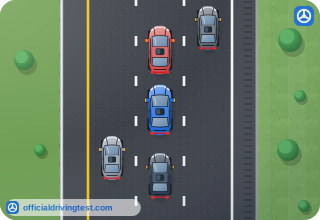
- Vehicles, bicycles, pedestrians or objects are in the space on both sides of you
- Another vehicle is following you too closely and you cannot change lanes
- You are driving in a lane that is too narrow
- You are stopped behind a vehicle at an intersection
Show answer
Correct answer: Vehicles, bicycles, pedestrians or objects are in the space on both sides of you
Being boxed in means the space on both sides is occupied, so you can only speed up or slow down to respond to a situation ahead.
Source: Rules of the Road: State of Wyoming Driver License Manual (2021 (August 2021)), page 76 · Open this page in the manual (Manual page 76)
-
Which action helps you keep a space cushion to your sides?
- Driving alongside other vehicles on multilane streets
- Staying close to parked vehicles
- Avoiding driving next to a bicyclist for prolonged periods
- Keeping as little space as possible from oncoming traffic
Show answer
Correct answer: Avoiding driving next to a bicyclist for prolonged periods
The manual lists avoiding driving next to a bicyclist for long periods, among other ways to keep space to your sides.
Source: Rules of the Road: State of Wyoming Driver License Manual (2021 (August 2021)), page 76 · Open this page in the manual (Manual page 76)