Wyoming: Speed and space — Part 1 Practice Test
Questions in this part include: “How large is the area of rubber that each tire has touching the road?” · “According to the manual, when do crashes tend to happen?”
Independent educational site · not affiliated with any government agency or DMV
Ready? Test yourself
Answer to start, or tap Start below:
How large is the area of rubber that each tire has touching the road?
- Instant feedback with an explanation
- Every answer cites its source in the manual
- Your best score is saved on this device
- Keyboard: press 1 to 4 to answer and Enter for the next question
Questions are original and based on the official manual "Rules of the Road: State of Wyoming Driver License Manual" (2021 (August 2021)), Wyoming Department of Transportation (WYDOT), Driver Services.
All 20 questions in this practice test
Take the test above first, then use this list to study. Tap “Show answer” to see the correct answer and explanation.
Show the questions and answersHide the questions
-
How large is the area of rubber that each tire has touching the road?
- About the size of a person's hand
- About the size of a dinner plate
- About the size of a sheet of paper
- About the size of a person's shoe
Show answer
Correct answer: About the size of a person's hand
Each tire touches the road with only a patch of rubber about the size of a person's hand, so the road condition strongly affects grip.
Source: Rules of the Road: State of Wyoming Driver License Manual (2021 (August 2021)), page 41 · Open this page in the manual (Manual page 41)
-
When should you adjust your speed for a curve?
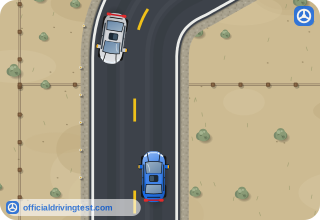
- Once you are in the middle of the curve
- Right as you reach the end of the curve
- Before entering the curve
- Only if the road is wet
Show answer
Correct answer: Before entering the curve
Going too fast can break the tires' grip on the road, so speed must be adjusted before you enter the curve.
Source: Rules of the Road: State of Wyoming Driver License Manual (2021 (August 2021)), page 41 · Open this page in the manual (Manual page 41)
-
Trees, bushes or buildings block your view of vehicles coming from the side at an intersection. What is the fastest you should approach it?
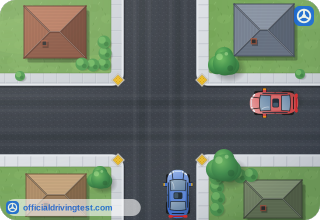
- 10 mph
- 15 mph
- 20 mph
- 25 mph
Show answer
Correct answer: 15 mph
The manual tells drivers to approach a blind intersection at no more than 15 mph because the view of side traffic is blocked.
Source: Rules of the Road: State of Wyoming Driver License Manual (2021 (August 2021)), page 41 · Open this page in the manual (Manual page 41)
-
By how much should you reduce your speed when driving on a wet road?
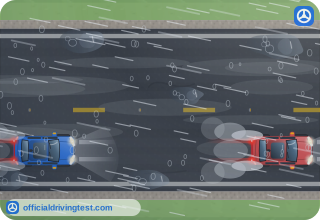
- At least 1-2 mph
- At least 20-25 mph
- At least one quarter
- At least 5-10 mph
Show answer
Correct answer: At least 5-10 mph
Slippery roads reduce the tires' grip, and on a wet road the manual says to slow by at least 5-10 mph.
Source: Rules of the Road: State of Wyoming Driver License Manual (2021 (August 2021)), page 41 · Open this page in the manual (Manual page 41)
-
By how much should you reduce your speed when driving on packed snow?
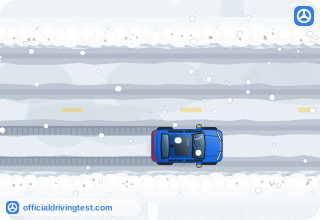
- By about one quarter
- By at least half
- By at least 1-2 mph
- By a little, only on hills
Show answer
Correct answer: By at least half
Packed snow gives much less grip than dry pavement, so the manual says to cut your speed by at least half.
Source: Rules of the Road: State of Wyoming Driver License Manual (2021 (August 2021)), page 41 · Open this page in the manual (Manual page 41)
-
How much should you reduce your speed when driving on ice?
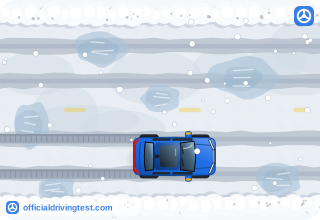
- By about one quarter
- By only 1-2 mph
- Not at all if no cars are ahead
- To a crawl
Show answer
Correct answer: To a crawl
Ice is extremely slippery, so the manual says to slow to a crawl, and you may have to slow even more if vehicles are ahead.
Source: Rules of the Road: State of Wyoming Driver License Manual (2021 (August 2021)), page 41 · Open this page in the manual (Manual page 41)
-
What is the legal speed limit on secondary highways, unless otherwise posted?
- 70 mph
- 55 mph
- 60 mph
- 65 mph
Show answer
Correct answer: 70 mph
The manual's table of legal speed limits gives 70 mph for secondary highways unless otherwise posted.
Source: Rules of the Road: State of Wyoming Driver License Manual (2021 (August 2021)), page 41 · Open this page in the manual (Manual page 41)
-
What is the legal speed limit in residential areas, unless otherwise posted?
- 20 mph
- 25 mph
- 30 mph
- 35 mph
Show answer
Correct answer: 30 mph
The manual's table of legal speed limits gives 30 mph for residential areas unless otherwise posted.
Source: Rules of the Road: State of Wyoming Driver License Manual (2021 (August 2021)), page 41 · Open this page in the manual (Manual page 41)
-
What is the legal speed limit in business areas, unless otherwise posted?
- 15 mph
- 40 mph
- 50 mph
- 30 mph
Show answer
Correct answer: 30 mph
The manual's table of legal speed limits gives 30 mph for business areas unless otherwise posted.
Source: Rules of the Road: State of Wyoming Driver License Manual (2021 (August 2021)), page 41 · Open this page in the manual (Manual page 41)
-
What is the speed limit in a school zone?
- 20 mph
- 10 mph
- 15 mph
- 25 mph
Show answer
Correct answer: 20 mph
The manual's speed table gives 20 mph for school zones.
Source: Rules of the Road: State of Wyoming Driver License Manual (2021 (August 2021)), page 41 · Open this page in the manual (Manual page 41)
-
According to the manual, when do crashes tend to happen?
- Only when every driver is going the same speed
- Only when roads are completely dry
- When a driver goes faster or slower than others
- Mostly when traffic is very light
Show answer
Correct answer: When a driver goes faster or slower than others
Crashes tend to happen when one driver's speed differs from the other vehicles on the road.
Source: Rules of the Road: State of Wyoming Driver License Manual (2021 (August 2021)), page 41 · Open this page in the manual (Manual page 41)
-
What does the manual say you will have to do if you go faster than traffic?
- Always arrive first at intersections
- Pass other vehicles
- Stop more often than other drivers
- Follow other vehicles more closely
Show answer
Correct answer: Pass other vehicles
Going faster than traffic forces you to pass other vehicles, and the chance of a crash increases if you pass many.
Source: Rules of the Road: State of Wyoming Driver License Manual (2021 (August 2021)), page 41 · Open this page in the manual (Manual page 41)
-
How does the manual compare going slower than traffic or stopping suddenly with speeding?
- It is much less dangerous than speeding
- It is dangerous only at night
- It is as dangerous as speeding
- It is safe if you stay in the right lane
Show answer
Correct answer: It is as dangerous as speeding
Driving slower than traffic or stopping suddenly adds the risk of rear-end collisions to the risk of vehicles passing you.
Source: Rules of the Road: State of Wyoming Driver License Manual (2021 (August 2021)), page 41 · Open this page in the manual (Manual page 41)
-
Which of these is a major cause of traffic crashes, according to the manual?
- Signaling too early
- Slowing suddenly
- Driving in the right lane
- Using headlights in daylight
Show answer
Correct answer: Slowing suddenly
The manual says you should adjust speed gradually, because slowing suddenly is a major cause of traffic crashes.
Source: Rules of the Road: State of Wyoming Driver License Manual (2021 (August 2021)), page 42 · Open this page in the manual (Manual page 42)
-
How far will your headlights let you see clearly at night, according to the manual?
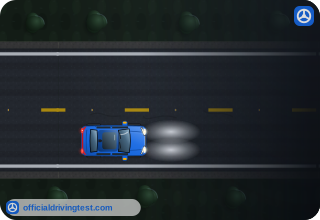
- About 150 feet
- About 350 feet
- About 250 feet
- About 450 feet
Show answer
Correct answer: About 250 feet
The manual says headlights only let you see clearly about 250 feet ahead.
Source: Rules of the Road: State of Wyoming Driver License Manual (2021 (August 2021)), page 42 · Open this page in the manual (Manual page 42)
-
On a dark road, driving faster than what speed means you are “driving blind”?
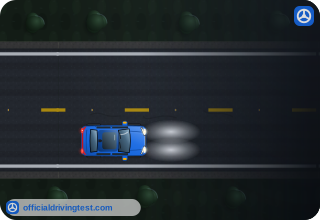
- 35 mph
- 55 mph
- 40 mph
- 45 mph
Show answer
Correct answer: 55 mph
Above 55 mph you cannot stop within the 250 feet your headlights light well enough to see, so you are driving blind.
Source: Rules of the Road: State of Wyoming Driver License Manual (2021 (August 2021)), page 42 · Open this page in the manual (Manual page 42)
-
In a very heavy rain, snowstorm or thick fog, what is the farthest you may be able to see ahead?
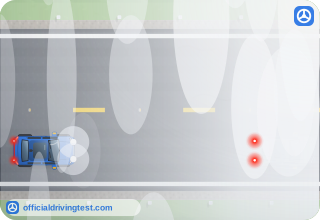
- No more than 50 feet
- No more than 300 feet
- No more than 600 feet
- No more than 100 feet
Show answer
Correct answer: No more than 100 feet
The manual says in very heavy rain, snow or thick fog you may not be able to see more than 100 feet.
Source: Rules of the Road: State of Wyoming Driver License Manual (2021 (August 2021)), page 42 · Open this page in the manual (Manual page 42)
-
Whenever you cannot see well enough because of rain, fog or snow, what should you do?
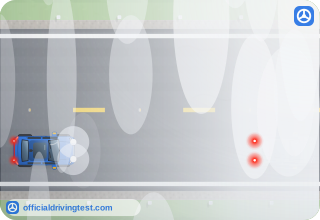
- Slow to 20 mph and keep driving
- Pull off the road and wait until it clears
- Speed up to drive out of the weather
- Follow closely behind the vehicle ahead
Show answer
Correct answer: Pull off the road and wait until it clears
The manual says that when you cannot see well enough you cannot drive safely at any speed, so you should pull off and wait.
Source: Rules of the Road: State of Wyoming Driver License Manual (2021 (August 2021)), page 42 · Open this page in the manual (Manual page 42)
-
Where can ice remain even after the sun comes out?
- On wide, flat, open stretches of highway
- On roads with wide shoulders
- On bridges, overpasses and shaded areas
- In the center of dry intersections
Show answer
Correct answer: On bridges, overpasses and shaded areas
The manual warns that ice can stay on bridges, overpasses and shaded areas even after the sun is out.
Source: Rules of the Road: State of Wyoming Driver License Manual (2021 (August 2021)), page 44 · Open this page in the manual (Manual page 44)
-
When traffic permits on a winter road, how does the manual suggest you check out the surface you are driving on?
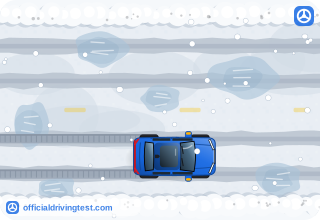
- Turn the steering wheel sharply from side to side
- Touch the brakes to see if it slows or swerves
- Speed up briefly, then let off the gas
- Open the window and feel the air temperature
Show answer
Correct answer: Touch the brakes to see if it slows or swerves
Lightly touching the brakes shows whether the road is slick, because the vehicle will slow normally or start to swerve.
Source: Rules of the Road: State of Wyoming Driver License Manual (2021 (August 2021)), page 44 · Open this page in the manual (Manual page 44)