Wyoming: Speed and space
Wyoming speed limits, adjusting speed for conditions, the two-second rule, scanning ahead and keeping a space cushion. Split into 4 shorter tests so you're not stuck in one long quiz.
Independent educational site · not affiliated with any government agency or DMV
Choose a part
Speed and space — Part 1
Questions in this part include: “How large is the area of rubber that each tire has touching the road?”
Speed and space — Part 2
Questions in this part include: “Sudden changes in road surface, from merely wet to extremely icy, occur often at which of these places?”
Speed and space — Part 3
Questions in this part include: “In the Execute step of IPDE, how should you carry out your decision?”
Speed and space — Part 4
Questions in this part include: “What does it mean to "separate risks"?”
Questions are original and based on the official manual "Rules of the Road: State of Wyoming Driver License Manual" (2021 (August 2021)), Wyoming Department of Transportation (WYDOT), Driver Services.
All 77 Speed and space questions with answers
Choose a part above to take a practice test, or study every question and answer here.
Show the questions and answersHide the questions
1Part 120 questions
-
How large is the area of rubber that each tire has touching the road?
- About the size of a person's hand
- About the size of a dinner plate
- About the size of a sheet of paper
- About the size of a person's shoe
Show answer
Correct answer: About the size of a person's hand
Each tire touches the road with only a patch of rubber about the size of a person's hand, so the road condition strongly affects grip.
Source: Rules of the Road: State of Wyoming Driver License Manual (2021 (August 2021)), page 41 · Open this page in the manual (Manual page 41)
-
When should you adjust your speed for a curve?
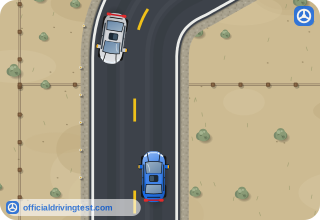
- Once you are in the middle of the curve
- Right as you reach the end of the curve
- Before entering the curve
- Only if the road is wet
Show answer
Correct answer: Before entering the curve
Going too fast can break the tires' grip on the road, so speed must be adjusted before you enter the curve.
Source: Rules of the Road: State of Wyoming Driver License Manual (2021 (August 2021)), page 41 · Open this page in the manual (Manual page 41)
-
Trees, bushes or buildings block your view of vehicles coming from the side at an intersection. What is the fastest you should approach it?
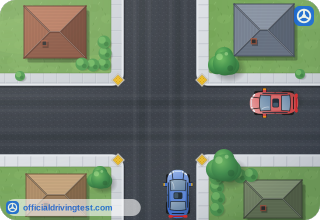
- 10 mph
- 15 mph
- 20 mph
- 25 mph
Show answer
Correct answer: 15 mph
The manual tells drivers to approach a blind intersection at no more than 15 mph because the view of side traffic is blocked.
Source: Rules of the Road: State of Wyoming Driver License Manual (2021 (August 2021)), page 41 · Open this page in the manual (Manual page 41)
-
By how much should you reduce your speed when driving on a wet road?
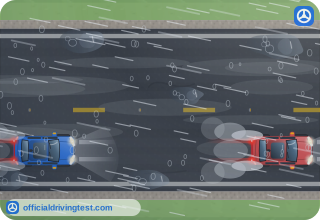
- At least 1-2 mph
- At least 20-25 mph
- At least one quarter
- At least 5-10 mph
Show answer
Correct answer: At least 5-10 mph
Slippery roads reduce the tires' grip, and on a wet road the manual says to slow by at least 5-10 mph.
Source: Rules of the Road: State of Wyoming Driver License Manual (2021 (August 2021)), page 41 · Open this page in the manual (Manual page 41)
-
By how much should you reduce your speed when driving on packed snow?
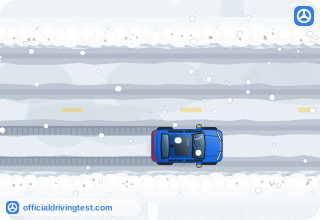
- By about one quarter
- By at least half
- By at least 1-2 mph
- By a little, only on hills
Show answer
Correct answer: By at least half
Packed snow gives much less grip than dry pavement, so the manual says to cut your speed by at least half.
Source: Rules of the Road: State of Wyoming Driver License Manual (2021 (August 2021)), page 41 · Open this page in the manual (Manual page 41)
-
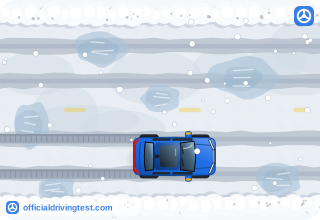
How much should you reduce your speed when driving on ice?
- By about one quarter
- By only 1-2 mph
- Not at all if no cars are ahead
- To a crawl
Show answer
Correct answer: To a crawl
Ice is extremely slippery, so the manual says to slow to a crawl, and you may have to slow even more if vehicles are ahead.
Source: Rules of the Road: State of Wyoming Driver License Manual (2021 (August 2021)), page 41 · Open this page in the manual (Manual page 41)
-
What is the legal speed limit on secondary highways, unless otherwise posted?
- 70 mph
- 55 mph
- 60 mph
- 65 mph
Show answer
Correct answer: 70 mph
The manual's table of legal speed limits gives 70 mph for secondary highways unless otherwise posted.
Source: Rules of the Road: State of Wyoming Driver License Manual (2021 (August 2021)), page 41 · Open this page in the manual (Manual page 41)
-
What is the legal speed limit in residential areas, unless otherwise posted?
- 20 mph
- 25 mph
- 30 mph
- 35 mph
Show answer
Correct answer: 30 mph
The manual's table of legal speed limits gives 30 mph for residential areas unless otherwise posted.
Source: Rules of the Road: State of Wyoming Driver License Manual (2021 (August 2021)), page 41 · Open this page in the manual (Manual page 41)
-
What is the legal speed limit in business areas, unless otherwise posted?
- 15 mph
- 40 mph
- 50 mph
- 30 mph
Show answer
Correct answer: 30 mph
The manual's table of legal speed limits gives 30 mph for business areas unless otherwise posted.
Source: Rules of the Road: State of Wyoming Driver License Manual (2021 (August 2021)), page 41 · Open this page in the manual (Manual page 41)
-
What is the speed limit in a school zone?
- 20 mph
- 10 mph
- 15 mph
- 25 mph
Show answer
Correct answer: 20 mph
The manual's speed table gives 20 mph for school zones.
Source: Rules of the Road: State of Wyoming Driver License Manual (2021 (August 2021)), page 41 · Open this page in the manual (Manual page 41)
-
According to the manual, when do crashes tend to happen?
- Only when every driver is going the same speed
- Only when roads are completely dry
- When a driver goes faster or slower than others
- Mostly when traffic is very light
Show answer
Correct answer: When a driver goes faster or slower than others
Crashes tend to happen when one driver's speed differs from the other vehicles on the road.
Source: Rules of the Road: State of Wyoming Driver License Manual (2021 (August 2021)), page 41 · Open this page in the manual (Manual page 41)
-
What does the manual say you will have to do if you go faster than traffic?
- Always arrive first at intersections
- Pass other vehicles
- Stop more often than other drivers
- Follow other vehicles more closely
Show answer
Correct answer: Pass other vehicles
Going faster than traffic forces you to pass other vehicles, and the chance of a crash increases if you pass many.
Source: Rules of the Road: State of Wyoming Driver License Manual (2021 (August 2021)), page 41 · Open this page in the manual (Manual page 41)
-
How does the manual compare going slower than traffic or stopping suddenly with speeding?
- It is much less dangerous than speeding
- It is dangerous only at night
- It is as dangerous as speeding
- It is safe if you stay in the right lane
Show answer
Correct answer: It is as dangerous as speeding
Driving slower than traffic or stopping suddenly adds the risk of rear-end collisions to the risk of vehicles passing you.
Source: Rules of the Road: State of Wyoming Driver License Manual (2021 (August 2021)), page 41 · Open this page in the manual (Manual page 41)
-
Which of these is a major cause of traffic crashes, according to the manual?
- Signaling too early
- Slowing suddenly
- Driving in the right lane
- Using headlights in daylight
Show answer
Correct answer: Slowing suddenly
The manual says you should adjust speed gradually, because slowing suddenly is a major cause of traffic crashes.
Source: Rules of the Road: State of Wyoming Driver License Manual (2021 (August 2021)), page 42 · Open this page in the manual (Manual page 42)
-
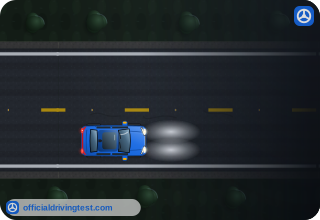
How far will your headlights let you see clearly at night, according to the manual?
- About 150 feet
- About 350 feet
- About 250 feet
- About 450 feet
Show answer
Correct answer: About 250 feet
The manual says headlights only let you see clearly about 250 feet ahead.
Source: Rules of the Road: State of Wyoming Driver License Manual (2021 (August 2021)), page 42 · Open this page in the manual (Manual page 42)
-
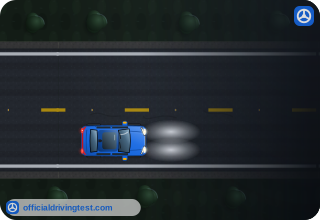
On a dark road, driving faster than what speed means you are “driving blind”?
- 35 mph
- 55 mph
- 40 mph
- 45 mph
Show answer
Correct answer: 55 mph
Above 55 mph you cannot stop within the 250 feet your headlights light well enough to see, so you are driving blind.
Source: Rules of the Road: State of Wyoming Driver License Manual (2021 (August 2021)), page 42 · Open this page in the manual (Manual page 42)
-
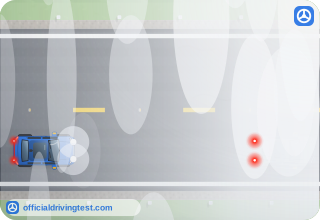
In a very heavy rain, snowstorm or thick fog, what is the farthest you may be able to see ahead?
- No more than 50 feet
- No more than 300 feet
- No more than 600 feet
- No more than 100 feet
Show answer
Correct answer: No more than 100 feet
The manual says in very heavy rain, snow or thick fog you may not be able to see more than 100 feet.
Source: Rules of the Road: State of Wyoming Driver License Manual (2021 (August 2021)), page 42 · Open this page in the manual (Manual page 42)
-
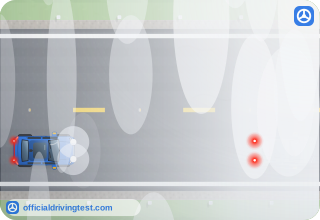
Whenever you cannot see well enough because of rain, fog or snow, what should you do?
- Slow to 20 mph and keep driving
- Pull off the road and wait until it clears
- Speed up to drive out of the weather
- Follow closely behind the vehicle ahead
Show answer
Correct answer: Pull off the road and wait until it clears
The manual says that when you cannot see well enough you cannot drive safely at any speed, so you should pull off and wait.
Source: Rules of the Road: State of Wyoming Driver License Manual (2021 (August 2021)), page 42 · Open this page in the manual (Manual page 42)
-
Where can ice remain even after the sun comes out?
- On wide, flat, open stretches of highway
- On roads with wide shoulders
- On bridges, overpasses and shaded areas
- In the center of dry intersections
Show answer
Correct answer: On bridges, overpasses and shaded areas
The manual warns that ice can stay on bridges, overpasses and shaded areas even after the sun is out.
Source: Rules of the Road: State of Wyoming Driver License Manual (2021 (August 2021)), page 44 · Open this page in the manual (Manual page 44)
-
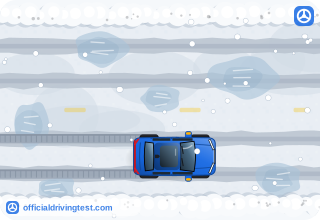
When traffic permits on a winter road, how does the manual suggest you check out the surface you are driving on?
- Turn the steering wheel sharply from side to side
- Touch the brakes to see if it slows or swerves
- Speed up briefly, then let off the gas
- Open the window and feel the air temperature
Show answer
Correct answer: Touch the brakes to see if it slows or swerves
Lightly touching the brakes shows whether the road is slick, because the vehicle will slow normally or start to swerve.
Source: Rules of the Road: State of Wyoming Driver License Manual (2021 (August 2021)), page 44 · Open this page in the manual (Manual page 44)
2Part 219 questions
-
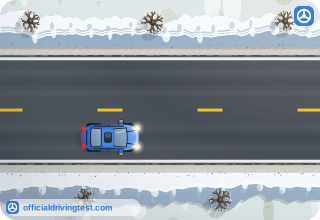
What does the manual say about black ice?
- It is easy to spot by its dark color
- It forms only on mountain passes
- It melts as soon as the sun comes out
- It is invisible and treacherous
Show answer
Correct answer: It is invisible and treacherous
Black ice cannot be seen, so you must always watch for sudden changes from merely wet to extremely icy.
Source: Rules of the Road: State of Wyoming Driver License Manual (2021 (August 2021)), page 44 · Open this page in the manual (Manual page 44)
-
Sudden changes in road surface, from merely wet to extremely icy, occur often at which of these places?
- In deep cuts and on high fills
- On long, flat, dry straightaways
- At the bottom of dry hills
- In the center of wide intersections
Show answer
Correct answer: In deep cuts and on high fills
The manual lists bridge decks, overpasses, high fills, deep cuts and places near snow fences as spots where such changes happen often.
Source: Rules of the Road: State of Wyoming Driver License Manual (2021 (August 2021)), page 45 · Open this page in the manual (Manual page 45)
-
What can thawing temperatures leave over melting ice?
- A thin film of water that makes it even more slick
- A rough layer that grips the tires
- A dry crust that is safe to drive on
- Nothing, because thawing removes all danger
Show answer
Correct answer: A thin film of water that makes it even more slick
Thawing leaves a thin film of water over melting ice, which makes the surface even more slick.
Source: Rules of the Road: State of Wyoming Driver License Manual (2021 (August 2021)), page 45 · Open this page in the manual (Manual page 45)
-
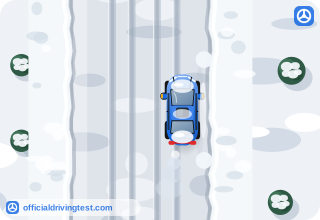
How should you start your car moving on snow and ice?
- With quick acceleration and the wheels turned slightly
- With the wheels turned toward the curb
- With slow, steady acceleration and wheels straight ahead
- With steady acceleration and the wheels turned to the left
Show answer
Correct answer: With slow, steady acceleration and wheels straight ahead
Starting on snow and ice takes slow, steady, careful acceleration with the front wheels straight ahead.
Source: Rules of the Road: State of Wyoming Driver License Manual (2021 (August 2021)), page 45 · Open this page in the manual (Manual page 45)
-
Which gear do many drivers rely on for safer starts on snow and ice?
- First gear, or low in an automatic
- Second gear, or “drive” in an automatic
- Reverse, then first gear
- Neutral, then drive
Show answer
Correct answer: Second gear, or “drive” in an automatic
Many drivers use second gear, or drive in an automatic, to start more safely on snow and ice.
Source: Rules of the Road: State of Wyoming Driver License Manual (2021 (August 2021)), page 45 · Open this page in the manual (Manual page 45)
-
Four-wheel-drive and front-wheel-drive vehicles generally have better traction on ice. What does the manual warn about them?
- They cannot skid on ice
- They need no increase in following distance
- They stop faster than other vehicles on ice
- They can skid if power changes suddenly
Show answer
Correct answer: They can skid if power changes suddenly
These vehicles can still skid with sudden changes in power to the drive wheels, such as when the accelerator is quickly released.
Source: Rules of the Road: State of Wyoming Driver License Manual (2021 (August 2021)), page 45 · Open this page in the manual (Manual page 45)
-
What does the manual say about four-wheel-drive vehicles with high centers of gravity on ice?
- They are less likely to skid than any other vehicle
- They are more likely to tip over in a skid
- They are less likely to tip over than other vehicles
- They need no extra care on icy roads
Show answer
Correct answer: They are more likely to tip over in a skid
A four-wheel-drive vehicle with a high center of gravity is more likely to tip over in a skid.
Source: Rules of the Road: State of Wyoming Driver License Manual (2021 (August 2021)), page 45 · Open this page in the manual (Manual page 45)
-
What typically results when drivers jam on conventional brakes?
- Shorter stopping distances
- Automatic pumping of the brakes
- Better traction on ice
- Locked wheels and skids
Show answer
Correct answer: Locked wheels and skids
Locked wheels and skids typically result when drivers jam on conventional brakes.
Source: Rules of the Road: State of Wyoming Driver License Manual (2021 (August 2021)), page 46 · Open this page in the manual (Manual page 46)
-
On a vehicle with conventional brakes, what is a good rule of thumb for pumping the brakes?
- Pump them once every second
- Pump them twice every second
- Pump them once every five seconds
- Hold them down without pumping
Show answer
Correct answer: Pump them once every second
Pumping conventional brakes once every second helps avoid locked wheels and skids.
Source: Rules of the Road: State of Wyoming Driver License Manual (2021 (August 2021)), page 46 · Open this page in the manual (Manual page 46)
-
What should you do about pumping the brakes on a vehicle with anti-lock brakes (ABS)?
- Pump them once every second
- Pump them twice as fast as conventional brakes
- Do not pump them, because that happens automatically
- Pump them only on dry roads
Show answer
Correct answer: Do not pump them, because that happens automatically
ABS brakes pump automatically, so the driver should not pump them.
Source: Rules of the Road: State of Wyoming Driver License Manual (2021 (August 2021)), page 46 · Open this page in the manual (Manual page 46)
-
How long does it take to look ahead to identify dangers, predict what could happen and decide what to do?
- Less than a quarter of a second
- At least one second
- About half a second
- Less than three-quarters of a second
Show answer
Correct answer: At least one second
Identifying, predicting and deciding takes at least one second, before you execute your decision.
Source: Rules of the Road: State of Wyoming Driver License Manual (2021 (August 2021)), page 49 · Open this page in the manual (Manual page 49)
-
About how long does it take to move your foot from the accelerator to the brake?
- About 1/4 second
- About 1 1/2 seconds
- About 2 seconds
- About 3/4 second
Show answer
Correct answer: About 3/4 second
The manual says moving your foot from the accelerator to the brake takes about 3/4 second.
Source: Rules of the Road: State of Wyoming Driver License Manual (2021 (August 2021)), page 49 · Open this page in the manual (Manual page 49)
-
Which of these does the distance needed to stop after the brake is applied depend on?
- Initial speed, brakes, tires, road and weather
- Only your initial speed and your vehicle's weight
- Only the road surface and your reaction time
- Only your tires and the weather
Show answer
Correct answer: Initial speed, brakes, tires, road and weather
The manual says stopping distance depends on initial speed, brakes, tires, road surface and weather conditions.
Source: Rules of the Road: State of Wyoming Driver License Manual (2021 (August 2021)), page 50 · Open this page in the manual (Manual page 50)
-
Compared with a passenger vehicle at the same speed, how long does a tractor-trailer rig take to stop?
- About the same time and distance
- Slightly less distance because of its brakes
- Considerably more time and distance
- Less time but more distance
Show answer
Correct answer: Considerably more time and distance
A tractor-trailer takes considerably more time and distance to stop than a passenger vehicle traveling at the same speed.
Source: Rules of the Road: State of Wyoming Driver License Manual (2021 (August 2021)), page 50 · Open this page in the manual (Manual page 50)
-
About how far can a passenger vehicle traveling 55 mph typically take to stop?
- About 60-70 feet
- About 30-40 feet
- About 300 feet
- About 130-140 feet
Show answer
Correct answer: About 130-140 feet
The manual says a passenger vehicle at 55 mph can typically stop in about 130-140 feet, about half the length of a football field.
Source: Rules of the Road: State of Wyoming Driver License Manual (2021 (August 2021)), page 50 · Open this page in the manual (Manual page 50)
-
How can being tired, having been drinking, or not paying attention affect stopping?
- You may not identify the danger at all
- Your brakes will take longer to work
- Your tires will lose grip on the road
- Your car will take longer to speed up
Show answer
Correct answer: You may not identify the danger at all
A tired, impaired or inattentive driver may not identify danger at all, and reaction time may also be slower.
Source: Rules of the Road: State of Wyoming Driver License Manual (2021 (August 2021)), page 50 · Open this page in the manual (Manual page 50)
-
In IPDE, what do defensive drivers call any person, vehicle, animal or thing that could cause them to slow down, speed up or turn?
- Warning cues
- Hazard zones
- Critical objects
- Space cushions
Show answer
Correct answer: Critical objects
In the Identify step, defensive drivers identify anything that could make them slow, speed up or turn as a critical object.
Source: Rules of the Road: State of Wyoming Driver License Manual (2021 (August 2021)), page 73 · Open this page in the manual (Manual page 73)
-
In the Predict step of IPDE, what do defensive drivers predict about a critical object?
- That it will stop moving
- The worst that could happen
- The most likely harmless result
- That other drivers will yield to it
Show answer
Correct answer: The worst that could happen
When a critical object is identified, defensive drivers predict the worst possible outcome.
Source: Rules of the Road: State of Wyoming Driver License Manual (2021 (August 2021)), page 73 · Open this page in the manual (Manual page 73)
-
In the Decide step of IPDE, what are decisions based on?
- Who has the right of way in the situation
- What the other drivers around you are doing at the time
- What the posted speed limit allows
- What can be done to prevent a crash, not who is right or wrong
Show answer
Correct answer: What can be done to prevent a crash, not who is right or wrong
Decisions are based on preventing a crash and never on who is right or wrong.
Source: Rules of the Road: State of Wyoming Driver License Manual (2021 (August 2021)), page 73 · Open this page in the manual (Manual page 73)
3Part 319 questions
-
In the Execute step of IPDE, how should you carry out your decision?
- In a smooth, predictable manner and in time to avoid a crash
- As quickly and forcefully as you can
- Only after another driver acts first
- With a sudden reaction once the danger is very close
Show answer
Correct answer: In a smooth, predictable manner and in time to avoid a crash
The final step is to carry out the decision smoothly and predictably, early enough to avoid a crash.
Source: Rules of the Road: State of Wyoming Driver License Manual (2021 (August 2021)), page 73 · Open this page in the manual (Manual page 73)
-
Which of these does driving defensively with IPDE require?
- Matching the speed of the traffic around you
- Staying in the left lane
- Isolating your vehicle in traffic
- Following the vehicle ahead closely
Show answer
Correct answer: Isolating your vehicle in traffic
The manual says IPDE requires scanning, communicating, isolating your vehicle, and separating risks and compromising space.
Source: Rules of the Road: State of Wyoming Driver License Manual (2021 (August 2021)), page 74 · Open this page in the manual (Manual page 74)
-
How far ahead do defensive drivers scan?
- At least 2 to 4 seconds
- At least 10 to 15 seconds
- At least 5 to 6 seconds
- At least 20 to 25 seconds
Show answer
Correct answer: At least 10 to 15 seconds
The manual says defensive drivers scan at least 10 to 15 seconds ahead.
Source: Rules of the Road: State of Wyoming Driver License Manual (2021 (August 2021)), page 74 · Open this page in the manual (Manual page 74)
-
If you are watching far enough ahead, how high will you count before you pass a fixed object beside the road?
- Only to one thousand and three
- Only to one thousand and five
- Only to one thousand and seven
- Past one thousand and ten
Show answer
Correct answer: Past one thousand and ten
Counting past one thousand and ten before reaching the object shows you are looking far enough ahead.
Source: Rules of the Road: State of Wyoming Driver License Manual (2021 (August 2021)), page 74 · Open this page in the manual (Manual page 74)
-
What may be true of drivers who have to react to unexpected traffic situations?
- They may not be checking far enough ahead to identify critical objects
- They are always driving faster than the posted speed limit allows
- They are always following too closely
- They are scanning too far to the sides
Show answer
Correct answer: They may not be checking far enough ahead to identify critical objects
Reacting to surprises can mean a driver is not looking far enough ahead to spot critical objects.
Source: Rules of the Road: State of Wyoming Driver License Manual (2021 (August 2021)), page 74 · Open this page in the manual (Manual page 74)
-
What is a space cushion?
- A padded area built into the front of a vehicle to absorb impacts
- The width of the shoulder beside the road that you can use to pull off
- The gap between your vehicle and the center line of the road
- Space ahead, behind and to the sides that isolates your vehicle from others
Show answer
Correct answer: Space ahead, behind and to the sides that isolates your vehicle from others
A space cushion is the space ahead, behind and to the sides that gives you distance to avoid other drivers' mistakes.
Source: Rules of the Road: State of Wyoming Driver License Manual (2021 (August 2021)), page 75 · Open this page in the manual (Manual page 75)
-
What type of crash is very common when drivers follow too closely?
- Rear-end collisions
- Head-on collisions
- Sideswipe collisions
- Rollover crashes
Show answer
Correct answer: Rear-end collisions
Rear-end collisions caused by following too close are a very common type of crash.
Source: Rules of the Road: State of Wyoming Driver License Manual (2021 (August 2021)), page 75 · Open this page in the manual (Manual page 75)
-
When using the two-second following distance rule, when do you start counting?
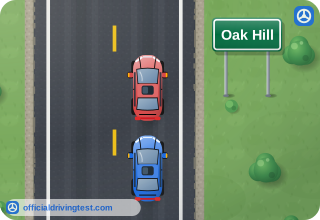
- When the front bumper of the vehicle ahead passes a fixed point
- When the vehicle ahead turns on its brake lights
- When the rear bumper of the vehicle ahead passes a fixed point
- When your front bumper reaches the fixed point
Show answer
Correct answer: When the rear bumper of the vehicle ahead passes a fixed point
You pick a fixed point, and start counting when the rear bumper of the vehicle ahead passes it.
Source: Rules of the Road: State of Wyoming Driver License Manual (2021 (August 2021)), page 75 · Open this page in the manual (Manual page 75)
-
The front of your vehicle passes the fixed point before you count off two seconds. What does this mean?
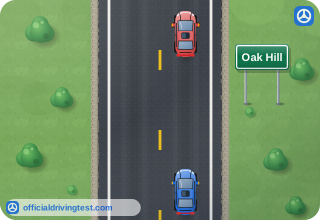
- You have a large enough space cushion
- You are too close to the vehicle ahead
- You are following at the right distance
- You should speed up to pass
Show answer
Correct answer: You are too close to the vehicle ahead
Reaching the fixed point in under two seconds means you are following too closely.
Source: Rules of the Road: State of Wyoming Driver License Manual (2021 (August 2021)), page 75 · Open this page in the manual (Manual page 75)
-
The two-second following distance rule works at which speeds?
- Only below 35 mph
- Only on the Interstate
- Only in good weather
- All speeds
Show answer
Correct answer: All speeds
The manual says the rule is simple and works at all speeds.
Source: Rules of the Road: State of Wyoming Driver License Manual (2021 (August 2021)), page 75 · Open this page in the manual (Manual page 75)
-
If you are driving a car, how far back from the vehicle ahead should you stay at least?
- Two seconds
- Three seconds
- Five seconds
- Six seconds
Show answer
Correct answer: Two seconds
Cars should stay at least two seconds behind the vehicle ahead.
Source: Rules of the Road: State of Wyoming Driver License Manual (2021 (August 2021)), page 75 · Open this page in the manual (Manual page 75)
-
How many seconds back should bus drivers stay at least?
- Two seconds
- Three seconds
- Four seconds
- Five seconds
Show answer
Correct answer: Four seconds
Bus drivers should stay at least four seconds back.
Source: Rules of the Road: State of Wyoming Driver License Manual (2021 (August 2021)), page 75 · Open this page in the manual (Manual page 75)
-
How many seconds back should tractor-trailer drivers stay at least?
- Two seconds
- Six seconds
- Three seconds
- Four seconds
Show answer
Correct answer: Six seconds
Tractor-trailer drivers should stay at least six seconds back.
Source: Rules of the Road: State of Wyoming Driver License Manual (2021 (August 2021)), page 75 · Open this page in the manual (Manual page 75)
-
How does towing a boat or trailer affect the following distance you need?
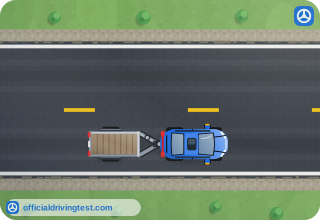
- It lets you use a shorter following distance
- It has no effect on the following distance
- It means you can follow at the same distance at low speeds
- It adds length and weight, so you need more following distance
Show answer
Correct answer: It adds length and weight, so you need more following distance
Towing adds length and weight to your vehicle, so it requires more following distance.
Source: Rules of the Road: State of Wyoming Driver License Manual (2021 (August 2021)), page 75 · Open this page in the manual (Manual page 75)
-
When the roads are wet, what does the manual say it makes sense to do about following distance?
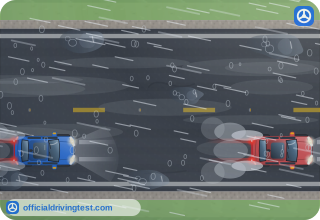
- Double the number of seconds
- Keep the same number of seconds
- Cut the number of seconds in half
- Add one second to the usual number
Show answer
Correct answer: Double the number of seconds
On wet roads, the manual says to double the number of seconds of following distance.
Source: Rules of the Road: State of Wyoming Driver License Manual (2021 (August 2021)), page 75 · Open this page in the manual (Manual page 75)
-
How does a tailgater affect you?
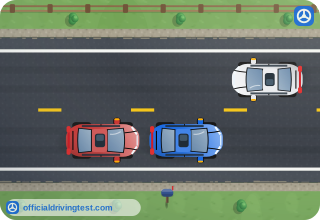
- The tailgater makes it easier for you to change lanes quickly
- The tailgater limits your ability to slow rapidly in an emergency ahead
- The tailgater lets you brake as hard as you want with less risk
- The tailgater gives you more space ahead
Show answer
Correct answer: The tailgater limits your ability to slow rapidly in an emergency ahead
A driver who tailgates limits your ability to slow rapidly if an emergency happens ahead.
Source: Rules of the Road: State of Wyoming Driver License Manual (2021 (August 2021)), page 76 · Open this page in the manual (Manual page 76)
-
Which action can you take when a driver is tailgating you?
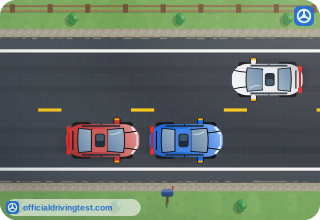
- Brake suddenly to warn the tailgater
- Increase your speed to stay ahead of the tailgater
- Move to the left lane of a multilane highway
- Reduce your speed to encourage the driver behind to pass
Show answer
Correct answer: Reduce your speed to encourage the driver behind to pass
The manual lists reducing your speed to encourage the tailgater to pass, along with other steps such as giving yourself more room ahead.
Source: Rules of the Road: State of Wyoming Driver License Manual (2021 (August 2021)), page 76 · Open this page in the manual (Manual page 76)
-
What does it mean to be "boxed in"?
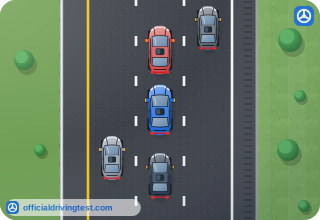
- Vehicles, bicycles, pedestrians or objects are in the space on both sides of you
- Another vehicle is following you too closely and you cannot change lanes
- You are driving in a lane that is too narrow
- You are stopped behind a vehicle at an intersection
Show answer
Correct answer: Vehicles, bicycles, pedestrians or objects are in the space on both sides of you
Being boxed in means the space on both sides is occupied, so you can only speed up or slow down to respond to a situation ahead.
Source: Rules of the Road: State of Wyoming Driver License Manual (2021 (August 2021)), page 76 · Open this page in the manual (Manual page 76)
-
Which action helps you keep a space cushion to your sides?
- Driving alongside other vehicles on multilane streets
- Staying close to parked vehicles
- Avoiding driving next to a bicyclist for prolonged periods
- Keeping as little space as possible from oncoming traffic
Show answer
Correct answer: Avoiding driving next to a bicyclist for prolonged periods
The manual lists avoiding driving next to a bicyclist for long periods, among other ways to keep space to your sides.
Source: Rules of the Road: State of Wyoming Driver License Manual (2021 (August 2021)), page 76 · Open this page in the manual (Manual page 76)
4Part 419 questions
-
What does it mean to "separate risks"?
- Deal with all risks at once
- Take risks one at a time whenever possible
- Keep the biggest risk behind you
- Speed up to get away from all risks
Show answer
Correct answer: Take risks one at a time whenever possible
Separating risks means handling risks one at a time when you can.
Source: Rules of the Road: State of Wyoming Driver License Manual (2021 (August 2021)), page 76 · Open this page in the manual (Manual page 76)
-
Joggers on the edge of the road and an oncoming truck will reach you at about the same time. How can you separate the risks?
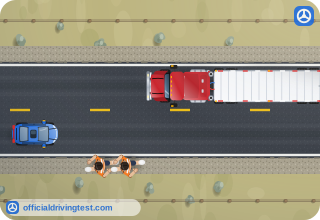
- Keep your speed and pass both at the same time with plenty of room
- Move toward the joggers to stay away from the truck
- Stop and let the truck and the joggers pass
- Speed up or slow down to pass the joggers before or after the truck
Show answer
Correct answer: Speed up or slow down to pass the joggers before or after the truck
By speeding up or slowing down, you can pass the joggers and the truck one at a time.
Source: Rules of the Road: State of Wyoming Driver License Manual (2021 (August 2021)), page 77 · Open this page in the manual (Manual page 77)
-
What should you do to compromise space when you cannot separate risks?
- Give the most room to the worst danger
- Give equal room to every danger
- Give the most room to the nearest danger
- Slow to a stop in your lane
Show answer
Correct answer: Give the most room to the worst danger
When two or more risks must be handled at once, the manual says to give the most room to the worst danger.
Source: Rules of the Road: State of Wyoming Driver License Manual (2021 (August 2021)), page 77 · Open this page in the manual (Manual page 77)
-
You are on a two-lane street with oncoming cars to your left and a child riding a bike to your right, and you cannot separate the risks. What should you do?
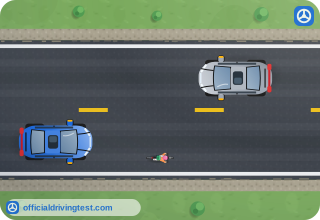
- Move toward the right edge to stay away from the oncoming cars
- Stay in the middle of your lane and keep your speed
- Move closer to the center line to give the child a larger space cushion
- Speed up to pass the child before the oncoming cars arrive
Show answer
Correct answer: Move closer to the center line to give the child a larger space cushion
The child is more likely to move suddenly, so the child is the greater danger and needs more room to the right.
Source: Rules of the Road: State of Wyoming Driver License Manual (2021 (August 2021)), page 77 · Open this page in the manual (Manual page 77)
-
At night, if you drive faster than what speed can you not stop in the distance that you can see ahead?
- 35 mph
- 55 mph
- 45 mph
- 65 mph
Show answer
Correct answer: 55 mph
Headlights show a limited distance, so above 55 mph you cannot stop within the distance you can see.
Source: Rules of the Road: State of Wyoming Driver License Manual (2021 (August 2021)), page 77 · Open this page in the manual (Manual page 77)
-
In fog, the chance of a crash is extremely high whenever the difference between your speed and the speed of other traffic is more than how many mph?
- 5 mph
- 15 mph
- 20 mph
- 25 mph
Show answer
Correct answer: 15 mph
A speed difference of more than 15 mph from other traffic makes a crash extremely likely in fog.
Source: Rules of the Road: State of Wyoming Driver License Manual (2021 (August 2021)), page 78 · Open this page in the manual (Manual page 78)
-
In fog, when you cannot see at least how far ahead should you consider pulling off at the nearest safe spot and stopping?
- 10 seconds ahead
- 2 seconds ahead
- 4 seconds ahead
- 6 seconds ahead
Show answer
Correct answer: 10 seconds ahead
If you cannot see at least 10 seconds ahead in fog, consider pulling off at the nearest safe spot and stopping.
Source: Rules of the Road: State of Wyoming Driver License Manual (2021 (August 2021)), page 78 · Open this page in the manual (Manual page 78)
-
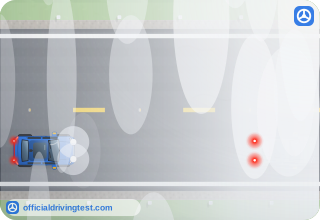
In fog, what size space cushion should you create when scanning ahead for taillights, headlights, pedestrians and stopped vehicles?
- The same cushion as in clear weather
- A cushion of exactly two seconds
- As big a space cushion as possible
- No cushion, so you can keep up
Show answer
Correct answer: As big a space cushion as possible
Fog hides hazards, so the manual says to create as big a space cushion as possible.
Source: Rules of the Road: State of Wyoming Driver License Manual (2021 (August 2021)), page 79 · Open this page in the manual (Manual page 79)
-
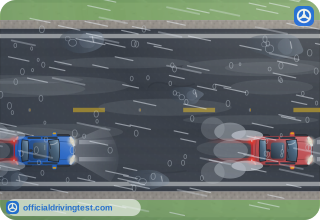
In rain, how much time should you leave between you and the vehicle ahead (cars)?
- One second
- Two seconds
- Ten seconds
- Four seconds
Show answer
Correct answer: Four seconds
In rain you double the following time, which is four seconds for cars.
Source: Rules of the Road: State of Wyoming Driver License Manual (2021 (August 2021)), page 79 · Open this page in the manual (Manual page 79)
-
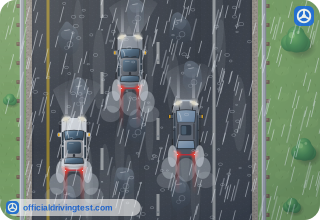
Why is the roadway especially slippery during the first half hour after rain begins?
- Dust and oil mix with the water
- The water freezes on the pavement
- Painted lines wash away
- Tires are cold and stiff
Show answer
Correct answer: Dust and oil mix with the water
Dust and oil mix with the water in the first half hour of rain and make the road slippery.
Source: Rules of the Road: State of Wyoming Driver License Manual (2021 (August 2021)), page 79 · Open this page in the manual (Manual page 79)
-
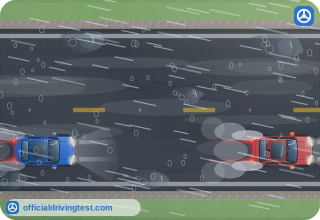
What is hydroplaning, which may occur during rainstorms?
- Tires locking up and sliding on an icy road
- Wipers failing to clear water from the glass
- Brakes fading because they got too wet
- Tires riding on a thin film of water, not the road
Show answer
Correct answer: Tires riding on a thin film of water, not the road
Hydroplaning means the tires ride on a thin film of water instead of the road surface.
Source: Rules of the Road: State of Wyoming Driver License Manual (2021 (August 2021)), page 79 · Open this page in the manual (Manual page 79)
-
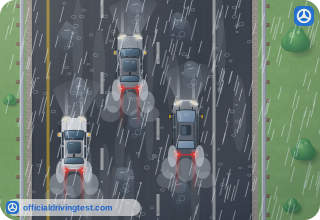
How can you prevent hydroplaning during a rainstorm?
- Turn on your high beams
- Slow down
- Brake hard and steadily
- Use cruise control
Show answer
Correct answer: Slow down
The manual's way to prevent hydroplaning is to slow down.
Source: Rules of the Road: State of Wyoming Driver License Manual (2021 (August 2021)), page 79 · Open this page in the manual (Manual page 79)
-
What does the manual say to equip your car with on snow or ice to prevent skidding and reduce stopping distance?
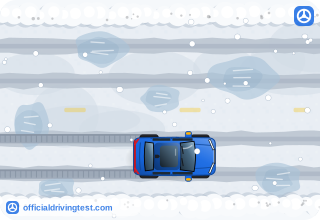
- Snow tires or chains
- Extra weight in the trunk
- Wider rear tires
- Higher tire pressure
Show answer
Correct answer: Snow tires or chains
Snow tires or chains help prevent skidding and shorten stopping distance on snow or ice.
Source: Rules of the Road: State of Wyoming Driver License Manual (2021 (August 2021)), page 79 · Open this page in the manual (Manual page 79)
-
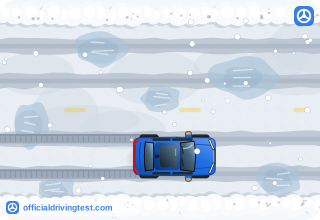
When driving on snow or ice, what should you NOT do suddenly?
- Turn on the windshield wipers
- Use your turn signal
- Change speed or direction
- Check your mirrors
Show answer
Correct answer: Change speed or direction
Sudden changes of speed or direction can cause a skid on snow or ice.
Source: Rules of the Road: State of Wyoming Driver License Manual (2021 (August 2021)), page 79 · Open this page in the manual (Manual page 79)
-
Why should you never lock your brakes on snow or ice?
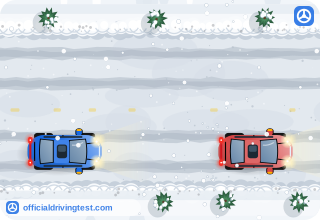
- You have no steering control unless the wheels turn
- Locked brakes overheat the tires and brake fluid
- Locked brakes drain the battery
- Locked brakes turn off the headlights
Show answer
Correct answer: You have no steering control unless the wheels turn
If the wheels are locked and not turning, you cannot steer.
Source: Rules of the Road: State of Wyoming Driver License Manual (2021 (August 2021)), page 79 · Open this page in the manual (Manual page 79)
-
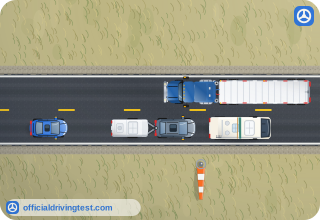
What is the best defense against wind, which is especially hazardous for trucks, recreational vehicles, campers and drivers towing trailers?
- Driving at the speed limit
- Driving at slower speeds
- Driving in the left lane
- Following another truck closely
Show answer
Correct answer: Driving at slower speeds
Slower speeds are the best defense against wind.
Source: Rules of the Road: State of Wyoming Driver License Manual (2021 (August 2021)), page 79 · Open this page in the manual (Manual page 79)
-
In windy conditions, what should you watch for after driving in a protected area?
- Open spaces, where the wind may change
- Wet pavement under bridges and overpasses
- Animals near the roadside
- Sudden stops by other drivers
Show answer
Correct answer: Open spaces, where the wind may change
After a protected area you may hit open spaces where the wind changes, so be ready to make steering corrections.
Source: Rules of the Road: State of Wyoming Driver License Manual (2021 (August 2021)), page 80 · Open this page in the manual (Manual page 80)
-
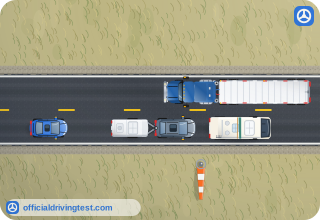
When meeting large trucks and buses in wind, what should you be prepared to do?
- Speed up to pass them as quickly as you can
- Move onto the shoulder
- Make steering corrections for wind changes
- Sound your horn
Show answer
Correct answer: Make steering corrections for wind changes
Large trucks and buses can cause sudden wind changes, so be ready to correct your steering.
Source: Rules of the Road: State of Wyoming Driver License Manual (2021 (August 2021)), page 80 · Open this page in the manual (Manual page 80)
-
What does total stopping distance include?
- Only the distance traveled after the brakes have been applied to the wheels
- The distance traveled while deciding to stop, reacting, and then braking
- Only the distance traveled while the driver is reacting to the danger
- The distance from the stop line to the crosswalk at the intersection
Show answer
Correct answer: The distance traveled while deciding to stop, reacting, and then braking
Total stopping distance is the complete distance traveled while deciding to stop, reacting, and after the brakes are applied.
Source: Rules of the Road: State of Wyoming Driver License Manual (2021 (August 2021)), page 94 · Open this page in the manual (Manual page 94)