Wyoming: Speed and space — Part 2 Practice Test
Questions in this part include: “Sudden changes in road surface, from merely wet to extremely icy, occur often at which of these places?” · “How long does it take to look ahead to identify dangers, predict what could happen and decide what to do?”
Independent educational site · not affiliated with any government agency or DMV
Ready? Test yourself
Answer to start, or tap Start below:
Sudden changes in road surface, from merely wet to extremely icy, occur often at which of these places?
- Instant feedback with an explanation
- Every answer cites its source in the manual
- Your best score is saved on this device
- Keyboard: press 1 to 4 to answer and Enter for the next question
Questions are original and based on the official manual "Rules of the Road: State of Wyoming Driver License Manual" (2021 (August 2021)), Wyoming Department of Transportation (WYDOT), Driver Services.
All 19 questions in this practice test
Take the test above first, then use this list to study. Tap “Show answer” to see the correct answer and explanation.
Show the questions and answersHide the questions
-
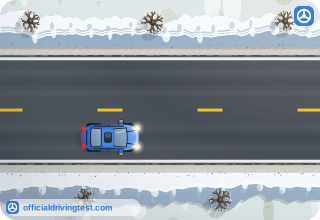
What does the manual say about black ice?
- It is easy to spot by its dark color
- It forms only on mountain passes
- It melts as soon as the sun comes out
- It is invisible and treacherous
Show answer
Correct answer: It is invisible and treacherous
Black ice cannot be seen, so you must always watch for sudden changes from merely wet to extremely icy.
Source: Rules of the Road: State of Wyoming Driver License Manual (2021 (August 2021)), page 44 · Open this page in the manual (Manual page 44)
-
Sudden changes in road surface, from merely wet to extremely icy, occur often at which of these places?
- In deep cuts and on high fills
- On long, flat, dry straightaways
- At the bottom of dry hills
- In the center of wide intersections
Show answer
Correct answer: In deep cuts and on high fills
The manual lists bridge decks, overpasses, high fills, deep cuts and places near snow fences as spots where such changes happen often.
Source: Rules of the Road: State of Wyoming Driver License Manual (2021 (August 2021)), page 45 · Open this page in the manual (Manual page 45)
-
What can thawing temperatures leave over melting ice?
- A thin film of water that makes it even more slick
- A rough layer that grips the tires
- A dry crust that is safe to drive on
- Nothing, because thawing removes all danger
Show answer
Correct answer: A thin film of water that makes it even more slick
Thawing leaves a thin film of water over melting ice, which makes the surface even more slick.
Source: Rules of the Road: State of Wyoming Driver License Manual (2021 (August 2021)), page 45 · Open this page in the manual (Manual page 45)
-
How should you start your car moving on snow and ice?

- With quick acceleration and the wheels turned slightly
- With the wheels turned toward the curb
- With slow, steady acceleration and wheels straight ahead
- With steady acceleration and the wheels turned to the left
Show answer
Correct answer: With slow, steady acceleration and wheels straight ahead
Starting on snow and ice takes slow, steady, careful acceleration with the front wheels straight ahead.
Source: Rules of the Road: State of Wyoming Driver License Manual (2021 (August 2021)), page 45 · Open this page in the manual (Manual page 45)
-
Which gear do many drivers rely on for safer starts on snow and ice?
- First gear, or low in an automatic
- Second gear, or “drive” in an automatic
- Reverse, then first gear
- Neutral, then drive
Show answer
Correct answer: Second gear, or “drive” in an automatic
Many drivers use second gear, or drive in an automatic, to start more safely on snow and ice.
Source: Rules of the Road: State of Wyoming Driver License Manual (2021 (August 2021)), page 45 · Open this page in the manual (Manual page 45)
-
Four-wheel-drive and front-wheel-drive vehicles generally have better traction on ice. What does the manual warn about them?
- They cannot skid on ice
- They need no increase in following distance
- They stop faster than other vehicles on ice
- They can skid if power changes suddenly
Show answer
Correct answer: They can skid if power changes suddenly
These vehicles can still skid with sudden changes in power to the drive wheels, such as when the accelerator is quickly released.
Source: Rules of the Road: State of Wyoming Driver License Manual (2021 (August 2021)), page 45 · Open this page in the manual (Manual page 45)
-
What does the manual say about four-wheel-drive vehicles with high centers of gravity on ice?
- They are less likely to skid than any other vehicle
- They are more likely to tip over in a skid
- They are less likely to tip over than other vehicles
- They need no extra care on icy roads
Show answer
Correct answer: They are more likely to tip over in a skid
A four-wheel-drive vehicle with a high center of gravity is more likely to tip over in a skid.
Source: Rules of the Road: State of Wyoming Driver License Manual (2021 (August 2021)), page 45 · Open this page in the manual (Manual page 45)
-
What typically results when drivers jam on conventional brakes?
- Shorter stopping distances
- Automatic pumping of the brakes
- Better traction on ice
- Locked wheels and skids
Show answer
Correct answer: Locked wheels and skids
Locked wheels and skids typically result when drivers jam on conventional brakes.
Source: Rules of the Road: State of Wyoming Driver License Manual (2021 (August 2021)), page 46 · Open this page in the manual (Manual page 46)
-
On a vehicle with conventional brakes, what is a good rule of thumb for pumping the brakes?
- Pump them once every second
- Pump them twice every second
- Pump them once every five seconds
- Hold them down without pumping
Show answer
Correct answer: Pump them once every second
Pumping conventional brakes once every second helps avoid locked wheels and skids.
Source: Rules of the Road: State of Wyoming Driver License Manual (2021 (August 2021)), page 46 · Open this page in the manual (Manual page 46)
-
What should you do about pumping the brakes on a vehicle with anti-lock brakes (ABS)?
- Pump them once every second
- Pump them twice as fast as conventional brakes
- Do not pump them, because that happens automatically
- Pump them only on dry roads
Show answer
Correct answer: Do not pump them, because that happens automatically
ABS brakes pump automatically, so the driver should not pump them.
Source: Rules of the Road: State of Wyoming Driver License Manual (2021 (August 2021)), page 46 · Open this page in the manual (Manual page 46)
-
How long does it take to look ahead to identify dangers, predict what could happen and decide what to do?
- Less than a quarter of a second
- At least one second
- About half a second
- Less than three-quarters of a second
Show answer
Correct answer: At least one second
Identifying, predicting and deciding takes at least one second, before you execute your decision.
Source: Rules of the Road: State of Wyoming Driver License Manual (2021 (August 2021)), page 49 · Open this page in the manual (Manual page 49)
-
About how long does it take to move your foot from the accelerator to the brake?
- About 1/4 second
- About 1 1/2 seconds
- About 2 seconds
- About 3/4 second
Show answer
Correct answer: About 3/4 second
The manual says moving your foot from the accelerator to the brake takes about 3/4 second.
Source: Rules of the Road: State of Wyoming Driver License Manual (2021 (August 2021)), page 49 · Open this page in the manual (Manual page 49)
-
Which of these does the distance needed to stop after the brake is applied depend on?
- Initial speed, brakes, tires, road and weather
- Only your initial speed and your vehicle's weight
- Only the road surface and your reaction time
- Only your tires and the weather
Show answer
Correct answer: Initial speed, brakes, tires, road and weather
The manual says stopping distance depends on initial speed, brakes, tires, road surface and weather conditions.
Source: Rules of the Road: State of Wyoming Driver License Manual (2021 (August 2021)), page 50 · Open this page in the manual (Manual page 50)
-
Compared with a passenger vehicle at the same speed, how long does a tractor-trailer rig take to stop?
- About the same time and distance
- Slightly less distance because of its brakes
- Considerably more time and distance
- Less time but more distance
Show answer
Correct answer: Considerably more time and distance
A tractor-trailer takes considerably more time and distance to stop than a passenger vehicle traveling at the same speed.
Source: Rules of the Road: State of Wyoming Driver License Manual (2021 (August 2021)), page 50 · Open this page in the manual (Manual page 50)
-
About how far can a passenger vehicle traveling 55 mph typically take to stop?
- About 60-70 feet
- About 30-40 feet
- About 300 feet
- About 130-140 feet
Show answer
Correct answer: About 130-140 feet
The manual says a passenger vehicle at 55 mph can typically stop in about 130-140 feet, about half the length of a football field.
Source: Rules of the Road: State of Wyoming Driver License Manual (2021 (August 2021)), page 50 · Open this page in the manual (Manual page 50)
-
How can being tired, having been drinking, or not paying attention affect stopping?
- You may not identify the danger at all
- Your brakes will take longer to work
- Your tires will lose grip on the road
- Your car will take longer to speed up
Show answer
Correct answer: You may not identify the danger at all
A tired, impaired or inattentive driver may not identify danger at all, and reaction time may also be slower.
Source: Rules of the Road: State of Wyoming Driver License Manual (2021 (August 2021)), page 50 · Open this page in the manual (Manual page 50)
-
In IPDE, what do defensive drivers call any person, vehicle, animal or thing that could cause them to slow down, speed up or turn?
- Warning cues
- Hazard zones
- Critical objects
- Space cushions
Show answer
Correct answer: Critical objects
In the Identify step, defensive drivers identify anything that could make them slow, speed up or turn as a critical object.
Source: Rules of the Road: State of Wyoming Driver License Manual (2021 (August 2021)), page 73 · Open this page in the manual (Manual page 73)
-
In the Predict step of IPDE, what do defensive drivers predict about a critical object?
- That it will stop moving
- The worst that could happen
- The most likely harmless result
- That other drivers will yield to it
Show answer
Correct answer: The worst that could happen
When a critical object is identified, defensive drivers predict the worst possible outcome.
Source: Rules of the Road: State of Wyoming Driver License Manual (2021 (August 2021)), page 73 · Open this page in the manual (Manual page 73)
-
In the Decide step of IPDE, what are decisions based on?
- Who has the right of way in the situation
- What the other drivers around you are doing at the time
- What the posted speed limit allows
- What can be done to prevent a crash, not who is right or wrong
Show answer
Correct answer: What can be done to prevent a crash, not who is right or wrong
Decisions are based on preventing a crash and never on who is right or wrong.
Source: Rules of the Road: State of Wyoming Driver License Manual (2021 (August 2021)), page 73 · Open this page in the manual (Manual page 73)