West Virginia: Interstate driving — Part 2 Practice Test
Questions in this part include: “On an entrance ramp, what are advisory speed limit signs used for?” · “What is an exit gore on an interstate?”
Independent educational site · not affiliated with any government agency or DMV
Ready? Test yourself
Answer to start, or tap Start below:
On an entrance ramp, what are advisory speed limit signs used for?
- Instant feedback with an explanation
- Every answer cites its source in the manual
- Your best score is saved on this device
- Keyboard: press 1 to 4 to answer and Enter for the next question
Questions are original and based on the official manual "West Virginia Driver's Licensing Handbook" (Revised July 2026), West Virginia Division of Motor Vehicles (DMV).
All 17 questions in this practice test
Take the test above first, then use this list to study. Tap “Show answer” to see the correct answer and explanation.
Show the questions and answersHide the questions
-
On an entrance ramp, what are advisory speed limit signs used for?
- They are used if the ramp curves sharply
- They show the minimum speed on the interstate
- They mark where the acceleration lane ends
- They warn that the exit ramp is closed
Show answer
Correct answer: They are used if the ramp curves sharply
Advisory speed limit signs on a ramp are used when the ramp curves sharply.
Source: West Virginia Driver's Licensing Handbook (Revised July 2026), page 58 · Open this page in the manual (Manual page 58)
-
When entering an interstate, at what point on the entrance ramp should you start checking traffic, using your turn signal, and looking for a gap?
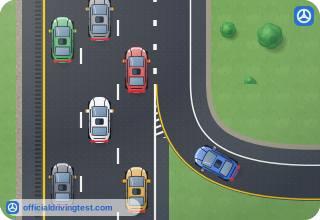
- At the very start of the ramp
- Only at the end of the acceleration lane
- After you have already entered the through lane
- About halfway on the entrance ramp
Show answer
Correct answer: About halfway on the entrance ramp
The handbook says to begin these steps about halfway along the entrance ramp.
Source: West Virginia Driver's Licensing Handbook (Revised July 2026), page 58 · Open this page in the manual (Manual page 58)
-
As you merge onto an interstate, what speed should you be traveling?
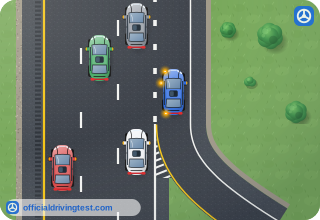
- The speed of the slowest vehicle on the ramp
- The same speed as other traffic
- A speed lower than other traffic to be safe
- Whatever speed the ramp sign suggests
Show answer
Correct answer: The same speed as other traffic
To merge safely you should match the speed of the other traffic.
Source: West Virginia Driver's Licensing Handbook (Revised July 2026), page 58 · Open this page in the manual (Manual page 58)
-
What should you do instead of cutting sharply to the left to enter the interstate traffic stream?
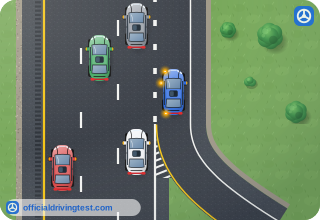
- Move left at once into the fastest lane available
- Follow the lane, merge with traffic, and then change lanes
- Stop at the end of the ramp and wait for a clear gap
- Merge onto the shoulder first and then cut across traffic
Show answer
Correct answer: Follow the lane, merge with traffic, and then change lanes
Do not cut sharply left; follow the lane, merge with traffic, and only then change lanes.
Source: West Virginia Driver's Licensing Handbook (Revised July 2026), page 58 · Open this page in the manual (Manual page 58)
-
What should you be prepared to do if another vehicle ahead of you in the acceleration lane slows or stops without warning?
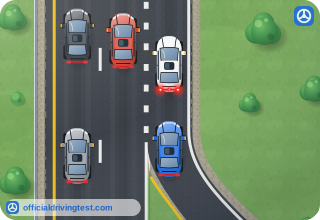
- Pass it on the shoulder
- Honk and keep your speed
- Stop right behind it and wait
- Adjust your driving
Show answer
Correct answer: Adjust your driving
Be ready to adjust your driving, and do not stop on the ramp or the acceleration lane.
Source: West Virginia Driver's Licensing Handbook (Revised July 2026), page 58 · Open this page in the manual (Manual page 58)
-
If no gap in traffic is available when you enter an interstate, what may be necessary as a last resort?
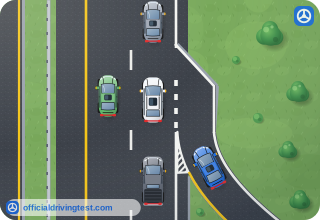
- Drive onto the shoulder past the acceleration lane and stop
- Cut sharply to the left into the nearest traffic lane
- Stop on the ramp itself until a gap finally appears
- Back up the entrance ramp and start the merge over
Show answer
Correct answer: Drive onto the shoulder past the acceleration lane and stop
Because entering the traffic stream from a stop is hazardous, stopping on the shoulder beyond the acceleration lane is only a last resort.
Source: West Virginia Driver's Licensing Handbook (Revised July 2026), page 58 · Open this page in the manual (Manual page 58)
-
When you enter an interstate from an entrance ramp, who has the right-of-way?
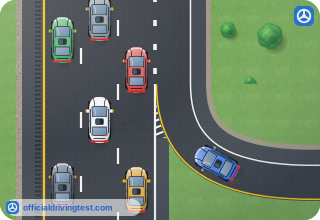
- Vehicles entering from the ramp
- Trucks and buses entering the interstate
- Traffic already on the interstate
- Whichever driver is going faster
Show answer
Correct answer: Traffic already on the interstate
Traffic on the interstate has the right-of-way, and you cannot count on other drivers moving over for you.
Source: West Virginia Driver's Licensing Handbook (Revised July 2026), page 58 · Open this page in the manual (Manual page 58)
-
When should you signal and move into the lane you need to exit an interstate?
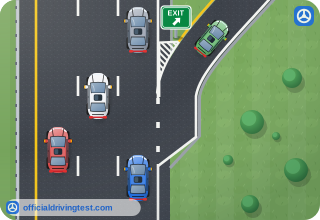
- Well before you have to exit
- Just as the exit ramp begins
- Only after you pass the exit sign
- At the last moment, so others cannot cut in
Show answer
Correct answer: Well before you have to exit
Changing lanes at the last moment risks missing your exit or causing a crash.
Source: West Virginia Driver's Licensing Handbook (Revised July 2026), page 59 · Open this page in the manual (Manual page 59)
-
Where should you begin to slow down when leaving an interstate?
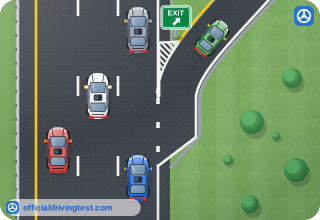
- In the through lane as soon as you see the exit sign
- On the shoulder before the exit
- In the deceleration lane
- In the exit gore
Show answer
Correct answer: In the deceleration lane
You should never slow down on the interstate itself; wait until you are in the deceleration lane.
Source: West Virginia Driver's Licensing Handbook (Revised July 2026), page 59 · Open this page in the manual (Manual page 59)
-
After you are in the deceleration lane, how should you brake?
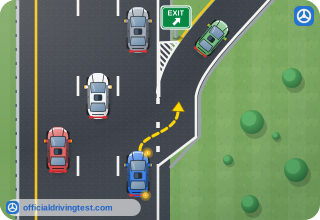
- Hard, to stop completely before the ramp begins
- Gently, until you match the posted exit ramp limit
- Not at all, keep your speed until the ramp ends
- Only after you have passed the exit sign
Show answer
Correct answer: Gently, until you match the posted exit ramp limit
In the deceleration lane you brake gently until your speed matches the posted exit ramp limit.
Source: West Virginia Driver's Licensing Handbook (Revised July 2026), page 59 · Open this page in the manual (Manual page 59)
-
For what should the shoulders of interstates be used?
- Changing drivers
- Reading a map
- Letting a passenger out
- Disabled vehicles only
Show answer
Correct answer: Disabled vehicles only
Interstate shoulders are only for disabled vehicles, not for non-emergency purposes.
Source: West Virginia Driver's Licensing Handbook (Revised July 2026), page 59 · Open this page in the manual (Manual page 59)
-
Where should activities such as changing drivers or reading a map be done?
- On the shoulder, well away from the through lane
- In the exit gore, out of the through lanes
- In a rest area or after exiting the interstate
- In the right-hand lane at a low speed
Show answer
Correct answer: In a rest area or after exiting the interstate
These non-emergency activities should be done in a rest area or after leaving the interstate.
Source: West Virginia Driver's Licensing Handbook (Revised July 2026), page 59 · Open this page in the manual (Manual page 59)
-
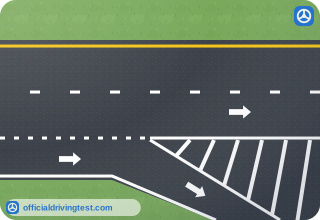
What is an exit gore on an interstate?
- The triangular area between the through lane and the exit ramp
- The lane used to slow down before you reach the exit ramp
- The paved strip separating the two directions of travel
- The shoulder that runs alongside the exit ramp itself
Show answer
Correct answer: The triangular area between the through lane and the exit ramp
The exit gore is the triangular area between the through lane and the exit ramp.
Source: West Virginia Driver's Licensing Handbook (Revised July 2026), page 59 · Open this page in the manual (Manual page 59)
-
Why should you not stop in an exit gore?
- Those areas are reserved for police and emergency vehicles
- Stopping there blocks the signs for the deceleration lane
- The pavement in a gore is usually unpaved and soft
- Another driver may cross it after missing the exit and hit you
Show answer
Correct answer: Another driver may cross it after missing the exit and hit you
A driver who misses the exit may try to cross the gore and hit a stopped vehicle.
Source: West Virginia Driver's Licensing Handbook (Revised July 2026), page 59 · Open this page in the manual (Manual page 59)
-
Why is driving much slower than other drivers on an interstate a hazard?
- Other drivers may be forced to change lanes abruptly
- The slow vehicle is likely to be towed
- Slow driving uses more fuel and heats the engine
- It blocks the view of the guide signs
Show answer
Correct answer: Other drivers may be forced to change lanes abruptly
Driving much slower than other traffic creates a hazard because crashes may happen when other drivers must change lanes abruptly.
Source: West Virginia Driver's Licensing Handbook (Revised July 2026), page 59 · Open this page in the manual (Manual page 59)
-
What should you do if you need to turn around on an interstate?
- Make a U-turn at a spot where traffic is light
- Use the nearest median crossover
- Stop on the shoulder and turn around there
- Go to the next exit to turn around before re-entering
Show answer
Correct answer: Go to the next exit to turn around before re-entering
You should never make a U-turn on an interstate; use the next exit instead.
Source: West Virginia Driver's Licensing Handbook (Revised July 2026), page 60 · Open this page in the manual (Manual page 60)
-
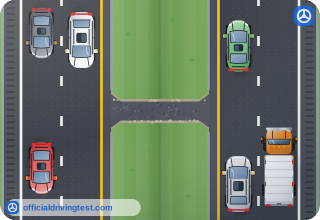
Who may use the gravel or paved crossovers in the medians of some highways?
- Only police and emergency vehicles
- Any driver who missed an exit
- Drivers of disabled vehicles
- Drivers when traffic is light
Show answer
Correct answer: Only police and emergency vehicles
The median crossovers are to be used only by police and emergency vehicles.
Source: West Virginia Driver's Licensing Handbook (Revised July 2026), page 60 · Open this page in the manual (Manual page 60)