West Virginia: Parking rules — Part 1 Practice Test
Questions in this part include: “In which direction must vehicles always be parked on a street?” · “Which reason is an exception to the rule against stopping, standing or parking in a prohibited location?”
Independent educational site · not affiliated with any government agency or DMV
Ready? Test yourself
Answer to start, or tap Start below:
Which exercise does the handbook describe as one of the best indicators that you have the basic skills necessary to safely operate a motor vehicle?
- Instant feedback with an explanation
- Every answer cites its source in the manual
- Your best score is saved on this device
- Keyboard: press 1 to 4 to answer and Enter for the next question
Questions are original and based on the official manual "West Virginia Driver's Licensing Handbook" (Revised July 2026), West Virginia Division of Motor Vehicles (DMV).
All 22 questions in this practice test
Take the test above first, then use this list to study. Tap “Show answer” to see the correct answer and explanation.
Show the questions and answersHide the questions
-
Which exercise does the handbook describe as one of the best indicators that you have the basic skills necessary to safely operate a motor vehicle?
- Parallel parking
- Three-point turnabout
- Forward two-point turnabout
- Reverse two-point turnabout
Show answer
Correct answer: Parallel parking
Parallel parking is described as one of the best indicators of the basic skills needed to operate a vehicle safely.
Source: West Virginia Driver's Licensing Handbook (Revised July 2026), page 27 · Open this page in the manual (Manual page 27)
-
In which direction must vehicles always be parked on a street?
- Facing the opposite direction of traffic on that side of the street
- Facing whichever direction lets you leave the space most easily
- Facing the curb at a slight angle on that side of the street
- In the same direction as the movement of traffic on that side of the street
Show answer
Correct answer: In the same direction as the movement of traffic on that side of the street
A parked vehicle must face the same direction as the traffic moving on that side of the street.
Source: West Virginia Driver's Licensing Handbook (Revised July 2026), page 45 · Open this page in the manual (Manual page 45)
-
How does the handbook describe double parking?
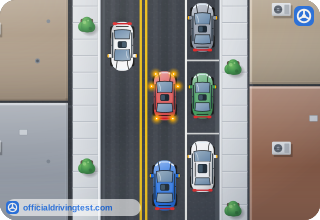
- Illegal and discourteous
- Legal if you stay with the vehicle
- Allowed for a few minutes with hazard lights on
- Allowed on streets with light traffic
Show answer
Correct answer: Illegal and discourteous
The handbook says double parking is illegal and discourteous.
Source: West Virginia Driver's Licensing Handbook (Revised July 2026), page 45 · Open this page in the manual (Manual page 45)
-
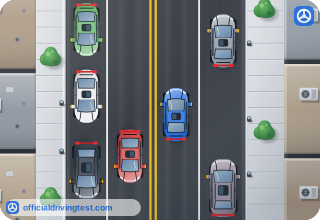
When you park, where should your vehicle be in relation to the traveled portion of the road?
- Partly on the traveled portion if the road is wide
- On the traveled portion if your hazard lights are on
- Completely off the traveled portion of the road
- On the traveled portion if the space is short
Show answer
Correct answer: Completely off the traveled portion of the road
A parked vehicle should be completely off the traveled portion of the road.
Source: West Virginia Driver's Licensing Handbook (Revised July 2026), page 45 · Open this page in the manual (Manual page 45)
-
What must you do whenever you park and leave your vehicle?
- Turn off the engine and leave the vehicle in neutral
- Turn off the engine and set the parking (emergency) brake
- Leave the engine running and lock the doors
- Set the parking brake and leave the lights on
Show answer
Correct answer: Turn off the engine and set the parking (emergency) brake
The handbook says you must turn off the engine and set the parking (emergency) brake when you park and leave.
Source: West Virginia Driver's Licensing Handbook (Revised July 2026), page 45 · Open this page in the manual (Manual page 45)
-
What does the handbook say to do about the keys and doors when you park and leave your vehicle?
- Lock the doors and hide the keys under the seat
- Leave the keys in the ignition so the vehicle can be moved
- Take your keys but leave the doors unlocked
- Lock your vehicle and take your keys
Show answer
Correct answer: Lock your vehicle and take your keys
The handbook says to lock your vehicle and take your keys.
Source: West Virginia Driver's Licensing Handbook (Revised July 2026), page 45 · Open this page in the manual (Manual page 45)
-
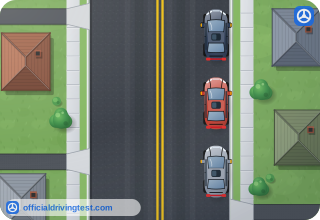
Why can getting out of your vehicle on the street side be dangerous?
- Passing drivers may not see you in time to avoid hitting your open door, or you
- The door may be blocked by the curb and trap you inside the vehicle
- Other drivers cannot tell that your vehicle is actually parked
- Street side doors cannot be locked when the engine is turned off
Show answer
Correct answer: Passing drivers may not see you in time to avoid hitting your open door, or you
Bicycles, motorcycles or larger vehicles passing may not see you in time to avoid the open door or you.
Source: West Virginia Driver's Licensing Handbook (Revised July 2026), page 45 · Open this page in the manual (Manual page 45)
-
Which reason is an exception to the rule against stopping, standing or parking in a prohibited location?
- Waiting briefly for a passenger to come out
- Making a quick delivery to a nearby building
- Obeying a police officer or a traffic signal
- Reading a map or taking a short phone call
Show answer
Correct answer: Obeying a police officer or a traffic signal
The rule has exceptions only to avoid a conflict with other traffic or to obey a law, a police officer or a traffic signal.
Source: West Virginia Driver's Licensing Handbook (Revised July 2026), page 45 · Open this page in the manual (Manual page 45)
-
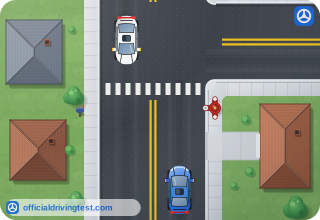
Stopping, standing or parking is not allowed within how many feet of a fire hydrant?
- 5 feet
- 15 feet
- 10 feet
- 25 feet
Show answer
Correct answer: 15 feet
The prohibited-parking list includes anywhere within 15 feet of a fire hydrant.
Source: West Virginia Driver's Licensing Handbook (Revised July 2026), page 45 · Open this page in the manual (Manual page 45)
-
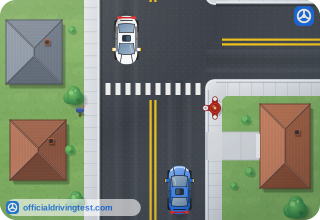
Stopping, standing or parking is not allowed within how many feet of a crosswalk at an intersection?
- 10 feet
- 25 feet
- 40 feet
- 20 feet
Show answer
Correct answer: 20 feet
You may not stop, stand or park within 20 feet of a crosswalk at an intersection.
Source: West Virginia Driver's Licensing Handbook (Revised July 2026), page 45 · Open this page in the manual (Manual page 45)
-
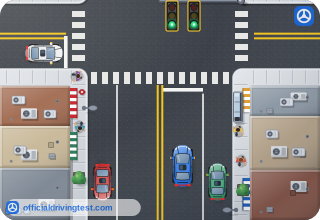
Stopping, standing or parking is not allowed within how many feet of any stop sign or traffic control signal?
- 30 feet
- 10 feet
- 25 feet
- 40 feet
Show answer
Correct answer: 30 feet
The list of prohibited places includes within 30 feet of any stop sign or traffic control signal.
Source: West Virginia Driver's Licensing Handbook (Revised July 2026), page 45 · Open this page in the manual (Manual page 45)
-
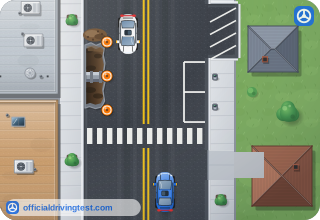
Which of these is a place where you must not stop, stand or park?
- In a parallel parking space within 18 inches of the right curb
- In front of a public or private driveway
- In an angle parking space on your right
- In a metered parking spot beside the road
Show answer
Correct answer: In front of a public or private driveway
Stopping, standing or parking in front of a public or private driveway is not allowed.
Source: West Virginia Driver's Licensing Handbook (Revised July 2026), page 45 · Open this page in the manual (Manual page 45)
-
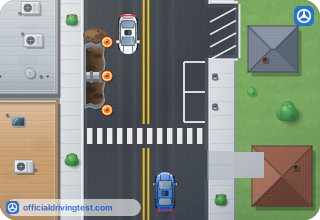
Where is stopping, standing or parking not allowed?
- In an angle parking space on your right
- In a metered parking spot beside the road
- Within 18 inches of the right curb on a two-way street
- On a crosswalk
Show answer
Correct answer: On a crosswalk
A crosswalk is on the list of places where stopping, standing or parking is not allowed.
Source: West Virginia Driver's Licensing Handbook (Revised July 2026), page 45 · Open this page in the manual (Manual page 45)
-
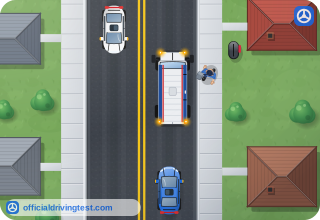
Stopping, standing or parking is not allowed within how many feet of a mailbox served by a carrier using a motor vehicle for daily deliveries?
- 20 feet
- 5 feet
- 10 feet
- 40 feet
Show answer
Correct answer: 20 feet
The prohibited-parking list includes within 20 feet of any mailbox served by a carrier using a motor vehicle for daily deliveries.
Source: West Virginia Driver's Licensing Handbook (Revised July 2026), page 46 · Open this page in the manual (Manual page 46)
-
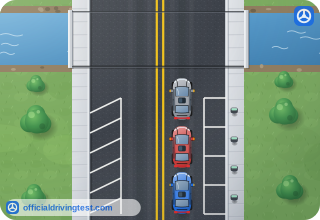
Which of these locations is on the handbook's list of no stopping, standing or parking places?
- In an angle parking space on your right
- In a metered parking spot beside the road
- Upon any bridge or other elevated structure
- In a parallel parking space on a two-way street, right wheels near the curb
Show answer
Correct answer: Upon any bridge or other elevated structure
Stopping, standing or parking is not allowed upon a bridge or other elevated structure, or in a highway tunnel.
Source: West Virginia Driver's Licensing Handbook (Revised July 2026), page 46 · Open this page in the manual (Manual page 46)
-
At which of these places is stopping, standing or parking prohibited?
- In an angle parking space on your right
- In front of a wheelchair ramp or curb cut
- In a metered parking spot beside the road
- In a parallel parking space with the right wheels near the curb
Show answer
Correct answer: In front of a wheelchair ramp or curb cut
The handbook lists the area in front of a wheelchair ramp or curb cut as a place where stopping, standing or parking is not allowed.
Source: West Virginia Driver's Licensing Handbook (Revised July 2026), page 45 · Open this page in the manual (Manual page 45)
-
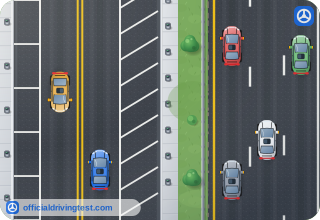
Which of these is a prohibited place to stop, stand or park?
- In an angle parking space on your right
- In a metered parking spot beside the road
- In a parallel parking space with the right wheels near the curb
- Upon any controlled-access highway
Show answer
Correct answer: Upon any controlled-access highway
Stopping, standing or parking is not allowed upon any controlled-access highway.
Source: West Virginia Driver's Licensing Handbook (Revised July 2026), page 46 · Open this page in the manual (Manual page 46)
-
Stopping, standing or parking is not allowed in which of these places?
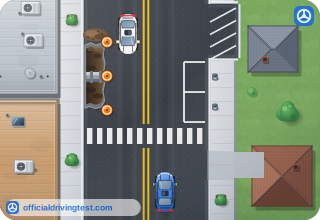
- Beside or opposite a street excavation where parking would obstruct traffic
- In an angle parking space on your right, entered with a signal
- In a metered parking spot beside the road with change in the meter
- In a parallel parking space with the right wheels near the curb
Show answer
Correct answer: Beside or opposite a street excavation where parking would obstruct traffic
Stopping, standing or parking is not allowed beside or opposite any street excavation or obstruction where it would obstruct traffic.
Source: West Virginia Driver's Licensing Handbook (Revised July 2026), page 46 · Open this page in the manual (Manual page 46)
-
What color may a curb in a no-parking zone be painted?
- Red
- White
- Yellow
- Blue
Show answer
Correct answer: Yellow
The handbook says a curb in a no-parking zone may be painted yellow.
Source: West Virginia Driver's Licensing Handbook (Revised July 2026), page 46 · Open this page in the manual (Manual page 46)
-
When entering an angle parking space on your right, what should you do first?
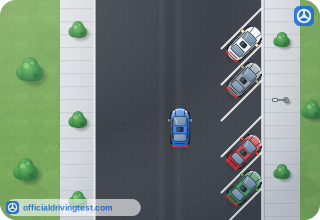
- Stop in the lane and then back toward the space
- Signal your intention to park and slow down
- Move to the left side of the lane for a wide turn
- Turn on your hazard lights and drive past the space
Show answer
Correct answer: Signal your intention to park and slow down
The handbook says to signal your intention to park and slow down when entering a space on your right.
Source: West Virginia Driver's Licensing Handbook (Revised July 2026), page 46 · Open this page in the manual (Manual page 46)
-
When approaching an angle parking space on your right, how far out from the parked vehicles should you remain, parallel to the curb?
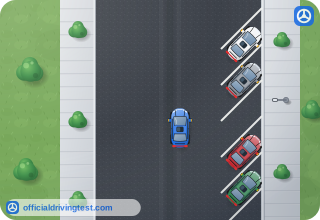
- At least one foot
- At least three feet
- At least ten feet
- At least five feet
Show answer
Correct answer: At least five feet
You should stay parallel to the curb, at least five feet out from the parked vehicles.
Source: West Virginia Driver's Licensing Handbook (Revised July 2026), page 46 · Open this page in the manual (Manual page 46)
-
When should you steer sharply to the right into an angle parking space?
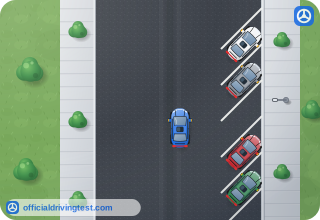
- When your vehicle's front end is even with the rear of the space
- When your vehicle's front end is even with the front of the space
- When your vehicle's front end is even with the middle of the space
- When your rear bumper passes the rear of the space
Show answer
Correct answer: When your vehicle's front end is even with the rear of the space
You steer sharply right when the front end of your vehicle is even with the rear of the parking space.
Source: West Virginia Driver's Licensing Handbook (Revised July 2026), page 46 · Open this page in the manual (Manual page 46)