West Virginia: Interstate driving
Route numbers, entering and leaving an interstate, lane use, exit gores, interstate speeds and stopping on the shoulder. Split into 2 shorter tests so you're not stuck in one long quiz.
Independent educational site · not affiliated with any government agency or DMV
Choose a part
Interstate driving — Part 1
Questions in this part include: “On an interstate, what have interstate and divided highways largely removed the chance of?”
Interstate driving — Part 2
Questions in this part include: “On an entrance ramp, what are advisory speed limit signs used for?”
Questions are original and based on the official manual "West Virginia Driver's Licensing Handbook" (Revised July 2026), West Virginia Division of Motor Vehicles (DMV).
All 35 Interstate driving questions with answers
Choose a part above to take a practice test, or study every question and answer here.
Show the questions and answersHide the questions
1Part 118 questions
-
In the handbook’s definitions, what is an acceleration lane?
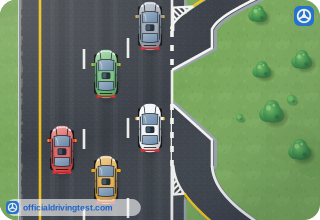
- A lane next to the regular lanes that lets vehicles leaving the highway reduce speed
- An extra lane on the side of a high-speed highway that lets you pick up speed before merging
- A passing lane on a two-lane highway reserved for vehicles traveling faster than traffic
- A lane at the left side of the highway reserved for vehicles merging from the right
Show answer
Correct answer: An extra lane on the side of a high-speed highway that lets you pick up speed before merging
An acceleration lane lets you enter a high-speed highway and pick up speed before merging with through traffic.
Source: West Virginia Driver's Licensing Handbook (Revised July 2026)
-
In the handbook’s definitions, what is a deceleration lane?
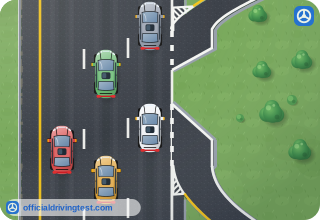
- An extra lane that lets you enter the highway and pick up speed before merging with traffic
- A lane at the end of an exit ramp reserved for vehicles that have come to a full stop
- A lane that lets vehicles pass slower traffic on the right side of the highway
- A traffic lane next to the regular lanes that lets vehicles leaving the highway reduce speed
Show answer
Correct answer: A traffic lane next to the regular lanes that lets vehicles leaving the highway reduce speed
A deceleration lane lets vehicles leaving the highway slow down without getting in the way of through traffic.
Source: West Virginia Driver's Licensing Handbook (Revised July 2026)
-
In the handbook’s definitions, what is a divided highway?
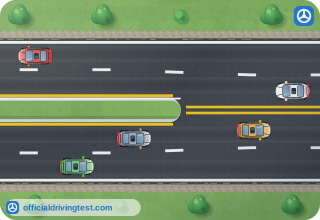
- A highway with separate roadways for opposite directions, split by an unpaved strip, median or barrier
- A highway whose opposite directions of travel are separated only by a painted double yellow line
- A highway that splits into two separate roads for a short distance at an interchange
- A highway with more than four lanes in total and a wide paved shoulder on each side
Show answer
Correct answer: A highway with separate roadways for opposite directions, split by an unpaved strip, median or barrier
A divided highway has separate roadways for opposite directions, kept apart by an unpaved strip, a raised median, or another physical barrier.
Source: West Virginia Driver's Licensing Handbook (Revised July 2026)
-
On an interstate, what have interstate and divided highways largely removed the chance of?
- Head-on collisions
- Crashes in heavy fog
- Breakdowns on the shoulder
- Crashes with large trucks
Show answer
Correct answer: Head-on collisions
Interstate and divided highways largely remove the chance of head-on collisions, although driving on interstates is still very different from other roads.
Source: West Virginia Driver's Licensing Handbook (Revised July 2026), page 57 · Open this page in the manual (Manual page 57)
-
What does the handbook say safe use of interstates demands from the driver?
- Staying in the left lane to keep a clear view ahead
- Driving only at the lowest speed allowed
- Complete awareness of high-speed driving and constant alertness
- Following other vehicles closely to keep up with traffic
Show answer
Correct answer: Complete awareness of high-speed driving and constant alertness
Interstate driving is high-speed driving, so the driver needs complete awareness and constant alertness.
Source: West Virginia Driver's Licensing Handbook (Revised July 2026), page 57 · Open this page in the manual (Manual page 57)
-
How should you treat trucks and buses that are entering the interstate?
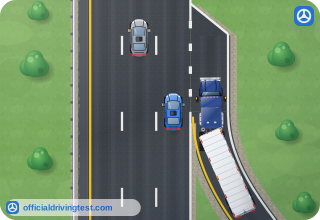
- Speed up to pass them before they merge
- Be cooperative and give them extra time and space
- Stay close behind them so they cannot slow you
- Flash your lights so they let you go first
Show answer
Correct answer: Be cooperative and give them extra time and space
Trucks and buses may need extra time to adjust to traffic patterns, so you should give them extra time and space.
Source: West Virginia Driver's Licensing Handbook (Revised July 2026), page 57 · Open this page in the manual (Manual page 57)
-
Where should slower traffic drive on an interstate, except when passing?
- In the left-hand lane
- In the center of the road
- On the shoulder
- In the right-hand lane
Show answer
Correct answer: In the right-hand lane
Slower traffic belongs in the right-hand lane except when passing.
Source: West Virginia Driver's Licensing Handbook (Revised July 2026), page 57 · Open this page in the manual (Manual page 57)
-
According to the handbook's numbering rules, in which direction do even-numbered interstates run?
- North to south
- Northeast to southwest
- East to west
- Around the edge of a city
Show answer
Correct answer: East to west
Even-numbered interstates run east to west.
Source: West Virginia Driver's Licensing Handbook (Revised July 2026), page 57 · Open this page in the manual (Manual page 57)
-
According to the handbook's numbering rules, in which direction do odd-numbered interstates run?
- North to south
- East to west
- Southeast to northwest
- Only inside city limits
Show answer
Correct answer: North to south
Odd-numbered interstates run north to south.
Source: West Virginia Driver's Licensing Handbook (Revised July 2026), page 57 · Open this page in the manual (Manual page 57)
-
On interstates, what does a three-digit number with an even first number identify?
- A business route into a city center
- A toll road between two states
- A route that runs only east to west
- A beltway or bypass around a city
Show answer
Correct answer: A beltway or bypass around a city
A three-digit interstate number that starts with an even number marks a beltway or bypass around a city.
Source: West Virginia Driver's Licensing Handbook (Revised July 2026), page 57 · Open this page in the manual (Manual page 57)
-
On interstates, what does a three-digit number with an odd first number identify?
- A truck-only route
- A spur route
- A route that crosses the whole state
- A road closed to passenger cars
Show answer
Correct answer: A spur route
A three-digit interstate number that starts with an odd number marks a spur route.
Source: West Virginia Driver's Licensing Handbook (Revised July 2026), page 57 · Open this page in the manual (Manual page 57)
-
Why is it important to plan your route in advance before driving on an interstate?
- Interstates have no guide signs to follow
- Interstate exits are always close together
- Interstates have no route numbers
- Entrances and exits are sometimes far apart
Show answer
Correct answer: Entrances and exits are sometimes far apart
Because interstate entrances and exits are sometimes far apart, you need to plan ahead.
Source: West Virginia Driver's Licensing Handbook (Revised July 2026), page 57 · Open this page in the manual (Manual page 57)
-
Before you leave for an interstate trip, the handbook says to check your gas, water, oil, and what else?
- Your tires, including the spare
- Your seat belt buckles only
- Your license renewal sticker
- Your glove box tools
Show answer
Correct answer: Your tires, including the spare
Before leaving you should check gas, water, oil, and the tires including your spare tire.
Source: West Virginia Driver's Licensing Handbook (Revised July 2026), page 57 · Open this page in the manual (Manual page 57)
-
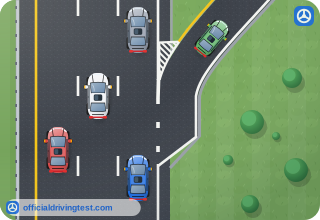
Where is the first guide sign for an interchange placed on an interstate?
- Right at the point where you must turn off the road
- Just past the exit, so you can see where you were
- Well in advance of the point where you must turn off
- Only after the exit ramp has started to curve away
Show answer
Correct answer: Well in advance of the point where you must turn off
The first guide sign is placed well ahead of the exit so you have ample time to change lanes and exit smoothly.
Source: West Virginia Driver's Licensing Handbook (Revised July 2026), page 57 · Open this page in the manual (Manual page 57)
-
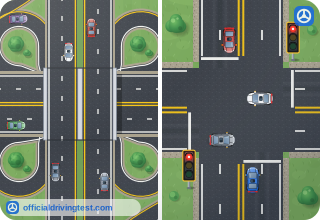
What is an interchange?
- The place where two highways cross at the same level with a traffic signal
- A short lane used only to slow down before an exit
- The intersection of two highways at different levels, with separate connecting roads
- A paved area where drivers stop to rest
Show answer
Correct answer: The intersection of two highways at different levels, with separate connecting roads
An interchange joins two highways at different levels (over and under) with separate connecting roads for moving traffic between them.
Source: West Virginia Driver's Licensing Handbook (Revised July 2026), page 57 · Open this page in the manual (Manual page 57)
-
Which of these is one of the three most common types of interchanges?
- Beltway
- Cloverleaf
- Median
- Gore
Show answer
Correct answer: Cloverleaf
The three most common interchange types are cloverleaf, diamond, and trumpet.
Source: West Virginia Driver's Licensing Handbook (Revised July 2026), page 57 · Open this page in the manual (Manual page 57)
-
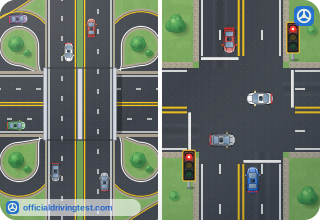
What does the design of an interchange enable vehicles to do?
- Park briefly beside the through lanes to read a map
- Cross the other road at a traffic signal
- Pass slower traffic without changing lanes
- Cross, enter, or leave either road without interfering
Show answer
Correct answer: Cross, enter, or leave either road without interfering
The over-and-under design lets vehicles cross, enter, or leave either road without interfering with other vehicles.
Source: West Virginia Driver's Licensing Handbook (Revised July 2026), page 57 · Open this page in the manual (Manual page 57)
-
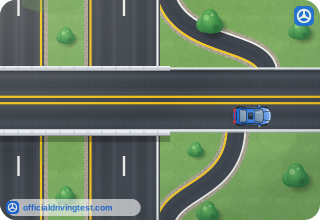
Often an exit ramp is next to the entrance ramp. How is the exit ramp marked?
- With “Yield” and “Stop Ahead” signs
- With “Merge” and “Lane Ends” signs
- With “Do Not Enter” and “Wrong Way” signs
- With “Slow” and “Keep Right” signs
Show answer
Correct answer: With “Do Not Enter” and “Wrong Way” signs
An exit ramp next to the entrance ramp is often marked with Do Not Enter and Wrong Way signs, so watch the signs when you enter.
Source: West Virginia Driver's Licensing Handbook (Revised July 2026), page 58 · Open this page in the manual (Manual page 58)
2Part 217 questions
-
On an entrance ramp, what are advisory speed limit signs used for?
- They are used if the ramp curves sharply
- They show the minimum speed on the interstate
- They mark where the acceleration lane ends
- They warn that the exit ramp is closed
Show answer
Correct answer: They are used if the ramp curves sharply
Advisory speed limit signs on a ramp are used when the ramp curves sharply.
Source: West Virginia Driver's Licensing Handbook (Revised July 2026), page 58 · Open this page in the manual (Manual page 58)
-
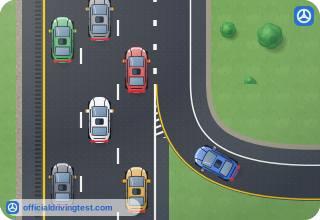
When entering an interstate, at what point on the entrance ramp should you start checking traffic, using your turn signal, and looking for a gap?
- At the very start of the ramp
- Only at the end of the acceleration lane
- After you have already entered the through lane
- About halfway on the entrance ramp
Show answer
Correct answer: About halfway on the entrance ramp
The handbook says to begin these steps about halfway along the entrance ramp.
Source: West Virginia Driver's Licensing Handbook (Revised July 2026), page 58 · Open this page in the manual (Manual page 58)
-
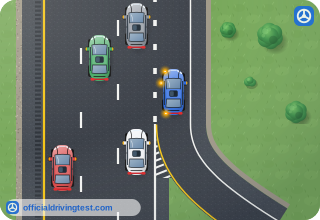
As you merge onto an interstate, what speed should you be traveling?
- The speed of the slowest vehicle on the ramp
- The same speed as other traffic
- A speed lower than other traffic to be safe
- Whatever speed the ramp sign suggests
Show answer
Correct answer: The same speed as other traffic
To merge safely you should match the speed of the other traffic.
Source: West Virginia Driver's Licensing Handbook (Revised July 2026), page 58 · Open this page in the manual (Manual page 58)
-
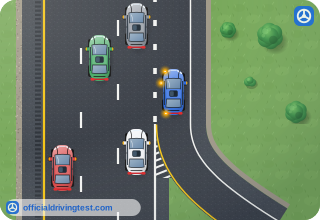
What should you do instead of cutting sharply to the left to enter the interstate traffic stream?
- Move left at once into the fastest lane available
- Follow the lane, merge with traffic, and then change lanes
- Stop at the end of the ramp and wait for a clear gap
- Merge onto the shoulder first and then cut across traffic
Show answer
Correct answer: Follow the lane, merge with traffic, and then change lanes
Do not cut sharply left; follow the lane, merge with traffic, and only then change lanes.
Source: West Virginia Driver's Licensing Handbook (Revised July 2026), page 58 · Open this page in the manual (Manual page 58)
-
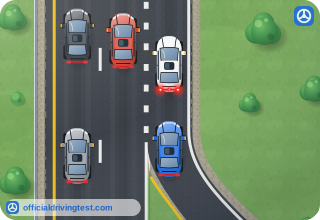
What should you be prepared to do if another vehicle ahead of you in the acceleration lane slows or stops without warning?
- Pass it on the shoulder
- Honk and keep your speed
- Stop right behind it and wait
- Adjust your driving
Show answer
Correct answer: Adjust your driving
Be ready to adjust your driving, and do not stop on the ramp or the acceleration lane.
Source: West Virginia Driver's Licensing Handbook (Revised July 2026), page 58 · Open this page in the manual (Manual page 58)
-
If no gap in traffic is available when you enter an interstate, what may be necessary as a last resort?
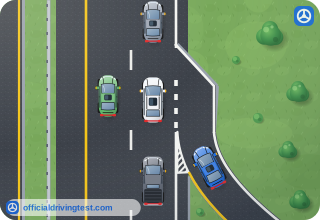
- Drive onto the shoulder past the acceleration lane and stop
- Cut sharply to the left into the nearest traffic lane
- Stop on the ramp itself until a gap finally appears
- Back up the entrance ramp and start the merge over
Show answer
Correct answer: Drive onto the shoulder past the acceleration lane and stop
Because entering the traffic stream from a stop is hazardous, stopping on the shoulder beyond the acceleration lane is only a last resort.
Source: West Virginia Driver's Licensing Handbook (Revised July 2026), page 58 · Open this page in the manual (Manual page 58)
-
When you enter an interstate from an entrance ramp, who has the right-of-way?
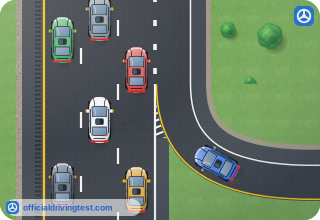
- Vehicles entering from the ramp
- Trucks and buses entering the interstate
- Traffic already on the interstate
- Whichever driver is going faster
Show answer
Correct answer: Traffic already on the interstate
Traffic on the interstate has the right-of-way, and you cannot count on other drivers moving over for you.
Source: West Virginia Driver's Licensing Handbook (Revised July 2026), page 58 · Open this page in the manual (Manual page 58)
-
When should you signal and move into the lane you need to exit an interstate?
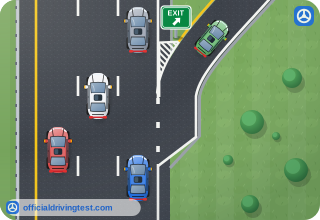
- Well before you have to exit
- Just as the exit ramp begins
- Only after you pass the exit sign
- At the last moment, so others cannot cut in
Show answer
Correct answer: Well before you have to exit
Changing lanes at the last moment risks missing your exit or causing a crash.
Source: West Virginia Driver's Licensing Handbook (Revised July 2026), page 59 · Open this page in the manual (Manual page 59)
-
Where should you begin to slow down when leaving an interstate?
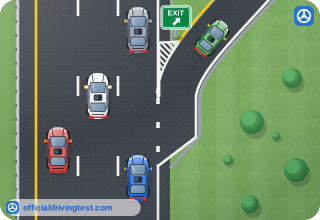
- In the through lane as soon as you see the exit sign
- On the shoulder before the exit
- In the deceleration lane
- In the exit gore
Show answer
Correct answer: In the deceleration lane
You should never slow down on the interstate itself; wait until you are in the deceleration lane.
Source: West Virginia Driver's Licensing Handbook (Revised July 2026), page 59 · Open this page in the manual (Manual page 59)
-
After you are in the deceleration lane, how should you brake?
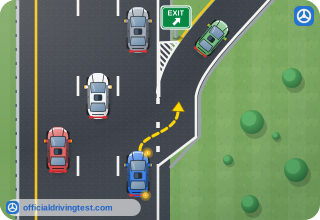
- Hard, to stop completely before the ramp begins
- Gently, until you match the posted exit ramp limit
- Not at all, keep your speed until the ramp ends
- Only after you have passed the exit sign
Show answer
Correct answer: Gently, until you match the posted exit ramp limit
In the deceleration lane you brake gently until your speed matches the posted exit ramp limit.
Source: West Virginia Driver's Licensing Handbook (Revised July 2026), page 59 · Open this page in the manual (Manual page 59)
-
For what should the shoulders of interstates be used?
- Changing drivers
- Reading a map
- Letting a passenger out
- Disabled vehicles only
Show answer
Correct answer: Disabled vehicles only
Interstate shoulders are only for disabled vehicles, not for non-emergency purposes.
Source: West Virginia Driver's Licensing Handbook (Revised July 2026), page 59 · Open this page in the manual (Manual page 59)
-
Where should activities such as changing drivers or reading a map be done?
- On the shoulder, well away from the through lane
- In the exit gore, out of the through lanes
- In a rest area or after exiting the interstate
- In the right-hand lane at a low speed
Show answer
Correct answer: In a rest area or after exiting the interstate
These non-emergency activities should be done in a rest area or after leaving the interstate.
Source: West Virginia Driver's Licensing Handbook (Revised July 2026), page 59 · Open this page in the manual (Manual page 59)
-
What is an exit gore on an interstate?
- The triangular area between the through lane and the exit ramp
- The lane used to slow down before you reach the exit ramp
- The paved strip separating the two directions of travel
- The shoulder that runs alongside the exit ramp itself
Show answer
Correct answer: The triangular area between the through lane and the exit ramp
The exit gore is the triangular area between the through lane and the exit ramp.
Source: West Virginia Driver's Licensing Handbook (Revised July 2026), page 59 · Open this page in the manual (Manual page 59)
-
Why should you not stop in an exit gore?
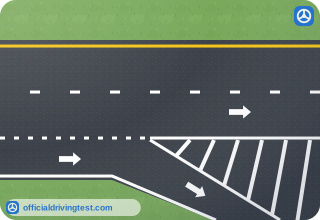
- Those areas are reserved for police and emergency vehicles
- Stopping there blocks the signs for the deceleration lane
- The pavement in a gore is usually unpaved and soft
- Another driver may cross it after missing the exit and hit you
Show answer
Correct answer: Another driver may cross it after missing the exit and hit you
A driver who misses the exit may try to cross the gore and hit a stopped vehicle.
Source: West Virginia Driver's Licensing Handbook (Revised July 2026), page 59 · Open this page in the manual (Manual page 59)
-
Why is driving much slower than other drivers on an interstate a hazard?
- Other drivers may be forced to change lanes abruptly
- The slow vehicle is likely to be towed
- Slow driving uses more fuel and heats the engine
- It blocks the view of the guide signs
Show answer
Correct answer: Other drivers may be forced to change lanes abruptly
Driving much slower than other traffic creates a hazard because crashes may happen when other drivers must change lanes abruptly.
Source: West Virginia Driver's Licensing Handbook (Revised July 2026), page 59 · Open this page in the manual (Manual page 59)
-
What should you do if you need to turn around on an interstate?
- Make a U-turn at a spot where traffic is light
- Use the nearest median crossover
- Stop on the shoulder and turn around there
- Go to the next exit to turn around before re-entering
Show answer
Correct answer: Go to the next exit to turn around before re-entering
You should never make a U-turn on an interstate; use the next exit instead.
Source: West Virginia Driver's Licensing Handbook (Revised July 2026), page 60 · Open this page in the manual (Manual page 60)
-
Who may use the gravel or paved crossovers in the medians of some highways?
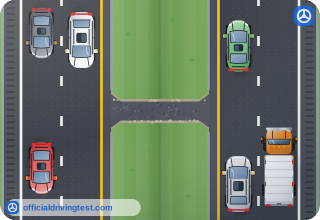
- Only police and emergency vehicles
- Any driver who missed an exit
- Drivers of disabled vehicles
- Drivers when traffic is light
Show answer
Correct answer: Only police and emergency vehicles
The median crossovers are to be used only by police and emergency vehicles.
Source: West Virginia Driver's Licensing Handbook (Revised July 2026), page 60 · Open this page in the manual (Manual page 60)