Washington: Right-of-way and turning — Part 3 Practice Test
Questions in this part include: “Why should you give large vehicles plenty of space at a roundabout?” · “After you cross the overpass or underpass at a diverging diamond, what are you directed to do?”
Independent educational site · not affiliated with any government agency or DMV
Ready? Test yourself
Answer to start, or tap Start below:
Why should you give large vehicles plenty of space at a roundabout?
- Instant feedback with an explanation
- Every answer cites its source in the manual
- Your best score is saved on this device
- Keyboard: press 1 to 4 to answer and Enter for the next question
Questions are original and based on the official manual "Washington Driver Guide" (© 2025), Washington State Department of Licensing (DOL).
All 17 questions in this practice test
Take the test above first, then use this list to study. Tap “Show answer” to see the correct answer and explanation.
Show the questions and answersHide the questions
-
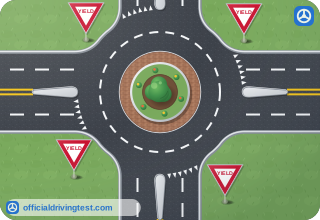
How do you travel once you enter a roundabout?
- Clockwise, staying in your lane
- Clockwise, moving to the inner lane
- Counterclockwise, staying in your lane
- Counterclockwise, moving freely between lanes
Show answer
Correct answer: Counterclockwise, staying in your lane
You enter to the right and travel counterclockwise in your own lane.
Source: Washington Driver Guide (© 2025), page 127 · Open this page in the manual (Manual page 127)
-
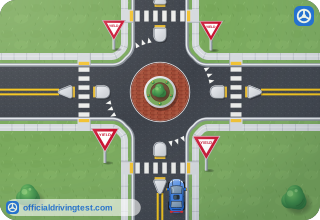
What are the truck aprons around the central island of a roundabout designed for?
- Large vehicles
- Bicyclists
- Pedestrian waiting areas
- Emergency vehicles only
Show answer
Correct answer: Large vehicles
A truck apron is the part of a roundabout built for large vehicles to cross.
Source: Washington Driver Guide (© 2025), page 127 · Open this page in the manual (Manual page 127)
-
Why should you give large vehicles plenty of space at a roundabout?
- They are required to drive in the outer lane only
- They must stop at the entrance until the circle is empty
- They may only enter from the left lane
- They are allowed to cross truck aprons and both lanes
Show answer
Correct answer: They are allowed to cross truck aprons and both lanes
Large vehicles can use truck aprons and both lanes, so they may need extra room as they approach and go through.
Source: Washington Driver Guide (© 2025), page 127 · Open this page in the manual (Manual page 127)
-
What happens as you approach a diverging diamond interchange?
- You are guided to cross over to the left side of the roadway
- You are guided to merge into the right-hand lane only
- You must stop and wait for a gap in oncoming traffic
- You are guided onto a one-lane road shared by both directions
Show answer
Correct answer: You are guided to cross over to the left side of the roadway
The lane shift moves you to the left side of the road, and clear markings and signals guide you.
Source: Washington Driver Guide (© 2025), page 129 · Open this page in the manual (Manual page 129)
-
After you cross the overpass or underpass at a diverging diamond, what are you directed to do?
- Continue on the left side of the road until the next ramp
- Stop and wait for the signal to change
- Cross back over to the right side of the road
- Make a U-turn to return to the freeway
Show answer
Correct answer: Cross back over to the right side of the road
The interchange returns you to normal driving on the right side of the road.
Source: Washington Driver Guide (© 2025), page 129 · Open this page in the manual (Manual page 129)
-
What is the main advantage of a diverging diamond for left turns onto the freeway?
- You can turn without stopping or yielding to oncoming traffic
- You can turn left from any lane without using a turn signal
- You can turn at higher speeds than on the freeway
- You can turn left on a red signal after you stop
Show answer
Correct answer: You can turn without stopping or yielding to oncoming traffic
The design lets you turn left onto the freeway without stopping or yielding to oncoming vehicles.
Source: Washington Driver Guide (© 2025), page 129 · Open this page in the manual (Manual page 129)
-
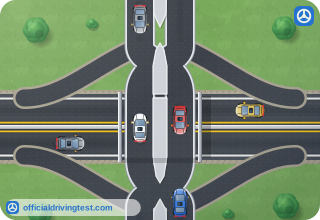
Why do diverging diamond intersections decrease the risk of collisions?
- They slow all traffic to a crawl at every ramp and signal
- They add more traffic signals on each ramp
- They reduce the number of points where vehicles cross paths
- They keep every vehicle in a single lane
Show answer
Correct answer: They reduce the number of points where vehicles cross paths
Fewer crossing points mean fewer chances for collisions, according to the guide.
Source: Washington Driver Guide (© 2025), page 128 · Open this page in the manual (Manual page 128)
-
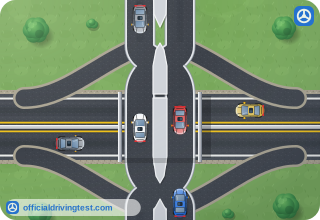
What should you pay close attention to when driving through a diverging diamond?
- Oncoming traffic when you turn left onto the freeway
- Signs and pavement markings
- Only the vehicle directly ahead of you
- The speed limit signs on the freeway only
Show answer
Correct answer: Signs and pavement markings
Signs and pavement markings guide you through the lane shift and the turns.
Source: Washington Driver Guide (© 2025), page 129 · Open this page in the manual (Manual page 129)
-
What is true of uncontrolled intersections?
- They have no right-of-way rules, so drivers must agree who goes first
- They are typically found on freeways and state highways
- They are controlled by a yield sign on every approach
- They don't have signs, but the normal right-of-way rules apply
Show answer
Correct answer: They don't have signs, but the normal right-of-way rules apply
Without signs, normal right-of-way rules still apply, and these intersections are typically on local roads and streets.
Source: Washington Driver Guide (© 2025), page 129 · Open this page in the manual (Manual page 129)
-
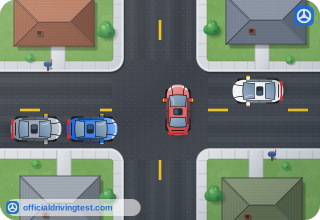
You reach an uncontrolled intersection and another vehicle is already in the intersection. What must you do?
- Enter first if you are traveling faster
- Enter first if you are turning right
- Honk and proceed
- Yield the right-of-way
Show answer
Correct answer: Yield the right-of-way
A vehicle already in the intersection is one of the cases where you must yield at an uncontrolled intersection.
Source: Washington Driver Guide (© 2025), page 129 · Open this page in the manual (Manual page 129)
-
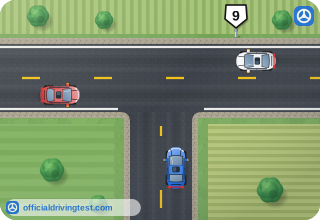
You are entering or crossing a state highway from a secondary road at an uncontrolled intersection. What must you do?
- Go first, because the road is a state highway
- Yield the right-of-way
- Go first if you arrived before the other driver
- Go first if you are turning right
Show answer
Correct answer: Yield the right-of-way
Entering or crossing a state highway from a secondary road is a case where you yield at an uncontrolled intersection.
Source: Washington Driver Guide (© 2025), page 129 · Open this page in the manual (Manual page 129)
-
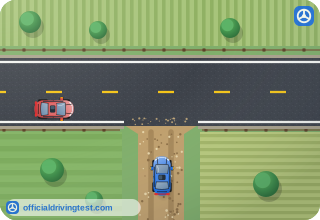
You are entering a paved road from an unpaved road at an uncontrolled intersection. What must you do?
- Go first, because you are already moving
- Go first if you are going straight
- Yield the right-of-way
- Go first if you signal
Show answer
Correct answer: Yield the right-of-way
Going from an unpaved road onto a paved one is a situation where you must yield at an uncontrolled intersection.
Source: Washington Driver Guide (© 2025), page 129 · Open this page in the manual (Manual page 129)
-
At an uncontrolled intersection you plan to turn left and a vehicle is approaching from the opposite direction. What must you do?
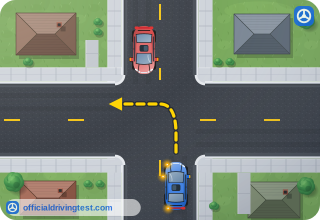
- Yield the right-of-way
- Turn first, since left turns have priority
- Turn first if you signaled in time
- Turn first if the other vehicle is slower
Show answer
Correct answer: Yield the right-of-way
A left turn with an approaching oncoming vehicle is a case where you must yield at an uncontrolled intersection.
Source: Washington Driver Guide (© 2025), page 129 · Open this page in the manual (Manual page 129)
-
When you turn and face oncoming traffic, how much time does the guide say it is better to give yourself?
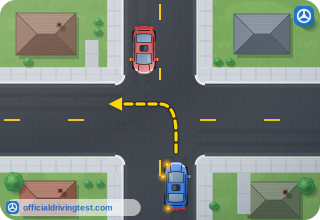
- Too much time rather than not enough
- Only the time you need to reach the speed limit
- As little as possible, so you do not block traffic
- Just enough time to count to three
Show answer
Correct answer: Too much time rather than not enough
Judging time for a turn is hard, so the guide says it is better to give yourself too much time than not enough.
Source: Washington Driver Guide (© 2025), page 162 · Open this page in the manual (Manual page 162)
-
When you turn in front of approaching vehicles, who has the right-of-way?
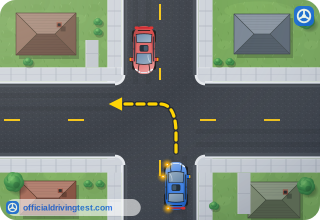
- The vehicle that signaled first
- The vehicle that turns
- Approaching traffic
- The slower vehicle
Show answer
Correct answer: Approaching traffic
The guide says to remember that approaching traffic has the right-of-way when you turn across its path.
Source: Washington Driver Guide (© 2025), page 162 · Open this page in the manual (Manual page 162)
-
How can you judge how much time you have to turn in front of oncoming vehicles?
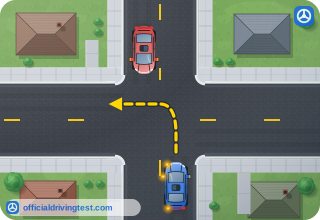
- Count how many vehicles are waiting behind you to turn onto the road
- Count the seconds oncoming vehicles take to pass a marker and clear the road
- Wait until the oncoming driver flashes the headlights to let you go
- Judge the distance by how large the oncoming vehicle appears to be
Show answer
Correct answer: Count the seconds oncoming vehicles take to pass a marker and clear the road
Counting the seconds oncoming vehicles take to pass a marker and clear the road lets you estimate how long the next vehicle will take.
Source: Washington Driver Guide (© 2025), page 162 · Open this page in the manual (Manual page 162)
-
When you turn into the flow of traffic, what do you need enough time to do?
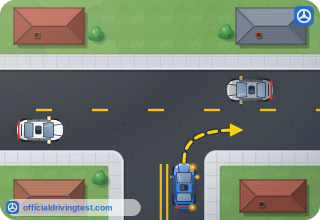
- Make the turn and then stop to check for traffic
- Wait for the traffic to slow down to your speed
- Complete the turn before you signal
- Make the turn and reach the speed of that traffic
Show answer
Correct answer: Make the turn and reach the speed of that traffic
You need time to turn without disturbing the flow of traffic you enter, which means also reaching its speed.
Source: Washington Driver Guide (© 2025), page 163 · Open this page in the manual (Manual page 163)