Washington: Railroad crossings Practice Test
Crossing signs and signals, stopping for trains, a vehicle stalled on the tracks, and light rail.
Independent educational site · not affiliated with any government agency or DMV
Ready? Test yourself
Answer to start, or tap Start below:
Where should you drive across railroad tracks?
- Instant feedback with an explanation
- Every answer cites its source in the manual
- Your best score is saved on this device
- Keyboard: press 1 to 4 to answer and Enter for the next question
Questions are original and based on the official manual "Washington Driver Guide" (© 2025), Washington State Department of Licensing (DOL).
All 15 questions in this practice test
Take the test above first, then use this list to study. Tap “Show answer” to see the correct answer and explanation.
Show the questions and answersHide the questions
-
Where should you drive across railroad tracks?
- Anywhere there is no train in sight
- Only at designated crossings
- At any flat section of track
- Wherever the road has a gap in the fence
Show answer
Correct answer: Only at designated crossings
Only drive across railroad tracks at designated crossings.
Source: Washington Driver Guide (© 2025), page 104 · Open this page in the manual (Manual page 104)
-
What do flashing red lights at a railroad crossing mean?
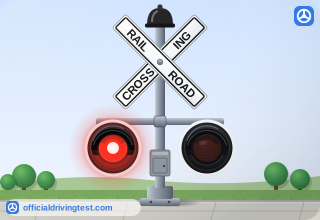
- A train has just passed and you may proceed carefully
- A train may be near, so slow down and look both ways
- The crossing is closed to vehicles over a certain weight
- A train is approaching and you need to stay outside of the gates
Show answer
Correct answer: A train is approaching and you need to stay outside of the gates
Flashing red lights at a railroad crossing mean a train is approaching, so stay outside of the gates.
Source: Washington Driver Guide (© 2025), page 104 · Open this page in the manual (Manual page 104)
-
Who has the right-of-way at a railroad crossing?
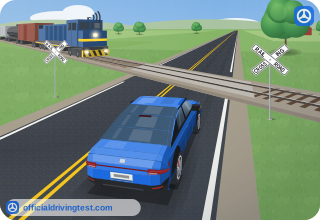
- Trains, always
- Whichever vehicle arrives first
- The larger vehicle
- The vehicle on the road with the higher speed limit
Show answer
Correct answer: Trains, always
Trains always have the right-of-way.
Source: Washington Driver Guide (© 2025), page 105 · Open this page in the manual (Manual page 105)
-
How far can it take a train to come to a full stop?
- Up to 450 feet
- Up to 1,000 feet
- Up to a mile
- Up to a quarter mile
Show answer
Correct answer: Up to a mile
Trains are heavy and cannot stop quickly; it can take up to a mile to stop.
Source: Washington Driver Guide (© 2025), page 105 · Open this page in the manual (Manual page 105)
-
Lights are flashing and bells are ringing at a train crossing, but the gate is not down. What must you do?
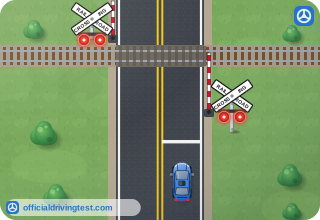
- Cross if you do not see a train
- Stop, whether or not the gate is down
- Slow down and cross carefully
- Drive around the gate
Show answer
Correct answer: Stop, whether or not the gate is down
You must stop whenever the lights flash and bells ring, whether the gate is down or not, and never drive around the gate.
Source: Washington Driver Guide (© 2025), page 105 · Open this page in the manual (Manual page 105)
-
How far from the nearest rail of a crossing must you stop when the signal is flashing?
- Between 5 and 10 feet
- Between 50 and 100 feet
- Between 100 and 200 feet
- Between 15 and 50 feet
Show answer
Correct answer: Between 15 and 50 feet
Stop between 15 and 50 feet away from the nearest rail when the signal is flashing.
Source: Washington Driver Guide (© 2025), page 105 · Open this page in the manual (Manual page 105)
-
When may you go after stopping for a train at a crossing?
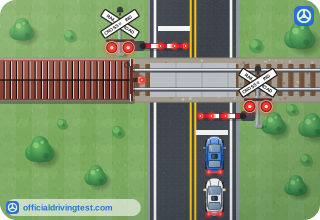
- When the red lights stop and all other warnings deactivate
- As soon as the last car of the train has passed the crossing
- When the gate begins to rise, even if the lights are still flashing
- As soon as the train's warning horn stops sounding
Show answer
Correct answer: When the red lights stop and all other warnings deactivate
You can go when the red lights stop flashing and all other warning signs deactivate.
Source: Washington Driver Guide (© 2025), page 105 · Open this page in the manual (Manual page 105)
-
The railroad warnings have just activated and you think you can beat the train across the tracks. What should you do?
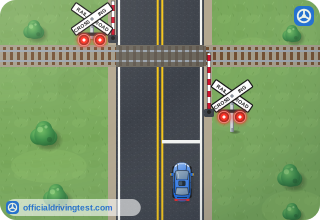
- Cross quickly if the train is far away
- Cross if the gates are still up
- Stop, and do not try to beat the train
- Slow down and cross when it is clear
Show answer
Correct answer: Stop, and do not try to beat the train
As soon as the warnings have been activated, stop; do not try to beat a train across the tracks.
Source: Washington Driver Guide (© 2025), page 105 · Open this page in the manual (Manual page 105)
-
Your vehicle gets stuck at a railroad crossing. What should you do?
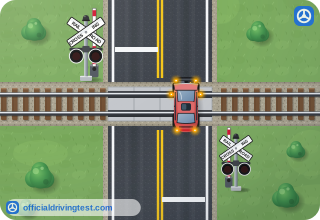
- Stay inside and call for help
- Get everyone out immediately
- Keep trying to restart the engine
- Stay in the vehicle with seatbelts fastened
Show answer
Correct answer: Get everyone out immediately
Do not stop on the tracks; if your vehicle gets stuck, get everyone out immediately.
Source: Washington Driver Guide (© 2025), page 105 · Open this page in the manual (Manual page 105)
-
Why should you trust railroad signals even if you don't see a train?
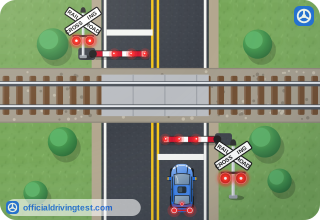
- Trains always run on a fixed schedule that drivers can check
- Signals are activated only when a train is visible from the road
- Trains run only at low speeds when they are near crossings
- Trains might be closer, quieter, and moving faster than they appear
Show answer
Correct answer: Trains might be closer, quieter, and moving faster than they appear
Even if you do not see a train, trust the signals, because trains can be closer, quieter and faster than they look.
Source: Washington Driver Guide (© 2025), page 105 · Open this page in the manual (Manual page 105)
-
Which statement about the direction of trains at a crossing is true?
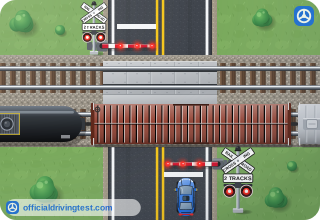
- Trains can come from either direction and run on any track
- Trains come only from the direction shown by the lights
- Trains run only on the track closest to the road
- Trains always travel in the same direction as traffic
Show answer
Correct answer: Trains can come from either direction and run on any track
Trains can come from either direction and run on any track.
Source: Washington Driver Guide (© 2025), page 105 · Open this page in the manual (Manual page 105)
-
What should you give the dispatcher when you call the number on the blue and white Emergency Notification System sign?
- Only your name, your phone number, and your license plate number
- Only the train's number, its direction, and its approximate speed
- The crossing ID number, your location, and the details of the situation
- Only the name of the railroad company and the time you called
Show answer
Correct answer: The crossing ID number, your location, and the details of the situation
You give the dispatcher the crossing ID number, your location and the details of the situation.
Source: Washington Driver Guide (© 2025), page 106 · Open this page in the manual (Manual page 106)
-
Something is on or close to the railroad tracks and there is no Emergency Notification System sign. What should you do?
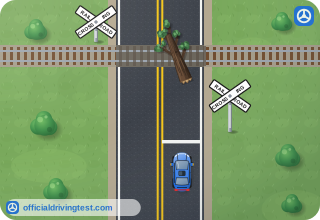
- Wait for the next train to report it
- Dial 911
- Call the railroad company's customer line
- Move the object off the tracks yourself
Show answer
Correct answer: Dial 911
If there is no sign, dial 911.
Source: Washington Driver Guide (© 2025), page 106 · Open this page in the manual (Manual page 106)
-
What is the least distance to leave between your vehicle and light rail trains?
- At least 10 feet
- At least half a car length
- At least 6 feet
- At least one car length
Show answer
Correct answer: At least one car length
Leave at least one car length, or more, between your vehicle and light rail trains.
Source: Washington Driver Guide (© 2025), page 106 · Open this page in the manual (Manual page 106)
-
How should you park near light rail lines?
- With plenty of room for rail trains to get around you
- As close to the tracks as possible to save space
- Wherever a train driver can see you
- With your hazard lights on
Show answer
Correct answer: With plenty of room for rail trains to get around you
Park with plenty of room for rail trains to get around you, and never stop or park on the tracks.
Source: Washington Driver Guide (© 2025), page 106 · Open this page in the manual (Manual page 106)